
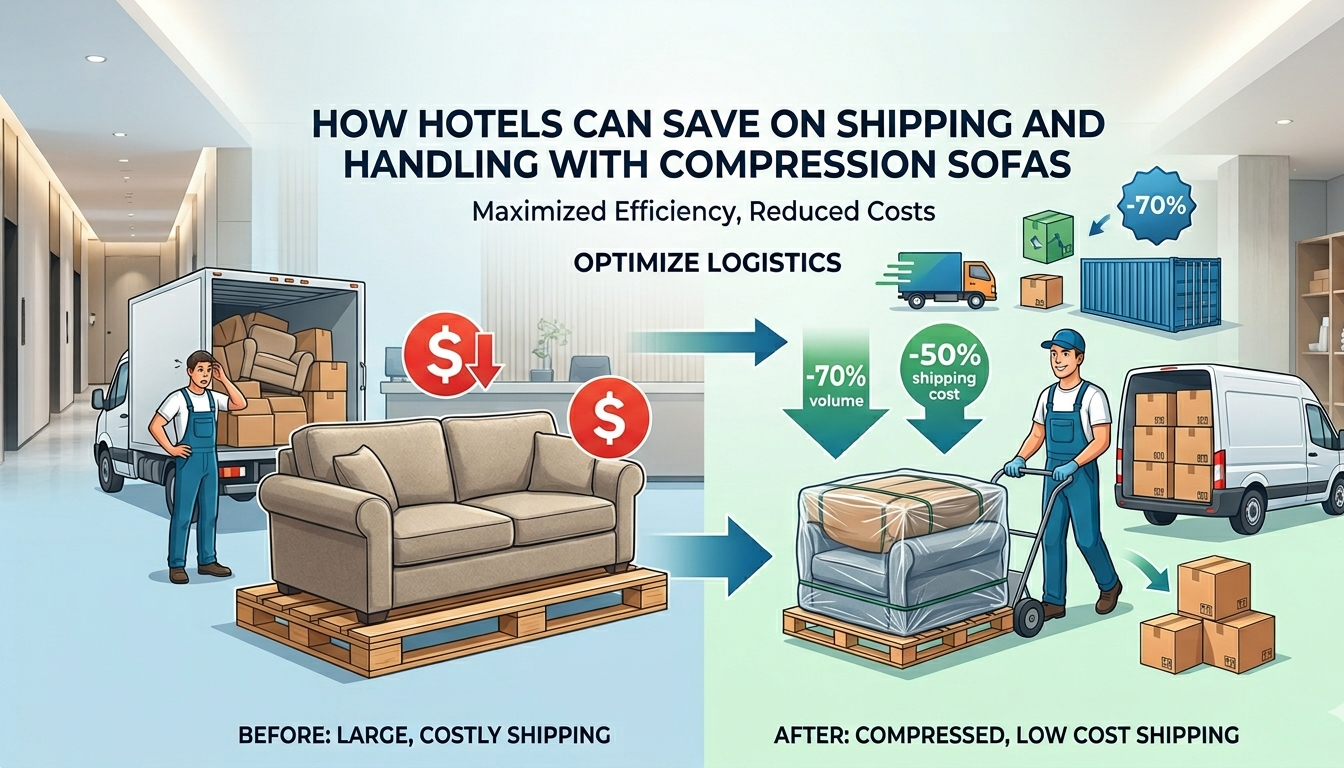
When outfitting a commercial hospitality or multi-family real estate project, loose furniture—specifically sofas and lounge seating—consumes the highest ratio of physical space within your shipping containers. Because traditional upholstered seating is shipped fully assembled, buyers regularly pay premium international freight rates to transport empty air trapped inside the frame contours.
Foshan, particularly the Shunde district, has adapted commercial mattress vacuum-compression technology to upholstered furniture manufacturing. By utilizing engineered high-resilience foam cores and modular knock-down (KD) internal frames, manufacturers can drastically compress the physical footprint of a sofa for transit.
For large-scale developments like hotels and service apartments, this engineering shift directly addresses the two highest soft costs of importing: ocean freight volumetric fees and on-site manual handling.
What is the Mechanical Difference Between Standard and Compression Sofas?
A standard commercial sofa relies on a static internal frame where the springs, padding, and outer upholstery are fixed permanently at the factory. This creates a non-yielding, high-volume block that cannot be altered during transit.
A compression sofa is engineered specifically for volumetric reduction. The manufacturing process segments the furniture into clear components:
- High-Resilience Polyurethane Foam Core: The cushions utilize high-density polyurethane foam (typically 35kg/m³ to 45kg/m³) with an open-cell structure. This specific density possesses the elastic memory required to be compressed under heavy hydraulic presses, sealed in vacuum barrier film, and rolled or flat-packed without tearing the internal cell walls.
- Modular Internal Skeleton: The structural frame (either kiln-dried larch or reinforced steel) is engineered with interlocking steel brackets. This allows the structural sides, backrest, and base to ship completely flat and assemble mechanically on-site without compromising structural integrity.
How Much Ocean Freight and CBM Can Hotels Actually Save?
International ocean freight is billed strictly by container volume. A standard 40-foot High Cube (40′ HQ) container provides a maximum usable volume of roughly 68 Cubic Meters (CBM).
When you ship traditional, fully assembled hospitality sofas, a standard three-seater model consumes approximately 1.5 CBM to 1.8 CBM due to the non-removable armrests and back angles. Consequently, a single 40′ HQ container can only accommodate around 35 to 40 traditional assembled sofas before hitting the physical volume limit.
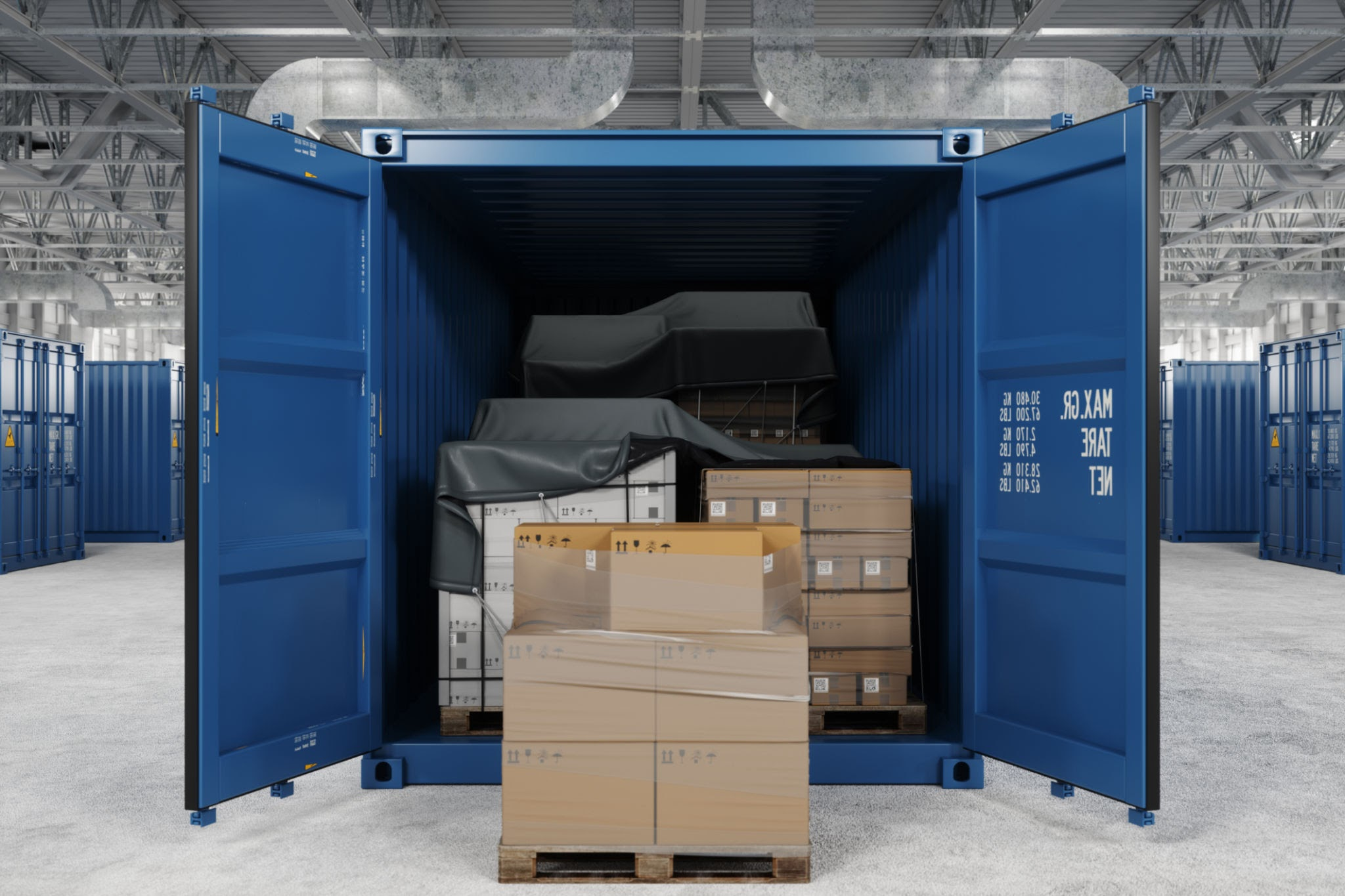
Volumetric Optimization of Boxed Freight Inside a 40ft Container. Source: onurdongel / Getty Images
By switching to vacuum-compressed or flat-packed KD sofa systems, the volumetric footprint of that exact same three-seater design drops to approximately 0.4 CBM to 0.5 CBM.
This geometric optimization allows the same 40′ HQ container to hold between 120 and 150 sofa units. By tripling or quadrupling the payload density per container, developers can cut their per-unit ocean freight costs by 60% to 70%, immediately freeing up capital within the FF&E budget.
Why Does Compression Packaging Drastically Reduce On-Site Handling Costs?
The financial savings of compressed furniture extend far beyond the shipping port. “Handling” represents a substantial portion of local contractor labor fees during the fit-out phase of a high-rise hotel or multi-family apartment block.
Moving a traditional, fully assembled 2.2-meter sofa through a construction site introduces several operational bottlenecks:
- Elevator Constraints: Assembled sofas often exceed the dimensions of standard service elevators, forcing labor crews to manually carry heavy upholstery up structural stairwells, which increases labor hours and injuries.
- Corridor Damage Risks: Maneuvering bulky furniture through tight hotel corridors frequently results in scraped wall finishes, torn wallpaper, or scuffed sofa leather before the property even opens.
- Crew Inefficiencies: Moving a traditional sofa typically requires a minimum of two to three manual laborers per unit to navigate corners and doors.
Compressed sofas bypass these issues entirely because they are delivered inside uniform, heavy-duty cardboard boxes. These flat or rolled boxes fit easily into standard passenger elevators and can be moved smoothly on standard flatbed hand-carts by a single worker. The furniture remains completely sealed inside its thick protective film until it is physically inside the designated guestroom, eliminating the risk of on-site dust, moisture, or plaster damage during the final construction phases.
Key Takeaways
- Max Payload Density: Vacuum compression and flat-pack KD framing reduce individual sofa CBM from ~1.5 CBM down to less than 0.5 CBM, allowing you to fit up to three times more units per container.
- Preserve Cushion Memory: Specifying high-resilience (HR) foam between 35kg/m³ and 45kg/m³ ensures that vacuum-packed seating recovers its exact structural shape and firmness within 24 to 48 hours of unboxing.
- Lower Local Labor Costs: Boxed components eliminate the need for multi-man stairwell carries and prevent costly accidental damage to freshly finished corridor walls.
- Protect Assets Prior to Placement: Sealed internal plastic vacuum barriers keep the underlying upholstery fabrics pristine and free from site dust up until the final handover day.
Why Choose HSY Sourcing for Your Furniture Procurement?
Based directly in Foshan, the global center for contract furniture production, HSY Sourcing operates as your independent engineering, quality control, and logistics management team on the ground.
- On-Floor Compression Inspections: We do not allow factories to shortcut the compression process. Our inspectors physically attend the vacuum sealing lines to verify that the foam used matches the contractually specified density and that the heat seals are airtight to prevent reinflation during transit.
- Interlocking Bracket Stress Testing: We check the mechanical hardware tolerances of KD frame systems. We ensure that all drop-in steel brackets align perfectly and lock securely, guaranteeing the assembled sofa meets commercial stability standards.
- True Volumetric Loading Engineering: We manage the consolidation of your furniture assets at our Foshan warehouse. We calculate the exact packing layout of your containers, ensuring boxed compression sofas are utilized to fill upper volumetric spaces while heavy materials form a stable base.
- Unedited Technical Transparency: We provide real-time data reports including actual package dimensions, exact component weights, and raw video footage of unboxing tests to verify the foam’s recovery rate before mass packing.
Visit www.hsysourcing.com to submit your hotel or apartment furniture schedules. Let our Foshan engineering team optimize your cargo footprint and reduce your project overhead.
Frequently Asked Questions (FAQ)
Q: Does vacuum compression permanently damage the sofa’s outer fabric or create permanent wrinkles?
A: If left compressed for too long or if low-grade fabrics are used, minor wrinkling can occur. To mitigate this, we mandate that factories use heavy-weight commercial fabrics with high elastic recovery (such as specific polyester blends or premium synthetic leathers) and limit the compression window to match the actual transit timeline. Once unboxed, any remaining surface lines typically smooth out naturally within a few days of room temperature exposure, or can be quickly cleared with a standard handheld fabric steamer.
Q: How long do guestroom sofas need to sit after unboxing before they can be used?
A: High-resilience polyurethane foam recovers roughly 90% of its original structural volume within 2 to 4 hours of opening the vacuum seal. However, to allow the internal open cells to fully equalize and reach their rated indentation load deflection (ILD), we advise allowing the cushions to settle for 24 to 48 hours before subjecting them to continuous guest use.
Q: Can luxury leather sofas be vacuum compressed for villa projects?
A: We do not recommend deep vacuum compression for genuine top-grain aniline or semi-aniline leathers, as the intense mechanical folding pressure can crack or permanently alter the natural surface grain. For high-end villa projects requiring genuine leather, we utilize a modified “semi-KD” approach—shipping the solid wooden frame flat while packing the uncompressed leather cushions in optimized, breathable structured cartons to preserve material integrity.