

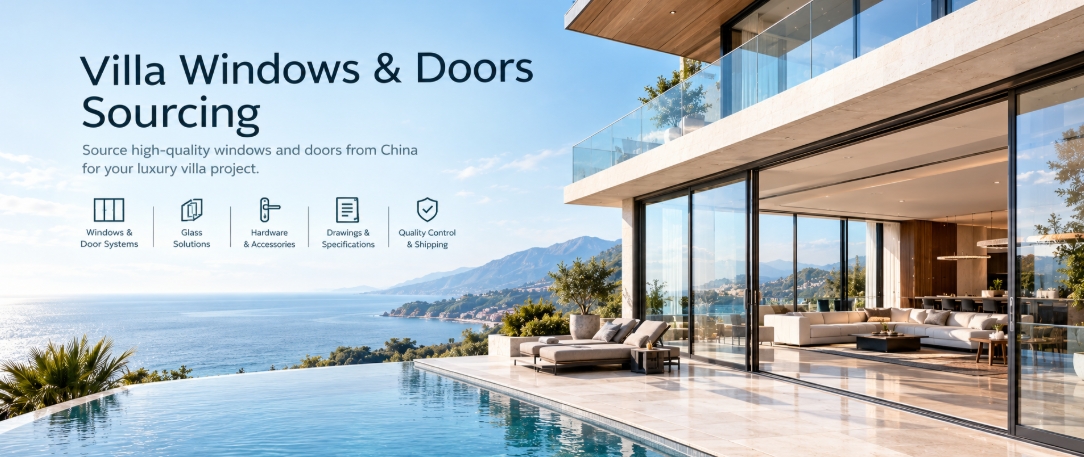
Windows and doors have a significant influence on the appearance, comfort, and performance of a luxury villa. Large glazed openings, slim aluminium frames, sliding glass doors, and carefully selected finishes can shape the relationship between indoor and outdoor spaces. However, the right products must also suit the building design, local climate, structural requirements, and installation conditions.
HSY Sourcing helps overseas homeowners source custom windows and doors from suppliers in Foshan and other relevant manufacturing areas in China. We coordinate supplier research, quotation comparisons, technical specifications, drawing discussions, order follow-up, and agreed quality checks according to the scope of each engagement.
Whether you are planning floor-to-ceiling glazing for a new villa, replacing windows during a major renovation, or sourcing large sliding doors for a coastal residence, the first step is to establish what the project actually requires.
Windows and Doors for Luxury Villa Projects
Villa projects rarely require just one standard window type. The specification may combine several opening styles, glass configurations, frame finishes, and door systems across different elevations.
The appropriate product range depends on the architectural design, opening dimensions, climate, and intended use.
Aluminium Windows
Depending on the project and supplier capabilities, the scope may include:
- Casement windows.
- Awning or top-hung windows.
- Tilt-and-turn windows where suitable.
- Fixed glazing and floor-to-ceiling windows.
- Sliding windows.
- Louvre windows where appropriate.
- Custom window configurations specified by the architect.
Different window types serve different purposes. A fixed glazed panel may suit a view where ventilation is unnecessary, while an operable window may be needed for ventilation, cleaning access, or other functional requirements.
The choice should follow the window schedule and design intent rather than the assumption that one opening system is suitable for every room.
Sliding Glass Doors and Large Openings
Large sliding doors are common in villa living areas, dining spaces, and openings that connect the house with a terrace, garden, or swimming pool.
Possible configurations include standard sliding doors, lift-and-slide systems, and multi-panel arrangements. Some projects may also require folding doors or other custom door systems.
Before selecting a system, consider the required opening width, panel height, glass weight, operating frequency, threshold design, drainage, and available structural support.
A wide opening can look straightforward in a rendering, but the actual system needs to accommodate the panel dimensions and performance requirements. Not every supplier or product series is suitable for every oversized opening.
Entrance and Other Exterior Doors
The entrance door and other external doors may need to coordinate with the villa’s architectural style, security requirements, weather exposure, and surrounding finishes.
Depending on the design, the procurement scope may include aluminium entrance doors, glazed doors, or other specified exterior door systems.
Door construction, locking hardware, finish durability, and installation details should be considered together. If the project includes different door materials or specialist systems, they may need to be sourced from separate suppliers.
What Should You Consider Before Choosing Villa Windows and Doors?
The visual design is only one part of the decision. Before requesting comparable quotations, the project team should clarify the important technical and functional requirements.
1. Frame Design and Sightlines
Slim frames can create a more open appearance and reduce the visual interruption between interior and exterior spaces. However, the narrowest available frame is not automatically the best choice.
Frame dimensions and configurations must work with the panel size, glass weight, hardware, wind loads, and structural requirements. The complete system also needs to provide the performance required for the project.
When reviewing a proposed system, look beyond catalogue photographs. Confirm the actual frame sections, mullion arrangement, opening configuration, and visible sightlines.
For large glazed openings, the architect or relevant design professional should review how the proposed system fits the building design and structural details.
2. Standard Sliding Doors or Lift-and-Slide Doors?
The choice depends on the opening and how the door will be used.
Standard sliding systems may suit many residential openings. Lift-and-slide systems use a mechanism that lifts the door panel for movement and lowers it into position when closed. Depending on the specific system, this can be useful for larger or heavier panels.
Before comparing the two, clarify:
- The overall opening dimensions.
- The size and weight of each panel.
- The specified hardware and its capacity.
- The expected ease of operation.
- The threshold and drainage arrangement.
- Accessibility requirements.
- The budget and installation conditions.
The system name alone does not establish performance. The supplier must confirm that the proposed configuration is suitable for the actual dimensions and project requirements.
For a more detailed comparison, see our related article, Lift-and-Slide or Standard Sliding Doors: What Should a Villa Owner Consider? Add the verified article URL when publishing.
3. Glass Configuration
Glass should be specified as a complete configuration, not simply described as “double glazing,” “triple glazing,” or “Low-E glass.”
Depending on the location and building requirements, relevant details may include:
- Single, double, or triple glazing.
- Glass thickness and individual pane configuration.
- Tempered or laminated safety glass where required.
- Low-E coatings and their specified performance.
- Solar heat gain and visible light transmission.
- Acoustic requirements.
- Spacer and edge-seal systems.
- Safety glazing for doors and other applicable locations.
The right configuration depends on climate, orientation, window size, energy-performance targets, safety requirements, and local regulations.
For example, a large west-facing glazed opening in a hot climate may need different solar-control considerations from a window in a cold region. Acoustic performance may also matter where the property is near a road or other noise source.
Ask suppliers to identify the proposed glass make-up in writing. A general statement such as “energy-saving glass” is not enough to compare technical specifications.
4. Thermal Performance and Weather Resistance
A window’s performance depends on the complete system, not just the aluminium profile.
Relevant factors may include thermal-break design, frame and sash construction, glazing, seals, drainage, and installation interfaces.
Depending on the destination market and project, requirements may cover:
- Thermal insulation.
- Air infiltration.
- Water penetration resistance.
- Wind-load resistance.
- Condensation risk.
- Acoustic performance.
Do not judge performance by profile thickness or thermal-break width alone. These are only parts of the overall design.
The supplier should provide relevant technical information or test documentation for the proposed system and configuration. The architect or other appointed professional should determine the performance requirements applicable to the building.
5. Climate and Site Exposure
The project’s location affects which products and finishes are suitable.
For a coastal villa, consider corrosion exposure, coating systems, hardware and fastener materials, and the maintenance requirements of the selected products.
For a hot climate, solar heat gain, glazing, shading, and thermal performance may be important. In colder climates, insulation and condensation risk deserve particular attention.
Where a site is exposed to strong winds, cyclones, or hurricanes, structural performance and applicable local requirements may be critical.
These conditions should be communicated to the supplier at the quotation stage. A product suitable for one residential project should not automatically be assumed suitable for a different climate or exposure.
What Drawings and Specifications Do Suppliers Need?
The information needed depends on the design stage and the complexity of the windows and doors.
For an initial sourcing discussion, useful documents may include:
- Architectural floor plans and elevations.
- Window and door schedules.
- Available opening dimensions.
- Preferred opening types and configurations.
- Sections showing frame positions and thresholds, where available.
- Glass and hardware requirements.
- Frame colour and surface-finish references.
- The project country and location.
- Any known local performance or compliance requirements.
- The approximate procurement timeline.
If you have CAD drawings or a developed window schedule, suppliers may be able to evaluate the requirements in greater detail. If you only have floor plans or 3D renders, further technical clarification may be needed before a meaningful quotation can be prepared.
What Is the Difference Between Design Drawings and Shop Drawings?
Architectural drawings communicate the intended design and building layout. Factory shop drawings provide more detailed information for manufacturing the specified products.
Depending on the system, shop drawings may show frame sections, panel dimensions, opening direction, mullion arrangements, hardware positions, glass configuration, and other relevant details.
These drawings need to be reviewed against the approved architectural design and project requirements before manufacturing begins.
The parties should also establish who is responsible for confirming final site dimensions. A factory should not automatically be assumed to measure the completed openings at an overseas property.
HSY can help coordinate technical questions and communication with suppliers within the agreed service scope. Structural engineering, architectural approval, site measurement, and installation responsibilities must be assigned to the appropriate professionals.
How HSY Coordinates Villa Windows and Doors Sourcing
Our sourcing process is based on the information available and the requirements agreed for each project.
Step 1: Review the Project
We begin by reviewing the project location, available drawings, required window and door types, preferred finishes, and approximate timeline.
This helps identify missing information and determine whether the immediate requirement is a preliminary sourcing assessment or a more detailed quotation exercise.
Step 2: Identify Suitable Suppliers
Supplier selection should reflect the actual system requirements rather than a general preference for aluminium windows.
For example, a supplier experienced in standard residential casement windows may not be the right choice for a project requiring very large sliding panels or a particular performance specification.
HSY helps identify and communicate with relevant suppliers based on the agreed product scope, technical requirements, and commercial considerations.
Supplier capabilities and documentation still need to be evaluated against the specific project.
Step 3: Collect and Compare Quotations
We help organize quotations so that the key differences are easier to understand.
The comparison may cover:
- Window and door types and quantities.
- Frame system and visible profile configuration.
- Glass make-up.
- Hardware brands and models.
- Surface finish and colour.
- Relevant performance documentation.
- Accessories and installation-related components.
- Packaging, delivery terms, and exclusions.
A quotation with a lower headline price may have a different glass configuration, hardware specification, or product scope. These differences should be clarified before a purchasing decision is made.
Step 4: Coordinate Technical Questions and Drawings
After a suitable supplier has been identified, outstanding technical questions need to be resolved.
This may include clarifying dimensions, opening configurations, glass specifications, hardware, finishes, thresholds, and other details affecting the finished product.
Where shop drawings or samples are required, HSY can coordinate communication and help organize the information for review. Design-critical and technical approvals should be completed by the responsible parties before production.
Step 5: Follow Up on the Order
Once the order and specifications are confirmed, supplier follow-up helps track progress and outstanding decisions.
Production timing depends on the product system, dimensions, glass availability, approvals, supplier workload, and order scope. Changes after confirmation may affect both cost and schedule.
The exact production timeline should therefore be confirmed with the supplier rather than assumed from a general industry estimate.
Step 6: Coordinate Agreed Quality Checks and Shipment
Quality checks can be arranged according to the agreed inspection scope and timing.
Depending on the product, inspection points may include frame configuration, visible finish, glass identification, hardware, basic operation, accessories, dimensions against approved documentation, and packaging.
Receiving goods at a warehouse is not the same as conducting a full technical inspection. The inspection method, scope, and limitations should be agreed in advance.
Where the project includes other building materials, warehouse receiving, cargo consolidation, and shipping coordination may also be discussed as separate or combined services according to the engagement.
How to Assess Window and Door Supplier Quotations
A useful quotation should make it possible to understand what is being supplied and which requirements remain unconfirmed.
Before comparing prices, check whether the suppliers are quoting against the same:
- Window and door schedule.
- Opening dimensions and configurations.
- Frame system and finish.
- Glass make-up and safety requirements.
- Hardware specification.
- Performance requirements.
- Accessories and scope of supply.
- Packaging and delivery terms.
- Documentation requirements.
Ask suppliers to identify any assumptions, exclusions, or proposed substitutions.
If the project requires a particular performance level, confirm how the supplier proposes to demonstrate that the selected system meets it. Do not treat a general catalogue statement as proof that a custom configuration has been tested to the same level.
The objective is not simply to obtain the lowest price. It is to understand the differences between quotations and decide which proposal is appropriate for the villa.
Quality Checks Before Shipment
Windows and doors may be difficult to replace once they have been delivered overseas, particularly when the products are custom-sized or include large glazed panels. It is therefore useful to define inspection requirements before production is completed.
Depending on the order and agreed scope, checks may include:
| Inspection area | What to review |
|---|---|
| Product configuration | Window type, opening direction, panel arrangement, and correspondence with approved drawings |
| Dimensions | Selected measurements against approved documentation and agreed tolerances |
| Frame finish | Visible scratches, coating defects, colour consistency, and workmanship |
| Glass | Identification and configuration against the approved specification, plus visible damage |
| Hardware | Specified components, basic operation, and visible installation |
| Accessories | Locks, handles, seals, fasteners, and other specified components |
| Labeling | Identification against the window and door schedule |
| Packaging | Protection of frames, corners, glass, and vulnerable components for transport |
The precise inspection method depends on the order, risks, and service agreement. A visual inspection or sampling process cannot guarantee that every hidden defect or future performance issue will be identified.
It is also important to distinguish product checks from testing an entire installed window system. Performance after installation depends on the product, installation details, surrounding construction, and other site conditions.
Compliance and Destination-Market Requirements
Windows and doors sourced from China must meet the requirements applicable to their intended market and project.
The relevant rules may differ by country, climate zone, building type, and product configuration. Some projects may require specific safety-glazing provisions, thermal-performance data, air and water performance results, wind-load evidence, or other documentation.
When reviewing supplier documents, confirm that the information relates to the actual product system and configuration being proposed. A test report for one product does not automatically demonstrate compliance for every custom window or door.
HSY can help request and organize available supplier documentation within the agreed sourcing scope. However, HSY should not be treated as a certification body or as the authority responsible for local building approval.
The homeowner and appointed design or building professionals should establish which requirements apply before the final specification is approved.
Can Windows and Doors Be Sourced Alongside Other Villa Materials?
Yes. Some homeowners prefer to coordinate window and door procurement with other major categories for a new villa or renovation.
Depending on the project, these may include custom kitchens and cabinetry, wardrobes, marble and other stone, flooring, bathroom products, furniture, and lighting.
The benefit of broader coordination is that supplier schedules, finish approvals, delivery readiness, and shipment planning can be considered together. It does not mean every product should come from one supplier or that all goods will automatically be ready to ship at the same time.
Different products may have different manufacturing schedules, packaging requirements, and handling risks. The consolidation plan should reflect these differences.
Learn more about Whole-Villa Building Materials Sourcing & Consolidation if your project involves multiple suppliers and building-material categories.
For a broader overview of HSY’s procurement support, see Luxury Villa Sourcing.
Why Work with HSY Sourcing?
Sourcing custom windows and doors involves more than finding a supplier with an attractive catalogue. The product configuration, glass, hardware, drawings, documentation, and commercial scope all need to be considered in relation to the villa project.
HSY Sourcing helps overseas homeowners coordinate these purchasing details with suppliers in China.
Our approach focuses on:
- Project-specific supplier selection: Match the sourcing process to the required window and door systems rather than relying on a generic product list.
- Quotation comparison: Clarify differences in specifications, included components, and commercial terms.
- Technical communication: Coordinate supplier questions and outstanding information about drawings, glass, hardware, and finishes.
- Approval coordination: Help organize samples and shop drawing discussions within the agreed scope.
- Order follow-up: Coordinate communication during the agreed procurement process.
- Transparent fees: Keep supplier prices separate from HSY’s service fees, without relying on hidden factory commissions or rebates.
- Broader procurement coordination: Discuss how windows and doors fit into the wider villa sourcing and shipment plan when required.
HSY is a sourcing and procurement coordinator, not a window or door manufacturer. The services provided for each project depend on the agreed scope and the information available.
Frequently Asked Questions
Can I source villa windows and doors from China using my architect’s drawings?
Yes, architectural drawings and window schedules can provide a starting point. Suppliers may need additional dimensions, technical specifications, and shop drawings before they can confirm a final quotation or begin manufacturing. The information required depends on the product system and project stage.
What if my window schedule is not finalized?
You can begin with the drawings and information currently available. However, quotations prepared before dimensions, glass, hardware, and opening configurations are confirmed may be provisional. Outstanding decisions should be identified before the order is finalized.
Are lift-and-slide doors better than standard sliding doors?
Not in every situation. Lift-and-slide systems may suit larger or heavier panels, depending on the specific system, while standard sliding doors may be suitable for other openings. Panel dimensions, hardware capacity, threshold design, accessibility, and budget should guide the decision.
How should I choose glass for a large villa window?
Start with the project’s climate, orientation, safety requirements, acoustic needs, and applicable performance targets. Then define the glass make-up, coatings, and other relevant details with the appointed design professional and supplier. “Double glazing” or “Low-E” alone is not a complete specification.
Can I match the frame colour across all windows and doors?
A coordinated finish can often be specified, but the available colours and finish processes depend on the product systems and suppliers selected. Confirm the actual finish reference and request physical samples where colour consistency is important, particularly if products come from different suppliers.
How can I check whether a supplier’s windows meet local requirements?
Identify the applicable requirements with the appointed architect, engineer, or other relevant professional. Ask the supplier for supporting documents that correspond to the proposed system and configuration. Do not assume that a general catalogue claim or a report for a different configuration proves compliance.
Who is responsible for measuring the openings and installing the windows?
This should be agreed before production. The homeowner’s appointed contractor, architect, site team, or another designated professional may be responsible for verifying final opening dimensions. Overseas installation arrangements should also be confirmed separately. Do not assume that the factory or HSY automatically provides site measurement or installation.
Discuss Your Villa Windows and Doors Project
If you are building or renovating a private villa and considering windows and doors from China, HSY Sourcing can help you review the procurement requirements and discuss suitable next steps.
To start the conversation, share the information you already have:
- Project country and location.
- New-build or renovation status.
- Architectural plans, elevations, or window and door schedules.
- Main window and door types required.
- Approximate opening dimensions, if available.
- Preferred frame appearance, glass specification, or hardware.
- Any known local performance or compliance requirements.
- Approximate procurement timeline.
- Whether other villa building materials also need to be sourced or coordinated.
You do not need to have every technical detail finalized for an initial discussion. The information available will help establish what needs to be clarified before supplier quotations can be meaningfully compared.
Contact HSY Sourcing to discuss your villa windows and doors sourcing requirements in China.


