

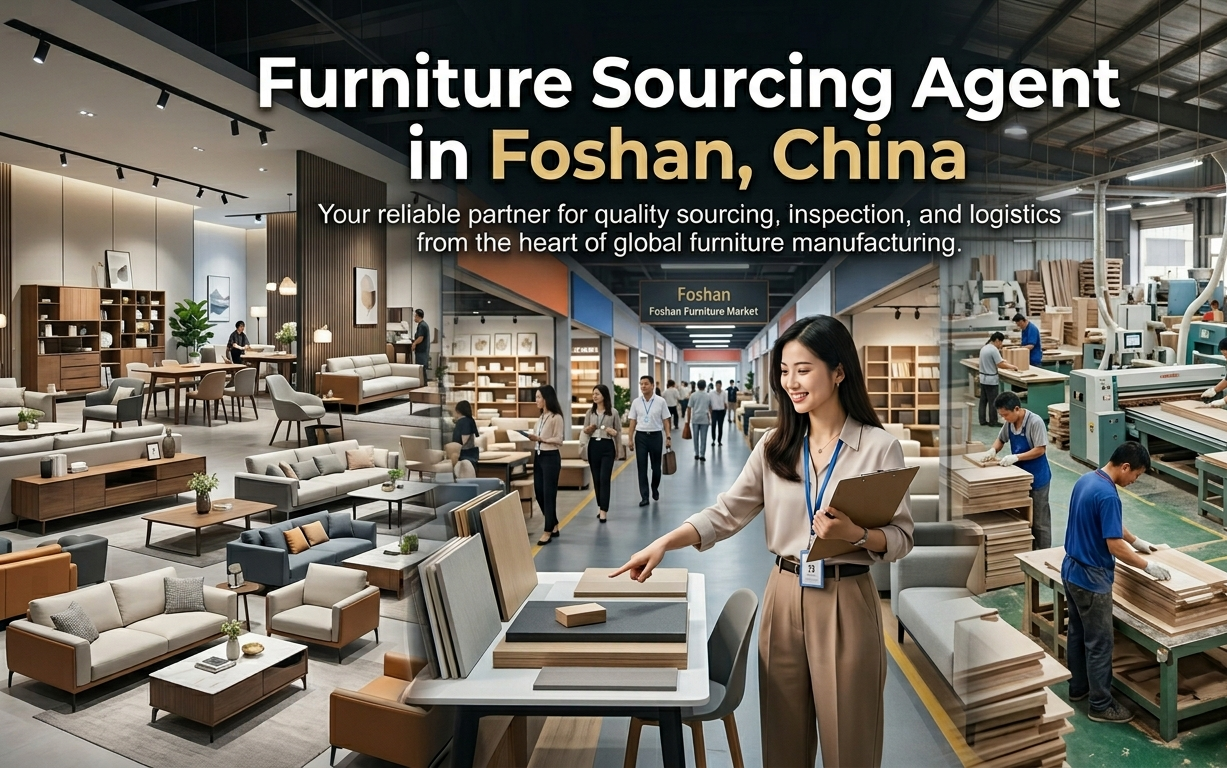
Furniture Sourcing Agent in Foshan, China
Foshan’s Shunde District — specifically the Longjiang and Lecong areas — is one of the largest furniture manufacturing concentrations in the world. The Lecong International Furniture City alone covers several million square metres of showroom space, backed by thousands of factories within a short driving radius. If you are sourcing furniture from China, this is the right location to be working from.
HSY Sourcing is based in Foshan. We source furniture for importers, wholesalers, retailers, interior designers, and project buyers who need a local agent to handle supplier identification, sample review, quality inspection, and coordinated shipping. We do not manufacture furniture and do not hold stock. Our role is to find the right factory for what you need, manage the process through production, and get goods shipped correctly.
This page covers what furniture categories we handle, how the sourcing process works, what affects pricing, and what buyers should know before starting.
👉 Send us your product list or specifications — we will come back within 48 hours with factory options and indicative pricing.
Why Source Furniture from Foshan Specifically
China has several furniture production clusters, each with different specialisations. Understanding which region suits your requirements is relevant to where we focus our sourcing efforts.
Foshan — Longjiang and Lecong is the primary cluster for comprehensive interior furniture: whole-house custom systems, hotel-specification casegoods, upholstered living room pieces, and design-led residential collections. Factories here range from small custom workshops to large export-focused manufacturers with their own design teams. This is the cluster we work from daily and know best.
Anji, Zhejiang specialises in seating — office chairs, gaming chairs, dining chairs, and bamboo furniture. If your order is primarily chair-focused, Anji factories often offer better pricing and faster lead times for that specific category than Foshan.
Ganzhou, Jiangxi (Nankang) is a solid wood furniture centre with competitive pricing for timber-frame pieces: dining tables, bedroom sets, and timber-look accent furniture. Useful when solid wood construction is a priority and budget is a constraint.
Bazhou, Hebei (Shengfang) focuses on glass, metal, and budget-tier dining furniture. For buyers needing entry-level price points on metal-frame or glass-top pieces, this cluster is relevant.
We source primarily from Foshan and Shunde for the categories we cover most often, but for specific requirements — a large chair order, solid wood pieces, budget dining furniture — we will tell you honestly if sourcing from a different cluster makes more sense for your order.
Furniture Categories We Source
Residential Indoor Furniture
Living room — sofas (modular, sectional, corner configurations), armchairs, ottomans, coffee tables, TV units, sideboards, bookshelves. Foshan’s Longjiang cluster produces upholstered seating extensively. Key specification considerations: fabric abrasion resistance (minimum 25,000 Martindale rubs for residential use, 40,000+ for commercial), foam density for seat cushions (35–40 kg/m³ for regular residential use), and frame construction (solid timber frame versus engineered wood frame — the difference matters for longevity).
Bedroom — bed frames (platform, upholstered headboard, storage beds), bedside tables, dressers, wardrobes, ottomans. Available in a range of substrate and finish options: solid wood, MDF with veneer, lacquered MDF, and board with foil wrap. The specification of board material and edge treatment affects both durability and price significantly.
Dining — dining tables (solid timber, marble-top, glass-top, sintered stone-top), dining chairs (upholstered, bentwood, metal frame), bar stools, benches, display cabinets.
Home office — desks, bookcases, filing cabinets, task chairs. If ergonomic office seating is a significant part of your order, we can source from both Foshan and Anji depending on specification and volume.
Whole-house custom systems — wardrobes, kitchen cabinets, bathroom vanities, TV walls, study cabinetry. These are the Shunde cluster’s particular strength: CNC-manufactured, custom-dimensioned, available in a wide range of board, veneer, and lacquer finishes. Lead time is longer than standard furniture (45–65 days typical) but pricing is competitive for custom work.
Hospitality and Commercial Furniture
Hotel guestroom — beds, bed bases, bedside tables, wardrobes, desks and desk chairs, luggage racks, minibars. Commercial hospitality specification differs from residential in hardware grade (drawer runners and hinges rated for higher use cycles), foam density for upholstered pieces (typically 38–42 kg/m³ for hotel beds), and formaldehyde emission compliance. We cover hotel furniture procurement in more detail on the Hotel Furniture Procurement page.
Public and lobby areas — sofas and lounge chairs, reception desks, lobby coffee tables, restaurant dining furniture, bar seating. Custom upholstery in COM (customer’s own material) is available from Shunde factories for higher-specification hospitality projects.
Office and workspace — workstations, meeting room tables, soft seating for reception and breakout areas.
Outdoor Furniture
Foshan and the surrounding Guangdong region also produce outdoor furniture extensively. Main frame materials: powder-coated aluminium (the most common for export, lightweight and corrosion-resistant), synthetic rattan on aluminium frame, FSC-certified teak, and stainless steel. Cushion fabric should be specified with UV and water resistance ratings for outdoor use — solution-dyed acrylic fabrics (Sunbrella-grade or equivalent) are the appropriate specification for furniture that will be left outdoors.
How Furniture Sourcing Works in Practice
Defining the Specification Before Approaching Factories
The most common reason furniture orders go wrong is insufficient specification at the start. A description like “modern sofa, grey fabric, 3-seater” gives a factory almost no information. What they produce to that description may bear no resemblance to what you expected.
Before we approach any factory on your behalf, we work through your requirements to establish: dimensions, frame construction, fabric or leather grade and category, foam density, surface finish for hard parts, hardware specification, and any compliance requirements for your destination market. This takes more time upfront but eliminates the most common source of disappointment — goods that arrive looking nothing like the sample.
Supplier Selection
For each furniture category, we identify 2–4 factories from our Foshan and Shunde network suited to your specification and budget. We visit factories physically where needed — we do not shortlist from online profiles alone. What we are looking for: relevant production equipment for your product type, current order capacity, quality of work currently on the production floor, and export experience.
We are not affiliated with any factory and do not receive fees from suppliers. Our fee comes from you, which means our job is to find the right factory for your order, not the most convenient one for us.
Sample Production and Approval
For new suppliers, physical samples should be produced and approved before bulk production begins. For furniture, this typically means a physical sample of the main piece — a sofa in the specified fabric, a bed frame in the specified finish — or at minimum a finish sample board and foam test block for upholstered items.
We photograph and document all samples against your written specification. If a sample needs revision — wrong fabric, wrong colour, different dimension — we manage that revision with the factory before you approve production.
For custom-dimensioned pieces (wardrobes, kitchen cabinets, custom joinery), we review technical drawings with factory engineers before sample production begins to confirm that dimensions and specifications are producible as drawn.
Production Monitoring
For larger orders, we visit factories during production to verify that materials in use match what was specified. The two most common issues we catch at this stage are fabric substitution (a factory using a lower-grade fabric when the specified grade is out of stock) and foam density deviation. Both are straightforward to catch during a production visit and very difficult to assess after goods are packed.
Pre-Shipment Inspection
Before any goods leave a factory, we inspect finished pieces against the approved sample and purchase order specifications. We check dimensions, surface finish, fabric (no pulls, no inconsistent dyeing), hardware function (drawer slides, hinges, door catches), packaging integrity, and unit count. We provide a written inspection report with photographs.
Goods that fail inspection are not released until defects are rectified. For furniture, the most common pre-shipment failures are upholstery defects (loose seams, inconsistent fabric alignment) and packaging that would not protect the piece in transit. Both are manageable at the factory; neither is manageable once the container is at sea.
Packaging for Furniture
Furniture packaging is one area where buyers frequently underestimate the importance of specification. Poorly packed furniture — corners unprotected, flat surfaces without foam padding, frames not secured against movement — arrives with damage regardless of how well the goods were made.
For residential and wholesale furniture shipping in containers, standard export carton with corner foam inserts and edge protection is the minimum. For high-value pieces or e-commerce furniture requiring ISTA 3A or 6A certification (for FBA or direct-to-consumer shipping), we specify and verify the packaging to the required standard. For knock-down (KD/flat-pack) furniture, we verify that assembly instructions are included and that all hardware packs are complete and correctly labelled.
What Affects Furniture Pricing from Foshan
Understanding what drives cost helps you evaluate quotes and avoid the trap of comparing incompatible specifications.
Frame material is the single largest cost variable. Solid hardwood frames are more expensive than engineered wood or MDF frames. For pieces that will see regular movement and long-term use — hotel beds, commercial seating — solid or laminated timber frame construction is worth the cost. For decorative pieces used lightly, MDF or particle board is practical and cost-effective.
Board specification for casegoods (wardrobes, cabinets, bed bases) follows the same logic as cabinetry: E1 or CARB Phase 2 formaldehyde emission compliance costs more than standard board but is required for many destination markets. Factories produce to the cheaper standard by default.
Fabric and leather grade has a wide price range. Commercial-grade fabrics with 40,000+ Martindale rub resistance cost significantly more than residential-grade fabrics. Solution-dyed outdoor fabrics cost more than standard indoor fabrics. Genuine leather costs more than PU and split leather, and the quality range within genuine leather is very wide. Specifying grade in the purchase contract rather than relying on a verbal description is important.
Foam density affects both comfort and price. Higher-density foam (38–42 kg/m³) costs more and lasts longer than low-density foam (25–28 kg/m³). Many factories use lower density foam by default unless specified otherwise.
Finish type for wooden surfaces: lacquer costs more than foil wrap; veneer costs more than lacquer; solid timber or real wood veneer costs more than paper-finish surfaces. At lower price points, what looks like wood is usually a printed paper or foil wrap over MDF — not inherently problematic, but it should match the buyer’s expectation and the selling price.
MOQ and customisation affect unit price in the obvious direction: higher volumes and standard designs cost less per unit than small runs and bespoke configurations.
Lead Times: Furniture from Foshan
| Category | Typical Production Lead Time |
|---|---|
| Standard sofas and upholstered seating (off-the-shelf designs) | 30 – 45 days |
| Custom sofas with COM fabric or bespoke dimensions | 45 – 60 days |
| Standard bedroom casegoods | 35 – 50 days |
| Whole-house custom wardrobes and cabinetry | 45 – 65 days |
| Hotel guestroom furniture packages | 45 – 65 days |
| Dining tables and chairs (standard) | 25 – 40 days |
| Outdoor furniture (aluminium and synthetic rattan) | 30 – 45 days |
Lead times run from confirmed order with deposit to goods ready for collection at our warehouse, and depend on factory order load at the time of booking. We provide factory-confirmed lead times at the quotation stage.
Compliance Specifications Worth Confirming Before Ordering
Formaldehyde emission class for board-based furniture: E1 (European standard), CARB Phase 2 (United States and some other markets), or E0 (low-emission, for buyers with strict IAQ requirements). Factories produce to standard — typically non-compliant — board unless specified.
Fire retardancy for upholstered furniture: TB117-2013 (California, widely adopted in North America), Crib 5 / BS 5852 (United Kingdom and some other markets). These need to be specified in foam and fabric grade — they are not automatically included and not all factories have testing capability.
Timber certification: FSC (Forest Stewardship Council) certification for solid wood components is required by some importers and retailers. Not all Foshan factories source certified timber; this needs to be confirmed before supplier selection if it is a requirement.
ISTA packaging standards: For e-commerce furniture (FBA, direct-to-consumer), packaging to ISTA 3A or 6A is required by major retailers and carriers. This needs to be specified and tested — it is not standard export packaging.
We specify all applicable compliance requirements in purchase contracts and request supporting documentation from factories before releasing orders.
Frequently Asked Questions
What is the minimum order quantity for furniture through HSY Sourcing?
There is no fixed minimum by unit count. Practically, the economics work best when the order fills at least one 20-foot container — roughly 10 to 20 sofas, or 20 to 40 bedroom sets, depending on piece size. For smaller orders, factory minimums may apply on custom configurations, and the freight cost per unit will be higher. Contact us with your product and quantity requirements and we will give you an honest assessment.
Can you source furniture to a specific design we have developed?
Yes. Foshan factories produce to buyer-provided designs and technical drawings regularly. For furniture with custom dimensions, custom frame details, or proprietary designs, we review your technical drawings with factory engineers before production begins. For proprietary designs, we recommend a non-disclosure agreement with the factory before sharing design details — we can advise on this at the briefing stage.
Can you source knock-down (flat-pack) furniture for e-commerce or FBA?
Yes. KD furniture is produced extensively in Foshan and is a common request from e-commerce buyers. We specify assembly instruction requirements, hardware pack completeness, and packaging to ISTA 3A or 6A as required. For FBA specifically, we ensure carton dimensions and weight are within Amazon’s receiving requirements.
How do you manage colour consistency across a large upholstered furniture order?
Fabric lot consistency is important for large orders where all pieces need to look identical. We specify the fabric roll lot at the time of order and request that all pieces in the order are cut from the same dye lot. For orders large enough to span multiple dye lots, we request lab dips and match them before production release. This is not something factories manage automatically; it needs to be specified.
We have had quality problems with furniture from China before. What specifically do you do differently?
The most common causes of furniture quality failures in our experience are: specification that was insufficiently detailed at the start (so the factory produced to their interpretation, not yours); no physical sample approval before bulk production (so the first time you see the goods is when the container arrives); no pre-shipment inspection (so defects that existed before shipping were not caught); and packaging that was not adequate for transit. Our process addresses each of these directly — written specification in the purchase contract, physical sample approval, production monitoring for larger orders, and pre-shipment inspection before goods are released. These are not guarantees of perfection, but they are the practical steps that catch and resolve the majority of quality issues before goods leave China.
Do you source outdoor furniture as well as indoor?
Yes. Outdoor aluminium-frame furniture with powder coating, synthetic rattan on aluminium frames, and teak outdoor sets are all categories we source regularly. For outdoor furniture, frame powder coating specification (thickness, salt spray test hours) and fabric UV resistance rating need to be confirmed upfront, particularly for buyers in coastal or high-UV climates.
HSY Sourcing — Furniture Sourcing Agent based in Foshan, China. Residential, hospitality, and commercial furniture — sourced from Foshan’s Longjiang and Lecong manufacturing clusters, quality inspected, and consolidated for shipping.


