

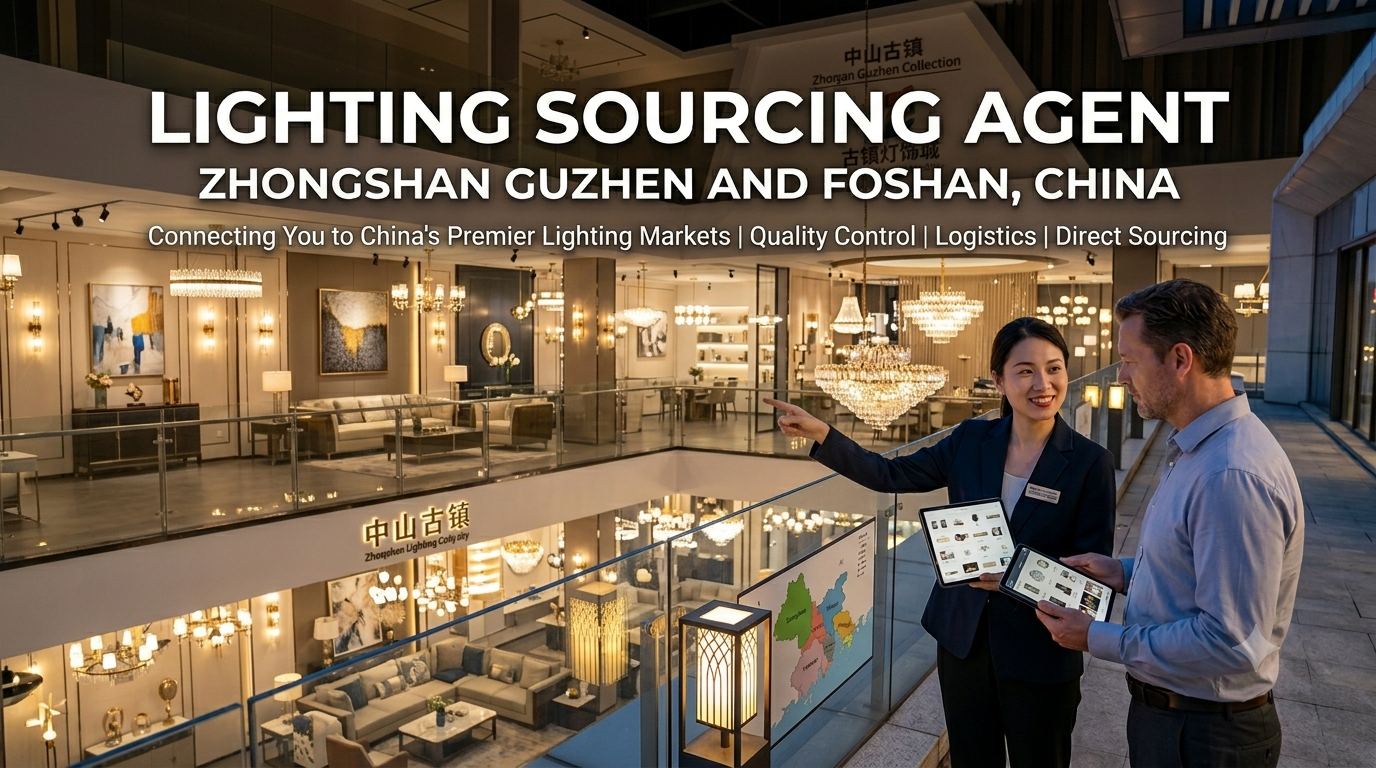
Lighting Sourcing Agent — Zhongshan Guzhen and Foshan, China
Zhongshan Guzhen is the primary lighting manufacturing cluster in China, housing over 5,000 manufacturers across decorative, architectural, commercial, and outdoor categories. It sits approximately one hour from our Foshan office, which means we source lighting from Guzhen as a routine part of the same consolidated shipments we manage for tiles, furniture, and sanitary ware from Foshan.
HSY Sourcing handles lighting procurement for property developers, interior designers, hotel operators, and importers who need a local agent to manage supplier selection, technical specification, sample review, quality inspection, and coordinated shipping. Lighting is technically more complex than most interior categories — driver quality, colour temperature consistency, and certification validity are the areas where things most commonly go wrong, and none of them are visible until the fixtures are installed.
This page covers what we source, how we manage the technical aspects of lighting procurement, what certification requirements to plan for, and what realistic lead times and pricing variables look like.
👉 Send us your fixture schedule or lighting specification — we will respond within 48 hours.
Why Guzhen for Lighting — and Why Location Matters
Guzhen’s concentration of lighting manufacturers means that decorative pendants, architectural downlights, track systems, linear profiles, outdoor wall washers, and landscape fittings are all available from factories within a short driving radius of each other. For a project sourcing multiple lighting categories, this allows us to visit several factories in a single day, coordinate sample production across suppliers, and consolidate goods from all of them into one container at our Foshan warehouse.
The practical implication for buyers is that sourcing lighting through us does not add a separate logistics chain. Your lighting arrives in the same container as your tiles, furniture, and fittings — one freight cost, one set of documentation, one customs entry at your destination.
The cluster also has specialist sub-areas. Decorative lighting — chandeliers, pendants, feature fixtures — is concentrated in the central Guzhen market area, with a large number of factories producing at various price and quality levels. Functional commercial lighting — downlights, panel lights, track lighting — is produced both in Guzhen and in the adjacent Henglan area of Zhongshan. For smart lighting and technically complex LED systems, Shenzhen-based factories are sometimes more appropriate; we source from there for projects where that specification is required.
Lighting Categories We Source
Architectural and Commercial Lighting
LED downlights — fixed and adjustable, recessed and surface-mount, standard and anti-glare (UGR<19 for hospitality and office applications). Driver specification is the most important quality variable here; we verify driver brand and grade before confirming a factory.
Track lighting systems — standard fixed-rail and magnetic track systems for retail, hospitality, and residential applications. Magnetic track systems allow flexible fixture positioning and are increasingly common in hotel and high-end residential projects. Compatibility between track rail and fixture head should be confirmed at the specification stage — different brands’ components are not always interchangeable.
Linear and strip lighting — LED profiles for cove lighting, stair lighting, feature wall lighting, and under-cabinet applications. Profile material (aluminium extrusion) and diffuser type affect light quality; milky diffusers reduce visual glare; clear diffusers show the LED strip more directly.
Panel lights — backlit and edge-lit panels for office and commercial ceiling applications. Colour temperature consistency across a batch is the main quality concern for large panel orders.
Emergency and exit lighting — required by building codes in commercial and hospitality applications. Certification to local standards (BS EN 60598 for UK, AS/NZS 2293 for Australia, UL 924 for North America) needs to be confirmed before supplier selection; not all factories hold the relevant certifications for all markets.
Decorative and Feature Lighting
Pendants and chandeliers — from standard residential-scale pieces to large-format hotel lobby installations. Guzhen factories produce across a wide price and complexity range. For custom designs or brand-specified pieces, Guzhen has factories that accept OEM/ODM work with 3D drawings and material specifications.
Wall lights and sconces — indoor and outdoor, IP-rated versions for bathroom and exterior use.
Table lamps and floor lamps — residential and hospitality bedside and accent lighting.
Ceiling fans with integrated lighting — common requirement for residential projects in tropical climates; available from Guzhen factories with a range of blade materials and motor types.
Outdoor and Landscape Lighting
Bollards and path lights — for garden, pathway, and driveway applications. IP65 or higher rating required for direct exposure to rain; IP67 or IP68 for submersible or wet-area applications.
Wall washers and facade lighting — for building exteriors and landscape feature lighting. RGB and RGBW colour-changing versions available for decorative applications; single-colour warm or neutral white is standard for architectural wash lighting.
Floodlights — for general outdoor area lighting, car parks, and security applications.
In-ground and underwater lights — for pool surrounds, water features, and illuminated paving. IP68 rating is required for submerged applications; stainless steel housing is appropriate for pool environments.
Outdoor post lights and garden fixtures — decorative landscape lighting for residential and hospitality grounds.
The Technical Issues That Actually Cause Problems
Lighting is the category where the gap between what a factory describes and what the fixture actually delivers is widest. The following are the specific issues we check for, and why they matter.
Driver Quality and Brand
The LED driver — the component that converts mains voltage to the DC current the LED module requires — determines the lifespan and reliability of the fixture far more than the LED chip itself. Low-grade drivers fail early, cause flicker, and are a fire risk. For project-grade orders, we verify that the driver brand is appropriate for the application: Lifud, Mean Well, and Philips Advance are the most common reliable brands used in project-specification fixtures. Generic unbranded drivers are the most common shortcut taken on low-price fixtures.
We specify the required driver brand in the purchase contract. If a factory quotes a fixture at a price that cannot accommodate a named-brand driver, we raise this explicitly rather than allowing an undisclosed substitution.
Colour Temperature Consistency — MacAdam Ellipse Binning
The most visible quality failure in large lighting installations — a hotel corridor where three nominally identical “3000K warm white” downlights have visibly different colour casts — is caused by insufficient binning control during LED chip selection. LED chips within the same nominal colour temperature specification can vary significantly. A 3-step MacAdam Ellipse binning standard is the accepted threshold for project applications where colour uniformity matters; 2-step is tighter and appropriate for high-end hospitality or retail.
We specify the required binning standard in purchase contracts for all projects where multiple fixtures of the same type are ordered. Factories that cannot meet this standard or cannot provide documentation are not appropriate for project-scale orders.
CRI and Lumen Output Accuracy
CRI (Colour Rendering Index) measures how accurately a light source renders the colours of objects compared to natural light. CRI 80+ is the minimum for most interior applications; CRI 90+ is appropriate for hospitality, retail, and any space where colour accuracy matters. Factories commonly quote CRI 90 on specification sheets; the actual measurement is often CRI 80 or lower. We can arrange integrating sphere testing on sample fixtures to verify actual CRI and lumen output against the factory’s stated values.
Lumen output is also frequently overstated on specification sheets. A fixture quoted at 1000 lumens may deliver 750 lumens in practice. For projects where photometric calculations have been done by a lighting designer, it matters that fixtures deliver the specified output.
Heat Management
LED chips degrade faster and fail earlier when operating temperature is too high. The heatsink — the aluminium body or heat sink fins that dissipate heat away from the LED module — needs to be adequately sized for the LED wattage. A cost-reduction commonly made by factories is reducing aluminium weight in the heatsink. We check housing weight and material specification (6063 aluminium alloy is standard for quality heatsinks; plastic-clad or thin-sheet aluminium are shortcuts) during factory visits and sample review.
IP Rating Accuracy
IP (Ingress Protection) ratings for wet-area and outdoor fixtures are frequently misrepresented. An IP65-rated fixture should be resistant to water jets; IP67 should survive temporary submersion; IP68 should survive continuous submersion. Factories sometimes apply IP ratings to fixtures based on design intent rather than actual testing. For outdoor fixtures, pool lighting, and bathroom fixtures in wet areas, we request the test report that verifies the IP rating claim, not just the factory’s specification sheet.
Certification Requirements by Market
Lighting certifications affect which fixtures can be legally installed in your destination market. These need to be confirmed at the supplier selection stage — retrofitting certification to a non-compliant fixture after the fact is either impossible or prohibitively expensive.
| Destination Market | Required Certification |
|---|---|
| European Union | CE marking (LVD + EMC directives); ErP/EcoDesign for LED products |
| United Kingdom (post-Brexit) | UKCA marking for new products |
| Australia and New Zealand | SAA (RCM mark); AS/NZS 60598 series |
| United States | UL listing (UL 1598 for luminaires); FCC for LED drivers |
| Canada | CSA or cUL listing |
| Middle East (GCC) | ESMA (UAE), SASO (Saudi Arabia) for some product types |
| General export (no specific market) | CB Scheme certificate — internationally recognised, accepted in most markets |
An important point on certifications: the certificate must belong to the factory manufacturing your goods, not a separate trading company or previous exporter. Factories in Guzhen sometimes present certificates obtained by other entities for their product designs. We verify that the certificate holder matches the factory producing the goods before confirming a supplier.
How We Manage Lighting Sourcing for a Project
Review your fixture schedule and specifications
A lighting schedule typically lists fixture type, location, wattage, colour temperature, CRI, dimming requirement, IP rating, and quantity. If you have one, send it to us. If you are still at an early stage, a list of fixture types and approximate quantities is enough to start a conversation about suppliers and pricing.
Supplier identification
For each fixture category in your schedule, we identify 2–4 factories from our Guzhen network. The selection criteria include: relevant product range, driver brand used in their standard production, certification status for your destination market, and export track record. We visit factories physically where the project scale justifies it.
Quotation and specification review
We present quotes transparently, with factory price, our service fee, and estimated logistics costs stated separately. For project-scale orders, we request factory specification sheets for each fixture and review them against your requirements before confirming any supplier.
Sample testing and approval
For project lighting orders, we recommend requesting physical samples before bulk production is committed. For technically critical fixtures (high-specification downlights, track systems, outdoor rated fixtures), we can arrange integrating sphere lumen and CRI testing and 48-hour ageing burn-in on sample units before approval is given. This adds time to the sampling stage but eliminates the most common source of on-site performance complaints.
Production monitoring and pre-shipment inspection
For larger orders, we conduct production monitoring visits to verify driver brands and chip specifications are as contracted. Pre-shipment inspection covers fixture dimensions, finish quality, packaging integrity, and unit count. For outdoor and wet-area fixtures, we request IP test documentation before release.
Warehouse consolidation
Guzhen lighting is collected at our Foshan warehouse and consolidated with your other sourced categories before container loading. We plan packing to protect fragile fixtures — pendants and chandeliers packed individually in foam-insulated cartons, fragile glass elements packed in timber crates where dimensions require it.
Lead Times for Lighting from Guzhen
| Category | Typical Production Lead Time |
|---|---|
| Standard LED downlights and panel lights (in-stock designs) | 15 – 25 days |
| Track lighting systems (standard rail and fixtures) | 20 – 30 days |
| Decorative pendants and ceiling fixtures (standard range) | 20 – 35 days |
| Custom decorative pendants (OEM/ODM) | 40 – 60 days |
| Large-format chandeliers (custom size or design) | 45 – 70 days |
| Outdoor lighting (standard IP65 range) | 20 – 35 days |
| Emergency and exit lighting (with certification) | 25 – 40 days |
| Smart/DALI lighting systems | 30 – 50 days |
Lead times are from confirmed order to ready for collection at our warehouse. Factory order load affects actual lead time; we provide factory-confirmed timelines at the quotation stage.
What Affects Lighting Pricing
Driver brand and grade is the most significant variable in LED downlight and commercial fixture pricing. A fixture with a Lifud or Mean Well driver costs more than the same housing with an unbranded driver. For project applications where reliability over a 5–10 year installation life matters, the difference is worth paying.
LED chip brand similarly affects price. Branded chips (Cree, Osram, Bridgelux, Samsung) cost more than generic chips sourced from smaller Chinese manufacturers. For CRI 90+ specifications, reputable chip brands are generally required to achieve and maintain the rating.
Certification status — fixtures with valid CE, SAA, UL, or other market certifications cost more than uncertified equivalents because certification testing is expensive and not all factories invest in it. For any fixture that will be installed in a commercial building, certification is not optional.
Customisation — custom colours, custom housing dimensions, branded logos, or non-standard colour temperatures add cost and extend lead time. Guzhen factories accept OEM work but it typically requires a minimum order quantity to justify the tooling.
IP rating — higher IP-rated fixtures cost more due to additional sealing components and materials. IP67 and IP68 fixtures are meaningfully more expensive than IP65 versions of the same fixture type.
Frequently Asked Questions
Can you source lighting to match a specific architect’s specification or photometric file?
Yes, within limits. If an architect has specified a fixture by brand and model, we first check whether that fixture is available from Chinese manufacturers under an OEM arrangement. If not, we identify the closest equivalent by beam angle, lumen output, CRI, and CCT, and present it for the designer’s approval. For photometric accuracy, we can request IES files from factory lighting engineers for Dialux or AGi32 simulation verification.
What is a realistic MOQ for custom decorative lighting?
For customised pendant designs, Guzhen factories will often produce single pieces or very small quantities for high-end hotel lobby or villa applications, with per-unit pricing reflecting the small run. For standard downlights with custom colour or branding, MOQs are typically 100 to 500 units depending on the factory and the extent of customisation. We confirm factory MOQs at the quotation stage for each specific product.
How do you handle warranty and replacement parts for lighting installed overseas?
We negotiate a spare parts percentage into the purchase contract for project lighting orders — typically 1 to 2% of the total quantity in drivers and LED modules. This gives installers on-site replacements for early-life failures without requiring a new order from China. For factory warranty claims, we hold the purchase contract and inspection documentation that provides the basis for a formal warranty request. Whether a warranty claim results in replacement goods or credit depends on the factory and the nature of the failure; we manage the process on your behalf but cannot guarantee outcomes.
Can you consolidate lighting from Guzhen with furniture and building materials from Foshan into one shipment?
Yes, and this is the standard arrangement for clients who source multiple interior categories through us. Lighting is collected from Guzhen factories, transported to our Foshan warehouse, and consolidated with tiles, furniture, sanitary ware, or cabinetry into a single container. This is one of the practical advantages of having a sourcing agent based in Foshan with a warehouse — the one-hour distance between Guzhen and our warehouse is not an obstacle.
Our project has both decorative feature lighting and functional commercial downlights. Do you handle both?
Yes. Most interior projects require both categories — decorative pendants or feature lighting for lobbies, dining areas, and living spaces, and functional downlights or track lighting for general illumination. We manage both from the same project brief, sourcing decorative fixtures from Guzhen’s decorative cluster and functional fixtures from commercial-specification factories in Guzhen or Henglan. Both arrive at our warehouse and ship together.
HSY Sourcing — Lighting Sourcing Agent based in Foshan, China. Architectural, decorative, commercial, and outdoor lighting sourced from Zhongshan Guzhen — consolidated with your other interior categories into one shipment.


