

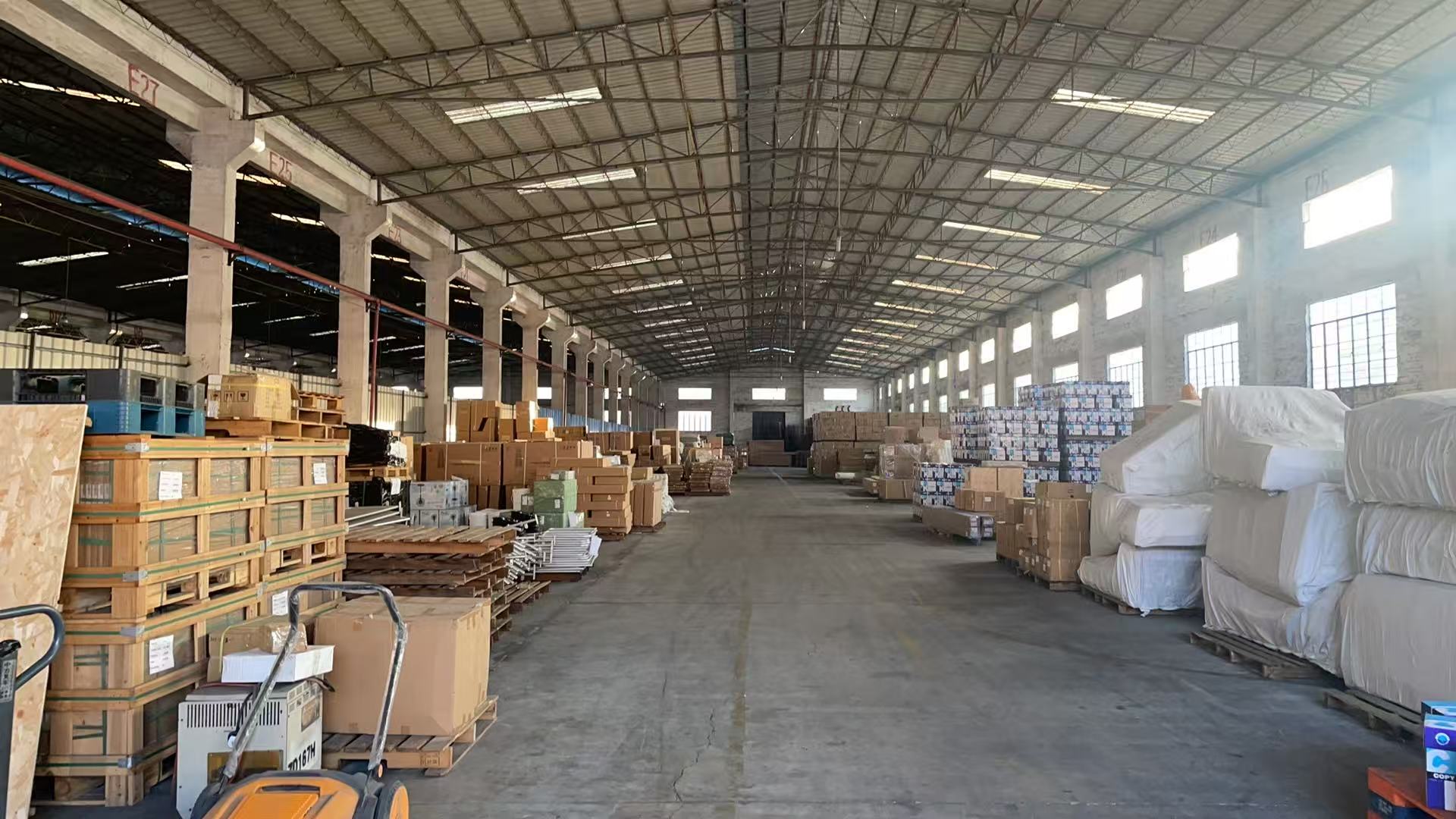
Foshan Warehouse & Cargo Consolidation
When you source building materials and interior goods from multiple factories across Foshan and Guangdong, the last practical problem is getting everything into one shipment without losing control of what goes into the container.
HSY Sourcing operates a private warehouse in Chancheng District, Foshan. We use it as the collection and consolidation point for every order we manage — tiles from Nanzhuang, furniture from Longjiang, lighting from Zhongshan Guzhen, sanitary ware from Chancheng, kitchen cabinets from Shunde. Everything comes here first, gets checked and counted, then loads into one container.
This page explains what the warehouse is used for, where it sits relative to the main Guangdong supply clusters, and what actually happens between goods leaving a factory and a container being sealed for export.
What the Warehouse Is and Is Not
It is worth being straightforward about what our warehouse service covers and where its scope ends.
What it is: a private warehouse we operate ourselves, used to receive goods from multiple suppliers, conduct receiving checks, hold goods while the full order assembles, plan container loading, and manage export documentation before shipment. It is a working logistics facility oriented around project procurement for building materials and interior goods.
What it is not: a public 3PL (third-party logistics) facility offering general storage contracts to any importer. We do not rent warehouse space independently of our sourcing and procurement services. The warehouse exists to support clients who are sourcing through us, or in some cases clients using our consolidation service for independently-sourced goods from the Guangdong region.
We manage the facility ourselves — we do not outsource to a third-party warehouse operator. This matters because it means the people receiving your goods and planning your container load are the same people who managed the sourcing, inspections, and supplier communication for your order. There is no handoff to a separate logistics company who does not know your order history.
Location and Distance to Main Supply Clusters
The warehouse is located in Chancheng District, Foshan — the same district as Foshan’s main ceramic and sanitary ware production cluster, and within short driving distance of the main furniture and cabinetry production areas in Shunde.
For most building material categories sourced through us, factory-to-warehouse delivery involves short domestic freight runs within Guangdong:
| Supply Cluster | Main Products | Approximate Drive to Our Warehouse |
|---|---|---|
| Nanzhuang / Chancheng, Foshan | Ceramic and porcelain tiles, sanitary ware | 10 – 25 minutes |
| Longjiang / Lecong, Shunde | Furniture, whole-house cabinetry, wardrobes | 25 – 35 minutes |
| Nanhai, Foshan | Aluminium windows and doors | 20 – 35 minutes |
| Zhongshan Guzhen | Lighting and electrical fixtures | 50 – 60 minutes |
| Kaiping, Guangdong | Faucets and bathroom fittings | 90 – 110 minutes |
| Guangzhou Nansha Port | Main export container terminal | 45 – 55 minutes |
| Yantian Port, Shenzhen | Alternative export terminal | 80 – 100 minutes |
The short distances between supply clusters and our warehouse mean domestic freight costs for collecting goods are relatively modest for most categories. For suppliers in Zhongshan and Kaiping, domestic freight is longer but still a straightforward single-day collection run.
What Happens at the Warehouse
Goods Receiving and Inbound Check
When goods arrive from a factory, we check the delivery against the purchase order and packing list: carton count, external carton condition, and any visible damage to packaging. We photograph goods on arrival.
If carton counts are short — a factory delivered 48 cartons instead of the 50 on the packing list — we flag this immediately and contact the factory before the full order is assembled. Finding a discrepancy at this stage is manageable. Finding it when a container has already been sealed at the port is not.
For goods that were not subject to a factory pre-shipment inspection (some clients use the warehouse receiving check as their primary quality gate for simpler product categories), we conduct a receiving inspection against the purchase order specification. This is not a substitute for a formal pre-shipment inspection at the factory — it is a secondary check at the point of delivery.
Holding and Staging
Most building material project orders involve goods from multiple factories finishing production at different times. Tiles and sanitary ware typically finish in 15–25 days; kitchen cabinets take 45–60 days; aluminium windows may take 50–65 days. A project order is not ready to ship until the last category has been received.
Goods that arrive at our warehouse before the full order is complete are held in the facility until everything has been received and cross-checked. We track what has arrived and what is still outstanding against the full order schedule, and report this to you on request.
Holding periods for project orders are typically 1–4 weeks between the first and last goods arriving. For orders with longer lead time variation between categories, we discuss the phasing at the planning stage and advise whether splitting into two shipments is more practical than holding the early-arriving goods.
Container Loading and Packing Plan
Once all goods for a shipment have been received and verified, we plan the container loading sequence. This is not simply filling a container in whatever order is convenient.
For building materials, the loading plan accounts for:
Weight distribution — heavy goods on the container floor, lighter goods on top and against walls. Ceramic tiles in reinforced cartons stack on the floor. Flat-pack furniture and lightweight cartons load above.
Fragile item protection — large-format stone slabs and glass panels packed in A-frame timber crates positioned against the container wall. Lighting fixtures in foam-padded boxes separated from heavy ceramic goods. Sanitary ware cartons stacked within their stated weight limits.
Stability — goods packed to prevent movement during the sea voyage. Gaps filled with dunnage bags or softwood timber blocking. Strapping for palletised goods.
Accessibility — for phased delivery projects, where possible we load goods that need to be unloaded first near the container doors.
We photograph the loaded container before sealing. The loading photographs, combined with the pre-shipment inspection reports and the packing list, form the documentation set used if a transit damage insurance claim is needed at the destination.
Export Documentation Preparation
Before the container is collected for transport to port, we prepare the export documentation set:
- Commercial invoice
- Detailed packing list (carton by carton, with dimensions and gross weights)
- Certificate of Origin (arranged through CCPIT or Chamber of Commerce)
- Product-specific certificates and test reports compiled from factories during the order process
- Fumigation certificate where wooden packaging is used (for destinations requiring ISPM 15 compliance — Australia, New Zealand, US, and others)
We send you the documentation set before the vessel departs so your customs broker at the destination can prepare for arrival.
The Consolidation Advantage for Building Material Projects
The financial case for consolidating through our warehouse rather than shipping each supplier’s goods separately is straightforward, and worth making concrete.
A 40-foot high-cube container shipping from Guangzhou Nansha to, for example, Melbourne or Dubai has a fixed freight cost whether it is full or partially loaded. That container holds approximately 67–72 cubic metres of cargo.
A building material fit-out for a 20-unit apartment project might involve:
- 15 CBM of floor and wall tiles
- 12 CBM of kitchen cabinets (flat-packed)
- 8 CBM of wardrobe systems
- 6 CBM of sanitary ware
- 5 CBM of bathroom fittings and accessories
- 4 CBM of lighting
- 8 CBM of aluminium windows (crated)
Total: approximately 58 CBM — enough to fill one 40ft high-cube container efficiently.
If each of these categories were shipped separately from each factory, the total logistics cost would involve: 7 separate LCL shipments or partial FCL bookings, 7 sets of export documentation, 7 customs entries at the destination, and 7 separate handling charges. The total cost of this approach typically runs 2 to 3 times higher than a single consolidated FCL shipment for the same volume.
The consolidation saving is not a rounding error. For a project of this scale, it represents a meaningful reduction in total landed cost.
Using Our Warehouse for Independently-Sourced Goods
Some buyers source certain goods themselves — they have existing supplier relationships or have found factories they are comfortable with — but want to use our warehouse for consolidation and shipping.
We offer consolidation as a standalone service for goods sourced independently from Foshan and the broader Guangdong region. We collect from your suppliers, receive at our warehouse, cross-check quantities against your purchase orders, hold until your full order is ready, load the container, and manage export documentation.
For this service, we charge for the logistics coordination work — collection, receiving, handling, container loading, and documentation. Freight is passed through at cost. We do not inspect goods sourced independently of our procurement service beyond the basic receiving check; if you want a pre-shipment inspection on independently-sourced goods, we arrange this separately as part of our quality control service.
If you are considering using this service for independently-sourced goods, contact us with the supplier locations, product categories, approximate cargo volumes, and destination port. We will provide a consolidation and freight estimate within 48 hours.
Frequently Asked Questions
How long can goods be stored at your warehouse before shipment?
For project orders being managed through our procurement service, we hold goods until the full order is assembled — typically a few weeks. For goods arriving significantly ahead of the rest of the order, we flag this during the production planning stage and agree on an appropriate approach. We do not offer open-ended storage contracts for goods unrelated to an active order; this is a working logistics facility, not a long-term warehousing service.
Can goods be repacked or relabelled at the warehouse?
Minor repacking — replacing damaged cartons, adding destination labels, consolidating loose items — is part of our standard handling. Significant repackaging, such as rebundling flat-pack furniture or repackaging goods for FBA compliance, can be arranged but needs to be discussed and quoted in advance.
Do you accept goods from suppliers who deliver directly to your warehouse without prior arrangement?
No. Every delivery to our warehouse is expected and cross-checked against a purchase order we hold for it. Unannounced deliveries from factories we are not expecting create confusion and cannot be properly received. For clients using our consolidation service for independently-sourced goods, we need a purchase order or packing list from each supplier before their goods arrive.
Can I visit the warehouse to inspect goods myself before shipment?
Yes, by appointment. If you are travelling to Foshan for a factory visit or Canton Fair and want to inspect goods held at our warehouse, we can arrange this. Most clients are overseas and review goods via the inspection reports and photographs we provide, but a physical visit is welcome if you are in the area.
What happens if a factory delivers goods to your warehouse that fail the receiving check?
We notify you immediately with photographs and a description of the discrepancy or damage. We then contact the factory on your behalf. Depending on the nature of the problem — short delivery, damaged cartons, wrong items — the resolution might be a replacement delivery from the factory, a credit, or a discussion about whether the goods can be accepted with a price adjustment. We do not hold up the rest of your shipment while a single-category issue is resolved unless the affected category is critical to the container loading plan.
HSY Sourcing — Foshan Warehouse and Cargo Consolidation. Building materials, furniture, lighting, and interior goods from multiple Guangdong suppliers, received, checked, and consolidated at our Chancheng District warehouse before sea freight to your destination port.


