
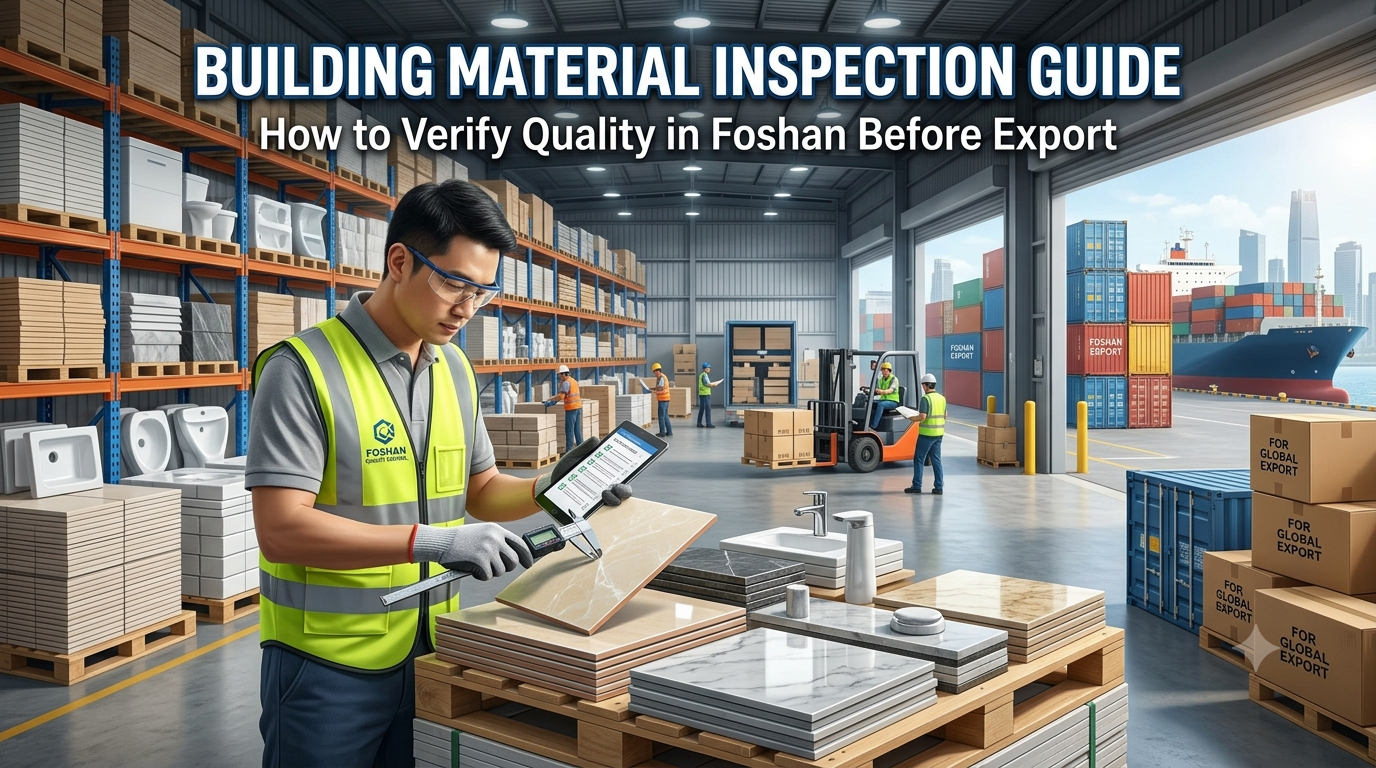
Sourcing architectural finishes, structural glazing, custom joinery, and ceramic tiles directly from Foshan, China can lower capital expenditure on commercial real estate projects by 30% to 45%. However, capturing those savings requires rigorous, on-the-ground quality control (QC).
Unlike off-the-shelf consumer goods, commercial building materials are manufactured to precise structural and dimensional tolerances. A batch of tiles with a 1mm diagonal variance, unverified moisture content in timber millwork, or non-compliant glass certifications can halt on-site installation, resulting in expensive field rework and missed opening deadlines. Once a container is sealed and dispatched from the port, resolving defects overseas becomes exponentially more costly than fixing them on the factory floor.
This guide outlines the technical inspection protocols, sampling standards, and category-specific quality audits required to verify building materials in Foshan prior to export.
What Are the Key Takeaways for Building Material Inspection?
- Implement a 3-Tier QC Process: Quality control must happen across three distinct production milestones: Pre-Production (Raw Material Audit), In-Line Production (IPQC), and Pre-Shipment Inspection (PSI). Relying solely on final inspections is too late to correct structural errors.
- Apply Recognized Sampling Standards: Use international acceptance sampling standards, such as ISO 2859-1 (AQL 2.5 for Major Defects, AQL 4.0 for Minor Defects), to evaluate high-volume items like tiles, flooring, and lighting.
- Control Equilibrium Moisture Content (EMC): Mandate that all solid timber, plywood, and MDF components are kiln-dried and tested with digital pin meters to maintain an 8% to 12% moisture limit before finish application and packaging.
- Mandate Trial Assembly for Custom Items: Custom kitchen cabinetry, bathroom vanities, and hotel guestroom millwork must undergo a 100% trial assembly on the factory floor to verify hardware alignment, drawer slide dampening, and CAD drawing compliance.
- Verify Building Code Certifications: Ensure that structural glass, aluminum profiles, and electrical fixtures carry verifiable physical safety stamps (such as SGCC, CE, UL, or AS/NZS 2208) matched against official laboratory test reports.
Why Is On-Site Factory Inspection Critical When Sourcing from Foshan?
Foshan’s manufacturing base is highly specialized by district—Chancheng for ceramic tiles, Nanhai for aluminum windows, Shunde for custom millwork, and Lecong for contract furniture. While these factories offer advanced manufacturing capabilities, high-volume production lines carry inherent operational risks.
       Factory Risk Factor                      On-Site Failure                          Inspection Remedy
┌──────────────────────────────┐       ┌──────────────────────────────┐       ┌──────────────────────────────────────────┐
│ Unannounced Substrate        │ ───>  │ Swelling, delamination, or   │ ───>  │ Pre-production raw material audit and    │
│ Substitution                 │       │ formaldehyde off-gassing     │       │ board core density verification.          │
└──────────────────────────────┘       └──────────────────────────────┘       └──────────────────────────────────────────┘
┌──────────────────────────────┐       ┌──────────────────────────────┐       ┌──────────────────────────────────────────┐
│ Ceramic Glaze Batch          │ ───>  │ Visible color and pattern    │ ───>  │ Lock single-run batch production with    │
│ Variance                     │       │ mismatch across installed wall│      │ master sample shade-matching checks.     │
└──────────────────────────────┘       └──────────────────────────────┘       └──────────────────────────────────────────┘
┌──────────────────────────────┐       ┌──────────────────────────────┐       ┌──────────────────────────────────────────┐
│ High Factory Ambient         │ ───>  │ Timber warping and splitting │ ───>  │ Digital moisture meter checks on core    │
│ Humidity                     │       │ in dry destination climates  │       │ wood prior to lacquer application.       │
└──────────────────────────────┘       └──────────────────────────────┘       └──────────────────────────────────────────┘
Relying on factory-provided photos or self-inspection reports is insufficient for commercial procurement. An independent, on-site inspection team physically verifies dimensions, material grades, and operational tolerances against your approved Bill of Quantities (BOQ) and CAD shop drawings.
How Does a 3-Tier Inspection Process Work for Commercial Building Materials?
To prevent systematic errors during mass manufacturing, inspections are structured into three distinct phases.
1.1. Incoming Quality Control (IQC):Phase 1: Pre-Production Audit.
Before mass manufacturing begins, inspectors audit raw materials on the factory floor. This includes checking board substrate thickness, verifying aluminum wall profile gauges, testing timber moisture levels, and confirming that glass units carry the required safety certification stamps.
2.2. In-Process Quality Control (IPQC):Phase 2: In-Line Production Checks.
Executed when 30% to 50% of the order has passed through processing. Inspectors verify CNC cutting precision, edge-banding tightness (demanding PUR hot-melt adhesives for wet-area cabinetry), tile edge squareness, and color consistency across initial production runs.
3.3. Pre-Shipment Inspection (PSI):Phase 3: Final Pre-Shipment Inspection.
Conducted when 100% of the order is manufactured and at least 80% is packed in final export cartons. Inspectors pull random samples using ISO 2859-1 (AQL 2.5) rules to audit dimensional accuracy, finish quality, hardware inclusions, packaging durability, and carton labeling.
What Category-Specific Quality Audits Are Required for Key Materials?
Different building materials require specific testing protocols and instruments during an on-site audit.
| Material Category | Key Inspection Parameters | Testing Tools & Standards Used | Pass/Fail Acceptance Criteria |
| Porcelain Tiles & Sintered Stone | Water absorption rate, diagonal squareness, surface flatness, glaze shade consistency. | Vernier calipers, diagonal square gauges, water immersion testing, Mohs hardness picks. | Water absorption $<0.5\%$ (porcelain) / $<0.1\%$ (sintered stone); diagonal tolerance $\le \pm 0.5\text{ mm}$. |
| Aluminum Windows & Doors | Profile wall thickness, corner crimping seal, glass safety stamps, water tightness. | Coating thickness gauge, digital micrometer, spray hose pressure testing. | Primary profile thickness $\ge 1.4\text{ mm}$ (windows) / $\ge 2.0\text{ mm}$ (doors); valid SGCC/CE stamps. |
| Custom Cabinetry & Joinery | Core board density, moisture content, PUR edge-banding tightness, hardware alignment. | Digital pin moisture meter, 3D laser level, Blum/DTC cycle testing verification. | Wood moisture content $8\% – 12\%$; zero visible glue line on PUR edge-banding; 100% soft-close function. |
| Sanitaryware & Plumbing | Glaze pinhole defects, flush performance, thread pitch compatibility, corrosion resistance. | Thread pitch gauges (NPT vs. BSP), 48-hour salt spray test reports, water pressure gauge. | Zero structural cracks/pinholes; BSP/NPT thread compatibility matching destination plumbing codes. |
How Do You Prevent Defects During Container Loading and Staging?
Even defect-free building materials can sustain damage during ocean transit if container loading is unmanaged. A dedicated Container Loading Supervision (CLS) audit ensures goods arrive at the job site undamaged.
┌────────────────────────────────────────────────────────────────────────┐
│                   CONTAINER STAGING & LOADING PROTOCOL                 │
├────────────────────────────────────────────────────────────────────────┤
│ 1. Container Floor & Wall Audit  ──> Check for holes, rust, and water │
│                                                                        │
│ 2. Bottom Ballast Layer          ──> Load heavy tiles & stone crates   │
│                                                                        │
│ 3. Center Structural Layer       ──> Stack flat-packed cabinet cartons │
│                                                                        │
│ 4. Top Protection Layer          ──> Secure lightweight furniture/lights│
│                                                                        │
│ 5. Humidity Protection           ──> Install calcium chloride desiccant│
└────────────────────────────────────────────────────────────────────────┘
Essential Container Loading Controls:
- Container Inspection: Verify that the shipping container is dry, odor-free, and light-tight. Ensure the timber floor moisture level is under 14% to prevent moisture transfer into packed goods.
- Density-Stratified Stacking: Position heavy, high-density crates (stone slabs, ceramic tiles, sanitaryware) flat on the container floor to establish a low center of gravity. Stack lighter, bulky flat-packed cabinetry and soft furnishings above.
- Export Packaging & Crating Verification: Confirm that all fragile glass panels, vanities, and stone tops are enclosed in solid, ISPM 15 compliant, fumigated plywood crates reinforced with internal EPE foam corner buffers.
- Desiccant Placement: Place high-capacity calcium chloride desiccant bags inside the container to absorb moisture during temperature changes across sea transit zones, preventing “container rain.”
Why Choose HSY Sourcing as Your Inspection & Procurement Partner in Foshan?
Managing quality control across multiple specialized Foshan factories requires technical expertise and on-ground presence. HSY Sourcing operates as your independent, local quality control and procurement team in Foshan.
What Sets HSY Sourcing Apart:
- In-House Quality Control Engineers: We do not outsource inspections to generic third-party agencies. Our dedicated QC engineers specialize in architectural building materials, custom cabinetry, fenestration, and contract FF&E.
- 3-Tier Inspection Strategy: We perform incoming raw material audits, mid-production inline checks, and final AQL 2.5 pre-shipment inspections directly on the factory floor.
- Dedicated Foshan Staging Warehouse: We receive shipments from multiple factories at our local warehouse facility, where we perform unboxing audits, trial assemblies, timber moisture testing, and export-grade re-crating before loading.
- Comprehensive Engineering & Shop Drawing Review: Our technical team reviews architectural plans, CAD shop drawings, and material specifications prior to production, catching dimensional conflicts early.
- Transparent Bilingual Reporting: Receive itemized QC reports within 24 hours of inspection, complete with high-resolution photos, dimensional measurements, pass/fail callouts, and clear corrective action recommendations.
What Are the Most Common Questions About Building Material Inspections? (FAQ)
Q1: What sampling standard is used for commercial building material inspections in China?
We apply the internationally recognized ISO 2859-1 (ANSI/ASQ Z1.4) single sampling plan. For commercial building materials, we typically set the Acceptance Quality Limit at AQL 0 for Critical Defects (e.g., safety hazards or code non-compliance), AQL 2.5 for Major Defects (e.g., dimensional errors or functional flaws), and AQL 4.0 for Minor Defects (e.g., minor surface blemishes).
Q2: How do you verify that custom kitchen cabinets or vanities will fit on site?
Before mass production, we require factories to produce full-scale physical prototypes for master sign-off. During final pre-shipment inspection, our engineers perform a 100% trial assembly of selected cabinet units on the workshop floor, checking dimensional tolerances, drawer slide dampening, appliance cutout dimensions, and hardware counts against approved CAD drawings.
Q3: What happens if a factory fails a Pre-Shipment Inspection (PSI)?
If an order fails inspection due to excessive defects or dimensional variances, HSY Sourcing issues a formal Corrective Action Plan (CAP) to the manufacturer. The factory must rework, repair, or reproduce the non-conforming items at their own expense. A re-inspection is conducted to confirm all issues are resolved before balance payments are released and container loading is authorized.
Q4: How do you check for moisture content issues in wood products shipped overseas?
Our inspection team uses digital pin-type moisture meters calibrated for specific timber species and composite panel types. We test raw substrate boards, door cores, and solid wood frames at multiple points during production and warehousing, enforcing a strict 8% to 12% Equilibrium Moisture Content (EMC) limit to prevent cracking or warping in dry destination climates.
Q5: Can HSY Sourcing verify international building code compliance for glass and windows?
Yes. Our QC engineers verify that structural aluminum window profiles match specified wall thicknesses and thermal break standards. We physically inspect glass units for required safety certification stamps (SGCC for North America, CE EN 12150 for Europe, AS/NZS 2208 for Australia) and cross-check batch numbers against official laboratory test reports.