
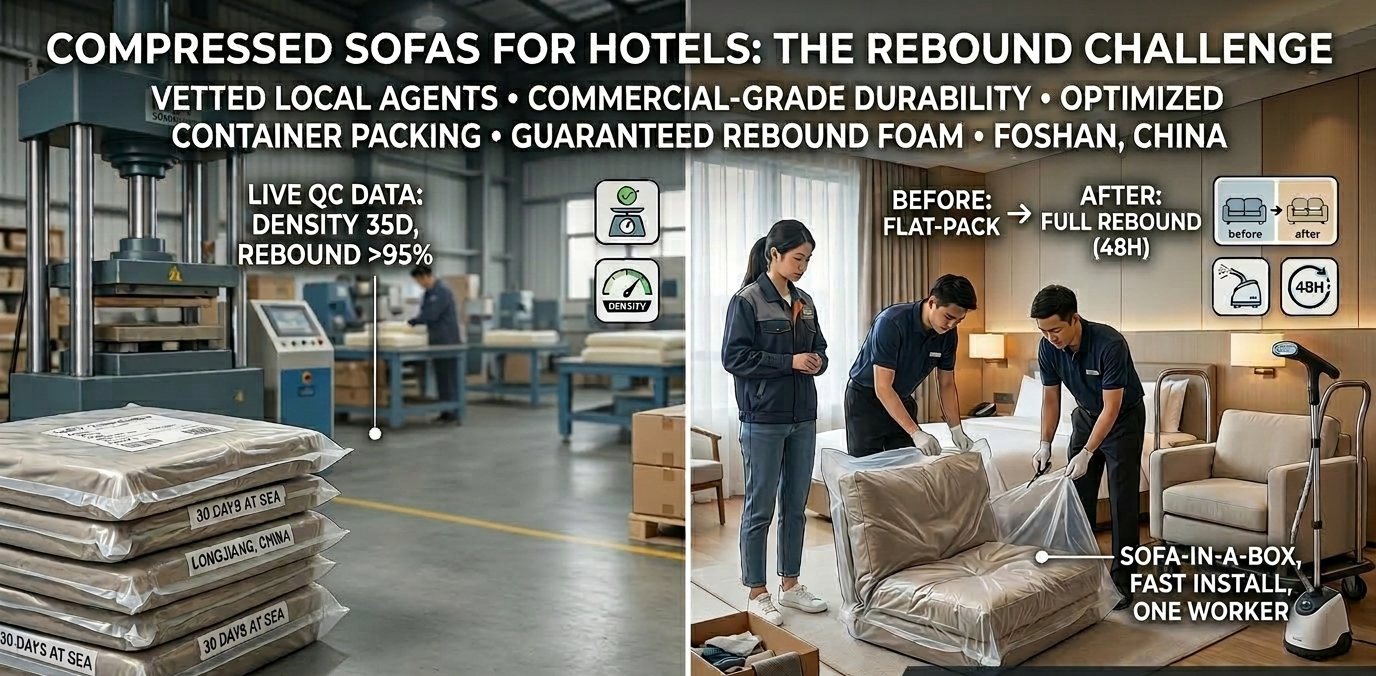
The idea of a compressed sofa is a dream for hotel owners. You can fit 150 units into a 40HQ container instead of just 40. That’s a massive saving on sea freight.
But then comes the nightmare: The container arrives, you open the vacuum-sealed bags, and the sofas stay as flat as a pancake. Or the fabric is so wrinkled it looks like it’s been in a car crash.
If you are sourcing furniture from Foshan or Longjiang, you need to know the truth about “Sofa-in-a-box” technology. Will it actually rebound after 30 to 45 days at sea? The answer is: Yes, but only if you don’t let the factory cheat on the foam.
Why does some foam stay flat after 30 days of compression?
Foam is basically made of tiny air bubbles. When you vacuum-pack a sofa, you suck all the air out. If the “cell walls” of those bubbles are weak, they break. Once they break, the foam loses its “memory” and will never bounce back.
This usually happens for two reasons:
- Low Density: Factories often use D25 or D28 foam to save money. This foam is too soft and weak for compression. For a hotel project, you need at least D35 or D45 High-Resiliency (HR) foam.
- Recycled Content: If the factory mixes in “recycled foam” (the colorful crunchy stuff), it will almost certainly fail the rebound test after a long voyage.
Does the fabric survive being crushed in a box for a month?
This is the second big worry. Even if the foam pops back up, the fabric—especially velvet or thick linen—can develop “death folds.” These are deep wrinkles that don’t go away just by sitting on them.
To prevent this, we specify two things at the factory:
- Fabric Backing: We ensure the fabric has a knitted backing to give it extra elasticity.
- The “Relaxation” Period: You cannot use a compressed sofa 10 minutes after opening it. For hotel projects, you must factor in a 48-to-72 hour “breathing” period before the guests arrive. We also recommend using a professional garment steamer on-site to kick-start the fibers.
How do we know if a factory is lying about the foam density?
In Longjiang, every factory says they use D35 foam. But density is about weight. D35 means one cubic meter of that foam weighs 35kg.
As your Foshan sourcing agent, we don’t just look at the sofa. We go to the production line before the fabric is sewn on. We cut a small cube of the foam and weigh it. If the math doesn’t add up, we stop the order. We also perform a “Stress Test”—we compress a sample in the factory’s machine for 7 days and see if it recovers in under an hour. If it fails after 7 days, it will definitely fail after 30 days at sea.
Is the “rebound” the same in cold climates versus hot climates?
Actually, yes, temperature matters. If your hotel project is in a cold climate (like Scandinavia or Canada) and you open the containers in winter, the foam will be “sluggish.” It might take a week to fully expand.
We advise our clients to store the boxes in a heated room before unboxing. It’s these small, real-world details that prevent a “quality disaster” during a project installation.
FAQ: Sourcing Compressed Sofas in China
Q: Does vacuum packing make the sofa feel harder?
A: Initially, yes. Because the air was forced out, the foam feels stiff for the first few days. It usually softens to its intended “Sit-Feel” after about a week of use.
Q: Can I compress a leather sofa?
A: NO. We strongly advise against compressing real leather or high-end PU leather. The vacuum process creates permanent cracks and “veins” in the leather that cannot be fixed. Compressed sofas should stay limited to woven fabrics.
Q: Is there a “Best Before” date for compressed sofas?
A: Yes. You should not leave sofas compressed for more than 3 to 4 months. If your project is delayed and the sofas sit in a warehouse for half a year, the rebound rate drops significantly.
Q: Do compressed sofas meet hotel fire ratings?
A: Vacuum packing doesn’t change the chemical properties of the foam. We can still source CA117 or BS5852 fire-retardant foam that is also high-density and suitable for compression.
How HSY Sourcing Protects Your Hotel Furniture Order
Sourcing compressed sofas is a high-reward, high-risk move. At HSY Sourcing, we take the risk out of the equation. We are based in the heart of the Foshan furniture hub, and we provide:
- Foam Density Verification: We weigh and test the foam before it’s covered in fabric.
- Vacuum Pressure Check: We ensure the factory isn’t “over-compressing” to the point of damaging the internal wood frame.
- Fabric Adhesion Testing: We make sure the fabric won’t delaminate or wrinkle permanently after unboxing.
- On-Site Loading Supervision: We make sure the boxes are stacked correctly in the 40HQ container to prevent crushing the bottom layer.
Worried about your sofas staying flat? Stop guessing. Send us your project specs, and we will find the right Longjiang factory that understands the science of the 30-day rebound.