

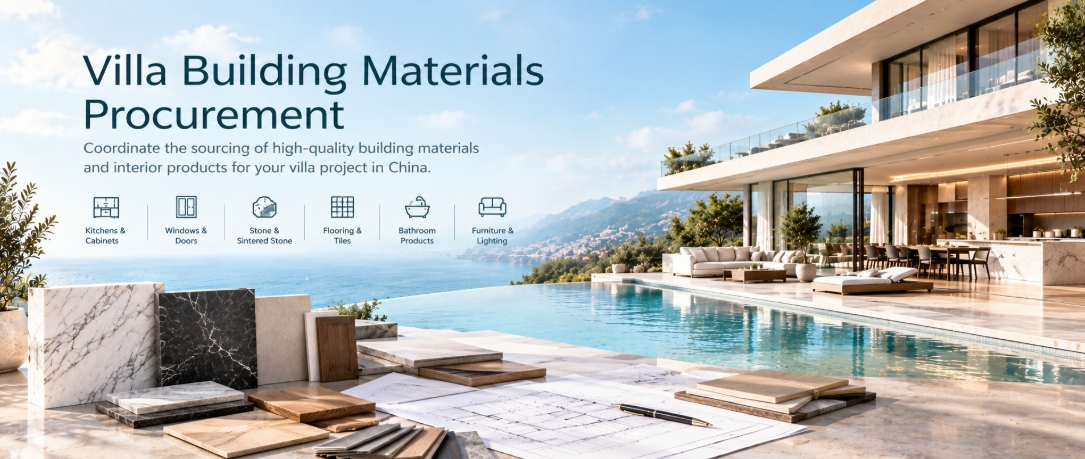
Building material procurement support for private villa construction and major renovation projects.
Sourcing building materials for a private villa involves more than collecting quotations. Custom kitchens, wardrobes, windows, stone, flooring, sanitary ware, and furniture may require different suppliers, technical specifications, approval processes, and production schedules.
HSY Sourcing helps overseas homeowners coordinate building materials procurement from China. Based in Foshan, Guangdong, we support supplier research, quotation comparison, specification coordination, order follow-up, and other agreed procurement services according to each project’s requirements.
Whether you already have architectural drawings and a bill of quantities (BOQ), or are still organizing your material selections, the first step is to understand what needs to be purchased, what information suppliers require, and which products are suitable for sourcing from China.
What Does Villa Building Materials Procurement Involve?
Villa building materials procurement covers the work required to identify suitable suppliers, compare quotations, clarify product specifications, coordinate orders, and prepare goods for delivery.
For a customized residential project, this process may involve several stages before a supplier can provide a reliable quotation or begin manufacturing.
For example, a kitchen quotation may depend on cabinet dimensions, carcass and door materials, hardware, finishes, internal accessories, and appliance requirements. A window quotation may depend on opening sizes, frame profiles, glass specifications, hardware, and installation conditions.
If these details are not clearly defined, quotations from different suppliers may not cover the same products or scope of work.
HSY helps organize these procurement activities within the agreed service scope. The aim is to help the homeowner make informed purchasing decisions and coordinate supplier-related work based on the available project information.
Procurement coordination does not replace architectural design, engineering, local regulatory approval, or installation services. Those responsibilities should remain with the appropriate professionals and suppliers.
Which Building Materials Can Be Sourced for a Villa?
HSY can help coordinate the sourcing of selected building materials and interior products according to the project requirements. The appropriate categories depend on the design, specifications, order quantities, supplier suitability, and destination market.
Custom Kitchens and Whole-House Cabinetry
Custom kitchens and cabinetry often require detailed procurement coordination because multiple components must work together.
Potential categories include:
- Custom kitchen cabinets and islands.
- Wardrobes and walk-in closets.
- Bathroom vanities.
- Built-in storage and other fitted cabinetry.
- Selected decorative panels and interior joinery.
A quotation should be evaluated by more than the stated board material or cabinet price. Carcass construction, door finishes, edge treatment, hardware, internal fittings, dimensions, and included accessories can all affect the specification and final cost.
For customized cabinetry, factory shop drawings are an important part of the process. They should be reviewed and approved by the responsible project parties before manufacturing begins.
Architectural drawings and 3D renders can help communicate the design intent, but additional dimensions and technical details may still be necessary.
Aluminium Windows and Doors
Windows and doors can be significant procurement items, particularly for villas with large sliding doors, extensive glazing, or customized frame finishes.
Important considerations include:
- Opening dimensions and installation conditions.
- Frame profiles and surface finishes.
- Glass configuration and performance requirements.
- Hardware and opening mechanisms.
- Water management, air-tightness, and other relevant performance criteria.
- Destination-market regulations and installation arrangements.
The appropriate specification depends on the building design, climate, exposure, and applicable local requirements. A product that appears suitable in a catalogue should not be assumed to meet the project’s technical or regulatory requirements without verification.
Marble, Natural Stone, and Sintered Stone
Stone may be used for kitchen countertops, islands, bathroom vanities, flooring, wall cladding, and decorative features.
Procurement considerations include material selection, slab availability, colour variation, vein direction, thickness, surface finish, edge details, fabrication drawings, and installation requirements.
For bookmatched stone or areas where the vein pattern needs to continue across several pieces, the actual slab selection and cutting layout are particularly important.
Photographs can help with preliminary selection, but they may not fully represent the appearance of the delivered material. The approval process should reflect the material and visual requirements of the project.
Flooring, Tiles, and Wall Finishes
Depending on the design, procurement may include porcelain tiles, selected stone flooring, engineered flooring, wall panels, and other interior finishes.
Before comparing quotations, confirm the required dimensions, finish, quantity, installation method, accessories, and whether the quoted price includes the necessary components.
For products with batch or colour variation, discuss how the supply will be selected and whether additional material should be allowed for cutting, installation, or future repairs.
Bathroom Products and Sanitary Ware
Bathroom procurement may cover vanities, basins, toilets, faucets, shower products, and selected accessories.
Check dimensions, finishes, compatible components, water connections, installation requirements, and the suitability of products for the destination market.
The relevant plumbing requirements and product approvals should be confirmed with the appropriate local professionals before orders are finalized.
Furniture and Lighting
Selected indoor furniture, outdoor furniture, and decorative lighting can also be considered within a villa procurement plan.
Furniture quotations should clarify dimensions, construction, upholstery, materials, finishes, and packaging. Lighting products require confirmation of electrical specifications, installation requirements, and applicable local compliance requirements.
Not every product needs to be sourced from China. The decision should reflect the actual specification, purchasing quantity, shipping costs, availability, and suitability for the project.
Common Procurement Challenges in Villa Projects
1. Quotations Based on Different Specifications
Two suppliers may quote what appears to be the same product while including different materials, hardware, finishes, accessories, packaging, or services.
Comparing the total price alone can therefore lead to an inaccurate assessment.
Where possible, prepare a common specification or quotation checklist for the suppliers being compared. Record any differences and exclusions so the homeowner can understand what each quotation covers.
If the specification is still under development, the quotations should be treated as preliminary rather than directly comparable final offers.
2. Incomplete Drawings and Missing Dimensions
Architectural plans and interior renders are useful for establishing the design direction, but they may not include all the information required for customized manufacturing.
Cabinet suppliers may need detailed dimensions and internal configurations. Window suppliers may need confirmed openings and technical requirements. Stone fabricators may need slab selections and fabrication drawings.
The relevant project professionals should confirm dimensions and technical decisions before production. HSY can help communicate outstanding questions to suppliers, but supplier clarification does not replace professional design approval.
3. Coordinating Finishes Across Different Suppliers
A villa may use related colours or finishes across cabinetry, doors, wall panels, furniture, and other interior elements.
However, different suppliers may use different materials and manufacturing processes. A similar colour reference does not guarantee an identical finished appearance.
Where visual consistency matters, establish finish references early, review samples where appropriate, and document the approved selections. If exact matching is not technically achievable, the differences should be understood before the orders are confirmed.
4. Minimum Order Quantities and Custom Orders
Some manufacturers have minimum order quantities (MOQs) or minimum order values, particularly for customized finishes, special dimensions, or less common materials.
This can affect a private villa project when the required quantity is relatively small compared with a supplier’s normal production orders.
Possible approaches include identifying suppliers suited to project-scale orders, reviewing alternative specifications, or discussing whether related products can be purchased from the same supplier.
These options depend on the product and supplier. Combining categories does not automatically reduce costs, and not every supplier will accept every customized quantity.
5. Different Production and Delivery Schedules
Products purchased for one villa may be manufactured by several independent suppliers. Their production schedules, approval requirements, and completion dates may differ.
Customized cabinetry may require drawing approval before production. Stone may depend on material selection and fabrication details. Windows, furniture, and other products may have their own manufacturing and packaging requirements.
Procurement planning should account for these differences instead of assuming all orders will be ready together.
Actual lead times depend on the product, supplier workload, specification, approval cycles, and logistics arrangements. They should be confirmed with the relevant supplier for each order.
6. Packing and Handling of Fragile or Oversized Products
Glass, stone slabs, aluminium profiles, cabinetry, and large furniture items may need specific packing and handling arrangements.
The packing method should reflect the product’s dimensions, weight, fragility, transport method, and agreed shipping requirements.
Before shipment, clarify the packing scope, shipping marks, quantities, and any special handling needs. The appropriate arrangement should be confirmed for the actual goods rather than assumed to be identical across all product categories.
How HSY Coordinates Villa Building Materials Procurement
The procurement process depends on the project stage and the information available. A project with approved specifications can move into supplier quotation and order coordination more directly than one that is still developing its design.
Step 1: Review the Project and Purchasing Requirements
We begin by understanding the project location, current stage, intended product categories, available drawings, and approximate purchasing timeline.
Useful documents may include architectural plans, CAD drawings, interior design drawings, a BOQ, material schedules, finish references, and 3D renders.
If some documents are not yet available, the initial discussion can help identify which categories are ready for supplier research and what further information is required.
Step 2: Identify Suitable Suppliers and Request Quotations
Once the sourcing requirements are sufficiently clear, supplier research and quotation requests can begin.
Where appropriate, quotations are compared against defined specifications, including materials, dimensions, finishes, included components, packaging, lead times, and commercial terms.
The objective is to understand the differences between supplier offers, not simply to select the lowest price.
Supplier availability and suitability must be assessed for each category. No supplier should be considered suitable for every product solely because it can provide a competitive quotation.
Step 3: Clarify Specifications and Approvals
Before orders are confirmed, relevant details may need to be clarified with the supplier.
Depending on the product, this can include material selections, dimensions, hardware, finishes, accessories, samples, technical information, and factory shop drawings.
For made-to-order products, the responsible project parties should approve the relevant specifications and drawings before manufacturing begins.
The approval process and responsibilities should be clear to all parties. HSY can coordinate supplier communication within the agreed scope but does not replace the homeowner’s architect, engineer, or other qualified professionals.
Step 4: Follow Up on Confirmed Orders
Once an order is placed, supplier follow-up may involve checking production progress, outstanding approvals, anticipated completion dates, and readiness for inspection or shipment.
This helps identify information gaps and coordination issues that may affect the next stage.
Supplier schedules can change, and follow-up does not guarantee that every order will be completed on the original estimated date. Production expectations should be confirmed with each supplier and updated when necessary.
Step 5: Arrange Quality Checks Where Agreed
Quality inspection should be planned according to the product, order requirements, identified risks, and agreed scope.
Depending on the arrangement, checks may cover selected dimensions, materials, finishes, workmanship, quantities, or packaging.
The inspection criteria and timing should be established in advance. Receiving goods at a warehouse is not the same as performing a full quality inspection.
For more information, see the relevant quality control service page once the link and inspection scope have been confirmed.
Step 6: Coordinate Receiving and Shipment Preparation
When several suppliers are involved, their goods may become ready at different times. The next step depends on the required delivery arrangement and whether the products are suitable for combined shipment.
Where included in the agreed service, HSY can coordinate warehouse receiving, storage, cargo consolidation, and shipping arrangements.
For details, see our Whole-Villa Building Materials Sourcing & Consolidation, Warehouse & Storage, and Cargo Consolidation & Shipping service pages.
What Documents Should You Prepare?
You do not need every final document before making an initial inquiry. However, more complete information generally helps suppliers understand the requirements and prepare more meaningful quotations.
Project Information
- Country and city where the villa is located.
- Whether the project is new construction or a major renovation.
- Current construction or design stage.
- Expected purchasing and delivery timeline.
Drawings and Specifications
- Architectural floor plans.
- CAD drawings, where available.
- Interior design drawings and 3D renders.
- BOQ or material schedule, if available.
- Kitchen, cabinetry, window, and door schedules.
- Material specifications, finish references, and product images.
- Known technical or local regulatory requirements.
Purchasing Requirements
- Product categories you want to source.
- Approximate quantities or dimensions.
- Budget expectations for the relevant categories, if established.
- Whether you need supplier research, quotation comparison, order follow-up, inspection arrangements, or logistics coordination.
- Whether you plan to visit suppliers in China or coordinate remotely.
If your design is not complete, you can still share the information currently available. The first discussion can establish what is possible at this stage and what additional design or technical work may be needed.
If you require a preliminary whole-house design proposal, this is a paid service and should be scoped separately.
Lead Times, Approvals, and Procurement Planning
For customized villa products, the procurement schedule includes more than factory production time.
Depending on the category, the process may involve supplier selection, quotation clarification, sample review, drawing preparation, approval, manufacturing, inspection, packing, and international shipping.
Delays at one stage may affect later activities. For example, a cabinet order cannot be manufactured accurately if critical dimensions or shop drawings remain unapproved. Similarly, stone fabrication may depend on final material selection and confirmed cutting details.
A practical procurement schedule should therefore identify key approvals and dependencies, not only the expected factory completion date.
When several suppliers are involved, each order should have its own confirmed requirements and anticipated timeline. If the goods are intended for consolidation, shipment planning should also consider which orders will be ready, how they will be packed, and whether holding completed goods is appropriate for the project.
HSY can help coordinate supplier follow-up and agreed logistics arrangements. Actual production dates, shipping schedules, and arrival dates remain dependent on the relevant suppliers, carriers, documentation, and destination requirements.
Quality Checks and Shipment Preparation
Quality checks and shipment preparation address different parts of the procurement process.
A quality inspection evaluates agreed product requirements at a specified stage. Shipment preparation concerns the identification, packing, handling, documentation, and movement of goods.
Depending on the product and service arrangement, the procurement plan may include:
- Checking selected specifications against the approved order.
- Reviewing visible finishes or workmanship against agreed criteria.
- Confirming quantities and packing details.
- Identifying goods by supplier, order, or product category.
- Coordinating receiving and storage arrangements.
- Preparing for cargo consolidation and international shipment.
The inspection scope should be documented before work begins. A limited visual check does not establish that every hidden component or technical performance requirement has been verified.
Likewise, receiving goods does not automatically confirm that they are free from defects. The appropriate checks depend on the product, inspection method, and agreed scope.
For more detail, visit our Whole-Villa Building Materials Sourcing & Consolidation page.
Service Fees and Responsibilities
HSY keeps supplier quotations separate from its own service fees. We do not rely on factory commissions or rebates.
This allows the homeowner to understand the supplier’s quoted price and the fee for HSY’s agreed procurement work separately.
The fee depends on the required scope. Supplier research, quotation collection, specification coordination, production follow-up, design support, quality inspection, warehousing, and shipping coordination may have different arrangements.
Before work begins, the service scope, deliverables, fees, exclusions, and responsibilities should be clarified.
Design work and preliminary whole-house design proposals are paid services where applicable. They should not be assumed to be included in a sourcing service without an agreed scope.
Supplier contracts, product warranties, manufacturing obligations, payment terms, and technical responsibilities should also be understood separately. HSY’s coordination role does not automatically make it the manufacturer or contractual guarantor of each product.
Why Work with HSY Sourcing?
A Foshan-Based Sourcing Service
HSY is based in Foshan, Guangdong, an area relevant to several building-material and interior-product categories. Our local presence supports supplier communication and coordination for suitable products in the region.
Some categories may require suppliers in other parts of China, depending on the project requirements.
Procurement Based on Defined Requirements
Customized products need to be compared against their actual specifications. HSY helps organize supplier quotations and clarify differences in materials, finishes, dimensions, included components, and commercial terms where these details are available.
This supports more informed purchasing decisions without assuming that every quotation is directly comparable.
Transparent Fees
Supplier prices and HSY service fees are separate, and our model does not rely on factory commissions or rebates.
The proposed work and associated charges should be clear before the relevant service begins.
Coordination Within an Agreed Scope
Some homeowners need help with supplier research and quotation comparison. Others need additional coordination for drawings, orders, quality checks, warehouse receiving, or shipment arrangements.
We discuss the available project information and the work required before establishing the appropriate service scope. Services beyond that scope should be agreed separately rather than assumed to be included.
Frequently Asked Questions
Can HSY work from architectural drawings without a complete BOQ?
Yes. Architectural drawings can support an initial discussion and help identify the main purchasing categories. However, detailed quotations for customized products may require additional dimensions, material specifications, product schedules, and technical information. A BOQ is useful when available, but it is not necessarily a prerequisite for the first conversation.
Can I source several building-material categories through HSY?
You can discuss multiple categories as part of one procurement plan. The appropriate scope depends on the products, available information, supplier requirements, and the services agreed with HSY. Different categories may involve separate suppliers, contracts, approvals, and production schedules.
How should I compare quotations from different suppliers?
First, check whether the quotations cover the same specifications and scope. Compare materials, dimensions, finishes, hardware, accessories, packaging, lead times, payment terms, and exclusions where relevant. If important details differ or are missing, clarify them before using the quotations to make a purchasing decision.
How can I coordinate finishes across different suppliers?
Start by identifying the important finish references and reviewing samples where appropriate. Share clear specifications and approval records with the relevant suppliers. Different materials and manufacturing processes may produce different appearances, so exact matching should not be assumed without verification.
Can HSY work with my architect or interior designer?
Yes, coordination can involve your architect or interior designer where appropriate. Their drawings and specifications can help suppliers understand the intended design. Technical approvals, structural decisions, local code compliance, and other professional responsibilities should remain with the relevant qualified parties.
Does procurement automatically include quality inspection and shipping?
No. These services depend on the agreed scope. Supplier research and quotation coordination do not automatically include a full product inspection, warehouse storage, cargo consolidation, or international shipping. Confirm the required services, inspection criteria, fees, and responsibilities before work begins.
Can I use my existing suppliers for some products?
You can discuss using existing suppliers as part of the project. Whether HSY can help coordinate them depends on the required service, supplier cooperation, available documentation, and the practical arrangements for inspection, receiving, and shipment. Any additional work should be agreed in advance.
Discuss Your Villa Building Materials Procurement Requirements
If you are building a new private villa or undertaking a substantial renovation, HSY Sourcing can review your available project information and discuss the procurement support that may be appropriate.
To help us understand your requirements, please share:
- Your project location.
- The current design or construction stage.
- Available architectural drawings, BOQ, or material schedule.
- The product categories you are considering sourcing from China.
- Your approximate purchasing timeline.
- The type of supplier coordination or procurement support you need.
You can contact us even if some drawings or specifications are still being developed. We can first review what is available and identify the information needed for the next stage.
Contact HSY Sourcing to discuss your villa building materials procurement requirements.


