
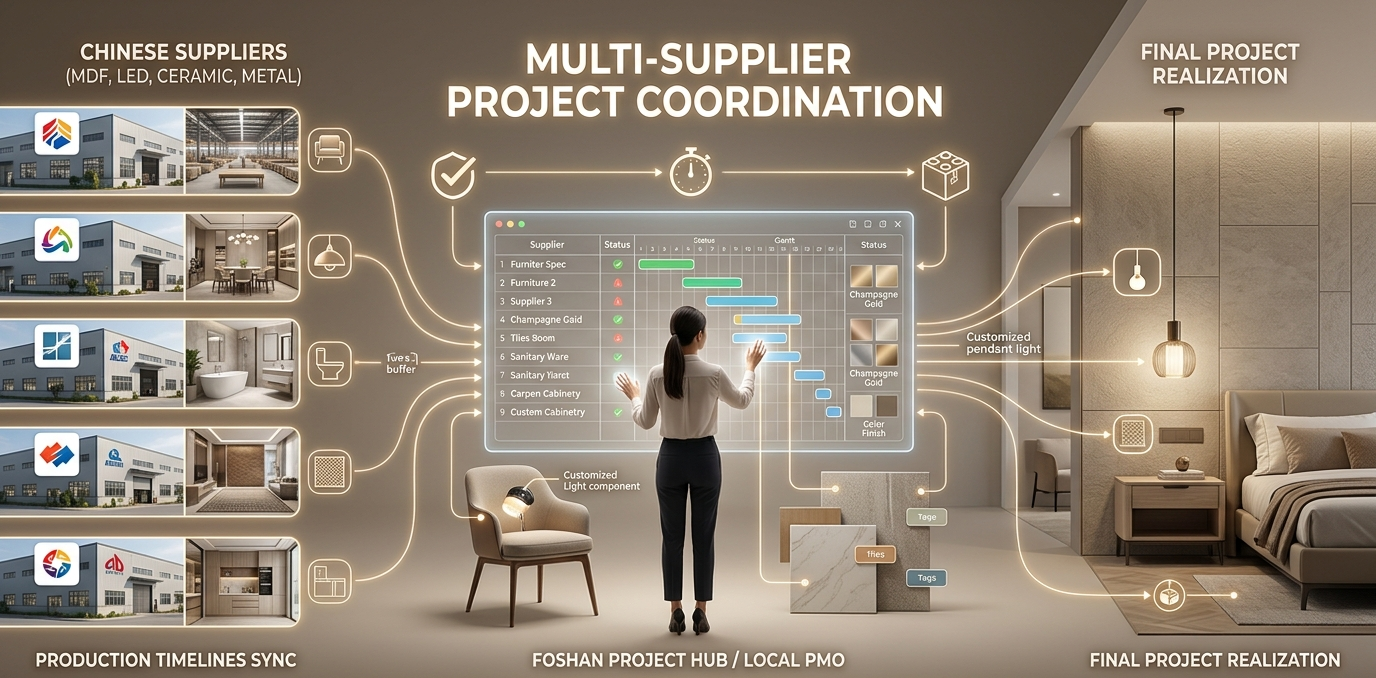
Managing a multi-supplier project in China is like conducting an orchestra. If one “instrument”—say, the lighting factory—is out of tune or late, the entire “performance” (your project timeline) suffers.
For property developers and hotel investors, a typical project might involve 15 to 30 different vendors across furniture, lighting, sanitary ware, and flooring. Managing these independently from 5,000 miles away is a high-risk strategy that often leads to mismatched finishes, shipping delays, and massive logistical costs.
Here is the professional’s guide to managing multi-supplier projects in China without losing control.
1. Create a “Single Source of Truth” (The Master Spec)
The biggest risk in multi-supplier projects is fragmentation. If your interior designer specifies “Champagne Gold” accents, Supplier A (faucets) might interpret that differently than Supplier B (door handles).
- Standardize the Finish: Do not rely on digital photos. Provide physical “control samples” to every vendor.
- Centralize the BOQ: Keep a master Bill of Quantities that includes every supplier’s contact, their specific items, and the latest version of the signed shop drawings.
- The “Golden Sample” Rule: For custom items, have the factory produce a master sample. Once approved, it is signed and kept as the legal benchmark for mass production.
2. Sync the Production Timelines
In a construction project, sequence is everything. You don’t want 500 sofas arriving at the port while the flooring factory is still three weeks behind schedule.
- Identify Lead Time Discrepancies: Lighting often has longer lead times due to component sourcing (drivers/chips), while tiles are usually faster.
- Buffer for “China Holidays”: Always account for the Lunar New Year or Golden Week. A one-week holiday in China can cause a three-week backlog in production.
- Weekly Progress Video Calls: Do not settle for “Everything is on schedule” emails. Request 2-minute video walk-throughs of the production floor every Friday.
3. Centralized Quality Control (QC)
You cannot visit 20 factories in five different cities. However, sending a QC inspector to each one individually is expensive and lacks a unified standard.
- Cross-Category Inspection: You need an inspector who understands how the furniture from Factory A interacts with the lighting from Factory B.
- The “Final Fit” Test: For hotel projects, it is common to pull one item from each supplier and assemble a “Mock-up Room” at a central warehouse in Foshan. This is the only way to ensure the vanity unit actually fits the plumbing fixtures before they are loaded into a container.
4. The Consolidation Strategy: The “Lego” of Shipping
- The Central Warehouse: Use a local project management office (PMO) with a warehouse in a hub like Foshan.
- Strategic Loading: Heavy items (tiles, stone) go on the bottom. Fragile items (glass, lighting) go on top. If you leave this to 20 different factories, they will each ship their own way, leading to breakage and higher freight costs.
- Sequence Loading: Load containers based on the installation sequence at the job site. The items needed for the first floor should be the last ones loaded, so they are the first ones out.
5. Why a Local Project Management Office (PMO) is Mandatory
At this scale, a “sourcing agent” isn’t enough; you need a Project Manager.
A local PMO acts as your eyes and ears:
- Pressure: They physically visit factories to push production when a vendor goes quiet.
- Verification: they verify that the “UL Listed” driver in your light is actually the brand you paid for.
- Problem Solving: If a factory makes a mistake, the PMO handles the replacement before the goods leave China, saving you from a logistical disaster at the destination.
Key Takeaways
- Control the Finishes: Physical swatches are the only way to ensure color matching across multiple vendors.
- Consolidate in Foshan: Use a central warehouse to check compatibility and save on shipping.
- Mock-up First: Build one complete room in China before shipping 200 rooms of inventory.
- Sequence Your Shipping: Load containers according to the construction site’s installation schedule.
FAQ: Managing Multiple Suppliers
How do I handle payments to 20 different factories?
Most project buyers use a local partner or an escrow-style payment structure. Do not pay 100% upfront. The standard is 30% deposit and 70% after a successful QC inspection and before loading.
What if one supplier is late and holds up the whole container?
This is why you need a central warehouse. You can hold the late supplier’s goods for the next shipment, or in some cases, the PMO can apply financial penalties (built into your contract) to cover the extra storage costs.
Is it better to source everything from one “General Trading Company”?
It’s tempting, but dangerous for projects. Specialized factories provide better quality. A “one-stop shop” usually marks up every item and has zero technical control over the production. It is better to use specialized factories coordinated by a professional project manager.