

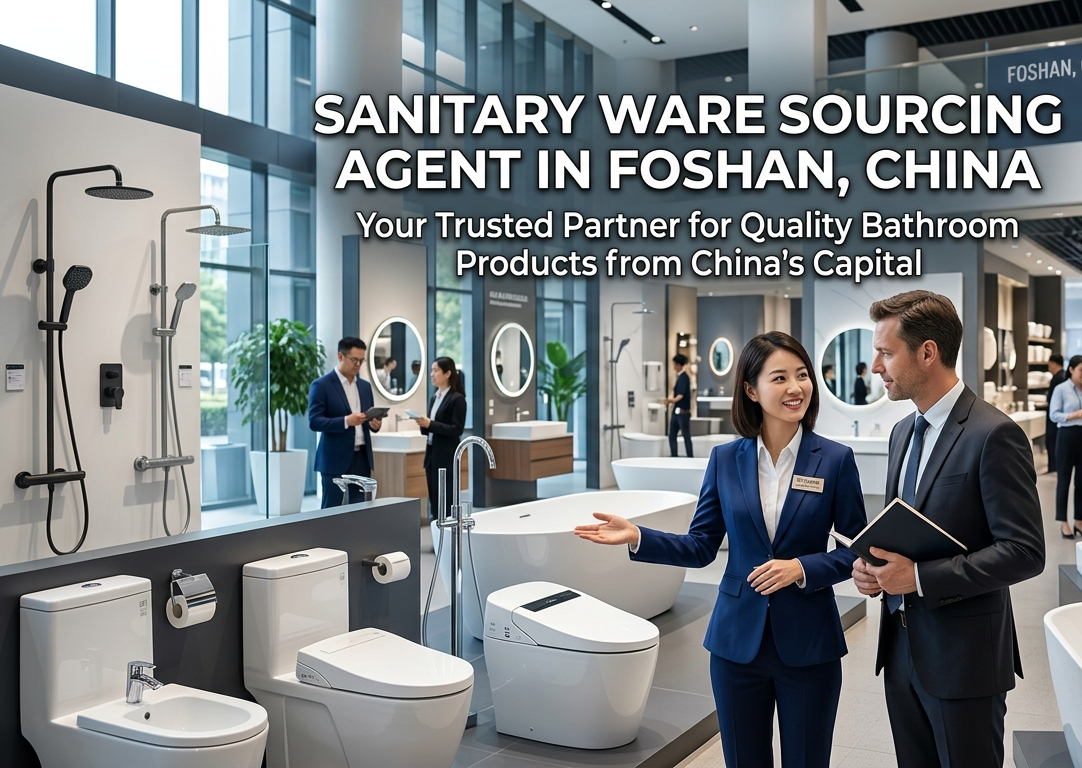
Sanitary Ware Sourcing Agent in Foshan, China
Foshan is where a significant share of China’s ceramic sanitary ware is produced. The Chancheng and Nanzhuang districts of Foshan, along with the surrounding areas of Guangdong Province, house hundreds of factories making toilets, washbasins, bathtubs, and shower enclosures — from budget residential grade through to products sold under international brand labels in Western markets.
HSY Sourcing is based in Foshan and sources sanitary ware for property developers, hotel operators, importers, and fit-out contractors who need local supplier management, quality inspection, and coordinated shipping as part of a broader interior procurement programme. For most of our clients, sanitary ware is one category within a multi-category bathroom order that also includes tiles, faucets, shower systems, bathroom accessories, and sometimes vanity cabinetry.
This page covers what sanitary ware categories we source, where they are manufactured, what quality variables matter, and what realistic lead times and compliance requirements look like.
👉 Send us your bathroom schedule or product list — we will respond within 48 hours.
Where Sanitary Ware Is Manufactured in China — and Why It Matters
Sanitary ware is not a single supply chain. The main categories — ceramic ware, faucets and mixers, shower systems, and shower enclosures — come from different production clusters with different strengths.
Foshan (Chancheng and Nanzhuang) is the primary cluster for ceramic sanitary ware: toilets, washbasins, and bathtubs in vitreous china and ceramic. Many of the brands sold in European, Australian, and Southeast Asian markets under private-label arrangements are manufactured here. Factories range from mid-volume OEM producers serving export markets to smaller workshops producing for domestic distribution.
Kaiping, Guangdong — approximately two hours from our Foshan office — is the primary production cluster for bathroom faucets, mixers, showerheads, and thermostatic shower systems. Kaiping accounts for a large proportion of China’s faucet exports and houses both large established manufacturers and the majority of faucet OEM production for international brands. For a complete bathroom fitting-out order, sourcing faucets from Kaiping alongside ceramic ware from Foshan, consolidated into one shipment at our warehouse, is the standard arrangement.
Zhongshan and Foshan both produce shower enclosures, frameless glass shower screens, and shower trays. Tempered glass quality, frame profile material (stainless steel versus aluminium), and sealing system quality are the main variables that affect performance and longevity.
Pinghu and Yuyao, Zhejiang produce bathroom accessories — towel rails, robe hooks, toilet roll holders, soap dispensers — at various quality levels. For project orders requiring matching accessory sets across many bathrooms, these clusters offer good range and pricing.
Understanding these geographic distinctions matters because it affects how we plan logistics. A complete bathroom sanitary ware order from us is not sourced from a single factory — it typically involves ceramic ware from Foshan, faucets from Kaiping, and accessories from Guangdong or Zhejiang. We collect from each supplier and consolidate at our Foshan warehouse before shipping.
Sanitary Ware Categories We Source
Ceramic Sanitaryware
Toilets — close-coupled suites, back-to-wall suites, wall-hung pans with concealed cisterns (in-wall frames), floor-mounted suites, one-piece toilets. For hotel and commercial applications, flush volume rating (4.5/3L dual flush is standard in many markets; specific WELS or WATERSENSE ratings may be required), flush mechanism brand (Geberit, Grohe, OLI, or local equivalents), and cistern access for maintenance are the key specification points.
Washbasins — countertop (vessel) basins, undermount basins, semi-recessed basins, wall-hung basins, pedestal basins. Materials available: vitreous china (the standard), stone resin (heavier, matte finish, popular for designer bathrooms), solid surface. For project orders, dimensional consistency across a batch and glaze uniformity are the main quality checks.
Bathtubs — freestanding baths (acrylic, stone resin, cast iron), built-in alcove baths (acrylic), drop-in baths. Acrylic baths are the most common for volume residential and hotel procurement due to cost and weight. Stone resin baths are heavier and more expensive but more durable and visually distinctive. Cast iron baths are significantly heavier and more expensive again; logistics cost is a practical consideration for international shipping.
Urinals — wall-hung and floor-standing, for commercial and hospitality applications.
Faucets, Mixers, and Shower Systems
Basin mixers — single-hole and three-hole, deck-mounted and wall-mounted. Cartridge quality is the most important durability variable: ceramic disc cartridges from established brands (Kerox, Sedal, or the factory’s stated cartridge supplier) last significantly longer than low-grade cartridges. We specify cartridge brand in purchase contracts for project orders.
Bath/shower mixers and thermostatic systems — exposed thermostatic shower columns, concealed thermostatic valves with separate outlets. For hotel applications, thermostatic systems reduce water waste and guest complaints about temperature variation; the thermostatic cartridge specification needs to be confirmed before ordering.
Kitchen faucets — for kitchen procurement within a broader fit-out order.
Showerheads — hand showers, rain shower heads, multi-function shower systems. Water flow rates and any water efficiency rating requirements should be specified upfront for markets with mandatory water efficiency regulations.
Shower Enclosures and Wet Areas
Frameless shower screens and enclosures — tempered glass (minimum 8mm for frameless, 6mm for semi-frameless), various configurations: pivot door, sliding door, bi-fold, walk-in panel. Glass tempering certification (EN 12150 or AS/NZS 2208 for Australian market) should be verified for commercial applications.
Shower trays — acrylic, stone resin, and ceramic. Drain outlet position needs to match your plumbing rough-in; this should be confirmed against building drawings before ordering.
Wet room panels and waterproofing systems — for bathrooms designed as full wet rooms without a shower enclosure.
Bathroom Accessories
Towel rails and heated towel rails, robe hooks, toilet roll holders, soap dispensers, toothbrush holders, bathroom shelving. For hotel projects requiring matching accessory sets across many rooms, we source to a consistent finish specification (brushed nickel, matte black, polished chrome, brushed gold) and verify batch finish consistency before shipment.
Quality Issues Specific to Sanitary Ware
Sanitary ware has some failure modes that are not obvious from photographs and require physical inspection or specific testing.
Glaze Pinholing and Surface Defects in Ceramics
Vitreous china products can have pinhole defects — small pores in the glaze surface — that are not visible in showroom lighting but become apparent under raking light or after installation. For volume project orders, we inspect ceramic goods under appropriate lighting conditions and apply an AQL sampling standard (typically AQL 2.5 for major defects) rather than a cursory visual check.
Dimensional Consistency for Multi-Unit Projects
For a hotel or apartment project where the same basin or toilet is installed in hundreds of bathrooms, dimensional variation between production batches matters. If wall-hung basins vary by 5mm in depth between production runs, the same vanity unit template cannot be used for installation throughout. We specify dimensional tolerance requirements in purchase contracts and check a sample from each production batch against the confirmed dimension.
Faucet Cartridge and Body Quality
The body material of a faucet — brass versus zinc alloy — is not visible externally but affects corrosion resistance and longevity significantly. Brass bodies are the appropriate specification for most applications; zinc alloy bodies are a common cost-reduction used in lower-price faucets. We specify body material in purchase contracts and can arrange weight-based checks (brass is significantly heavier than zinc alloy for the same casting) as part of pre-shipment inspection.
For cartridge quality, we request the cartridge brand and model from factories and verify against the purchase contract. A named-brand ceramic disc cartridge is a specific, verifiable item; “ceramic cartridge” without a brand specification is not a meaningful quality commitment.
Water Pressure and Flow Testing for Faucets
For project-scale faucet orders, we can arrange flow rate testing on a sample from each production batch. This is relevant for markets with mandatory water efficiency ratings (WELS in Australia, WaterSense in the US) where specific maximum flow rates are required.
Shower Enclosure Glass Certification
Tempered glass for shower enclosures should carry certification to the relevant safety standard for your market. Factories in China can produce glass panels certified to EN 12150 (Europe), AS/NZS 2208 (Australia/New Zealand), or ANSI Z97.1 (US). Uncertified glass is not appropriate for commercial bathroom applications. We request certification documentation before confirming supplier selection for shower enclosure orders.
Compliance and Water Efficiency Requirements by Market
| Destination Market | Key Compliance Requirements |
|---|---|
| Australia and New Zealand | WELS (Water Efficiency Labelling and Standards) — toilets, faucets, showerheads; WaterMark for plumbing products installed in buildings |
| United States | WaterSense (EPA) for toilets and faucets; UPC/IPC plumbing code compliance |
| European Union | CE marking for pressure-bearing fittings; EN standards for ceramic sanitaryware (EN 997 for toilets, EN 14688 for washbasins) |
| United Kingdom | WRAS (Water Regulations Advisory Scheme) approval for products in contact with drinking water |
| Middle East (UAE, Saudi) | ESMA / SASO product registration for some sanitary ware categories |
| General / project export | Factory quality certificates, test reports to relevant EN or ISO standards |
Compliance requirements need to be specified at the beginning of procurement — not after orders are placed. Not all Foshan factories hold certifications for all markets. We confirm which factories in our network hold the certifications relevant to your destination before finalising supplier selection.
How We Manage Sanitary Ware Sourcing
Review your bathroom schedule
Most projects come to us with a room-by-room or unit-by-unit schedule specifying what products are needed in each bathroom type. We review the full schedule, identify any specification gaps (missing flush volume ratings, unspecified cartridge brands, missing dimensional requirements), and flag these before approaching suppliers.
Supplier selection across categories
For a complete bathroom order — ceramic ware, faucets, shower enclosures, accessories — we select suppliers from the appropriate clusters (Foshan for ceramics, Kaiping for faucets, Guangdong for accessories), visit factories where the project scale justifies it, and present a co-ordinated quote covering all categories.
Sample confirmation
Physical samples are arranged for all key items before bulk orders are placed. For ceramic products, we review glaze quality, dimensional accuracy, and finish under appropriate lighting. For faucets, we check body weight (as an indicator of material), cartridge brand, and finish quality. For shower enclosures, we verify glass thickness and review the sealing system.
Production monitoring and pre-shipment inspection
For ceramic ware in large quantities, we conduct pre-shipment inspection with AQL sampling, checking glaze quality, dimensions, packaging integrity, and unit counts. For faucets, we check cartridge brand on a sample and conduct a basic function test (smooth operation, no leaks under hand pressure). We provide written inspection reports with photographs for all categories.
Warehouse consolidation
All goods — ceramics from Foshan, faucets from Kaiping, accessories from Guangdong or Zhejiang — are collected at our Foshan warehouse and consolidated before container loading. Ceramic ware is fragile; we plan container loading to protect against movement damage, with ceramic items packed in foam-padded cartons with appropriate stacking limits respected.
Lead Times for Sanitary Ware from Foshan
| Category | Typical Production Lead Time |
|---|---|
| Standard ceramic toilets and basins (stocked designs) | 15 – 25 days |
| Custom-colour or special-finish ceramic ware | 30 – 45 days |
| Freestanding acrylic baths (standard range) | 20 – 30 days |
| Stone resin freestanding baths | 30 – 45 days |
| Faucets and mixers (standard range) | 15 – 25 days |
| Thermostatic shower systems | 20 – 35 days |
| Frameless shower enclosures (standard sizes) | 20 – 30 days |
| Custom-size shower enclosures | 30 – 45 days |
| Bathroom accessories (standard finish, stock range) | 15 – 25 days |
Lead times are from confirmed order to goods ready for collection at our warehouse. Actual lead time depends on factory order load at the time of booking. We provide factory-confirmed timelines at the quotation stage.
What Affects Sanitary Ware Pricing
Ceramic grade and firing quality for toilets and basins varies between factories. Higher-grade vitreous china with a denser ceramic body and more consistent glaze application costs more than standard-grade production. The difference is visible in surface smoothness, glaze depth, and resistance to staining over time. For hotel and commercial applications, specifying a minimum ceramic density or vitrosity grade is worth doing.
Flush mechanism brand for toilets is a significant cost variable. Geberit and Grohe in-wall frames and cisterns are meaningfully more expensive than Chinese-made equivalents, but have established global service networks. For projects in markets where maintenance access to Geberit parts is easy, the brand specification makes sense. For projects in markets where parts availability is limited, a well-made local equivalent may be more practical.
Faucet body material — brass versus zinc alloy — affects both price and longevity as described above. For project specifications, brass body should be the default unless budget constraints are significant.
Finish type and colour — polished chrome is the baseline; brushed nickel, matte black, brushed gold, and other PVD finishes cost more. Coloured finishes have more variation between factories and batches; for hotel projects requiring consistent finish across hundreds of rooms, finish consistency verification is important.
Shower glass specification — 8mm tempered versus 10mm tempered, certified versus uncertified — affects price. For commercial applications, certification is not optional regardless of cost.
Frequently Asked Questions
Can you source a complete bathroom package — ceramics, faucets, shower, and accessories — as a single order?
Yes, and this is the most common arrangement for project buyers. We manage all categories as a single procurement programme, with coordinated sampling, production monitoring, and consolidated shipping. You deal with us as a single point of contact for everything in the bathroom, not separate suppliers for each category.
Our project requires toilets with a specific flush volume rating for a WELS or WaterSense rating. Can Foshan factories produce to these specifications?
Yes. Dual-flush toilets with 4.5/3L or 6/3L flush volumes are standard production in Foshan. Factories that export to Australia hold WELS registration for their products; factories exporting to the US hold WaterSense certification. We confirm which factories have the relevant certification for your destination before placing orders.
How do you handle the risk of ceramic goods breaking in transit?
Ceramic sanitary ware is fragile and breakage in transit is a real risk if packaging is inadequate. We specify export-grade packaging — foam-padded inner cartons, reinforced outer cartons with appropriate stacking weight limits — in purchase contracts and verify packaging quality during pre-shipment inspection. We also recommend ordering a 3–5% breakage buffer, particularly for tiles and ceramic basins. Marine cargo insurance covers transit losses and is recommended for all sanitary ware shipments.
Our hotel project requires wall-hung toilets with in-wall cistern frames. Can you source the complete system — pan, frame, and flush plate?
Yes. We source complete wall-hung toilet systems including the in-wall cistern frame, toilet pan, and flush plate as a matched set. For hotel projects, we specify the frame brand (Geberit or equivalent) and confirm that the flush plate is compatible with the cistern before ordering. Matching finish between the flush plate and other bathroom fittings (faucets, accessories) is also something we coordinate during the sample review stage.
Can you source sanitary ware to match a specific design from an interior designer’s specification?
We work from specification sheets and mood boards. For standard products — toilets, basins, faucets — we identify the closest match from factory ranges and arrange samples for designer approval. For genuinely custom designs (unusual shapes, non-standard dimensions, custom colours), we confirm whether custom production is available and at what minimum order quantity before recommending this approach.
What is the minimum order quantity for sanitary ware procurement?
There is no fixed minimum. For standard products from factory stock ranges, quantities as small as one container load are practical. For custom colours or finishes, factories typically require higher minimums — usually 50 to 100 units of a specific item — to justify a special production run. Contact us with your specific product list and quantities and we will advise on what is practical.
HSY Sourcing — Sanitary Ware Sourcing Agent based in Foshan, China. Toilets, washbasins, bathtubs, faucets, shower systems, and bathroom accessories — sourced from Foshan’s ceramic cluster and Kaiping’s faucet cluster, consolidated and shipped as one.


