
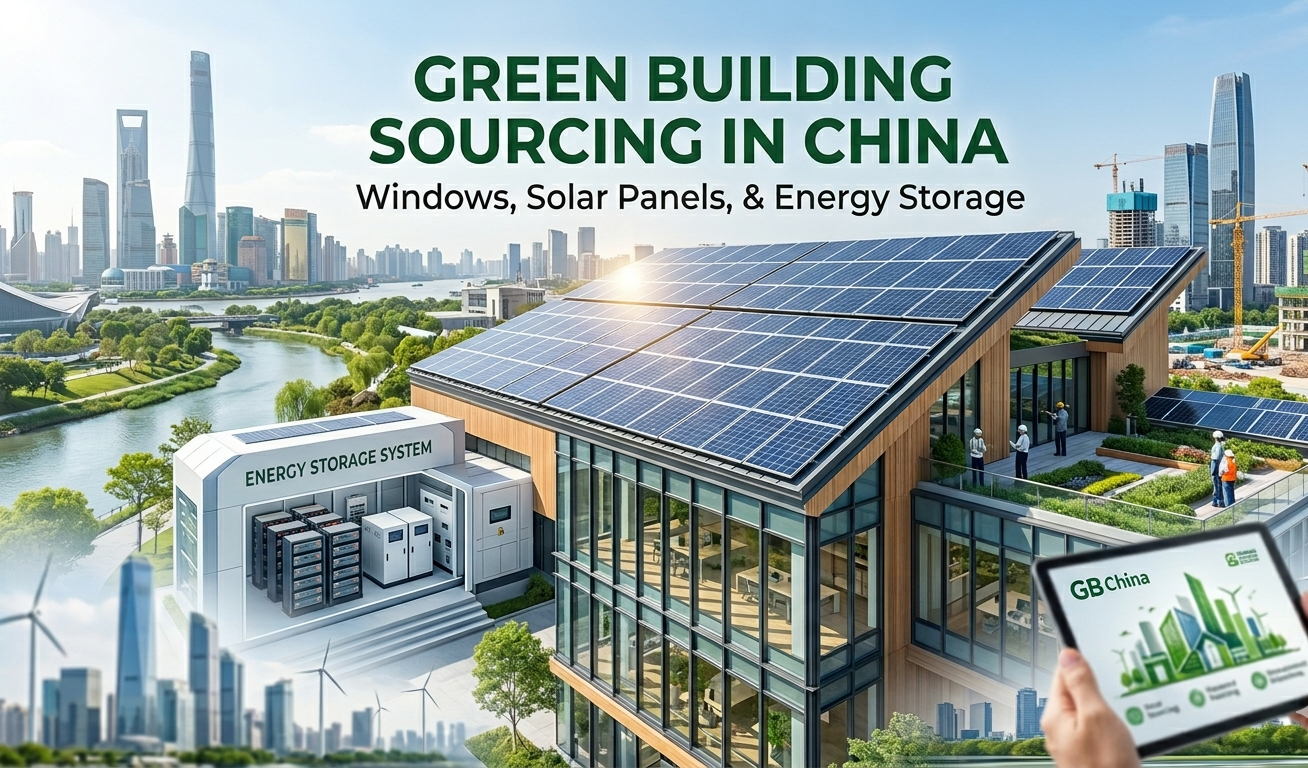
For hotel developers and commercial operators in 2026, “Green Building” is no longer a PR buzzword—it is a hedge against volatile energy prices. The goal is to reduce the building’s thermal load while simultaneously generating and storing electricity on-site.
China has become the global production hub for this “Green Trinity”: high-performance glazing, solar PV, and Lithium Iron Phosphate (LFP) storage. However, sourcing these components for a commercial project requires moving past marketing brochures and focusing on the interoperability of the systems.
Why start with the building’s “skin” before buying solar panels?
The most common mistake in green building is trying to “out-generate” a leaky building. If your windows have poor thermal resistance, your HVAC system will consume every watt your solar panels produce.
In China, the standard for green hotels has shifted toward high-performance thermally broken aluminum and UPVC systems.
- U-Value Matters: Don’t just ask for “double glazing.” Specify a target U-value (e.g., 1.4 W/m²K or lower).
- The “Warm Edge” Detail: Ensure the factory uses warm-edge spacers rather than standard aluminum spacers between the glass panes to prevent condensation and thermal bridging.
- Low-E Coating: Specify the “Solar Heat Gain Coefficient” (SHGC). In hot climates, you need a low SHGC to block radiant heat; in cold climates, you may want a higher SHGC to assist with passive heating.
Is Tier-1 Solar still the safest bet for commercial projects?
When sourcing solar panels (PV modules) from China, the market is divided into “Tier-1” manufacturers and “B-grade” assembly shops. For a 25-year hotel investment, Tier-1 is the only logical choice.
- N-Type TopCon vs. PERC: In 2026, N-Type TopCon technology has become the cost-effective standard, offering higher efficiency and lower degradation than older PERC panels.
- Bifacial Modules: If you have a flat, light-colored roof or ground-mount space, bifacial panels (which generate power from both sides) can increase yield by 5-15%.
- The Inverter Bridge: Your panels are only as good as the inverter. Ensure the factory provides string inverters (like Huawei or Sungrow) that offer high-level monitoring at the individual string level.
Why is LFP (Lithium Iron Phosphate) the preferred storage for hotels?
Energy storage (BESS) allows a hotel to “Peak Shave”—charging batteries when solar is abundant or grid prices are low, and discharging them during expensive peak evening hours.
In the Chinese market, LFP (LiFePO4) has completely overtaken NMC (Nickel Manganese Cobalt) for stationary storage because:
- Safety: LFP is much more thermally stable, which is critical for guest safety in a hotel environment.
- Cycle Life: LFP batteries typically handle 6,000+ cycles, whereas NMC might only handle 2,000-3,000.
- C-Rating: For hotels, you don’t need “fast discharge” (high C-rating); you need long-duration discharge to cover the evening HVAC load.
How do you coordinate the logistics of a “Green Package”?
Sourcing windows, solar, and batteries involves three different types of manufacturing expertise. Shipping them together requires careful coordination:
- Glass is Fragile: Windows must be crated in fumigated plywood and loaded vertically.
- Batteries are “Dangerous Goods”: Lithium batteries require specific UN38.3 certifications and specialized MSDS documentation for sea freight. They cannot simply be “stuffed” into a container with windows without proper hazardous materials declaration.
- System Integration: You need to ensure the solar inverters and the battery management system (BMS) are compatible. A sourcing agent should verify the communication protocols (usually RS485 or CAN) before the goods leave China.
Key Takeaways
- Reduce Before You Produce: Invest in high-spec thermally broken windows to lower the base energy load.
- Specify N-Type Technology: For 2026 projects, TopCon or HJT modules offer the best ROI.
- Prioritize LFP for Safety: Use Lithium Iron Phosphate for any battery storage located near guest areas.
- Verify Certifications: Ensure solar and storage systems have local grid-tie certifications (UL, CE, TUV) before importing.
FAQ: Green Building Procurement
Q: What is the typical payback period for a hotel solar system?
A: Depending on local electricity rates and solar irradiation, most commercial projects in 2026 see a “break-even” point in 5 to 8 years.
Q: Can I source windows that match my specific architectural style?
A: Yes. Chinese manufacturers can provide hidden-frame, slim-profile, or even wood-clad aluminum systems that meet high thermal standards while maintaining a luxury aesthetic.
Q: Do I need a full “Off-Grid” system for my hotel?
A: Usually, no. A “Hybrid” or “Grid-Tied” system is more practical. It allows you to use solar and batteries first but fall back on the grid if there is a week of cloudy weather.
Why Choose HSY Sourcing for Your Green Project?
Procuring green building technology is a technical challenge that requires more than just “finding a supplier.” You need an agent who understands the intersection of construction, electronics, and international logistics.
HSY Sourcing provides a specialized service for developers and brands looking to decarbonize their assets.
- Technical Vetting: We don’t just look at the price. We verify U-values for windows, efficiency ratings for PV, and the actual “Cycle Life” data for battery cells.
- Tier-1 Access: We have direct relationships with top-tier solar manufacturers and specialized custom window factories in the Guangdong cluster.
- Hazardous Goods Management: We are experienced in the specialized shipping requirements for large-scale battery storage, ensuring all UN38.3 and MSDS paperwork is perfect to avoid port delays.
- On-Site Representation: We perform factory audits to ensure the “thermal break” in your windows is made of high-quality Polyamide (PA66), not cheap PVC, and that your solar panels are free of micro-cracks before loading.