

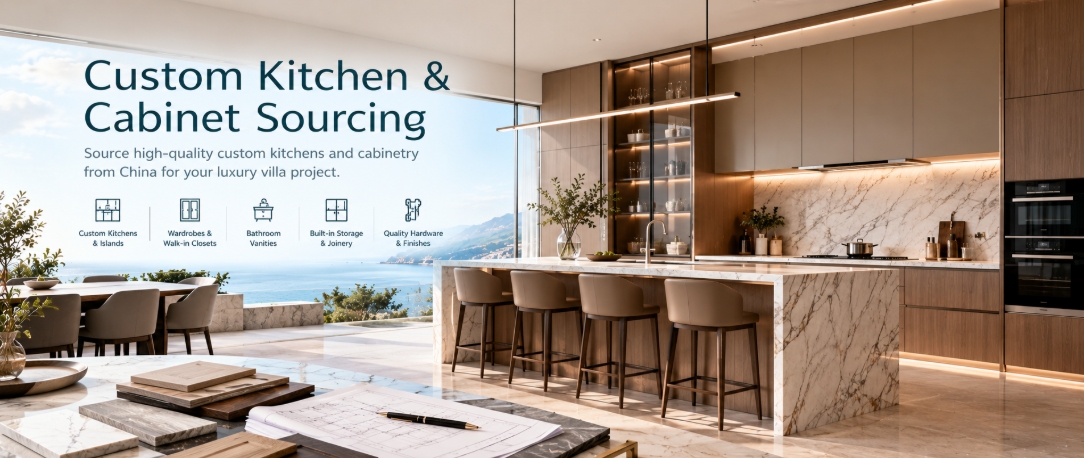
Custom kitchens and fitted cabinetry are among the most specification-sensitive parts of a villa project. The appearance may be defined by an architect or interior designer, but the final result also depends on cabinet construction, materials, hardware, detailed drawings, manufacturing tolerances, and coordination with other finishes.
HSY Sourcing helps overseas homeowners source custom kitchen cabinets and other fitted cabinetry from suppliers in Foshan and other relevant manufacturing areas in China. We coordinate supplier research, quotation comparisons, specification discussions, drawing and sample approvals, and order follow-up according to the agreed service scope.
Whether you are planning a statement kitchen for a new luxury villa or coordinating wardrobes and built-in storage for a major renovation, we help you work through the procurement details before they become production or installation problems.
Planning a custom kitchen or cabinetry package for your villa? Share the drawings and project information you have available to discuss the sourcing requirements and appropriate next steps.
Custom Kitchen and Cabinetry for Private Villa Projects
A villa cabinetry package may include more than kitchen cabinets. Depending on the design and procurement plan, it may cover several rooms and different types of fixed joinery.
Custom Kitchen Cabinets
Kitchen cabinetry often involves a combination of materials, finishes, internal fittings, and functional requirements. The scope may include:
- Base, wall, and tall cabinets.
- Kitchen islands and breakfast counters.
- Pantry cabinets and integrated appliance housings.
- Drawer systems, pull-outs, and internal organizers.
- Cabinet doors, end panels, fillers, and plinths.
- Coordination with countertops, splashbacks, sinks, and appliances where included in the project scope.
The important question is not simply which cabinet material to choose. It is whether the proposed construction, finish, hardware, and dimensions suit the design and intended use of each component.
Wardrobes and Whole-House Cabinetry
Homeowners may also need fitted wardrobes, walk-in closet systems, bathroom vanities, laundry cabinets, display units, and other built-in storage.
Sourcing these products together can help coordinate visible finishes and project schedules. However, it does not automatically mean that every item should be manufactured by the same supplier. The appropriate arrangement depends on the product requirements, supplier capabilities, and the level of coordination needed.
If your project includes cabinetry across several rooms, HSY can help clarify the scope and identify suitable suppliers for the agreed requirements.
What Should You Decide Before Requesting Kitchen Cabinet Quotes?
A quotation is only useful when you understand what it includes. Two suppliers may quote for a kitchen with a similar appearance but use different materials, hardware, internal fittings, or construction methods.
Before comparing prices, clarify the following areas where possible.
1. Cabinet Carcass and Door Materials
The carcass, doors, exposed panels, and internal components do not necessarily need to use the same material.
Common options include plywood, MDF, particleboard or MFC, and other specified board products. Door finishes may include melamine, laminate, lacquer, veneer, or solid timber, depending on the design and supplier’s capabilities.
No single board type is automatically the best choice for every application. Suitability depends on the component, moisture exposure, surface finish, construction details, emissions requirements, and manufacturing quality.
For a villa kitchen, the specification should identify the intended material and construction rather than relying on a general description such as “premium board.”
2. Door Finish and Visible Details
Cabinet doors and exposed panels contribute significantly to the overall appearance of a kitchen.
When reviewing samples, consider:
- Colour and surface texture under the intended lighting.
- Gloss level and reflectivity.
- Wood grain direction and veneer appearance.
- Edge treatment and visible joints.
- Consistency between doors, end panels, fillers, and other exposed surfaces.
A colour name or finish code alone may not ensure an identical appearance across different materials or suppliers. Physical samples should be reviewed and approved where appearance is important.
If the kitchen connects visually with wardrobes, internal doors, or wall panels, those finishes may also need to be coordinated.
3. Hinges, Drawer Systems, and Accessories
Hardware specifications affect cabinet function, usability, and cost.
The specification may identify hinge and drawer-runner brands, model numbers, opening mechanisms, load requirements, internal organizers, and handle details.
If you require a particular brand, confirm the exact product and model in the quotation and approved documentation. If alternative hardware is acceptable, define the required performance and obtain approval before substitution.
A brand name alone is not enough to establish that every component in the quotation matches your intended specification.
4. Kitchen Island, Countertop, and Appliance Coordination
A kitchen island can involve more than cabinetry. It may need to accommodate seating, drawers, electrical provisions, a sink, cooking equipment, or other features defined by the design.
Countertops and splashbacks may be sourced from the cabinet supplier or arranged separately. In either case, dimensions, edge details, cut-outs, support requirements, and installation sequence need to be coordinated.
Appliance models are also important. Refrigerators, ovens, dishwashers, range hoods, and other integrated appliances may have specific dimensions, ventilation clearances, and access requirements.
If the appliance schedule or countertop specification is incomplete, the cabinetry quotation may be provisional and the drawings may need revision.
What Drawings Does a Cabinet Supplier Need?
The information required depends on how far your villa design has progressed.
For an initial sourcing review, useful documents may include:
- Architectural floor plans and available kitchen dimensions.
- Kitchen elevations or sections.
- Interior design drawings or 3D renders.
- Appliance schedule and product models, if selected.
- Cabinet schedule or bill of quantities, if available.
- Preferred materials, finishes, hardware, and reference images.
- Project location and anticipated procurement timeline.
A floor plan or render can help communicate the design direction, but it may not contain enough technical information for manufacturing.
Before production, the supplier may need detailed shop drawings showing cabinet dimensions, elevations, sections, construction details, fillers, appliance openings, and other relevant information.
The exact drawing requirements depend on the project and the agreed supplier scope.
What if You Only Have a Floor Plan?
You do not necessarily need a complete set of production drawings to begin discussing sourcing options. However, the next step should reflect the information available.
If you only have an architectural floor plan, the project may first need design development, more detailed dimensions, or additional kitchen drawings. If you already have a developed kitchen design, the process may move more directly into supplier evaluation and specification review.
Detailed design or drawing services should be discussed separately and confirmed before work begins. HSY’s sourcing coordination should not be confused with a promise of free kitchen design.
For a more detailed explanation, see our related guide: What Drawings Does a Chinese Factory Need to Manufacture Custom Villa Cabinets?
How HSY Coordinates Custom Kitchen and Cabinet Sourcing
The sourcing process depends on the project scope and the completeness of the specifications. The following outlines the main stages.
Step 1: Review the Project Requirements
We review the available drawings, cabinetry scope, finish preferences, project location, and approximate timeline.
This initial review helps identify missing information and establish whether you need kitchen cabinets only or a broader package covering wardrobes and other fitted cabinetry.
The aim is to clarify the requirements before comparing suppliers on price alone.
Step 2: Identify and Evaluate Suitable Suppliers
Supplier selection should reflect the type of cabinetry required, construction details, finishes, hardware, order scope, and relevant production capabilities.
A supplier suitable for a straightforward cabinet package may not necessarily be the right choice for a kitchen with complex veneer matching, detailed finishes, or demanding coordination requirements.
HSY helps identify and communicate with potential suppliers based on the agreed requirements. Supplier suitability should be assessed against the specific project rather than assumed from a catalogue or showroom appearance.
Step 3: Compare Quotations Against the Specification
We help organize quotations so that the included scope and important differences are easier to review.
Depending on the project, comparison points may include:
- Cabinet dimensions and quantities.
- Carcass and door materials.
- Surface finishes and exposed panels.
- Hardware brands and models.
- Drawer systems and internal accessories.
- Countertop or splashback inclusions.
- Packaging, delivery, and other exclusions.
If a supplier proposes an alternative material or hardware option, that difference should be made clear rather than treated as equivalent without review.
A lower quotation is not necessarily better value if it excludes important components or uses a different specification.
Step 4: Coordinate Drawings, Samples, and Approvals
Before production, relevant specifications and drawings need to be reviewed and approved by the responsible parties.
This stage may involve clarifying dimensions, appliance openings, filler panels, finish selections, hardware, and other details that affect manufacturing or installation.
Samples are particularly useful when colour, texture, veneer appearance, or surface quality is important.
The homeowner, architect, or appointed designer should review design-critical information. HSY can help coordinate communication, but final technical and design approvals must be assigned clearly among the parties involved.
Step 5: Follow Up on the Order
Once the order and approved specifications are established, supplier follow-up can help track production progress and outstanding decisions.
The timing of production depends on the supplier, order complexity, materials, approvals, and current workload. Changes to drawings or finishes after confirmation may affect the schedule.
For this reason, decisions that influence manufacturing should be resolved as early as reasonably possible.
Step 6: Coordinate Agreed Quality Checks and Shipment Preparation
Quality checks should be based on the agreed inspection scope and timing. Depending on the arrangement, checks may cover visible workmanship, dimensions against approved drawings, specified materials and finishes, hardware function, completeness, and packaging.
The inspection method and sample size should be agreed in advance. A visual inspection does not guarantee that every hidden or future performance issue will be identified.
If the cabinetry is part of a larger villa shipment, receiving, storage, cargo consolidation, and shipping coordination may be arranged separately according to the agreed service scope.
For multi-category projects, see Whole-Villa Building Materials Sourcing & Consolidation.
Quality Checks for Custom Kitchen Cabinets
A finished cabinet can look attractive in a showroom yet still have issues if the delivered product differs from the approved specification.
The most useful quality checks are those tied to documented requirements.
| Checkpoint | What to review |
|---|---|
| Dimensions | Key measurements against approved drawings and agreed tolerances |
| Materials | Board types, door construction, and specified components |
| Finishes | Colour, texture, visible defects, edge treatment, and consistency |
| Hardware | Specified brands and models, installation, and basic operation |
| Workmanship | Panel alignment, visible joints, exposed edges, and surface condition |
| Completeness | Cabinet parts, accessories, fittings, and labeling |
| Packaging | Protection for panels, doors, glass, and other vulnerable components |
Not every project requires the same inspection scope. The appropriate approach depends on the order value, product complexity, risks, and service agreement.
It is also important to distinguish product inspection from warehouse receiving. Receiving confirms that goods have arrived and can be identified against the relevant records; it does not automatically constitute a full technical inspection.
Can You Source Kitchen Cabinets and Other Villa Materials Together?
Yes, a project may combine custom cabinetry with other building materials and interior products sourced from different suppliers.
For example, a villa procurement plan may include kitchen cabinets, wardrobes, windows and doors, stone, flooring, bathroom products, furniture, and lighting.
Coordinating these categories requires attention to more than purchasing dates. Product dimensions, finish approvals, packing information, delivery readiness, and the sequence of orders may all affect how the project is organized.
However, sourcing several categories together does not mean that every supplier should be treated as interchangeable or that every item should be consolidated automatically. Product requirements, packaging, shipment volume, and timing need to be assessed.
HSY can help coordinate the cabinetry scope with other villa procurement requirements when this is included in the agreed engagement.
Learn more about our Villa Building Materials Procurement service.
Custom Cabinet Sourcing Costs: What Affects the Quotation?
There is no meaningful standard price for a custom villa kitchen without understanding the dimensions, specification, and scope.
The main factors affecting a quotation may include:
- Overall cabinet dimensions and configuration.
- Carcass material and construction.
- Door material, finish, and detailing.
- Hardware brand, model, and quantity.
- Internal accessories and drawer systems.
- Veneer matching or other finish requirements.
- Countertops, splashbacks, and related components.
- Packaging and delivery requirements.
- Drawing development or other separately agreed services.
When comparing quotations, ask suppliers to identify what is included, what is excluded, and which specifications remain provisional.
For example, two quotations may appear similar while differing in drawer systems, door finishes, end panels, or countertop scope. Clarifying these differences before placing an order is more useful than comparing headline prices alone.
HSY’s service fees are separate from supplier prices. The applicable scope and fees should be clarified before the work begins.
Who Is Responsible for Measurement and Installation?
Measurement and installation arrangements should be agreed before production.
The factory may work from approved dimensions and shop drawings, but this does not automatically make the factory responsible for measuring the completed overseas site or installing the cabinetry.
Depending on the project, measurements and technical information may come from the homeowner’s appointed contractor, architect, kitchen designer, site team, or another agreed party.
The parties should clarify:
- Who provides and verifies final site dimensions.
- Whether dimensions are preliminary or confirmed.
- Who reviews and approves shop drawings.
- Who checks appliance and countertop interfaces.
- Who handles installation and site adjustments.
- How design or site changes are communicated after approval.
These responsibilities matter because cabinetry is manufactured to specific dimensions. If site conditions change after the drawings are approved, modifications may be required.
HSY can help coordinate communication with suppliers within the agreed service scope, but overseas site measurement and installation should not be assumed to be included.
Why Work with HSY Sourcing?
Custom cabinetry sourcing involves decisions that connect design intent, technical specifications, supplier quotations, manufacturing, and shipment preparation.
HSY Sourcing provides procurement coordination from Foshan, helping overseas homeowners communicate with Chinese suppliers and organize the information needed to make informed purchasing decisions.
Our approach emphasizes:
- Specification-based comparisons: Review quotations against defined materials, finishes, hardware, and scope rather than price alone.
- Clear communication: Help coordinate questions and information between homeowners, designers, and suppliers.
- Drawing and sample coordination: Help organize relevant approvals before production.
- Order follow-up: Coordinate supplier communication during the agreed procurement process.
- Transparent commercial arrangements: Keep supplier prices separate from HSY’s service fees, without relying on factory commissions or rebates.
- Broader project coordination: Where required, discuss how cabinetry procurement fits into the wider villa building-materials plan.
HSY is a sourcing and procurement coordinator, not a cabinet manufacturer. The value of the service depends on the project’s requirements and the coordination support agreed with the client.
Frequently Asked Questions
Can I source custom kitchen cabinets from China using my architect’s drawings?
Yes, drawings can provide a useful starting point. The supplier will need to assess whether the available information is sufficient for quotation and manufacturing. Detailed shop drawings, appliance information, final dimensions, and finish approvals may still be required.
What if I only have a floor plan or 3D render?
You can begin discussing the project with the information available. However, a floor plan or render may not contain all the dimensions and technical details required for an accurate quotation or production. Further design development or drawing work may be necessary.
Can I source wardrobes and bathroom vanities together with kitchen cabinets?
Potentially, yes. The appropriate arrangement depends on the product specifications, supplier capabilities, finish requirements, and procurement schedule. One supplier may be suitable for several categories, while other projects may benefit from using different specialists.
Can I specify particular hardware brands and door finishes?
You can include preferred brands, models, and finishes in the specification. Confirm availability, exact product identity, and any proposed substitutions before approving the quotation and production documents.
How should I compare quotations from different cabinet suppliers?
Compare the same scope wherever possible, including dimensions, carcass and door materials, finishes, hardware, internal accessories, countertops, packaging, and exclusions. If the specifications differ, ask for clarification before treating the prices as directly comparable.
Who should confirm the final kitchen measurements?
This responsibility must be agreed for each project. The appointed site team, contractor, architect, designer, or another designated party may be responsible for verifying dimensions. Do not assume that an overseas factory will automatically measure the completed site.
Can HSY help coordinate cabinetry with other villa building materials?
Yes, broader procurement coordination may be discussed if the project also includes categories such as windows and doors, stone, flooring, bathroom products, or furniture. The scope of coordination, receiving, consolidation, and shipping should be confirmed separately.
Discuss Your Custom Kitchen or Cabinetry Project
If you are planning a custom kitchen, fitted wardrobes, or a broader cabinetry package for a private villa, HSY Sourcing can help you assess the procurement requirements and discuss suitable next steps.
To begin, share the information you already have:
- Your project country and location.
- Whether the property is a new build or renovation.
- Whether you need kitchen cabinetry only or several cabinetry categories.
- Available floor plans, kitchen drawings, 3D renders, or a preliminary BOQ.
- Your preferred materials, finishes, or hardware, if decided.
- Your approximate project and procurement timeline.
You do not need to have every document ready for an initial discussion. The available information will help determine what needs to be clarified before supplier quotations can be meaningfully compared.
Contact HSY Sourcing to discuss your custom kitchen and cabinet sourcing requirements in China.


