
Key Takeaways:
- Match Core Material to Tenant Traffic: Solid SPC or co-extrusion composites belong in high-friction apartment entryways and corridors. Standard hollow-core WPC or lightweight bamboo charcoal panels are optimal for bedroom accent walls.
- Incorporate Modular Furniture Alignment: Sourcing panels alongside modular apartment furniture within the same regional cluster prevents dimensional mismatches where built-in wardrobes meet the wall cladding.
- Mandate Third-Party Fire Certifications: Multi-family housing requires certified compliance, typically Class B1 (Europe/Asia) or ASTM E84 Class A (North America). Do not rely on unverified factory datasheets.
- Verify the Edge Profile Milling: For seamless apartment handovers, lock-joint profiles must maintain a tolerance variance under 0.2mm to eliminate manual on-site trimming and visible gaps.
For multi-family residential developments, build-to-rent complexes, and serviced apartment projects, the finishing phase represents a major logistical bottleneck. Traditional multi-coat drywall finishing—requiring plastering, sanding, curing, and painting—is slow and labor-intensive.
Engineered interior wall panels offer a practical alternative, allowing installation crews to cover bare masonry rapidly using hidden mechanical clips.
Foshan’s industrial ecosystem provides an integrated manufacturing footprint for these components. Because the decorative panel sector sits directly adjacent to the city’s massive contract furniture and cabinetry clusters, procurement managers can source fully coordinated interior packages efficiently.
This guide outlines the core technical metrics required to evaluate and bulk-buy interior wall panels for commercial apartment projects.
Which Wall Panel Core Material Balances Budget and Durability for Multi-Family Apartments?
Selecting the correct underlying composite formulation prevents early material degradation under continuous tenant occupancy. Commercial apartment projects utilize three primary engineered cores, each with specific performance characteristics:
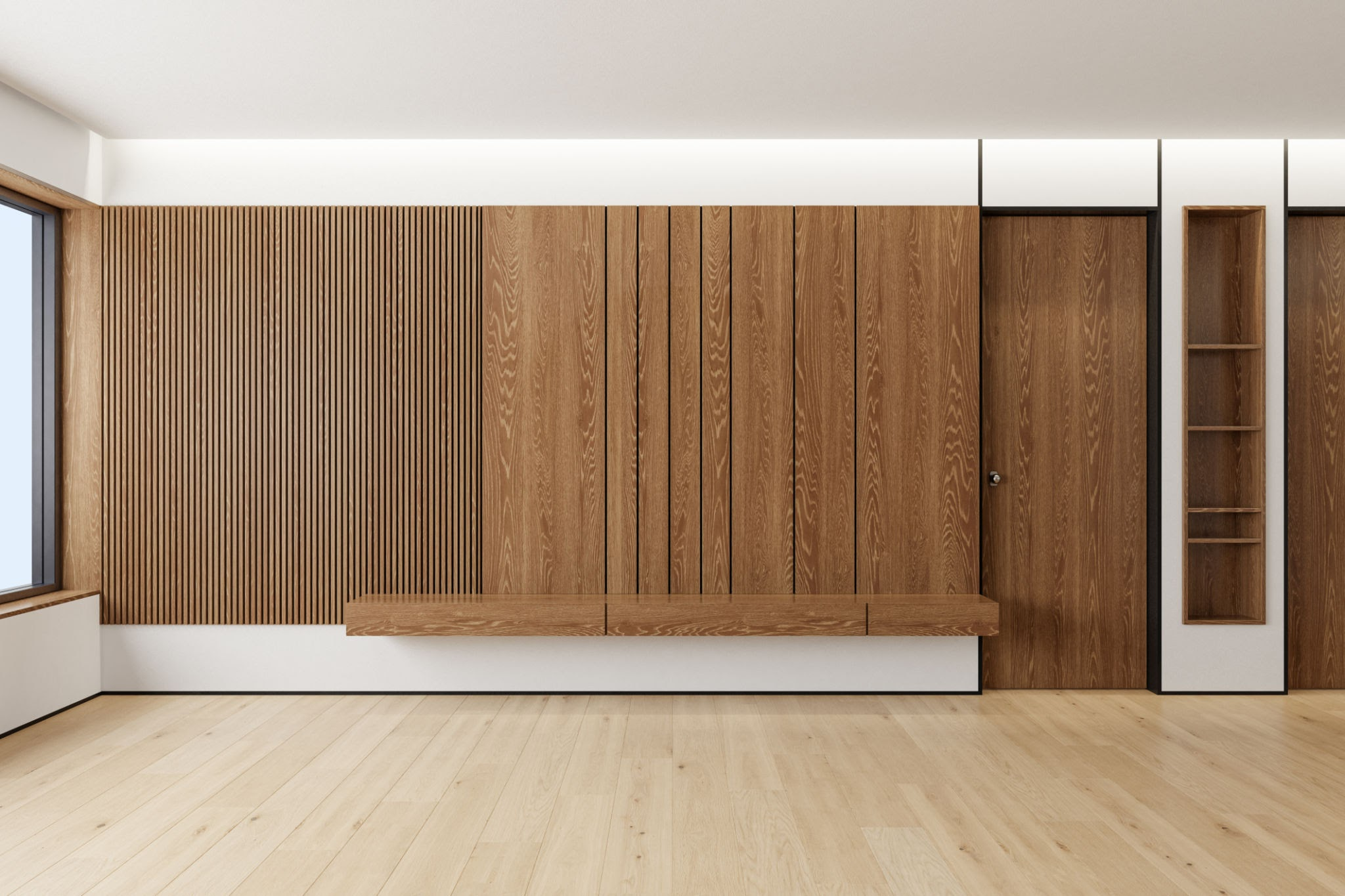
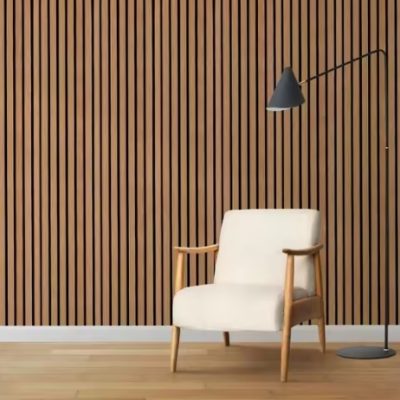
Seamless Architectural Wall Panel Integration in a Modern Residential Unit. Source: tulcarion / Getty Images
- Bamboo Charcoal Fiber Panels: An increasingly standard choice for apartment living rooms and bedrooms. This formulation blends processed bamboo carbon powders with polymer binders, yielding a stable sheet with low thermal expansion and high moisture resistance. They provide an excellent flat substrate for high-definition surface films.
- Stone Plastic Composite (SPC) Solid Boards: Highly recommended for high-impact zones like apartment entryways, corridors, and communal laundry spaces. SPC features a high stone-powder core concentration, making it extremely rigid and highly puncture-resistant, though its weight increases shipping and handling overhead.
- Standard Wood-Plastic Composite (WPC) Profiles: Best suited for decorative fluted linear designs, feature backdrops, and drop-ceiling trim. WPC profiles are typically extruded as hollow-core structures to minimize material weight. For commercial developments, ensure the internal structural ribs maintain a thickness of at least 1.6mm to prevent crushing.
How Do Installation Systems Affect the Total Cost of an Apartment Fit-Out?
The method used to secure panels to the sub-wall directly dictates your on-site contractor labor hours and the long-term stability of the finish.
| Installation Method | Wall Preparation Required | On-Site Labor Speed | Long-Term Maintenance Risk |
| Direct Structural Adhesive | High (Wall must be perfectly flat, dry, and dust-free) | Fast initial placement | High risk of telegraphing wall warps; difficult to replace single damaged panels |
| Aluminum Batten + Hidden Clip | Low (Batten track absorbs raw concrete irregularities) | Extremely rapid mechanical interlocking | Low; provides a clean ventilation cavity that blocks structural dampness |
For large-scale apartment rollouts, relying on direct adhesive over raw masonry introduces high risks. Real-world concrete walls regularly exhibit variances of 10mm or more over a 3-meter vertical run. Gluing panels directly to an uneven surface causes the finished face to mimic those imperfections, resulting in misaligned joints.
Specifying a coordinated interlocking clip-rail or batten system within your Bill of Quantities (BOQ) allows installers to build a perfectly level frame grid first, ensuring a flat finish across the entire apartment run.
What Environmental and Fire Standards Are Mandatory for Multi-Family Housing?
International building codes impose strict legal requirements on interior wall linings inside high-density residential properties. Failure to verify these metrics prior to container loading can halt project handovers during local fire marshall inspections.
First, check the formaldehyde emission classification. For indoor residential spaces, panels must satisfy the E0 or European E1 (EN 717-1) standard. Low-tier workshops often utilize cheap solvent-based glues during the decorative film lamination process, causing toxic volatile organic compounds (VOCs) to outgas inside the sealed apartment rooms. Ensure your supplier utilizes certified PUR (Polyurethane Reactive) hot-melt adhesive, which forms an irreversible, eco-friendly structural bond.
Second, enforce fire retardancy standards. Most international jurisdictions mandate a minimum of Class B1 (Flame Retardant) performance, meaning the material will self-extinguish when the direct flame source is removed and generate minimal smoke. For the North American market, verify that the formulation passes the ASTM E84 Class A tunnel test. Always request recent, batch-specific test reports from international testing agencies like SGS or Intertek.
Why Does Sourcing Wall Panels and Furniture from the Same Ecosystem Minimize Project Risk?
One of the largest hidden expenses in multi-family fit-outs stems from spatial coordination errors—specifically where custom built-in wardrobes, kitchen cabinetry, and loose sofas interface with the finished wall panel sheets.
Isolated Regional Sourcing:
[Province A: Wall Panel Plant] ──> (No Data Sharing) <── [Province B: Cabinet Factory]
                                            │
                                            ▼
                        [Site Arrival: 15mm Trim Gap Conflict]
                        (Requires Costly Manual Field Repairs)

Integrated Foshan Ecosystem:
[Local Panel Extrusion] <───> [HSY Ground Coordination] <───> [Lecong Custom Cabinetry]
                                            │
                                            ▼
                        [Site Arrival: Perfect Flush Fitment]
When wall panels are sourced from an isolated mill in one province and the apartment furniture is built elsewhere, color tone and dimensional adjustments are rarely coordinated. A “Walnut” film from a panel factory will rarely match the “Walnut” lacquer used by a furniture factory.
By leveraging Foshan’s geographic clustering—where leading panel extruders operate right alongside Shunde’s custom cabinetry and furniture manufacturers—these technical variables can be managed locally. Material swatches can be physically routed between the adjacent manufacturing facilities within a single morning, ensuring that matching veneers, grain textures, and joinery clearances align perfectly before volume manufacturing begins.
Why Choose HSY Sourcing for Your Apartment Project?
Based directly in the center of Foshan’s major building material and architectural manufacturing clusters, HSY Sourcing operates as your independent engineering, quality management, and logistics consolidation partner on the ground in China.
- Integrated Project BOQ Auditing: We review your interior design drawings and material schedules as a cohesive system, checking that panel thicknesses, transitional corner profiles, and structural furniture boundaries match up accurately.
- Direct Production Floor Verification: Our quality control engineers conduct unannounced visits to the production lines. We measure panel core density, check film adhesion via cross-hatch peel tests, and verify tongue-and-groove milling tolerances using digital calipers before any cargo is packed.
- Regulatory Compliance Tracking: We manage the collection and third-party verification of required environmental and fire documentation, ensuring the chemical formulations used for your production batch match the required international standard certificates.
- Horizontal Logistics Management: Wall panels are highly susceptible to bending or edge-crushing during long ocean shipments. We manage the consolidation of your panel assets at our local warehouse, mandating and inspecting the construction of reinforced, full-length horizontal wooden crates to ensure your materials arrive straight and undamaged.
Visit www.hsysourcing.com to submit your apartment floor plans and material specification sheets. Let our local engineers build a compliant, highly efficient interior supply chain for your next real estate development.
Frequently Asked Questions (FAQ)
Q: Can these interior wall panels be safely installed in apartment bathrooms and kitchens?
A: Yes, provided you select water-resistant cores like bamboo charcoal fiber or solid SPC sheets combined with PUR hot-melt lamination. These materials do not absorb moisture or support mold growth. However, for direct wet areas like shower enclosures, you must specify matching watertight interlocking joints and use structural silicone sealant during assembly to prevent water from migrating behind the panel system.
Q: How do we handle electrical outlets and light switches when using wall panels over a batten sub-frame?
A: The batten sub-frame creates a highly useful structural cavity (typically 15mm to 30mm deep) that simplifies the routing of electrical conduits and low-voltage LED drivers. Hole cuts for standard junction boxes are easily executed on-site using standard hole-saws mounted on electric drills. The panel material is rigid enough to support standard electrical trim plates securely.
Q: What is the typical minimum order quantity (MOQ) for custom color films or custom panel profiles in Foshan?
A: For standard factory-stocked color films and existing extrusion profiles, the MOQ is generally low, often starting around 100 to 200 square meters per color. If your apartment project requires a completely custom film print or a proprietary extruded profile shape, factories typically require a minimum run of 1,000 to 3,000 meters to offset the setup costs of new steel calibration dies and print rollers.