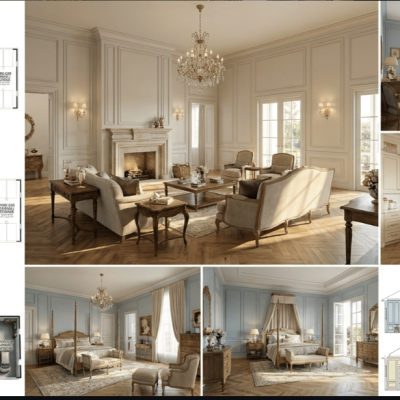

When you build or renovate a private villa, buying custom materials directly from Chinese manufacturers often comes up. The appeal is clear: direct access to factories that make custom aluminum doors, stone cladding, hardwood joinery, and tailored kitchen joinery at scale.
However, once you start contacting suppliers directly, the administrative complexity mounts quickly. A single villa project can require coordinating eight to twelve separate factories across different industrial zones.
This is where the idea of hiring a China sourcing agent comes in. Yet many homeowners remain unclear on what a sourcing agent actually does day-to-day. Is an agent just a middleman who marks up factory prices? Or do they act as your on-the-ground procurement team?
Understanding the practical role of a sourcing agent, what they do not do, and where their true value lies can help you determine whether hiring one makes sense for your project.
What Does a China Sourcing Agent Actually Do?
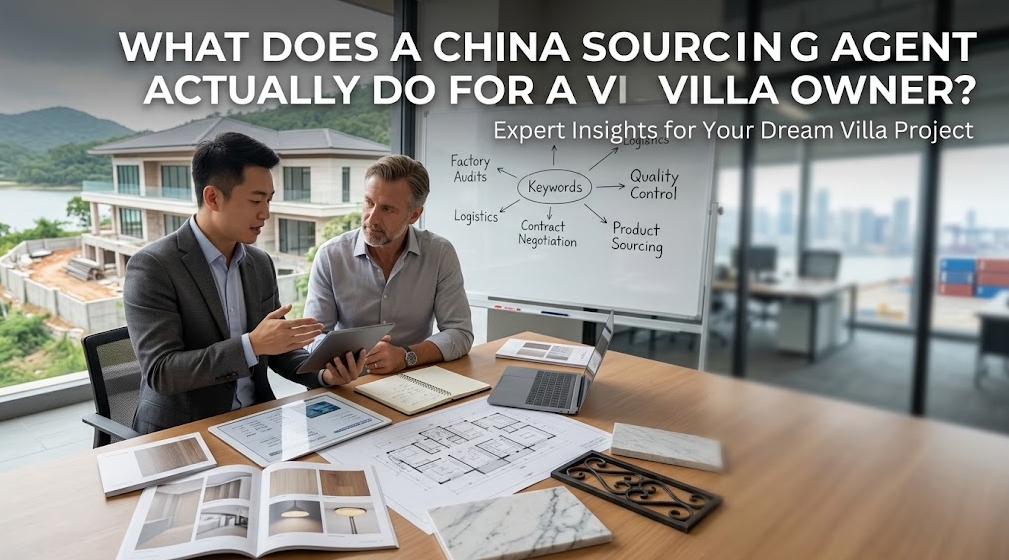
At its core, a China sourcing agent acts as your local procurement representative. They coordinate between your project team (your architect, interior designer, and local contractor) and the manufacturers in China.
A sourcing agent does not manufacture products, draw architectural plans, or install materials on-site. Their job is to manage the procurement lifecycle so that what was specified on your design drawings matches what arrives at your building site.
+-------------------------------------------------------------------+
|                        THE SOURCING LIFECYCLE                     |
+---------------------+-----------------------+---------------------+
| 1. Requirements     | 2. Sourcing & Quotes  | 3. Shop Drawings    |
| Review BOQ & plans  | Match vetted plants   | Reconcile specs     |
+---------------------+-----------------------+---------------------+
| 4. Sample Approval  | 5. Production Checks  | 6. Pre-Shipment QC  |
| Finishes & hardware | Schedule track        | Physical inspection |
+---------------------+-----------------------+---------------------+
| 7. Warehouse Consolidation                  | 8. Export & Freight |
| Staging in Foshan hub                       | Container loading   |
+---------------------------------------------+---------------------+
1. Reviewing Project Requirements and BOQs
The process begins with your design documents. An agent reviews your architectural plans, interior renderings, and Bill of Quantities (BOQ). They break down the project into clear procurement categories—such as thermal-break aluminum windows, custom millwork, natural stone tiles, or sanitary ware—and flag any missing specifications, such as door opening directions or appliance dimensions.
2. Identifying and Evaluating Factories
Instead of searching public directories, an agent leverages established local networks to match your project with suitable manufacturers. For a private villa, this means finding factories capable of custom, low-volume, high-specification production rather than mass-market commodity plants.
3. Technical Communication and Shop Drawings
The main breakdown in remote sourcing usually stems from communication gaps, not factory capability. A sourcing agent works with the factory’s technical department to produce detailed shop drawings for your approval before production starts.
4. Sample Management
Before full production runs, the agent collects, inspects, and ships physical finish samples—such as wood veneers, stone slabs, powder-coat metal swatches, and hardware—for your design team’s approval.
5. Production Tracking
Once production begins, the agent monitors manufacturing schedules, tracks raw material preparation, and resolves mid-production questions that arise on the factory floor.
6. Pre-Shipment Quality Control (QC)
Before final payment is released, the agent or their inspector visits the factory to check dimensions, finishes, quantity, structural assembly, and packaging against the approved shop drawings and physical samples.
7. Warehouse Consolidation and Logistics Coordination
Because your materials will originate from multiple factories, the agent receives the finished goods at a central warehouse, staging them for inspection, clear labeling, and consolidated container loading.
Why Is Sourcing From China Different for a Private Villa?
Sourcing materials for a private villa differs fundamentally from standard commercial procurement or retail importing.
| Procurement Factor | Commercial/Wholesale Importing | Private Villa Sourcing |
| Product Nature | High-volume, standardized catalog items | Low-volume, highly customized, specification-driven |
| Tolerance to Error | Spare units can offset minor defect rates | A single wrong kitchen panel halts installation |
| Order Quantities | Full container loads (FCL) of single items | Fragmented orders across 8–15 specialized factories |
| Dimension Rules | Standardized sizes | Precision site-measurements (millimeter level) |
| Lead Time Alignment | Staggered inventory restocking | Synchronized delivery to meet building milestones |
If an importer buys 500 identical dining chairs and two have surface scratches, they accept the loss ratio or return them. If you order a single custom marble island top that arrives cracked or cut to the wrong sink cutout dimensions, your entire kitchen installation halts.
Furthermore, a private villa project requires strict synchronization across trade categories. Your window frames must match your structural rough openings, your floor tiles must align with your concealed shower drain specifications, and your kitchen cabinet clearances must match your imported appliance cutouts. A sourcing agent handles these multi-category dependencies locally before goods leave the factory.
How Does an Agent Find the Right Factory for a Custom Project?
Finding a factory in China is easy; finding the right factory for a high-specification private villa is difficult.
Many buyers assume the best strategy is to contact the largest, most famous manufacturers. However, large export factories are often structured for automated, mass production. When presented with a complex, highly customized villa order with small quantities, a massive factory may delegate the work to a secondary line, charge exorbitant custom engineering fees, or refuse the order outright.
Conversely, very small local workshops may lack export licenses, quality control procedures, or experience with international shipping standards.
A sourcing agent evaluates factories based on specific criteria:
- Customization Flexibility: Does the factory have a dedicated engineering team for short-run, custom orders?
- Hardware Integration: Can the factory work with international hardware brands (such as Blum, Grass, or Hafele) specified by your designer?
- Material Verification: Does the supplier use genuine, certified materials (e.g., E0 grade plywood, solid brass fittings, certified thermal-break aluminum)?
- Export Experience: Has the factory previously packaged and exported goods to your region, adhering to local timber treatment and packaging standards?
Does a Sourcing Agent Compare More Than Just the Factory Price?
A low initial quotation from a factory is often misleading. In Chinese manufacturing, a lower price frequently indicates a lower underlying material specification or excluded services.
When evaluating factory quotes, a sourcing agent performs a detailed line-item comparison:
+-------------------------------------------------------------------------+
|                    QUOTATION ANALYSIS COMPARISON                        |
+----------------------------------+--------------------------------------+
| SUPPLIER A: $12,000              | SUPPLIER B: $16,500                  |
+----------------------------------+--------------------------------------+
| • 1.2mm frame thickness          | • 2.0mm extruded aluminum frame      |
| • Generic local hardware         | • German Siegenia hardware           |
| • Single-glazing / clear glass   | • Double-glazed, Low-E argon filled  |
| • Standard bubble wrap           | • Custom wooden crate protection     |
| • Ex-works (EXW) pricing         | • Delivered to staging warehouse     |
+----------------------------------+--------------------------------------+
| Initial cost appears lower       | Full technical spec compliance       |
+----------------------------------+--------------------------------------+
A sourcing agent ensures you are comparing identical specifications across all candidate factories so you can make informed budget decisions.
Who Handles Drawings, Specifications, and Technical Communication?
One of the most common friction points in villa procurement is technical translation.
Your interior designer produces artistic renderings and floor plans. However, a factory cannot manufacture a custom door or wardrobe from a 3D rendering. They require detailed production drawings (shop drawings) showing section cuts, edge bandings, internal joinery, structural reinforcement, and clearance tolerances.
+--------------------------------------------------------------------------+
|                      TECHNICAL DRAWING WORKFLOW                          |
+-----------------------+------------------------+-------------------------+
| ARCHITECT / DESIGNER  | SOURCING AGENT         | FACTORY ENGINEERING     |
| Design Renderings     | Technical Translation  | Shop Drawings           |
| Plan Layouts          | Specification Review   | Section Details         |
| Material Intent       | Interface Coordination | Production CAD          |
+-----------------------+------------------------+-------------------------+
                                   |
                                   v
+--------------------------------------------------------------------------+
|                       HOMEOWNER / DESIGNER APPROVAL                      |
|                  (Physical sign-off before production)                   |
+--------------------------------------------------------------------------+
A sourcing agent bridges this gap:
- They translate your designer’s architectural intent into technical parameters the factory’s engineering team understands.
- The factory generates formal shop drawings based on these details.
- The agent reviews these drawings against your original plans to flag errors—such as incorrect swing directions, wrong panel offsets, or missing wiring channels—before submitting them to your architect for final sign-off.
The agent does not invent design details. If your drawings lack specific measurements or appliance specifications, the agent requests those details from your team rather than letting the factory make assumptions.
How Does a Sourcing Agent Manage Samples and Approvals?
Digital photos and video calls cannot convey how a material will look and feel in your home. Lighting conditions, camera sensor variations, and screen color calibrations distort physical appearance.
[Architectural Specification]
             │
             ▼
[Agent Collects Factory Swatches] ──► (Veneer, Stone, Anodized Finishes)
             │
             ▼
[Pre-Shipment Inspection of Samples] ──► (Checks against spec sheets)
             │
             ▼
[Air Courier to Homeowner/Designer] ──► (Physical hands-on review)
             │
             ▼
[Signed Approval Master Retained] ◄── (One stays in China for QC reference)
For custom villa builds, physical sample approval is critical. A sourcing agent manages this step by:
- Consolidating Samples: Collecting wood veneer swatches, natural stone cutouts, powder-coated aluminum sections, glass samples, and fabric cuts from multiple factories into a single package.
- Reviewing Quality First: Inspecting swatches locally to ensure they match requested specs before paying for international air courier shipping.
- Creating Master Reference Sets: Retaining identical physical samples in China. One set stays with you or your designer, and one set stays with the agent in China to serve as the benchmark during pre-shipment quality control.
What Happens After You Place the Factory Order?
Once you place an order and pay a deposit, production does not happen automatically. Factories balance multiple commercial orders, and without regular physical follow-ups, custom residential projects can experience delays.
A sourcing agent maintains active production oversight:
- Raw Material Tracking: Verifying that the factory has sourced the correct raw materials (e.g., specific marble blocks or timber grades) before production starts.
- Milestone Verification: Visiting the factory or requesting video verification at key milestones—such as frame cutting, preliminary assembly, and finish application.
- Resolving Floor Issues: Addressing unexpected manufacturing challenges immediately. If a chosen stone slab reveals natural fissures during cutting, the agent notifies you with photos and options before work continues.
How Does Quality Control Work Before Products Leave China?
Once a factory packages and ships an order, resolving a defect from overseas becomes costly and time-consuming. Pre-shipment Quality Control (QC) is your primary risk management tool.
+------------------------------------------------------------------------+
|                    PRE-SHIPMENT QC CHECKLIST SCOPE                     |
+--------------------+---------------------+-----------------------------+
| CRITERIA           | CHECK METHOD        | TOLERANCE ACCEPTANCE        |
+--------------------+---------------------+-----------------------------+
| Dimensional        | Laser measure / tape| +/- 1mm to 2mm max variance |
| Finish & Color     | Master sample match | Exact batch match           |
| Quantity & BOM     | Physical count      | 100% line-item match        |
| Operational Fit    | Dry-fit assembly    | Smooth hinge & slider work  |
| Packaging Safety   | Drop-test / crate   | IPPC stamped wooden crates  |
+--------------------+---------------------+-----------------------------+
A sourcing agent conducts or coordinates pre-shipment inspections covering key areas:
1. Dimensional Accuracy
Verifying outer frame dimensions, thickness parameters, hole cutouts, and diagonal squareness against approved shop drawings.
2. Visual and Surface Inspection
Inspecting finishes under proper lighting for scratches, dent marks, color inconsistencies, or uneven lacquer coats.
3. Functional Testing
Assembling or test-operating moving parts—such as running cabinet drawers on their slides, testing window lock mechanisms, or dry-fitting sectionals.
4. Quantity and Component Checks
Cross-checking physical contents against the packing list to ensure hardware, handles, installation brackets, and fasteners are included.
5. Packaging Verification
Confirming that delicate goods (like glass panels and polished marble) are packed in fumigated, solid wooden crates lined with protective foam.
While an inspection significantly reduces risk, it cannot uncover hidden internal manufacturing flaws. A professional agent provides a written QC report with detailed photographs and video footage so you can review and approve the goods before paying the final balance.
Can One Sourcing Agent Coordinate Several Chinese Factories?
Managing ten separate factories directly requires handling ten separate payment schedules, ten production timelines, ten logistics pick-ups, and ten sets of export documents.
                      WITHOUT SOURCING AGENT
[Homeowner] ───► (10x Contracts, 10x Payments, 10x QC Checks, 10x Shipments)
                     │
     ┌───┬───┬───┬───┼───┬───┬───┬───┐
     ▼   ▼   ▼   ▼   ▼   ▼   ▼   ▼   ▼
    F1  F2  F3  F4  F5  F6  F7  F8  F9  ... (Fragmented)

========================================================================

                       WITH SOURCING AGENT
[Homeowner] ───► [Sourcing Agent] ───► Central Warehouse Consolidation
                                                 │
     ┌───┬───┬───┬───┼───┬───┬───┬───┐           │
     ▼   ▼   ▼   ▼   ▼   ▼   ▼   ▼   ▼           ▼
    F1  F2  F3  F4  F5  F6  F7  F8  F9      [Single Container]
A sourcing agent acts as a single central contact. They track all orders across various suppliers, ensure different components finish on schedule, and coordinate local transport to bring everything to a central staging facility.
The Value of Warehouse Staging and Consolidation
For a private villa build, shipping partial containers from individual factories is inefficient and expensive.
A sourcing agent operates or utilizes a local consolidation warehouse—typically in major manufacturing hubs like Foshan—where goods are received, staged, and managed:
- Staggered Receiving: Factories complete orders on different dates. The warehouse safely stores early-arriving goods while waiting for remaining items.
- Final Visual Check: Goods can undergo a final outer-carton inspection upon arrival at the warehouse to verify crate integrity.
- Optimized Container Loading: A well-planned container loading schedule maximizes space, balances weight distribution, and ensures items needed first on your site are loaded last (so they are unloaded first).
Can You Source From China Without Traveling There?
Yes, remote sourcing for a private villa is common today. However, it requires clear project documentation and realistic expectations.
+--------------------------------------------------------------------------+
|                      REMOTE VS. IN-PERSON SOURCING                       |
+----------------------------------+---------------------------------------+
| REMOTE SOURCING WORKS WELL WHEN: | IN-PERSON VISITS ARE HELPFUL WHEN:    |
+----------------------------------+---------------------------------------+
| • Architectural plans are 100%   | • You are in the early design phase   |
|   complete                       |   and need visual inspiration         |
| • Detailed interior BOQ exists   | • You are making large-scale stone or |
| • Physical samples can be sent   |   furniture selections                |
|   via air express                | • You want to personally inspect      |
| • You have a trusted local agent |   factory facilities before ordering  |
+----------------------------------+---------------------------------------+
If you prefer not to travel, a sourcing agent serves as your hands, eyes, and ears on the ground. However, if your budget allows and your project involves high levels of customization, visiting China for a 3- to 5-day selection trip alongside your agent can accelerate material selection and design alignment.
Sourcing Agent vs. Other Service Providers
To set clear boundaries, it helps to understand how a sourcing agent differs from other professionals involved in your build.
+------------------------------------------------------------------------------------+
|                         ROLE AND RESPONSIBILITY BOUNDARIES                         |
+--------------------+---------------------------------------------------------------+
| ROLE               | PRIMARY RESPONSIBILITY                                        |
+--------------------+---------------------------------------------------------------+
| Sourcing Agent     | Sourcing, factory vetting, technical translation, QC, staging |
| Manufacturer       | Physical fabrication of specified goods                       |
| Freight Forwarder  | Sea/air shipping, vessel booking, bill of lading documentation|
| Architect/Designer | Design vision, structural engineering, spatial dimensions     |
| Local Contractor   | On-site installation, local code compliance, measurements     |
+--------------------+---------------------------------------------------------------+
What a China Sourcing Agent Should NOT Promise
To avoid misunderstandings, know the limitations of a sourcing agent’s role. A professional agent should not claim to:
- Guarantee Zero Defects: No manufacturing process is entirely defect-free. An agent minimizes errors through inspection, but cannot guarantee perfection.
- Replace Your Architect or Designer: An agent communicates technical specs to factories, but does not design your home or issue engineering calculations.
- Handle Local Site Installation: Sourcing agents do not manage your site labor or handle installation abroad.
- Guarantee Local Building Code Compliance: While an agent can request specific certified materials (e.g., double-glazed tempered glass meeting AS/NZS or US NFRC standards), your local architect and contractor remain responsible for confirming compliance with local building codes.
Is Hiring a China Sourcing Agent Worth the Cost?
Hiring a sourcing agent adds a service fee to your budget, so it is important to evaluate whether the investment makes sense for your project.
When Hiring an Agent Makes Sense:
- Your material and loose-item budget is substantial enough that direct factory pricing provides meaningful cost advantages.
- You are sourcing across multiple product categories from different specialized factories.
- You require custom-manufactured products rather than standard off-the-shelf items.
- Neither you nor your design team has a dedicated procurement office in China.
When an Agent May Not Be Necessary:
- You are buying only one standard, non-customized product (e.g., standard floor tiles from a single supplier).
- You are working with an importer or distributor in your local market who handles end-to-end supply and installation.
- You already have an established relationship with a reliable Chinese exporter who manages your technical details and quality control directly.
Fee Structures
Sourcing agents structure their fees in various ways:
- Percentage Fee: A management fee based on the total value of the goods sourced (typically ranging from 5% to 10%, depending on project size and complexity).
- Fixed Project Fee: A set fee covering defined scope items (e.g., factory audits, shop drawing coordination, sample shipping, and pre-shipment inspections).
- Hybrid Model: A lower fixed fee to cover initial sourcing and administration, combined with a smaller performance or coordination fee upon order completion.
Why Foshan Matters for Villa Sourcing
When sourcing building materials in China, you will likely encounter Foshan. Located in Guangdong Province near Guangzhou and Hong Kong, Foshan is China’s primary manufacturing hub for building materials and interior furnishings.
+-------------------------------------------------------------------+
|               GREATER FOSHAN & GUANGDONG CLUSTERS                 |
+------------------------+------------------------------------------+
| CATEGORY               | PRIMARY MANUFACTURING ZONE               |
+------------------------+------------------------------------------+
| Ceramic & Porcelain    | Nanchuang / Shiwan (Foshan)              |
| Furniture & Millwork   | Shunde (Foshan)                          |
| Custom Aluminum Doors  | Nanhai (Foshan)                          |
| Decorative Lighting    | Guzhen (Zhongshan - adjacent)            |
| Sanitary Ware          | Gaoming (Foshan) / Kaiping               |
+------------------------+------------------------------------------+
The primary advantage of Foshan is concentration. For a villa project, your agent can visit window manufacturers, cabinet plants, tile showrooms, and furniture workshops within the same regional cluster. This close proximity simplifies factory audits, sample collection, quality inspections, and staging at local consolidation warehouses.
Practical Example: A 700 m² Villa Procurement Scenario
Consider how a sourcing setup works for a 700 m² private villa build requiring six material categories:
[Project BOQ & Design Package]
              │
              ▼
    [HSY Sourcing Review]
              │
    ┌─────────┼─────────┬─────────┬─────────┐
    ▼         ▼         ▼         ▼         ▼
 Kitchen   Windows   Sanitary  Lighting  Furniture
 (Shunde)  (Nanhai)  (Gaoming) (Guzhen)  (Shunde)
    │         │         │         │         │
    └─────────┴─────────┼─────────┴─────────┘
                        ▼
            [Technical Shop Drawings]
                        │
            [Physical Sample Approval]
                        │
             [Production Monitoring]
                        │
            [Pre-Shipment Inspection]
                        │
            [Foshan Warehouse Staging]
                        │
           [Single Container Export Load]
- Information Transfer: You provide your CAD plans, interior renderings, and BOQ items.
- Factory Selection: HSY Sourcing identifies two vetted factories per category that specialize in custom residential production.
- Quotation & Spec Comparison: HSY normalizes quotes into a line-item comparison sheet showing material grades, hardware brands, and lead times.
- Drawing Sign-off & Samples: HSY manages shop drawing iterations for kitchen cabinets and window frames, sending a consolidated sample box for your approval.
- Quality Control: HSY inspectors visit each facility before final payments are released, issuing detailed photo and video inspection reports.
- Consolidation & Export: Goods are received at a local Foshan warehouse, checked for outer packaging integrity, loaded into a 40ft high-cube container, and handed over to your freight forwarder.
Why Choose HSY Sourcing for a Private Villa Project?
HSY Sourcing is a Foshan-based sourcing and procurement management agency specializing in building materials, custom millwork, and interior furnishings for residential projects.
What HSY Sourcing Does:
- Translates your design drawings and BOQs into technical factory specifications.
- Identifies, vets, and negotiates with suitable custom-capable manufacturers.
- Coordinates shop drawings, finish samples, and technical approvals.
- Performs physical, on-site pre-shipment quality control inspections.
- Receives, inspects, and consolidates goods at a local Foshan staging warehouse.
What HSY Sourcing Does Not Do:
HSY Sourcing is a procurement and coordination agency, not a factory, freight forwarder, architect, or installation contractor.
By serving as your local procurement representative in China, HSY Sourcing helps manage factory interactions, verify material specifications, and oversee production details before goods leave for your site.
Learn more about how we support custom residential builds through our Villa Construction Materials Procurement services or explore how Chinese plants execute custom orders in our guide on Can Chinese Factories Work Directly From Your Villa Floor Plans and 3D Designs?.
Key Takeaway
A China sourcing agent is not a manufacturer, an architect, or an installation contractor. Their primary value lies in procurement management, technical communication, quality control, and logistics staging.
For a private villa project involving complex customization across multiple factories, a sourcing agent serves as your local representative in China—working to ensure that what was designed on paper matches what arrives at your construction site.
Frequently Asked Questions
What does a China sourcing agent do for a villa owner?
A sourcing agent manages the overseas procurement process for your project. This includes identifying custom-capable factories, comparing technical quotes, translating architectural drawings into factory shop drawings, collecting physical samples, tracking production, conducting pre-shipment inspections, and consolidating shipments from multiple suppliers at a central warehouse.
Do I need a sourcing agent to buy building materials from China?
If you are buying a single, standard product from a trusted supplier, you may not need an agent. However, if your villa build involves multiple custom product categories (such as millwork, windows, stone, and lighting) from different factories, an agent helps manage the specifications, quality control, and logistics required to successfully execute your orders.
Can a sourcing agent work from my architect’s drawings?
Yes. An experienced sourcing agent uses your floor plans, elevations, 3D renderings, and BOQ as the foundation for the procurement process. They translate these design documents into technical manufacturing requirements for factory engineering teams and manage the resulting shop drawing approval process with your designer.
Does a sourcing agent negotiate prices with Chinese factories?
Yes. An agent reviews factory pricing to ensure line-item transparency. Beyond negotiating base costs, they confirm that quotes include specified material grades, quality hardware, protective export packaging, and delivery to the consolidation warehouse.
What is the difference between a sourcing agent and a freight forwarder?
A sourcing agent manages factory selection, product specifications, shop drawings, quality inspections, and warehouse consolidation. A freight forwarder takes over once goods are packaged and staged, handling ocean or air transportation, customs clearance documentation, and delivery to your destination port or site.
How much does a China sourcing agent charge?
Sourcing fees vary based on project scope and structure. Common models include a fixed project management fee, a percentage fee (typically 5% to 10% of the managed procurement value), or a hybrid model combining a baseline administrative fee with a performance component.
Is using a China sourcing agent worth it for a private villa build?
For substantial villa projects requiring custom fabrication across multiple suppliers, a sourcing agent provides clear value. Their services help prevent costly manufacturing errors, verify specifications before balance payments are made, and reduce the administrative burden of managing multiple overseas suppliers directly.