
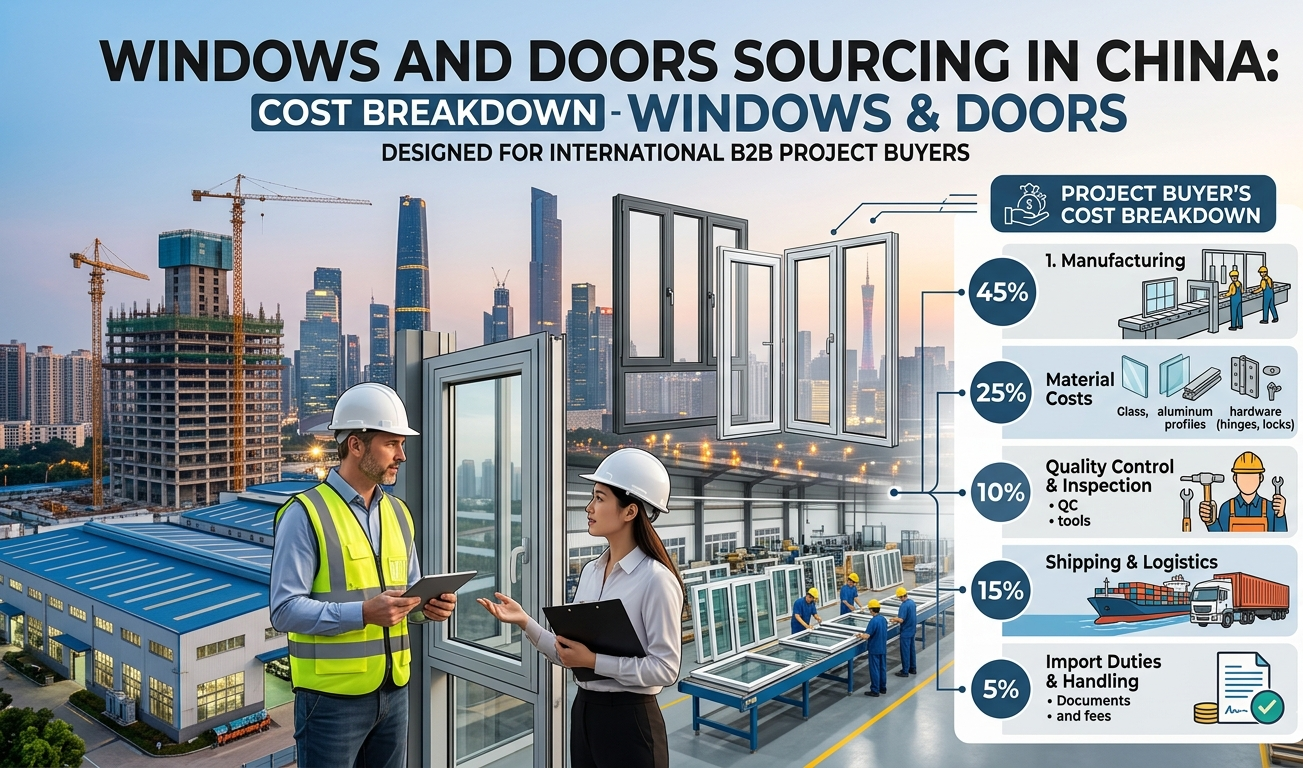
For a real estate developer or hotel owner, the line item for “Windows and Doors” is often one of the top three expenses in an interior fit-out. In the Foshan manufacturing hub, quotes can vary by as much as 40% for what looks like the same window.
This price gap isn’t just “extra profit”—it represents fundamental differences in aluminum grade, hardware longevity, and structural safety. If you are managing an apartment complex or a luxury villa project, you need to understand where the money actually goes. Buying based on the lowest per-square-meter ($/sqm) price without a technical breakdown is the fastest way to fail a building inspection or face leaking issues post-installation.
What are the primary drivers of the “Per Square Meter” price?
The cost of a custom aluminum window is not a flat rate; it is a calculation of three physical components:
- Aluminum Weight and Alloy: High-rise apartments and commercial projects require 6063-T5 aluminum. The price fluctuates with the global aluminum ingot market. However, the real cost driver is wall thickness. A 1.4mm frame is significantly cheaper than a 2.0mm structural frame. For commercial projects, saving on thickness increases the risk of frame deformation under wind load.
- Glass Specifications: Standard double-glazing (5mm + 12A + 5mm) is the baseline. The cost increases as you add technical layers: Low-E coatings for energy efficiency, laminated interlayers for acoustics, or argon gas filling.
- The “Hardware Ratio”: On a small window, the hardware (hinges, handles, locks) might represent 30% of the total cost. On a large sliding door, that ratio changes.
Why does hardware choice drastically impact the project budget?
Hardware is where most “cheap” quotes hide their savings. In a hotel or rental apartment, the windows are operated thousands of times.
- Premium Engineering: Specifying German-engineered brands like Hopo or Siegenia ensures the friction stays won’t sag and the locks won’t jam after six months. This adds a premium to the initial cost but eliminates the massive expense of on-site repairs.
- Domestic Quality: Top-tier Chinese hardware like Kinlong offers a middle ground.
- The Hidden Risk: Avoid “unbranded” hardware. These are often made from low-grade zinc alloys that corrode in humid or coastal environments, leading to total mechanical failure.
How do packaging and certification add to the landed cost?
Many buyers forget to factor in the “safe arrival” costs. Windows are heavy and fragile.
- Plywood Crating: For international projects, standard cardboard is insufficient. You must budget for fully enclosed, fumigated plywood crates. This usually adds $5 to $10 per square meter, but it prevents glass breakage and frame scratches during ocean transit.
- Compliance Costs: If your project requires specific certifications like AS2047 (Australia) or NFRC (USA), the factory must use tested extrusions and glass. These certified lines carry a higher price tag because of the rigorous testing and third-party auditing involved.
How can you offset window costs using Foshan’s furniture cluster?
This is the “insider’s secret” to Foshan procurement. Windows are “heavy cargo.” When you load a container with windows, you hit the weight limit long before the container is physically full. You are essentially paying for a lot of empty space.
To optimize the cost, professional project buyers use Cross-Category Consolidation. By sourcing your Vacuum-Compressed Sofas and mattresses from the same region (Foshan), you can load the heavy window crates at the bottom and fill the remaining 50% of the container’s volume with “lightweight” furniture. This effectively allows you to ship your apartment furniture for near-zero additional freight cost, significantly lowering the overall landed cost of your building materials.
Key Takeaways
- Quote by Weight and Spec: Never accept a flat $/sqm price without knowing the aluminum wall thickness (e.g., 1.8mm) and glass type.
- Budget for Hardware: Invest in branded hardware (Hopo/Kinlong) to avoid the high cost of post-installation maintenance in commercial buildings.
- Don’t Skimp on Crating: Plywood packaging is a mandatory insurance policy for long-distance shipping.
- Consolidate for ROI: Mix heavy windows with high-volume items like compression sofas to maximize your container’s value.
Why Choose HSY Sourcing?
Managing the cost and quality of building materials in Foshan requires a partner who understands both engineering and logistics. HSY Sourcing acts as your on-site procurement office.
- Technical Cost Audits: we break down your quotes into raw materials, hardware, and labor. We ensure you are paying for 6063-T5 aluminum and the exact glass specs your project demands.
- Physical Inspection: Led by our team uses digital calipers and glass thickness gauges to verify every order against the approved shop drawings.
- Strategic Consolidation: We specialize in “one-stop” project sourcing. We coordinate the collection of your heavy windows/doors and your Foshan compression sofas, loading them into optimized containers that reduce your total freight spend.
- Direct Factory Access: We bypass the trading companies and work directly with the extrusion plants and assembly workshops, ensuring you get factory-direct pricing with professional oversight.
Get a transparent, technical breakdown for your next project. Contact the HSY Sourcing team today.
FAQ
Q1: What is a “reasonable” price for commercial aluminum windows in China?
A: Depending on the specs, prices typically range from $80 to $180 per square meter. Anything significantly lower usually indicates sub-standard aluminum thickness or low-grade glass.
Q2: How do we ensure the windows fit the on-site openings?
A: We manage the “Shop Drawing” process. The factory produces detailed CAD drawings based on your architectural plans. Production only starts once your site engineer signs off on every dimension.
Q3: Can HSY Sourcing help with the shipping of fragile glass?
A: Yes. We supervise the loading of every container in Foshan. We ensure the plywood crates are braced and strapped to prevent movement during the 30-day ocean voyage.
Q4: Is it better to source windows and furniture from the same agent?
A: In Foshan, yes. It allows for perfect logistics synchronization. We can ensure your windows (needed early in construction) and your compression sofas (needed for fit-out) are handled under one quality control and shipping plan.