
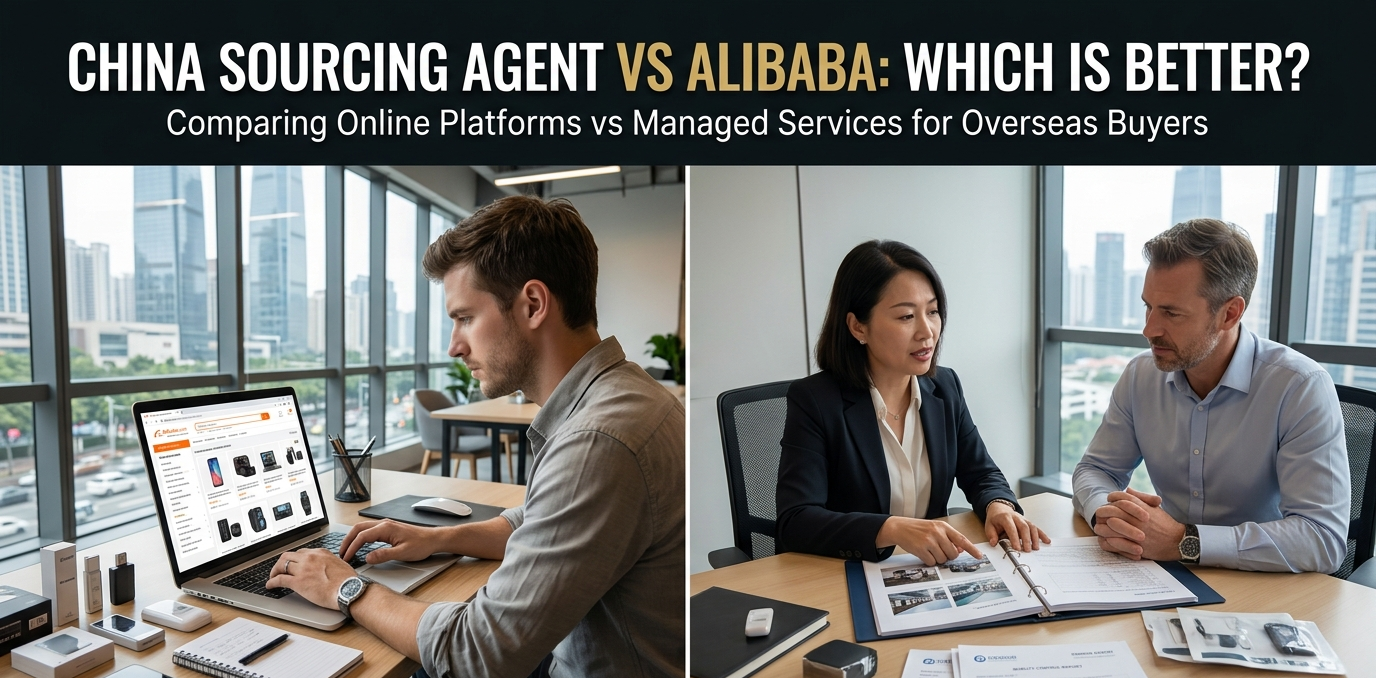
If you’re sourcing products from China, you’ve probably come across two common options:
- using a platform like Alibaba
- working with a China sourcing agent
Both are widely used by overseas buyers. But they work in very different ways.
So which one is better?
The short answer is:
👉 it depends on your experience, order size, and how much control you want over the process.
In this guide, we’ll break down the real differences between Alibaba and sourcing agents, based on how buyers actually use them.
What Is Alibaba and How Does It Work?
Alibaba is an online marketplace where you can find suppliers across different product categories.
Typical process:
- search products
- contact multiple suppliers
- compare quotes
- place orders directly
It’s a useful starting point for buyers who want to find suppliers in China quickly.
However, Alibaba mainly helps you connect with suppliers.
After that, most of the work is still your responsibility.
What Does a China Sourcing Agent Do?
A sourcing agent works differently.
Instead of just listing suppliers, a china sourcing agent service usually covers:
- supplier sourcing and verification
- price negotiation
- sample follow-up
- production monitoring
- quality inspection
- shipping coordination
In simple terms, a sourcing agent helps manage the entire procurement process, not just the supplier search.
What Are the Main Differences Between Alibaba and a Sourcing Agent?
Here’s a practical comparison based on real use cases:
Supplier Access
- Alibaba: large number of suppliers, easy to browse
- Sourcing agent: fewer options, but more filtered
Communication
- Alibaba: direct communication with suppliers
- Sourcing agent: agent handles communication
Quality Control
- Alibaba: you need to arrange inspection yourself
- Sourcing agent: agent can manage inspections
Risk Management
- Alibaba: depends on your experience
- Sourcing agent: helps reduce common risks
Cost
- Alibaba: no agent fee, but risk of hidden costs
- Sourcing agent: service fee or commission
Convenience
- Alibaba: more DIY
- Sourcing agent: more managed process
Is Alibaba Safe for Overseas Buyers?
Many buyers ask whether Alibaba is safe.
The answer is:
👉 generally yes, but not risk-free.
There are still common issues such as:
- inconsistent product quality
- misleading product listings
- communication misunderstandings
Alibaba offers tools like Trade Assurance, but it doesn’t fully control supplier behavior.
So buyers still need to manage risk when they buy from China using Alibaba.
When Is Alibaba a Better Option?
Alibaba can work well in certain situations:
- you have sourcing experience
- your product is simple or standardized
- you can manage suppliers directly
- you are placing small or test orders
For experienced buyers, Alibaba is a flexible and cost-effective tool.
When Is a China Sourcing Agent a Better Choice?
A sourcing agent is more useful when:
- you are new to sourcing from China
- you are ordering custom products
- you are working with multiple suppliers
- you cannot visit China
- you need help with quality control and logistics
For buyers who want to buy from China without visiting, this is often the more practical option.
Can You Use Both Alibaba and a Sourcing Agent Together?
Yes, and many buyers actually do this.
For example:
- find suppliers on Alibaba
- then ask a sourcing agent to verify and manage them
Or:
- let the sourcing agent source suppliers
- and compare them with Alibaba options
This hybrid approach can give you more flexibility.
What Are the Risks of Each Option?
Alibaba risks
- choosing unreliable suppliers
- lack of production follow-up
- quality issues if not inspected
Sourcing agent risks
- additional cost
- varying service quality between agents
- less direct factory contact
Neither option removes risk completely.
They just manage it differently.
Which Option Is Better for Your Business?
There is no single answer.
👉 If you prefer control and lower upfront cost:
Alibaba may be a better fit
👉 If you prefer support and less hands-on work:
A sourcing agent may be more suitable
In practice, the best choice depends on your:
- experience level
- order complexity
- internal resources
Final Thoughts
Alibaba and sourcing agents are not direct competitors—they are tools used in different ways.
Alibaba is a platform for finding suppliers.
A sourcing agent is a service that helps manage the process.
Many buyers start with Alibaba, then move to sourcing agents as their business grows or becomes more complex.
Understanding the differences helps you choose the right approach for your situation.
Practical Tip
If you’re sourcing through Alibaba, it works well for finding suppliers—but managing quality, timelines, and communication still requires time and experience.
For buyers handling multiple suppliers, custom products, or bulk orders, working with a sourcing agent can make the process more structured and easier to manage, especially when you’re not based in China.
If you need support with supplier sourcing, inspection, or shipping coordination, having a local team can help reduce common issues and save time during the process.
FAQ: China Sourcing Agent vs Alibaba
Is it better to use Alibaba or a sourcing agent?
It depends on your experience and needs. Alibaba is good for finding suppliers, while a sourcing agent helps manage the entire sourcing process.
Can I trust suppliers on Alibaba?
Some suppliers are reliable, but not all. Buyers should verify suppliers and arrange inspections when necessary.
Do sourcing agents replace Alibaba?
Not necessarily. Many buyers use both—Alibaba for sourcing ideas, and agents for managing production and quality.
Is using a sourcing agent more expensive?
Yes, there is usually a service fee. However, it may reduce risks and save time, especially for complex orders.
Can I use Alibaba without visiting China?
Yes, but you may need third-party inspection or support to manage quality and logistics remotely.