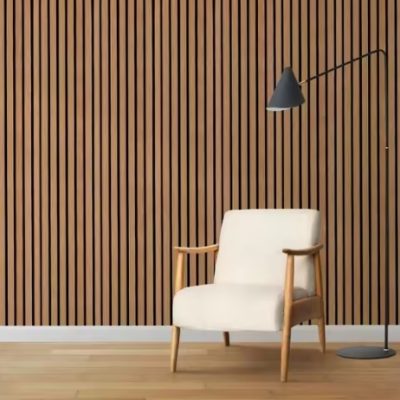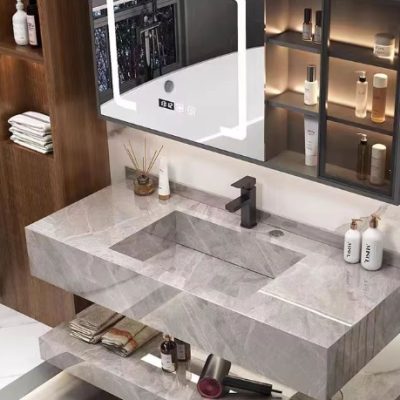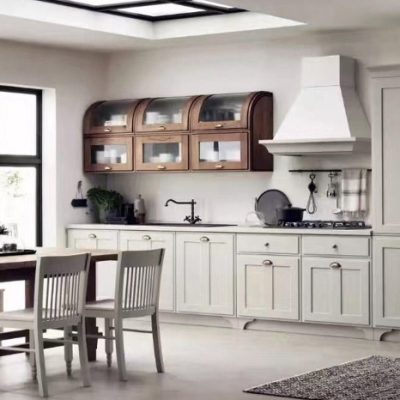

Sourcing building materials directly from manufacturing hubs in Foshan, China allows property developers and villa owners to purchase custom aluminum doors, windows, kitchen cabinetry, porcelain tiles, and sanitary ware at 35% to 50% lower costs than domestic retail channels.
However, the primary operational hurdle in direct-factory procurement is not purchasing—it is logistics consolidation. A typical luxury villa requires products from 5 to 10 separate specialized factories across Foshan and Shunde. Shipping these items separately via LCL (Less than Container Load) incurs exorbitant port handling fees, multiple customs entries, and high damage rates due to repeated freight re-handling.
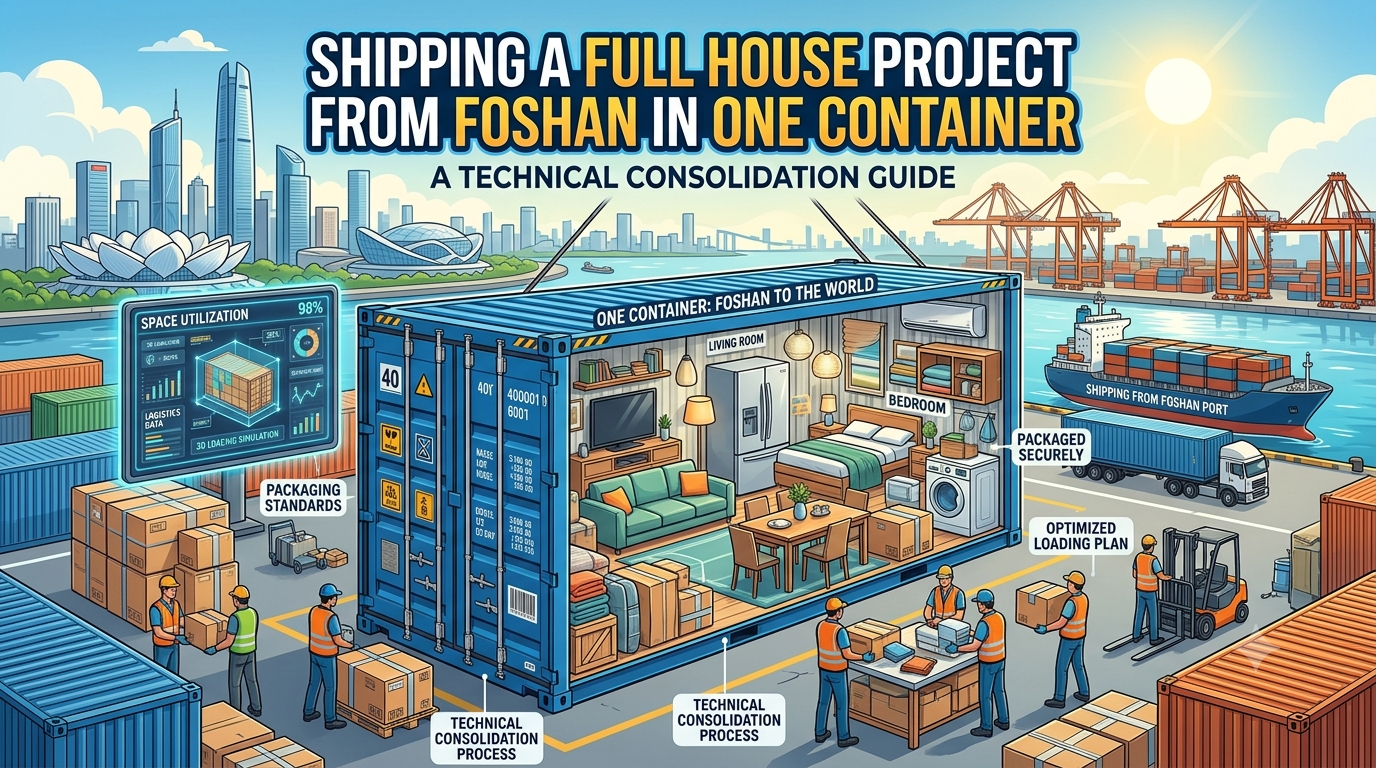
Consolidating all project materials into a single dedicated 40ft High Cube (40HQ) container reduces ocean freight expenses by 30% to 40%, simplifies customs clearance into a single entry, and ensures all finishes arrive on-site simultaneously for scheduled installation.
Key Takeaways
- Payload Planning Dual Limits: A standard $40\text{ft}$ High Cube container offers a usable volumetric capacity of $65\text{m}^3$ to $68\text{m}^3$ and a maximum road-weight payload limit of $26,000\text{kg}$ (varies by destination port road regulations).
- Load Balance Rule: Heavy, dense products (tiles, stone, sanitary ware) must form the bottom payload layer, while light, voluminous products (custom cabinetry, vanity boxes) occupy the upper space to avoid crushing damage.
- Timeline Alignment Buffer: Production cycles vary by product category ($15$ days for tiles vs. $40$ days for custom joinery). A local staging warehouse in Foshan with a 10 to 14-day free storage window is necessary to synchronize factory deliveries.
- Wood Packaging Compliance: All solid wood pallets and protective crates must carry international ISPM-15 fumigation stamps (IPPC mark) to prevent customs rejections or border quarantine holds at destination ports.
How Do You Calculate CBM Volume and Weight Capacity for a Villa Package?
Container optimization requires balancing two physical constraints simultaneously: volumetric space ($\text{m}^3$) and gross weight limit ($\text{kg}$). Building materials fall into two distinct cargo profiles: high-density/heavy cargo and low-density/bulky cargo.
Container Volume & Weight Profile:
┌─────────────────────────────────────────────────────────┐
│ Top Layer: Light & Voluminous (Cabinets, Vanities)       │  <-- Maxes out Volume (CBM)
├─────────────────────────────────────────────────────────┤
│ Mid Layer: Structural (Windows, Doors, Hardware)        │
├─────────────────────────────────────────────────────────┤
│ Base Layer: Heavy & Dense (Tiles, Stone, Sanitary Ware) │  <-- Maxes out Weight (KG)
└─────────────────────────────────────────────────────────┘
The table below details standard ocean container shipping capacities used in full-house consolidation:
| Container Type | Internal Dimensions (L×W×H) | Max Usable Volume | Max Weight Payload | Cargo Density Strategy |
| 20ft Standard (20GP) | $5.90\text{m} \times 2.35\text{m} \times 2.39\text{m}$ | $\approx 28 – 30\text{m}^3$ | $\approx 21,000 – 24,000\text{kg}$ | Best for high-density heavy cargo (tiles, natural stone, metal hardware) |
| 40ft Standard (40GP) | $12.03\text{m} \times 2.35\text{m} \times 2.39\text{m}$ | $\approx 56 – 58\text{m}^3$ | $\approx 24,000 – 26,000\text{kg}$ | Balanced cargo mix with height constraints |
| 40ft High Cube (40HQ) | $12.03\text{m} \times 2.35\text{m} \times 2.69\text{m}$ | $\approx 65 – 68\text{m}^3$ | $\approx 25,000 – 26,500\text{kg}$ | Standard choice for full villa builds (mix of heavy tiles + bulky cabinets/windows) |
Note: Overloading a container past local highway axle limits (e.g., $38,000\text{lbs}$ or $\approx 17,200\text{kg}$ cargo limit for standard US road transport without heavy-weight permits) results in heavy fines or denied port haulage.
How Should Factory Production Timelines Be Synchronized for One Container?
Factories in Foshan do not finish orders at the same speed. Loading a single container requires establishing a reverse timeline based on the longest manufacturing lead time.
Production Lead Time Matrix:
 ├── Porcelain Tiles & Sanitary Ware: 15–20 Days
 ├── Thermal Break Windows & Doors: 30–35 Days
 ├── Custom Kitchen Cabinets & Wardrobes: 35–45 Days
 └── Warehouse Staging Buffer: 10–14 Days
- Phase 1: Order Placement Alignment: Place orders for long-lead custom joinery (kitchen cabinets, walk-in closets) and custom aluminum windows first. Standard tiles, sanitary porcelain, and lighting can be ordered 15 to 20 days later to minimize warehouse storage fees.
- Phase 2: In-Line QC Gateways: Inspect raw materials and finished goods at individual factories as items complete production, rather than waiting until all items arrive at the consolidation warehouse.
- Phase 3: Warehouse Staging: Move finished goods to a central Foshan consolidation warehouse as they are ready. Having a dedicated 10 to 14-day staging window allows your inspection team to audit box counts, review wooden crating quality, and verify cross-factory dimensions before bringing in the container.
What Is the Correct Container Loading Sequence to Prevent Damage in Transit?
Improper loading is the primary cause of material breakage during ocean transit. Cargo inside a container experiences continuous lateral, vertical, and longitudinal forces during ocean shipping and highway haulage.
Container Loading & Weight Distribution Workflow:
Weight Audit & CBM Mapping ──> Base Heavy Cargo ──> Structural Frame Staging ──> Upper Volumetric Packing ──> Lashing & D-Ring Anchoring
1. Base Layer: Heavy Foundation Cargo
Place non-compressible, high-density products flat on the container floor:
- Porcelain & Ceramic Tiles: Place palletized tiles directly over the floor stringers, distributing weight evenly along the center axis. Never stack heavy pallets higher than $1.2\text{m}$.
- Sanitary Ware & Natural Stone: Position toilets, bathtubs, and slab crates directly adjacent to tile pallets.
2. Mid Layer: Vertical and Structural Units
- Aluminum Window & Door Crates: Assembled window frames and door panels packed in plywood crates should be placed upright along the container side walls or braced securely against the heavy base pallets.
- A-Frame Glass & Stone Crates: Large sintered stone counter slabs or glass units must be secured on vertical steel or wooden A-frames positioned against structural container points and lashed directly to internal wall D-rings using heavy-duty ratchet straps.
3. Top Layer: Volumetric & Fragile Cargo
- Pre-Assembled Cabinet Box Units: Stack lightweight wooden cabinet carcasses, closet modules, and vanity units on top of the base tile pallets or structural frames.
- Void Space Gap Filling: Fill empty gaps between cabinet boxes and container walls using inflatable dunnage bags, high-density foam sheets, or light boxed accessories (e.g., LED strip channels, handles, bathroom accessories) to prevent load shift.
Which Documents Are Required for Single-Container Export and Customs Clearance?
A consolidated container contains products from multiple suppliers. Merging these items under a single export shipment requires unified customs documentation to avoid border inspection holds.
Consolidated Export Documentation Set:
 ├── Master Bill of Lading (Single Shipper to Single Consignee)
 ├── Single Commercial Invoice (Categorized by HS Codes)
 ├── Unified Detailed Packing List (Carton/Crate Mapping)
 ├── ISPM-15 Fumigation Certificate (IPPC Stamped Crates)
 └── Certificate of Origin (Form E, Form A, or Standard CO)
- Unified Commercial Invoice & Packing List: Individual factory invoices must be merged into a single comprehensive Commercial Invoice and Packing List. The packing list must map every carton number, item description, quantity, net weight, gross weight, volume, and corresponding Harmonized System (HS) Code.
- ISPM-15 Fumigation Stamp: Any solid wood pallets, bracing timber, or crates used to pack stone or glass must undergo heat treatment or methyl bromide fumigation and display a legible IPPC stamp. Synthetic plywood and MDF crates are exempt from fumigation mandates.
- Product Certification Marks: Ensure electrical fixtures, window glass, and plumbing fittings carry the required destination region marks—such as CE (Europe), SGCC/UPC (North America), or WaterMark/AS2208 (Australia)—to ensure seamless customs clearance.
Why Partner with HSY Sourcing for Your Villa Container Consolidation in Foshan?
Managing the consolidation of 5 to 10 factory deliveries into a single container remotely presents significant risks—ranging from damaged cabinet boxes to missed container loading cut-offs. HSY Sourcing acts as your local technical procurement and logistics management team in Foshan.
1. Free Local Foshan Staging Warehouse
We provide dedicated, secure warehouse space in Foshan to collect, hold, and consolidate deliveries from your various suppliers free of charge during your staging window.
2. 3D Container Loading Optimization & Weight Distribution
Our logistics team uses 3D container loading software to model the exact placement of every crate, pallet, and box before the container arrives. We calculate exact weight distribution to ensure your shipment complies with road-weight regulations while maximizing every cubic meter of space.
3. On-Site Inspection & Loading Supervision
We do not simply hand over goods to container drivers. Our staff supervises the entire loading process at our warehouse:
- Pre-Load Crate Inspection: Verifying box counts, corner protections, and ISPM-15 fumigation stamps.
- Loading Supervision: Enforcing proper weight layering (heavy items on bottom, fragile on top) and applying dunnage air bags.
- Security & Container Sealing: Securing cargo with heavy-duty ratchet tie-downs, photographing the loading stages, and recording the official bolt seal number.
4. Consolidated Customs Declaration
We combine all itemized supplier invoices into a single unified export declaration set, handling export customs clearance in China and coordinating with your freight forwarder for smooth import clearance at your destination port.
Frequently Asked Questions About Shipping Full-House Containers
Can a complete 300 to 500 sqm villa project fit into a single 40HQ container?
Yes. A typical $300\text{m}^2$ to $500\text{m}^2$ luxury villa package—including aluminum doors and windows, kitchen and wardrobe joinery, bathroom sanitary ware, porcelain floor tiles, and lighting—generally occupies $55\text{m}^3$ to $65\text{m}^3$ when properly packed, making it an ideal fit for a single $40\text{ft}$ High Cube container.
What happens if one factory delays its delivery to the consolidation warehouse?
By setting a strict $10$ to $14$-day staging buffer before booking the ocean vessel, minor factory delays do not incur port demurrage fees. If a non-essential minor item is severely delayed, we help you decide whether to ship the main container on schedule and send the delayed item via air freight or express LCL.
How are fragile glass panels and sintered stone protected against breakage?
Glass panels and large-format porcelain slabs are packed in custom-built, fully enclosed plywood crates lined with thick EVA shock-absorbing foam. During container loading, these crates are loaded vertically or placed on heavy steel A-frames anchored directly to the container’s structural floor and wall rings using high-tensile ratchet straps.
Do I need to pay individual export customs fees for every factory?
No. When you work with HSY Sourcing, we consolidate all factory production packages under a single unified export declaration. You clear customs at your destination port using one Master Bill of Lading, one Commercial Invoice, and one Packing List.