
Key Takeaways:
- Cluster Efficiency: Foshan integrates multiple distinct manufacturing sectors—ceramics, aluminum, sanitary ware, and furniture—into a single geographic radius, allowing for highly synchronized project procurement.
- Cross-Category Consolidation: Purchasing hard building materials and soft furnishings from the same region enables optimized container loading, significantly lowering ocean freight costs per unit.
- Staged Delivery: A centralized sourcing hub allows procurement managers to sequence factory outputs precisely with on-site construction phases, preventing premature material arrivals and storage bottlenecks.
- Standardization Control: Using a single local team to monitor different factories ensures aesthetic consistency (e.g., color-matching metal trims across doors, bathroom fixtures, and furniture).
Coordinating the interior fit-out for a multi-unit property—whether a boutique hotel, a high-rise apartment complex, or a luxury villa development—involves managing dozens of distinct product categories. Procuring these items from scattered global or domestic suppliers creates severe logistical friction, leading to misaligned delivery schedules and inconsistent quality.
For commercial developers and B2B buyers, leveraging the centralized manufacturing ecosystem of Foshan offers a structural solution to these procurement challenges.
What Makes Foshan the Ideal Hub for Property Fit-Outs?
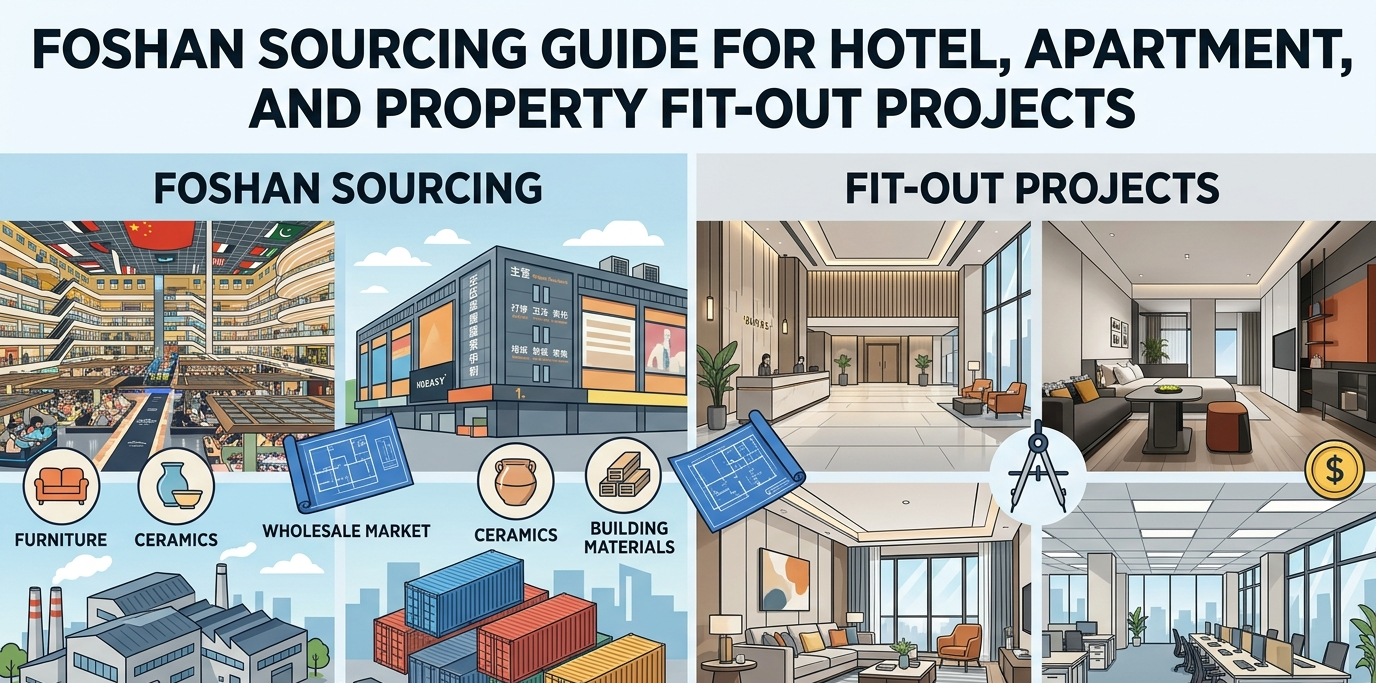
Foshan is not just a city with factories; it is a highly specialized industrial cluster where adjacent districts focus on complementary building categories. This geographical concentration forms a complete supply chain for property interiors:
- Lecong and Longjiang: Globally recognized for commercial and residential furniture, upholstery, and custom joinery.
- Shiwan and Nanzhuang: The epicenter of China’s ceramic tile and porcelain slab manufacturing.
- Nanhai District: The primary hub for architectural aluminum profiles, windows, doors, and hardware.
- Chancheng: Specialized in sanitary ware, bathroom fixtures, and lighting.
Instead of flying across different provinces or countries to vet suppliers for tiles, then windows, and then beds, procurement teams can evaluate the entire physical supply chain within a 50-kilometer radius. This proximity drastically reduces the time and cost associated with supplier auditing and sample approval.
How Does Centralized Sourcing Reduce Project Supply Chain Risks?
When a project relies on fragmented suppliers, the failure of one factory can halt the entire construction timeline. For example, if interior doors from one region are delayed, the flooring and painting contractors on site cannot complete their work.
Centralizing procurement in Foshan mitigates this risk through unified logistics. Instead of managing multiple Less-than-Container Load (LCL) shipments from different ports, a localized sourcing strategy consolidates materials into Full Container Loads (FCL). You can pair heavy pallets of floor tiles with lightweight, high-volume items like mattresses or acoustic paneling in the same container. This “heavy-light” nesting maximizes container volume and weight limits, reducing the overall landed cost of the materials.
What Are the Quality Control Challenges in Multi-Category Procurement?
Managing quality across diverse material categories requires specific technical knowledge for each product. The QC checklist for an aluminum window (measuring PA66 thermal breaks and glass seal integrity) is entirely different from the QC process for a hotel sofa (verifying foam density and Martindale abrasion ratings for fabric).
A major risk in whole-project sourcing is aesthetic mismatch. A designer may specify “brushed brass” for bathroom fixtures, door handles, and furniture legs. If these are produced by isolated factories in different provinces, the final finishes will inevitably clash. By operating within Foshan, physical color swatches and master samples can be carried directly between the metalwork factory, the door manufacturer, and the furniture supplier to guarantee uniform finishing across the entire project scope.
How Do You Manage Lead Times for a Full Hotel or Apartment Fit-Out?
A commercial property fit-out is highly sequential. Delivering loose furniture to a site before the drywall and paint are finished results in damaged goods and wasted storage fees.
A structured procurement plan aligns factory lead times with your specific construction schedule:
| Construction Phase | Sourcing Category | Required Production Lead Time |
| Phase 1: Shell & Core | Custom Windows, Exterior Doors, Structural Glass | 35 – 45 Days |
| Phase 2: Wet Works | Floor/Wall Tiles, Bathtubs, Sanitary Ware | 20 – 30 Days |
| Phase 3: Fixed Fit-Out | Interior Doors, Custom Cabinetry, Wardrobes | 30 – 40 Days |
| Phase 4: FF&E | Loose Furniture, Lighting, Soft Furnishings | 25 – 35 Days |
A local Foshan team manages this sequencing by holding finished goods in a central consolidation warehouse, releasing containers for export only when the project site is ready to receive and install that specific category of materials.
Why Choose HSY Sourcing for Your Project Procurement?
At HSY Sourcing, we act as your dedicated procurement office stationed directly inside the Foshan manufacturing cluster. We specialize in managing the complexities of one-stop interior solutions for commercial property developments.
- Direct Factory Access: We bypass trading companies to negotiate directly with the specialized manufacturers in Lecong, Nanhai, and Shiwan, ensuring your budget goes into material quality, not middleman markups.
- Cross-Category Expertise: Our engineering and QC teams possess the technical capability to audit everything from the extrusion thickness of aluminum windows to the fire-retardant certifications of hotel carpets.
- Logistical Consolidation: We manage the collection, warehousing, and optimized container loading of your entire project inventory, delivering a single, organized shipment timeline.
- Risk Mitigation: We enforce strict Quality Control protocols—including pre-production sample approvals and on-site factory loading supervision—to ensure what arrives at your site perfectly matches your approved Bill of Quantities (BOQ).
Visit www.hsysourcing.com to share your project specifications and floor plans, and let our team structure a consolidated procurement strategy for your development.
Frequently Asked Questions (FAQ)
Q: Can we source custom-designed furniture and joinery rather than standard catalog items?
A: Yes. Foshan excels at OEM manufacturing. We routinely work with interior designers’ CAD drawings and 3D renderings to produce bespoke hotel cabinetry, wardrobes, and loose furniture tailored precisely to your floor plans.
Q: Do you help verify that building materials meet our local building codes?
A: We require all partner factories to provide the necessary certification reports (such as CE, AS2047 for windows, or specific fire-ratings for upholstery) before initiating bulk production. We cross-check these against the requirements you specify for your target country.
Q: What is the typical payment structure for a multi-category project order?
A: Generally, factories require a 30% deposit to begin production, with the 70% balance paid after goods pass final Quality Control inspection and before container loading. We manage this disbursement process systematically to protect your capital.