
For international real estate developers, hospitality procurement executives, and commercial general contractors, kitchen cabinetry is one of the most complex line items in a fit-out budget. Cabinetry is not loose furniture; it must integrate perfectly with appliances, plumbing lines, electrical runs, and stone countertops while withstanding years of high-frequency physical wear and humidity.
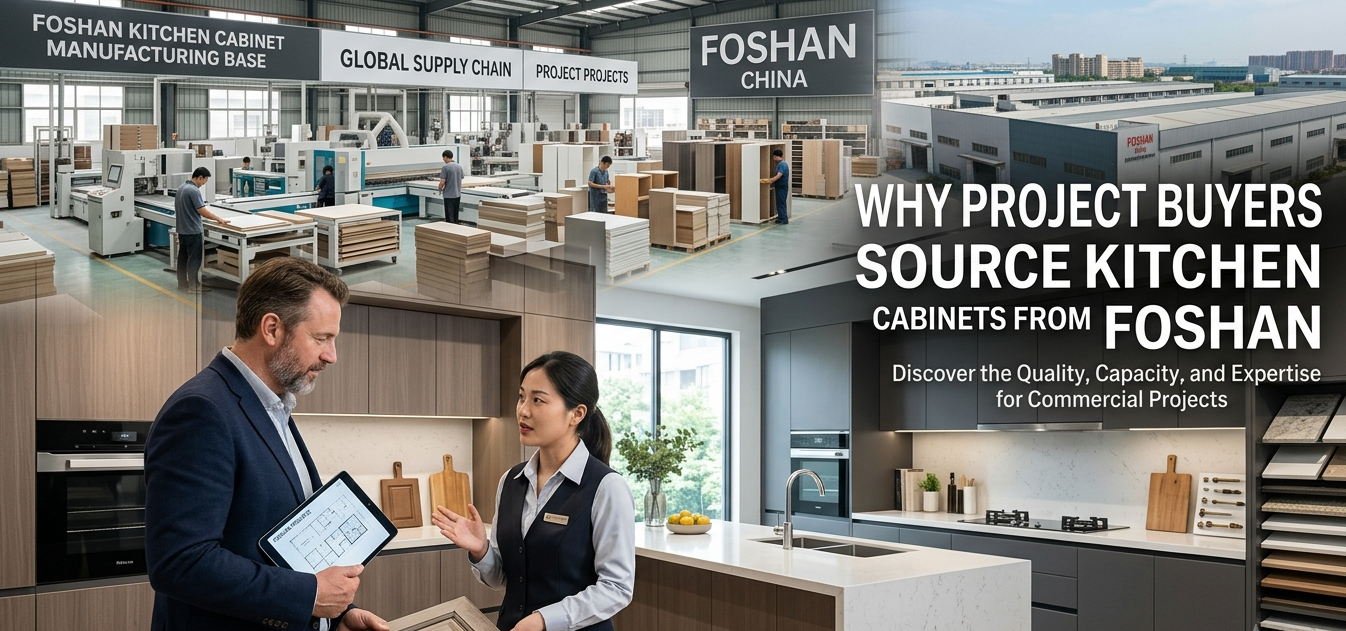
To control budgets and ensure product uniformity across hundreds of identical units, project buyers increasingly bypass domestic distributors and source directly from China. Within China, Foshan—specifically the Shunde district—stands as the undisputed capital for commercial cabinetry and custom joinery.
This guide provides an objective, technical analysis of why institutional project buyers focus their kitchen cabinet supply chains within the Foshan industrial cluster and how to successfully manage the procurement process.
Key Takeaways
- Industrial Supply Chain Density: Sourcing in Foshan eliminates middleman markups by placing raw board processors, lacquer lines, and hardware manufacturers within a $30\text{ km}$ municipal radius.
- Machinery-Driven Precision: Top-tier Foshan OEM factories utilize automated CNC nesting lines (such as German Homag systems) to maintain structural tolerances of under $\pm0.5\text{ mm}$ across large-scale runs.
- Comprehensive Substrate Customization: Buyers can contractually specify distinct core materials for dry and wet cabinetry zones—such as high-density Melamine Faced Chipboard (MFC) for carcasses and multi-layer plywood with PUR bonding for under-sink units.
Why does the geographical concentration of Shunde’s cabinet manufacturers lower ex-works pricing?
In manufacturing logistics, the physical distance between component suppliers directly dictates production lead times and overhead costs. If a cabinetry factory must ship raw core boards from one province, decorative PVC laminates or timber veneers from another, and structural hardware from a third, the cumulative transport fees and coordination delays are built into your final quote.
Foshan, particularly the Shunde district, operates as a hyper-dense, vertically integrated manufacturing hub for millwork and cabinetry. Within Shunde and its immediate surrounding districts, you will find:
- Board Extrusion and Pressing Mills: Processing raw timber fibers into high-density MDF, MFC, and plywood sheets.
- Advanced Surface Finishing Facilities: Automated UV lacquer curing lines, PVC vacuum-press lines, and wood veneer dye shops.
- The Global Hardware Hub: Leliu town in Shunde produces a massive percentage of the world’s functional hinges, drawer glides, and mechanical pull-out organizers.
- Machinery Fabricators: Local factories producing heavy-duty edge-banders, CNC boring machines, and automated packaging lines.
Because these upstream and downstream suppliers operate on the same municipal grid, a cabinet manufacturer in Shunde can receive raw raw materials, custom-finished door panels, or specialized hardware within hours. For an international project buyer, this geographical density eliminates domestic long-haul freight costs, removes trading-house markups, and compresses production lead times down to a predictable $30\text{-to-}45\text{-day}$ cycle.
How do automated CNC nesting lines ensure dimensional accuracy for multi-unit projects?
On a large-scale real estate project, such as a 150-unit apartment block or a 200-room hotel, a deviation of even $2\text{ mm}$ in cabinet panel sizes can cause catastrophic installation delays on-site. Traditional manual cutting and panel-saw routing introduce human error, resulting in cabinet boxes that are out of square, misaligned drawer glides, and uneven door gaps.
The leading OEM manufacturers in Foshan prevent these errors by investing heavily in computerized automation.
[CAD/CAM Shop Drawings] ➔ [Direct Code Upload to CNC] ➔ [Automated Panel Cutting & Boring] ➔ [Precision Edge-Banding]
When you approve the technical shop drawings, the data is fed directly into integrated CAD/CAM software linked to automated CNC Nesting and Boring Lines (predominantly high-end German Homag or top-tier domestic KDT machinery).
- Sub-Millimeter Tolerances: The machine cuts, bores structural dowel holes, and routes hinge pockets in a single continuous operation, keeping dimensional variances below $\pm0.5\text{ mm}$.
- Consistent Batch Quality: Because the process is digital, the last cabinet panel produced on day 30 is identical to the first panel cut on day 1. This level of precision ensures that on-site installation proceeds rapidly without requiring expensive manual adjustments by local carpenters.
What material specifications should be written into the cabinetry contract to prevent structural failures?
A kitchen cabinet that looks flawless in a digital rendering can deteriorate rapidly if the material chemistry is substandard. To protect your investment, your purchase contract must contain precise, measurable technical parameters rather than relying on vague terms like “export grade” or “commercial quality.”
Your contract specifications should mandate the following thresholds:
1. High-Density MFC Carcasses (Dry Zones)
For standard cabinet carcasses and shelves, specify Melamine Faced Chipboard (MFC) with a core density of $\ge 720\text{ kg/m}^3$ and a panel thickness of $\ge 18\text{ mm}$. Low-density particleboard ($<600\text{ kg/m}^3$) will sag under the heavy static load of stone or quartz countertops and lacks the screw-holding capacity required to keep hinges tight over years of use.
2. Multi-Layer Plywood Carcasses (Wet Zones)
For high-moisture cabinet zones—specifically the under-sink carcasses—ban the use of standard chipboard or MDF. Enforce Multi-layer Plywood bonded with WBP (Water Boil Proof) phenolic adhesives, and require an integrated aluminum foil shield on the bottom panel. This construction prevents swelling and board splitting when plumbing fixtures eventually leak.
3. Polyurethane (PUR) Hot-Melt Edge-Banding
Standard budget cabinets use cheap, water-based EVA (Ethylene Vinyl Acetate) adhesives to seal panel edges. EVA is a thermoplastic glue that softens when exposed to ambient kitchen steam, heat from ovens, or dishwasher exhaust, leading to peeling edge strips and subsequent moisture absorption.
Your contract must specify PUR Hot-Melt Edge-Banding. PUR forms an irreversible chemical bond with the wood fibers that will not re-soften or release when exposed to moisture or temperatures up to $120\text{°C}$.
How does physical mockup testing mitigate the risk of appliance and utility misalignment?
The most expensive mistake in international cabinetry procurement is releasing mass production based solely on 2D blueprints. A CAD drawing cannot account for actual utility tolerances, physical plumbing trap clearances, or specific appliance ventilation requirements.
To prevent overseas errors, you must establish a mandatory technical gate: a 1:1 scale physical prototype kitchen constructed directly on the factory floor using your exact specified substrates, finishes, and functional hardware.
- Appliance Dry-Fitting: Drop your specified project appliances (ovens, dishwashers, cooktops, range hoods) directly into the prototype openings. This allows you to verify that ventilation channels, face-panel clearances, and electrical plug access lines are aligned.
- Plumbing Alignment: Physically trace where the water supply, drains, and angle valves pass through the cabinet backboards. This allows the factory to pre-cut clean utility openings with finished grommets, eliminating messy, manual on-site cutting.
- Color Temperature Matching: View your chosen door finishes (such as high-gloss lacquer, PET films, or timber veneers) under calibrated D65 color-matching lights. This ensures that cabinet fronts, side panels, and filler strips match perfectly across different raw material runs.
Why Choose HSY Sourcing?
Navigating the industrial zones of Shunde to secure competitive pricing while maintaining rigid quality standards requires a dedicated, technically competent local partner. HSY Sourcing operates as your on-the-ground procurement, engineering, and quality control office in China.
- Absolute Independence: We maintain zero factory alliances and accept no supplier commissions. We operate entirely on a transparent service-fee framework, ensuring your development team has direct access to true factory-floor pricing.
- On-the-Line Quality Control: We do not rely on factory progress reports or check cartons only at the warehouse dock. Our QC engineers visit the factory floors in Shunde to physically verify core wood moisture content (target: $8\%\text{-}12\%$), measure board thicknesses with digital calipers, check PUR edge-banding adhesion, and verify hardware authenticity before mass packaging.
- Cross-Category Finish Matching: Kitchen cabinets, interior doors, and wall panels must coordinate visually. We physically transport master control samples between your independent cabinet, door, and millwork manufacturers in Foshan, ensuring a seamless color and grain match across your entire property fit-out.
- Engineered Container Consolidation: Cabinetry is highly volumetric. At our local staging facilities, we design and execute density-stratified load plans. We load heavy building materials like porcelain floor tiles or quartz countertops on the container floor, layering your flat-packed cabinetry safely on top to maximize container utilization and lower landed shipping costs.
Frequently Asked Questions (FAQ)
How does climate change impact wood panels exported from Southern China?
Foshan has a humid, subtropical climate, whereas your project site might be dry or highly climate-controlled. If raw cabinet boards absorb excess moisture during fabrication, they will shrink at the destination, causing warped doors and loose hinge screws. We solve this by contractually enforcing a target wood core moisture level of 8% to 12% at the factory floor before panels are sealed and packed.
How can we confirm that the factory is using authentic E0-grade timber boards?
We do not rely on emailed PDF certificates. Our QC team audits the raw material delivery manifests directly at the factory intake gate to match the incoming boards with their certified batch testing logs. Additionally, we check for branded core stamps and edge markings on the raw, uncut sheets on the production floor.
Should we order project cabinetry pre-assembled or flat-packed?
Flat-pack (Ready-to-Assemble/RTA) cabinetry takes up significantly less container space (CBM), lowering your ocean freight bill. However, it requires intensive on-site assembly, which increases local labor costs. We analyze your destination labor rates against ocean freight indexes to recommend the most cost-effective approach for your project.
How are custom countertop cutouts managed when sourcing cabinetry from Foshan?
We recommend sending the exact CAD/DXF sink and cooktop templates provided by your appliance manufacturers directly to the stone fabrication yard in Foshan. We cross-verify the countertop templates against the cabinet carcass drawings during the 1:1 physical mockup phase, ensuring a perfect drop-in fit on-site.