

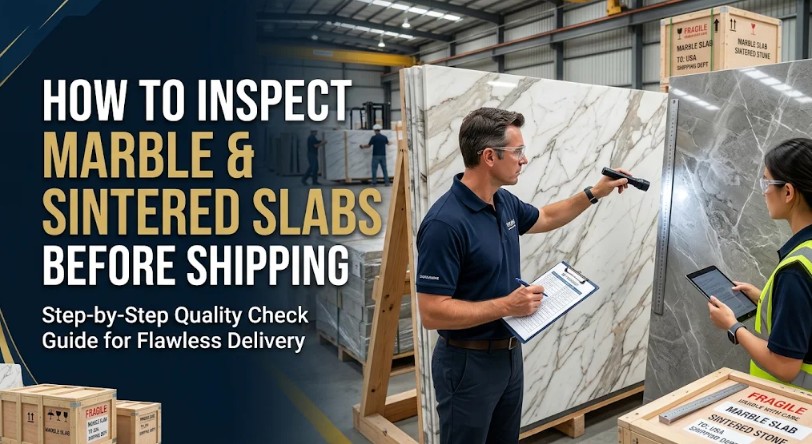
Once marble or sintered stone slabs are packed and shipped internationally from China, correcting a visible problem becomes significantly more difficult and costly. However, a pre-shipment inspection is not designed to make natural stone unnaturally uniform or to eliminate every future site challenge.
A thorough pre-shipment inspection answers four practical questions:
- Is this the exact material that was approved?
- Is the quantity and size sufficient for the project’s room-by-room requirements?
- Are there visible or measurable defects that should be addressed before the material leaves China?
- Are the slabs packed, labeled, and documented properly for international transport?
Natural marble and manufactured sintered slabs require different inspection standards. While natural stone variation is expected and should not be treated as a defect, sintered slabs require strict manufacturing consistency. By verifying these details before shipment, private villa owners, architects, and sourcing representatives can mitigate risk before international transit.
1. Start With the Approved Reference, Not the Slabs
Inspection should always begin with documentation and approved references rather than subjective visual impressions. A visually striking slab can still be incorrect for a project if it does not match the agreed specification.
Inspectors should compare physical slabs against:
- Approved physical samples or colour boards.
- Supplier quotations and formal purchase orders.
- Material schedules, Bill of Quantities (BOQ), and room-by-room application lists.
- Slab photographs, stone codes, and quarry or source information.
- Approved CAD drawings, elevations, and slab layouts.
Discrepancies often occur not because the stone is poor, but because specifications were mismatched during production. Common issues include the correct colour in the wrong stone type, the correct material in an incorrect finish, insufficient quantities, or wrong thicknesses for specific applications. Verification must begin with documentation.
2. Confirm the Stone Type, Code and Quantity
Before conducting a detailed visual inspection, verify that the physical inventory matches the procurement schedule.
For Natural Marble
- Verify the commercial stone name and supplier or quarry information if contractually specified.
- Check individual slab identification numbers against the packing list.
- Confirm total quantity, slab dimensions, thickness, and surface finish.
For Sintered Slabs
- Verify product names, manufacturer codes, and series specifications.
- Confirm colour, surface finish, exact slab dimensions, thickness, and total quantity.
- Check batch or production information where applicable.
Quantity verification is particularly critical for villas. A project typically requires precise stone allocations across multiple areas such as kitchen islands, worktops, bathroom walls, flooring, staircases, feature walls, and vanity tops. If bookmatching or directional veining is required, having the correct number of slabs is insufficient; the sequence, orientation, and pairing must also be verified.
3. Inspect Slab Dimensions and Thickness
Slab dimensions must be checked against order requirements and intended applications. Verify length, width, thickness, squareness, flatness, and dimensional consistency across multiple slabs.
Acceptable tolerances should be evaluated against:
- The supplier’s agreed technical specification.
- Published manufacturer tolerances where available.
- Project fabrication requirements and local installation methods.
In large-format villa applications, small dimensional discrepancies compound quickly. A variance of a few millimeters can disrupt alignment across large kitchen islands, long walls, continuous bathroom elevations, floor layouts, and bookmatched feature walls.
4. Inspect Marble for Natural Variation and Visible Defects
Natural marble must not be inspected as if it were a factory-made uniform product. Natural stone possesses inherent variations that form part of its character.
Colour and Background
Compare the physical slabs against the approved selection. Look for unexpected differences in base colour, background tone, secondary colours, and veining intensity.
Veining
Determine whether the physical slabs broadly correspond to the approved selection and intended layout. Natural vein variation is expected and should not be categorized as a defect.
Cracks and Fissures
Inspectors must distinguish between natural veining, hairline fissures, open cracks, repaired cracks, and filled areas. Hairline fissures and resin-filled areas are common in many marbles and may be structurally stable. Visible cracks or structural weaknesses should be recorded and evaluated to determine if they compromise the intended application, such as unsupported kitchen overhangs or high-traffic flooring.
Surface Condition
Check for scratches, dull patches, polishing inconsistencies, staining, edge damage, chips, or handling marks resulting from factory movement.
5. Inspect Sintered Slabs Differently
Sintered slabs are manufactured panels rather than natural blocks and require a more objective evaluation framework.
- Check product codes, colours, surface finishes, and printed pattern alignment.
- Verify pattern consistency, thickness, dimensions, and panel flatness.
- Inspect corners, edges, and surfaces for scratches, chips, stains, or production flaws.
When multiple sintered slabs are specified for an open space, compare them side by side to ensure the visual relationship between panels is acceptable. For large-format feature walls or bookmatched porcelain designs, verify that pattern direction and sequence match the approved shop drawings. Do not assume all slabs from the same product series are visually identical unless guaranteed by the manufacturer.
6. Check the Surface Finish Under Proper Lighting
Photographs can hide surface irregularities and gloss inconsistencies. Slabs should be inspected under appropriate lighting conditions and from multiple viewing angles.
- Polished Natural Stone: Inspect reflections across the surface to reveal uneven polishing marks, hairline scratches, texture inconsistencies, or surface waviness that remain invisible in flat photographs.
- Textured or Matte Sintered Surfaces: Use directional lighting to detect surface scratches, production abrasions, or gloss contamination.
No single lighting setup reveals every surface condition; moving around the slab under natural or adjustable task lighting is essential.
7. Inspect Edges and Corners Carefully
Slabs are vulnerable around edges and corners during cutting, handling, storage, loading, and packing.
Inspectors should check for:
- Edge chips, broken corners, and edge cracks.
- Uneven edge finishing or visible impact damage.
While stone fabricators trim edges during on-site installation or shop fabrication, edge damage can reduce the usable dimension of a slab or create structural weaknesses. Document damage and verify with the project fabricator whether the affected area can be safely avoided during cutting.
8. Check Bookmatching and Slab Sequence Before Packing
For projects utilizing bookmatched marble or coordinated vein sequencing, inspection must extend beyond individual slabs to verify the complete layout.
- Verify correct slab pairs, sequence, orientation, and vein direction.
- Confirm visual continuity and check individual slab identification markings.
When practical, photograph slabs arranged in their intended sequence. Once packed and separated in crates, reconstructing the sequence at the destination becomes challenging. While final fabrication and cutting plans depend on accurate site measurements, verifying the sequence before export prevents misaligned shipments.
9. Check the Slabs Against the Actual Project Application
Inspection must account for where and how the stone will be installed. Different applications demand specific performance and dimensional considerations:
- Kitchen Countertops: Verify suitability, thickness, dimensions, cut-out areas, and edge finishes.
- Bathroom Walls: Prioritize slab size, surface condition, moisture considerations, and pattern matching.
- Flooring: Confirm thickness tolerances, slip resistance ratings, surface conditions, and installation system requirements.
- Staircases: Check precise dimensions, anti-slip details, edge treatments, and fabrication allowances.
- Feature Walls: Focus on visual continuity, vein direction, and sequence integrity.
- Outdoor or Exposed Areas: Confirm that the stone type and finish suit local environmental conditions.
Technical suitability should be confirmed by relevant professionals, architects, or stone fabricators before material release.
10. Photograph and Record Every Important Finding
An inspection record requires structured documentation rather than a disorganized folder of photographs.
For each inspected slab, record:
- Individual slab ID and product code.
- Measured dimensions and thickness.
- General condition, surface finish, and quantity.
- Intended room or application.
Photographic records should include full-slab views, close-ups of slab identification tags, detailed shots of any identified defects with a scale reference, edge conditions, and sequential photos for bookmatched layouts. Linking every photograph to a specific slab ID ensures clear communication with suppliers.
11. Decide Which Problems Need Correction Before Shipping
Inspection findings should be categorized to guide practical decision-making:
- Accept: The condition aligns with the approved specification and intended application.
- Review: The condition requires clarification with the homeowner, designer, or fabricator before shipment.
- Reject / Correct Before Shipping: The material fails to meet agreed specifications, exhibits severe damage, or presents an installation risk.
Acceptance thresholds must account for natural stone variation versus manufacturing defects. Decisions should rely on contractual purchase specifications rather than subjective judgment.
12. What Happens If a Problem Is Found Before Shipping?
When a non-conformance is identified, follow a structured resolution sequence:
- Document the issue thoroughly with reference photos and measurements.
- Match the affected slab against the approved purchase order and specification.
- Notify the supplier in writing with clear supporting evidence.
- Determine whether replacement, repair, selection adjustment, or re-cutting is appropriate.
- Confirm corrective actions in writing and re-inspect replacement material.
- Update packing lists and shipping documentation.
For villa projects, requesting a replacement slab requires caution. Natural replacement slabs may display different background tones or veining patterns, altering the overall visual continuity of a matched room layout.
13. Inspect Packing and Labeling Before the Slabs Leave China
Packaging quality dictates whether inspected slabs arrive undamaged. Inspection must encompass export preparation:
- Verify slab identification numbers, quantities, and crate conditions.
- Check protective interleaving materials, edge protectors, and strapping.
- Confirm room or project identification labels, packing lists, and clear shipping marks.
For large-format natural and sintered slabs, robust packaging is vital. Crates must be fumigated (where required), structurally sound, properly braced, and loaded securely to withstand multi-modal international transport.
14. What a Pre-Shipment Inspection Cannot Tell You
Pre-shipment inspection has inherent limitations and cannot guarantee:
- Final on-site installation quality or substrate preparation.
- Site measurement accuracy relative to architectural drawings.
- Future breakage caused by rough handling during local transport or unloading.
- Long-term performance under untested environmental conditions.
- Final aesthetic results after site fabrication, cutting, and lighting installation.
For natural stone, inspection cannot eliminate natural variations. For sintered slabs, visual inspection cannot replace certified technical performance testing for specific engineering requirements. The goal of pre-shipment inspection is risk reduction prior to export.
15. Should You Inspect Marble and Sintered Slabs Yourself or Use a Local Inspection Team?
Inspection responsibility depends on project scale, location, and expertise:
- Homeowner Inspection: Suitable if the buyer is present in China and familiar with stone characteristics.
- Designer or Architect Inspection: Ideal when aesthetic design intent, bookmatching, and layout coordination are paramount.
- Sourcing Representative: Useful when international buyers require local coordination, supplier communication, and physical verification.
- Independent Inspection Company: Appropriate when a third-party evaluation against defined criteria is required.
Selecting the right inspection approach depends on project value, material complexity, and the potential consequences of receiving non-conforming materials.
Practical Pre-Shipment Marble and Sintered Slab Checklist
| Category | Inspection Item | Status / Action |
| Material Identity | Correct stone name or product code | [ ] Verified |
| Correct colour, background, and finish | [ ] Verified | |
| Correct quantity and thickness | [ ] Verified | |
| Correct dimensional tolerances | [ ] Verified | |
| Visual Condition | Colour and vein appearance reviewed | [ ] Approved |
| Cracks, fissures, and filled areas assessed | [ ] Approved | |
| Surface scratches and polish checked | [ ] Approved | |
| Edges and corners inspected for chips | [ ] Approved | |
| Project Coordination | Slab sequence confirmed for matching | [ ] Confirmed |
| Intended room application reviewed | [ ] Confirmed | |
| Documentation | Individual slab IDs recorded | [ ] Completed |
| Inspection photos and defect logs saved | [ ] Completed | |
| Packing & Shipping | Crate structure and protection checked | [ ] Approved |
| Packing lists and shipping marks verified | [ ] Approved |
Frequently Asked Questions
What should I check before shipping marble slabs from China?
Verify material identity, quantity, dimensions, thickness, surface finish, edge condition, visual characteristics, veining consistency, documentation, and crating quality.
How do I inspect natural marble without rejecting normal variation?
Distinguish between natural veining, colour movement, and structural defects such as open cracks or unacceptable damage. Natural variation is an inherent feature of quarried stone.
What should I check when inspecting sintered stone slabs?
Focus on exact product codes, dimensions, thickness, surface flatness, printed pattern consistency, edge and corner integrity, and freedom from manufacturing defects or scratches.
Should I inspect every marble slab before shipping?
For high-value luxury villa projects, comprehensive slab inspection is strongly recommended to verify that every piece aligns with project requirements and layout schedules.
Can a factory replace a defective marble slab before shipping?
Yes, provided the supplier agrees and replacement stock is available. Replacement slabs should be re-inspected to ensure visual and batch consistency with the rest of the order.
Is a pre-shipment inspection enough to guarantee the stone arrives safely?
No. Inspection confirms condition prior to departure, while transport, handling, and site offloading introduce additional variables that require proper logistics management.
Key Takeaways
- Inspect physical slabs against approved references rather than relying on general expectations.
- Apply different criteria for natural marble versus manufactured sintered slabs.
- Verify dimensions, thickness, surface condition, edges, quantity, and visual attributes systematically.
- Inspect slab sequence and orientation for bookmatched or large feature installations.
- Document findings thoroughly with clear slab identification before packing.
- Resolve significant discrepancies before international shipment whenever practical.
How HSY Sourcing Can Help
For international villa owners and developers sourcing building materials from China, coordinating quality control remotely presents logistical challenges. HSY Sourcing operates locally in Foshan and Guangdong to help bridge the gap between overseas buyers and Chinese manufacturers.
For villa stone procurement, HSY Sourcing coordinates:
- Supplier pre-screening and quotation comparison.
- Specification and purchase order confirmation.
- Collection and review of physical material samples.
- Factory or warehouse visits and physical slab inspections according to agreed criteria.
- Photographic documentation and defect reporting.
- Supplier follow-up and corrective action coordination.
- Cargo consolidation, packaging verification, and shipping coordination.
Technical suitability for specific architectural applications should always be confirmed by your architect, interior designer, or stone fabricator. HSY Sourcing provides structured on-the-ground coordination in China so you can verify your stone materials before they leave the factory floor.
If your villa project has a stone schedule, BOQ, approved samples, or room-by-room material requirements, contact HSY Sourcing to discuss how we can help coordinate your supplier communication, pre-shipment inspection, and shipping logistics.