
You have signed off on architectural drawings, reviewed 3D renders with your interior designer, and built a detailed Bill of Quantities (BOQ) for your new villa. Now comes the operational reality.
Instead of buying everything under one roof, your kitchen cabinets come from a specialized joinery workshop in Foshan, your aluminium window systems are fabricated in a plant two districts away, your natural marble is selected from a stone market, and your loose furniture, lighting, sanitary ware, and interior doors are scattered across separate production bases.
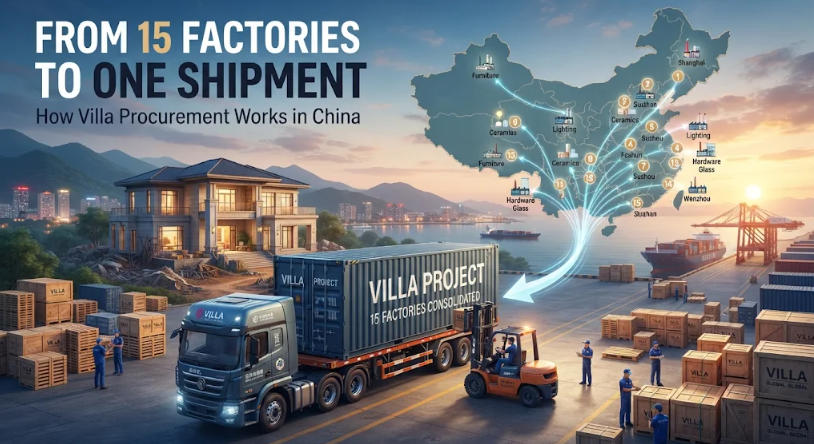
Multiply those categories across roughly 15 different suppliers, and you arrive at a critical operational question: Who is actually making sure that these independent factory orders become one organized, workable shipment?
Consolidating custom villa products from multiple Chinese factories is not simply a matter of renting a warehouse and telling suppliers to drop off their boxes. For a high-value residential build or major renovation, bridging the gap between separate factory floors and a single export container requires a structured project management system.
Why a Whole Villa Rarely Comes From One Factory
In commercial construction or large-scale real estate development, buyers often look for single-source suppliers to minimize administrative overhead. For a custom luxury villa, however, sourcing everything from one manufacturer is rarely practical.
No single factory excels at everything. A cabinet maker skilled in custom lacquer finishes and bespoke joinery rarely produces high-performance thermal break aluminium windows. A stone yard holding unique marble slabs does not manufacture upholstered dining chairs or architectural lighting. While working with specialized vendors allows you to source higher-quality products matched to your design intent, it creates a distinct trade-off: more supplier choices mean more coordination work.
Using 15 different suppliers does not just mean choosing 15 products—it means managing 15 separate production schedules, communication chains, quality standards, and delivery methods.
What “15 Factories” Actually Means in a Villa Project
When people talk about sourcing from “15 factories,” they are usually referring to product categories rather than a neat, uniform row of suppliers. In a real villa project, those 15 suppliers operate at entirely different speeds and scales.
To keep the project moving forward without constant confusion, someone has to track the lifecycle of every single order. For each supplier, you need real-time clarity on:
- Legal entity name, factory location, and primary contact
- Specific villa room assignment (e.g., Master Suite, Ground Floor Kitchen, Guest Bathrooms)
- Approved shop drawings, material specifications, and finish samples
- Exact itemized quantities and hardware inclusions
- Production status and estimated completion dates
- Packaging specifications (cartons, wooden crates, steel A-frames)
- Agreed inspection requirements and delivery schedules
- Warehouse receiving and staging status
Without a central tracking mechanism, a homeowner or designer is forced to piece together project updates from dozens of disconnected WeChat threads, emails, and spreadsheets.
The Villa Procurement Master List
To turn 15 independent supplier relationships into a single project, you need a master procurement tracker. This is not a simple shopping list; it is a live operational document that connects every stage of the procurement cycle.
| Product Category | Supplier | Approved Specs | Production Status | Next Action |
| Kitchen Cabinets | Factory A | Shop drawings signed | In production (Cabinet carcases) | Confirm completion milestone |
| Wardrobes & Joinery | Factory B | Drawings approved | Material preparation | Schedule veneer inspection |
| Aluminium Windows | Factory C | Profiles & glass confirmed | Ready | Arrange factory QC & transport |
| Marble Slabs | Supplier D | Slabs selected & marked | Cutting & dry-lay | Confirm crating requirements |
| Loose Furniture | Factory E | Fabrics & dimensions approved | Upholstery in progress | Check upholstery status |
The purpose of this master list is simple: it shows how separate manufacturing streams converge into a unified delivery plan.
The First Coordination Problem: Specifications
Factories cannot coordinate what has not been rigorously specified. In custom residential design, a supplier may manufacture a product perfectly according to their own shop drawing, yet the finished item can still create a coordination failure on site if it clashes with an adjacent trade.
Consider how different custom elements interact during procurement:
- Kitchen cabinet dimensions must align precisely with built-in appliance electrical and plumbing rough-ins.
- Window and door frame dimensions must match exact structural masonry or steel openings.
- Stone flooring thicknesses must match finished floor levels set by doors and baseboards.
- Wardrobe heights must clear dropped ceilings or AC soffits.
Resolving these dimensional tolerances requires catching discrepancies before production begins, rather than discovering them when goods arrive at the villa site.
The Second Coordination Problem: Different Factory Timelines
Fifteen independent suppliers will almost never finish production at the exact same time. Some workshops operate on shorter lead times for stock-based components, while custom joinery or specialized metalwork takes weeks longer.
Furthermore, “factory says finished” does not mean “ready to ship.” When a factory completes manufacturing, several intermediate steps remain:
- Final cleaning, hardware sorting, and protective wrapping.
- Preparing an itemized packing list with accurate carton counts and gross weights.
- Conducting any pre-shipment quality checks.
- Arranging local trucking from the factory gate to the consolidation warehouse.
Production timelines vary widely depending on the product category, level of customization, order volume, and factory workload. Assuming all 15 suppliers will hit the exact same target date is a recipe for project delays.
What Happens When the First Factories Finish Early?
When early-finished goods sit in a factory workshop, they are vulnerable to dust, accidental damage, or being moved around congested factory floors. However, shipping them immediately to your destination country before other items are ready results in multiple costly partial shipments (LCL) and fragmented deliveries.
Instead, a coordinated procurement plan allows early-finished products to be safely received, inspected, and held in a dedicated export holding warehouse near the manufacturing hubs. This protects the goods, clears factory space, and lets you accumulate a complete, balanced shipment phase.
What Happens When One Factory Is Late?
In a multi-supplier project, delays happen. If 14 suppliers finish on schedule but the custom interior doors or specialized kitchen panels are delayed by three weeks, you face a logistical decision:
- Wait for the delayed cargo: Hold the completed goods at the warehouse until the missing items arrive, accepting minor storage costs in exchange for receiving a complete shipment.
- Ship in phases: Dispatch the primary structural and first-fix materials (such as windows, stone, and rough-ins) so site work can proceed, while holding second-fix joinery and furniture for a later shipment.
There is no universal formula. The right choice depends on your site construction schedule, the volume of delayed cargo, ocean freight costs, and your target installation date.
From Factory to China Warehouse
Once manufacturing finishes and local transport is booked, cargo begins moving into a central consolidation facility—typically located in a manufacturing hub like Foshan, Guangdong.
For this physical transfer to succeed, clear information must travel alongside the goods. Every package delivered to the warehouse needs standardized shipping marks that identify:
- The project reference or homeowner name
- The supplier and product category
- The specific room or floor destination
- Purchase order and carton numbers (e.g., Box 12 of 30)
- Handling instructions (Fragile, Keep Dry, This Side Up)
Without clear labeling, mixing hundreds of cartons from 15 different factories turns the warehouse floor into an unmanageable puzzle.
Receiving Is Not the Same as Quality Inspection
A common misconception among overseas buyers is that warehouse receiving and quality control are the same thing. They serve entirely different functions:
- Warehouse Receiving: Staff verify that physical deliveries match advance delivery notes, count piece numbers, inspect outer packaging for visible transit damage, record dimensions and weights, and log items into the inventory system.
- Product Inspection: A technical check against approved specifications, drawings, dimensions, finishes, or hardware functionality. This can take place either at the factory before dispatch or at the warehouse, depending on the agreed inspection scope.
Receiving cargo into a warehouse does not guarantee that the product inside is defect-free. An intact outer cardboard box confirms that the box arrived safely, but it does not verify whether a marble slab has a hairline fracture or whether a custom cabinet door has the correct finish sheen. Inspection scope must be defined based on the criticality of each product.
Why Not Everything Should Automatically Go Into One Container?
It is tempting to assume that a “single shipment” means stuffing every single villa product into one 40-foot container. In practice, forcing diverse villa products into a single container can create severe physical risks.
Container strategy depends on volume, weight limits, dimensions, fragility, and unloading priorities. Certain product categories require specialized handling:
- Large natural stone slabs must travel upright on heavy steel A-frames to prevent cracking.
- Oversized aluminium windows and glass sliding doors require dedicated racking and adequate vertical clearance (often necessitating a 40-foot High Cube container).
- Upholstered loose furniture and decorative lighting cannot bear heavy loads stacked on top of them.
- Porcelain tiles and sanitary ware reach maximum weight limits long before physical container volume is exhausted.
Splitting shipments into logical phases—such as structural and exterior products first, followed by interior joinery and furniture—often protects fragile finishes and matches the physical progress of your villa build.
How Different Products Affect the Loading Plan
Container loading is an exercise in three-dimensional engineering. A well-designed loading plan evaluates six core variables:
- Weight Distribution: Heavy materials (stone, tiles, sanitary hardware) must be anchored on the floor with weight balanced evenly across the container.
- Fragility: Glass, mirrors, high-gloss finishes, and delicate joinery must be isolated where shifting cargo cannot crush them.
- Packaging Compatibility: Stackable wooden crates form a sturdy base, while soft-wrapped or irregular items belong in upper tiers or protected zones.
- Destination Unloading Sequence: Items needed first on site—or heavy crates requiring mechanical lifting equipment—must be positioned near the container doors.
- Site Access Constraints: Individual crate dimensions must be verified against local trucking and destination unloading equipment limits.
The Information Flow Behind One Shipment
The physical container arriving at your villa site is only the final output of a complex information network. Behind the scenes, a successful multi-factory shipment relies on continuous data exchange:
Plaintext
Homeowner / Designer
       │
       ▼ (Approved drawings, specs, finishes)
Procurement Coordinator (HSY Sourcing)
       │
       ▼ (Production tracking, scheduling, milestone checks)
Chinese Factories
       │
       ▼ (Packing lists, physical dispatch, transport details)
China Consolidation Warehouse
       │
       ▼ (Receiving, piece counts, labeling, staging)
Inspection / QC Team
       │
       ▼ (Verification reports, defect remediation)
Freight Forwarder & Shipping Line
       │
       ▼ (Container loading, customs clearance, ocean transit)
Your Villa Site
Managing this flow prevents communication breakdowns between independent suppliers who have no commercial relationship with one another.
Who Is Responsible for What?
Clear accountability prevents project friction. In a multi-factory villa procurement setup, responsibilities are divided among distinct parties:
- Homeowner & Design Team: Responsible for approving architectural drawings, material selections, color finishes, and purchase quantities, as well as making timely decisions when site adjustments arise.
- Manufacturers (Factories): Responsible for producing goods strictly in accordance with approved specifications, maintaining factory quality standards, and providing accurate packing details.
- Procurement Coordinator: Responsible for tracking production milestones, coordinating factory communication, arranging warehouse receiving and agreed inspections, consolidating multi-supplier cargo, and managing export logistics.
- Freight & Shipping Partners: Responsible for international transport, customs documentation, and ocean or air freight execution.
A coordinator manages the workflow and communication between these parties, but does not replace the factory’s core manufacturing responsibility.
What a Private Villa Owner Should Prepare Before Ordering
The more structured your project information is from the outset, the smoother multi-factory coordination becomes. Before engaging multiple suppliers, gather:
- Architectural floor plans, elevations, and interior design drawings
- Approved shop drawings and finish schedules
- A detailed Bill of Quantities (BOQ) where available
- Itemized product specifications and brand/material preferences
- Initial supplier lists or quotes you have already gathered
- Target procurement timelines and expected site installation dates
- Destination port, country, and any known local site delivery constraints
When Does a China-Side Procurement Coordinator Make Sense?
Coordinating multi-factory orders independently is challenging when you are based overseas. Working with a Foshan-based procurement partner makes sense under specific conditions:
- You are sourcing across multiple product categories (kitchens, windows, stone, furniture, lighting) from three or more separate factories.
- You want direct-factory pricing without trading-company markups, but need someone on the ground to manage the operational complexities.
- Your cargo volume justifies full container loads, requiring professional consolidation and loading engineering.
- You do not have local staff in China to verify production milestones, inspect incoming warehouse deliveries, or resolve factory discrepancies.
Conversely, consolidation coordination may be unnecessary if you are purchasing from only one or two suppliers who manage their own export logistics, or if your total order volume is very small.
Coordinating Your Villa Sourcing With HSY Sourcing
Operating from Foshan—the manufacturing heartland for custom joinery, furniture, and building materials in southern China—HSY Sourcing acts as an on-the-ground procurement and coordination partner for overseas villa projects.
Rather than manufacturing products, HSY manages the complex operational web that connects independent suppliers to your building site. Services include tracking production milestones across multiple factories, managing central warehouse receiving, organizing agreed quality inspections, engineering container loading plans, and coordinating international export logistics.
If you are planning a luxury villa build or major renovation and intend to source custom products from several Chinese suppliers, we can help bring your separate orders into a unified workflow.
To discuss your project requirements, share the following details with our team:
- Destination country and city
- Approximate villa size (square meters or footage)
- Available floor plans, architectural drawings, or BOQ
- Product categories you are planning to source
- Number of suppliers or factories already contacted
- Target procurement or site installation timeline