
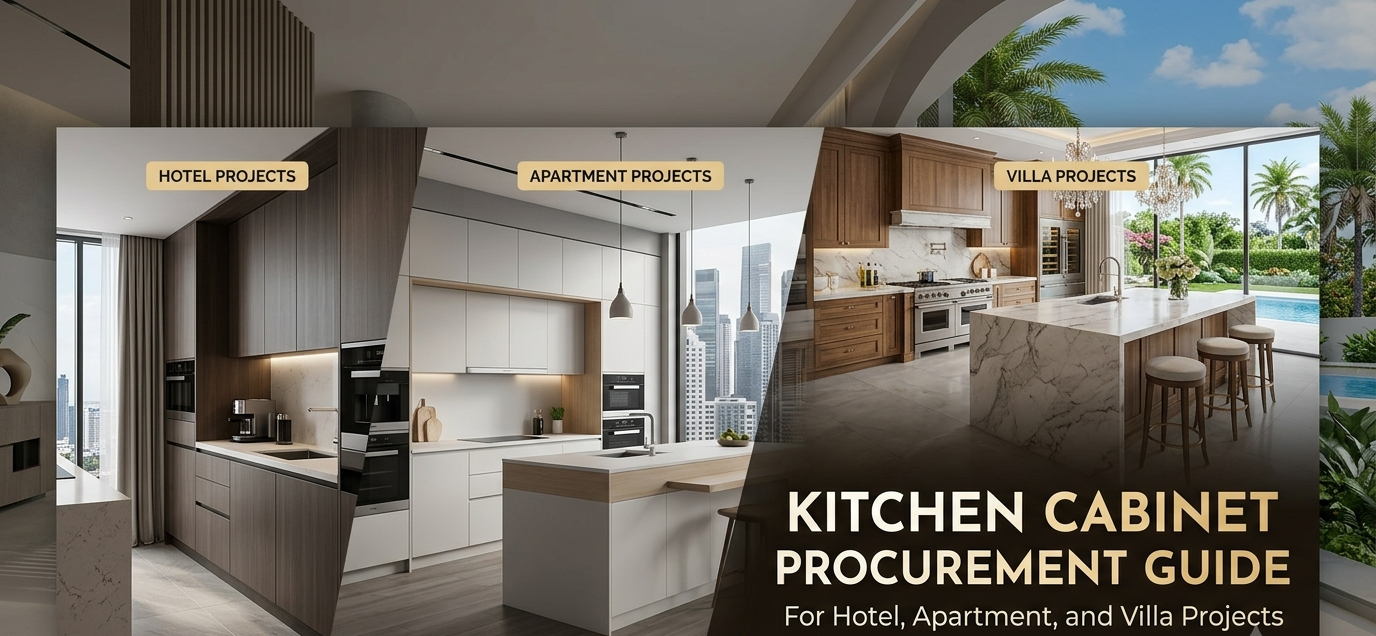
For institutional real estate developers, asset managers, and general contractors, millwork and kitchen cabinetry represent one of the most complex line items in an interior fit-out budget. Unlike loose furniture, built-in kitchen cabinets are fixed architectural components that interface directly with electrical configurations, plumbing rough-ins, and structural walls.
When managing a procurement package across 200 apartment units or a luxury resort villa portfolio, a minor dimensional variance or structural specification error cascades into massive financial damage. Discovering that a sink cutout is off by 10 millimeters or that a laminate edge band is peeling under local humidity conditions post-installation can stall handovers and invite costly on-site remediation.
The path to a seamless cabinet package relies entirely on objective technical documentation and ground-level factory floor enforcement. Leveraging the geographic density of Foshan—specifically the Shunde millwork cluster—allows international buyers to systematically eliminate specification risks prior to container loading.
Key Takeaways
- Substrate Differentiation: Tailor your base core materials strictly to your asset type. Specify moisture-resistant plywood for wet zones and high-end villas, and high-density MFC (Melamine Faced Chipboard) to optimize multi-family CAPEX budgets.
- Prioritize Hardware Cycle Ratings: Do not compromise on moving parts. Ensure your contracts mandate branded functional hardware certified for at least 80,000 to 100,000 open-close cycles to survive commercial tenant turnover.
- Enforce Environmental Compliance: Verify that all core panels carry authenticated lab reports aligning with your destination country’s emissions laws, such as CARB Phase 2 for North America or E0/E1 for Europe.
How do you choose the right cabinet substrate for different real estate tiers?
Selecting a cabinet core based on generic terms like “solid wood” or “wood composite” is a critical procurement error. Factories utilize distinct engineered boards that offer drastically different performance characteristics regarding screw-holding capacity, moisture swelling, and structural deflection.
When auditing engineering files for a commercial project, the core panels must match the specific functional demands of the target zone:
- Multi-Layer Plywood (Multi-ply): Constructed from cross-laminated wood veneers bonded with water-resistant resins. This is the mandatory standard for under-sink base cabinets, high-humidity environments, and premium villa properties due to its minimal thickness swelling when exposed directly to moisture.
- Medium-Density Fiberboard (MDF): Made from broken-down wood fibers combined with wax and resin binders under high thermal pressure. Because its surface is perfectly uniform and free of grain texture, it serves as the ideal substrate for high-gloss lacquer, polyurethane paint, and intricate CNC router profiling on decorative cabinet doors.
- Melamine Faced Chipboard (MFC) / Particleboard: Composed of wood chips and shavings compressed into a rigid core sheet. While highly vulnerable to water damage if poorly sealed, commercial-grade, high-density MFC ($>700 \text{ kg/m}^3$) wrapped in a robust melamine layer is highly cost-effective and structurally stable for overhead wall cabinets in high-density apartment builds.
Why does functional hardware choice dictate the long-term ROI of a hospitality project?
A kitchen cabinet carcass or door panel rarely fails structurally under normal use. Instead, tenant complaints and maintenance overhead are driven almost entirely by the breakdown of functional hardware components—specifically concealed hinges and drawer runners.
In a commercial apartment or busy hotel suite, kitchen drawers are subjected to repetitive kinetic stress and uneven weight loading. If a developer accepts generic, unbranded slide systems to shave a fraction of a percent off the purchasing invoice, the consequences appear within months of occupancy: sagging drawer fronts, misaligned doors, and soft-close mechanisms that stick open.
[Generic Hinge] ──────> Fails at ~20,000 Cycles ──────> Sagging Cabinet Doors & Damaged Facades
[Brand-Certified Hinge] ──> Certified to 100,000 Cycles ──> Maintains Real Estate Asset Integrity
When writing your technical specifications, require manufacturers to supply functional hardware with independent SGS verification certificates indicating compliance with international standards (such as ANSI/BHMA or EN standards). Specify tier-one brands like Blum or high-grade domestic equivalents like DTC.
Hinges must feature a minimum 3-way adjustment matrix to allow installation crews to correct minor wall deviations during field tracking, and drawer runners should utilize full-extension under-mount configurations with integrated hydraulic dampening.
What chemical emission standards must you enforce to pass local customs and inspections?
Importing large quantities of engineered timber cabinetry into strictly regulated markets like North America, Western Europe, or Australia carries significant compliance risks. Engineered cores utilize urea-formaldehyde or phenol-formaldehyde resins to bind wood particles together. Over time, these chemicals off-gas into the indoor environment.
If your ground sourcing agent fails to verify chemical baselines before production begins, you risk having the entire shipment seized at your destination port by customs authorities, or facing severe legal liability during local municipal occupancy inspections.
| Target Market Region | Mandatory Regulatory Standard | Maximum Allowable Formaldehyde Emission | Required Documentation for Compliance |
| United States & Canada | EPA TSCA Title VI / CARB Phase 2 | $\le 0.05 \text{ ppm}$ for Plywood; $\le 0.11 \text{ ppm}$ for MDF. | Validated third-party TPC certification tracking code stamped on packaging. |
| European Union | EN 13986 (E1 Standard) | $\le 0.124 \text{ mg/m}^3$ of air volume. | CE Mark declaration of conformity backed by verified laboratory testing. |
| Australia & NZ | AS/NZS 1859.1 (E0 / Super E0) | $\le 0.5 \text{ mg/L}$ (E0) or $\le 0.3 \text{ mg/L}$ (Super E0). | Independent NATA-accredited laboratory test reports matched to the specific production run. |
What step-by-step verification process prevents installation failure at the job site?
Bespoke multi-unit cabinet manufacturing requires shifting from a transactional ordering mindset to a strict, milestone-driven engineering sequence. The production lifecycle must be mapped directly against your on-site construction timelines.
1.Shop Drawing Translation and Hardware Mapping:Phase 1: Pre-Production.
We translate the architectural layout into manufacturing shop drawings detailing exact box dimensions, material callouts, plumbing line sleeve positions, and hardware clearance paths. These drawings must be signed off by the project’s lead designer before materials are ordered.
2.The 1:1 Scale Prototype Mockup Audit:Phase 2: Validation Gate.
The factory builds a full-scale physical mockup of a complete kitchen configuration. Our QC engineers test the unit for alignment, evaluate joint tolerances, check color matching under calibrated lighting, and verify that undermount sinks and appliances fit seamlessly.
3.In-Line PUR Edge-Banding and Milling Inspections:Phase 3: Active Production.
During mass production, we monitor the critical edge-banding lines. We require Polyurethane (PUR) hot-melt adhesive tracking instead of standard EVA glues for kitchen units. PUR provides superior heat and water resistance, preventing moisture from entering the core chipboard.
4.Flat-Pack vs. Rigid Packaging Strategy:Phase 4: Logistic Loading.
Based on your local site labor costs, we execute either flat-pack (RTA) packing to maximize container volume, or rigid pre-assembled packaging to accelerate field installation. Every box is marked with a unique unit/apartment number barcode to streamline sorting on-site.
Why choose HSY Sourcing as your cabinet sourcing agent in Foshan?
Navigating the dense furniture and cabinetry production clusters of Shunde requires continuous on-the-ground presence, contract tracking, and complete independence from manufacturing kickbacks. HSY Sourcing operates strictly as your dedicated procurement and engineering representative in South China, working solely to safeguard your commercial project metrics.
- Direct Access to Primary Industrial Lines: We bypass high-markup export trading fronts and decorative showrooms. We route your institutional real estate orders directly to automated primary manufacturing facilities equipped with CNC nesting machinery and automated edge-banding setups.
- Rigorous Interface Risk Control: Our engineering team acts as the bridge between your appliance vendors, stone fabricators, and cabinetry lines. We cross-verify spatial specifications to ensure your ovens, dishwashers, and range hoods slot into place without on-site modifications.
- Uncompromising Material Auditing: We conduct randomized, physical moisture monitoring and destructive bond-strength testing on active manufacturing batches, completely refusing core stock that does not align with your contract specifications.
- Engineered Container Freight Consolidation: Operating out of our local Foshan hub, we safely coordinate mixed-container loads. We place heavy masonry elements (such as quartz or sintered stone kitchen countertops) securely at the base of the container and layer flat-pack cabinetry arrays on top, optimizing your ocean freight spend while preventing transit damage.
Frequently Asked Questions (FAQ)
What is the practical difference between PUR and EVA edge banding for kitchen projects?
EVA (Ethylene Vinyl Acetate) is a conventional hot-melt adhesive that can soften if exposed to persistent heat and steam from stovetops or dishwashers, leading to peeling edge bands. PUR (Polyurethane) utilizes a chemical moisture-curing process that forms an unbreakable, water-resistant bond. We mandate PUR edge-banding for all commercial kitchen cabinets to prevent moisture from causing the internal wood particles to swell.
How do you handle dimensional variations when a construction site’s walls are not perfectly plumb?
No real estate development features perfectly true 90-degree walls. To accommodate unavoidable structural settling and framing tolerances on-site, we design specialized filler panels (scribing pieces) matching the exact door finishes into both ends of the cabinet run. Installation crews trim these matching panels in the field to match the wall’s irregular contours, ensuring a seamless built-in look without exposing structural gaps.
Why is a 1:1 scale mockup kitchen required before mass manufacturing begins?
Reviewing shop drawings on a computer screen cannot completely replace a physical assembly check. A physical 1:1 prototype allows us to test the structural rigidity of the carcass joints, confirm the tactile finish of the lacquer or laminate surfaces under real lighting, and catch hidden layout errors before the factory processes materials for hundreds of subsequent units.
Can we combine our cabinet shipments with other interior finishes from different factories?
Yes. Managing multi-supplier consolidation is a primary reason developers utilize HSY Sourcing in Foshan. We collect your stone surfaces, bathroom fixtures, plumbing hardware, and flooring packages at our central local warehouse. Our logistics team then engineers optimized Full Container Loads (FCL), positioning heavy building materials safely at the floor level and stacking your cabinetry components securely on top.