
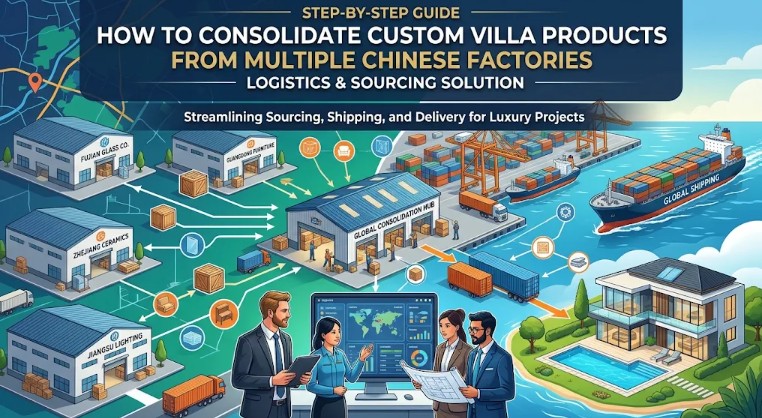
You have approved the shop drawings for your kitchen cabinets in Foshan, finalized the specifications for aluminium windows with a factory in Guangdong, selected sintered stone slabs from another supplier, and ordered loose furniture and lighting from two more workshops. On paper, every individual order looks well-priced and suited to your architectural plans. Then the practical questions start: each supplier gives a different production completion date, some goods are ready three weeks ahead of schedule while others fall behind, and none of the factories are responsible for what happens after their cargo leaves their loading bay.
Turning separate custom orders from multiple Chinese factories into one manageable international shipment is one of the most underestimated parts of building or renovating a private villa overseas. Consolidation is not simply a matter of sending trucks to a single warehouse and loading boxes into a container. When you are dealing with made-to-order building materials and custom interiors, consolidation is an ongoing coordination process covering schedules, packaging, identification, inspection, storage, and loading sequence.
Why Multiple Custom Factories Make Villa Consolidation Difficult
Buying off-the-shelf retail stock in bulk is straightforward because every carton has standard dimensions and predictable availability. Custom villa procurement works the opposite way. A private residence typically pulls products from six to ten specialized manufacturers—kitchen cabinetry, wardrobes, interior wooden doors, aluminium windows and doors, marble or sintered stone, sanitary ware, custom furniture, and architectural lighting.
Several operational realities make combining these orders difficult:
- Project-specific dimensions: Almost nothing is pulled from ready stock. A kitchen island, a three-meter sliding glass door, or a curved sofa is manufactured to your villa’s floor plans and elevations.
- Mid-production revisions: When an architect updates a ceiling height or wall opening after initial approval, one factory’s timeline shifts, throwing off the schedule you originally planned for the shipment.
- Mismatched production schedules: A lighting supplier might finish assembling fixtures weeks before a bespoke wardrobe factory completes lacquer curing, or a stone fabricator finishes cutting slabs while the window supplier is still waiting on imported hardware.
- Clashing physical profiles: A single villa shipment often mixes heavy, dense crates of stone and porcelain tiles with oversized, fragile glass panels, long aluminium extrusions, and bulky upholstered furniture.
- Inconsistent packaging standards: One factory may crate goods in solid plywood boxes suitable for sea freight, while another wraps items in thin cardboard and bubble wrap intended only for local domestic trucking.
- Zero inter-factory coordination: Individual suppliers focus strictly on their own contract. The cabinet maker does not know—and does not track—when your sanitary ware supplier is delivering to the warehouse.
The real challenge is rarely finding factories capable of making each item. The challenge is keeping separate production lines synchronized enough that the finished goods become receivable, identifiable, inspectable, and shippable within a workable window.
What Should Be Planned Before Ordering From Multiple Factories?
Consolidation fails most often when a homeowner waits until the first factory says “your goods are ready” before thinking about warehousing and shipping. By that point, cargo is already sitting on a factory floor incurring storage pressure, or trucks are arriving at a warehouse with no advance paperwork.
Before deposits are paid and production starts, four pieces of groundwork should be in place:
1. A Master Product and Supplier Schedule Combine your bill of quantities (BOQ), interior schedules, and supplier quotations into one master tracking sheet. Every line item should link a specific villa room or zone to a specific factory.
2. Core Supplier and Cargo Data For each order, track:
- Supplier name and factory location
- Product description and room allocation
- Exact quantities (including spare tiles, extra hardware, or touch-up paint)
- Estimated packaged dimensions and gross weight
- Packaging type (carton, wooden crate, steel rack, pallet)
- Estimated production completion date
- Agreed inspection requirement (pre-shipment at the factory or post-arrival at the warehouse)
- Warehouse arrival status
3. Standardized Documentation and Labeling Rules Before factories begin packing, establish what paperwork and carton markings are required. Each factory should supply an accurate packing list, commercial invoice details, and clear references matching your approved drawings and finish samples.
4. Destination Port and Site Unloading Constraints The destination country and your villa’s physical access directly affect how goods should be packed and loaded in China. If a 40-foot high-cube container cannot navigate the narrow hillside road to your villa site—meaning cargo must be transferred to smaller flatbed trucks at the port—heavy stone crates or oversized windows cannot be packed in a way that requires a heavy gantry crane to remove.
How to Coordinate Different Factory Completion Dates
One of the most common points of confusion in multi-factory sourcing is the gap between a factory’s production completion date and the actual warehouse-ready date.
When a sales representative tells you an order will be finished on the 15th of the month, that date usually refers to the moment the item comes off the assembly line. Before that product can enter a consolidation warehouse, it still requires final cleaning, protective wrapping, crating, packing list preparation, any agreed quality inspection, and booking a local truck. Depending on the product’s fragility and the factory’s workload, that post-production stage can add several days—or more than a week—to the timeline.
Production lead times themselves vary widely depending on the product category, level of customization, order volume, and seasonal factory congestion. Custom stone fabrication, curved joinery, and specialized glazing rarely move at the same pace as standard hardware or loose furniture.
To keep the schedule realistic:
- Group suppliers into shipping waves if necessary: If your villa construction is phased—for example, windows, doors, and stone flooring are needed on-site months before loose furniture and decorative lighting—plan two coordinated shipments rather than forcing early structural items to sit in storage waiting for sofas.
- Build buffer time between target completion and vessel booking: Never book ocean freight based on the optimistic date the slowest factory promises. Container booking should happen only once critical-path items have passed inspection and either arrived at the warehouse or have confirmed local dispatch dates.
- Confirm storage terms early: Clarify how long your consolidation warehouse can hold early-arriving goods without heavy demurrage or storage fees while waiting for the remaining suppliers.
Consolidation vs. Quality Control: Keeping the Roles Separate
A frequent misconception among private buyers is assuming that once goods are delivered to a consolidation warehouse in China, they have been inspected and approved for quality. In practice, warehouse receiving, quality inspection, and consolidation are distinct steps with very different scopes.
| Stage | What Actually Happens | What It Does Not Guarantee |
| Factory Production | The supplier manufactures products based on your approved drawings, material specs, and samples. | Does not guarantee the factory caught every dimension error or finish defect before packing. |
| Quality Inspection | An inspector checks dimensions, materials, finishes, assembly, and quantity against approved specs (at the factory or warehouse, depending on the agreed scope). | Cannot be done thoroughly if items are already nailed inside sealed wooden crates without opening them. |
| Warehouse Receiving | Warehouse staff accept delivery, count packages, check outer condition, log supplier identity, and note visible exterior damage. | Does not verify internal product quality, color accuracy, or missing internal components inside sealed boxes. |
| Consolidation | Cargo from multiple factories is sorted, grouped by order/project, re-labeled if needed, and staged for loading. | Does not fix manufacturing defects or replace missing accessories left behind at the factory. |
| Container Loading | Goods are loaded into containers based on weight distribution, fragility, dimensions, and unloading order. | Does not protect poorly packaged items if the factory failed to crate fragile surfaces properly. |
A crushed corner on an outer cardboard carton does not automatically mean the tapware inside is broken—and an intact plywood crate does not prove the custom cabinet doors inside were painted in the right sheen or cut to the right millimeter. Complex custom items such as cabinetry, windows, stone slabs, and bespoke furniture should ideally be inspected at the factory before final crating and dispatch to the warehouse, where defects are far easier to rectify.
What Happens When Products Arrive at the China Warehouse?
When individual factories dispatch cargo to a central warehouse—often in a logistics hub like Foshan or Guangzhou for southern China building materials—a disciplined receiving routine prevents chaos later during loading.
1. Scheduled Delivery and Unloading Factories or their local drivers notify the warehouse before arrival so unloading bays and forklifts are ready, particularly when heavy crates arrive.
2. Quantity Verification and Exterior Check Staff count the total cartons, crates, or pallets against the driver’s delivery note and the supplier’s packing list. Any torn wrapping, crushed corners, wet cartons, or broken wooden slats are photographed and logged immediately before the driver leaves.
3. Clear Cargo Identification When three hundred cartons from eight factories share warehouse floor space, unlabeled boxes quickly become a liability. While there is no single universal labeling format mandatory across China, practical shipping marks on every package typically include:
- Project reference or homeowner identifier
- Supplier name and product category (e.g., “Kitchen Cabinets” or “Master Bath Vanity”)
- Order number and carton sequence (e.g., “Carton 4 of 18”)
- Destination port
- Special handling instructions (“Fragile,” “This Side Up,” “Do Not Stack”)
4. Zone Storage and Status Tracking Accepted cargo is separated from other clients’ goods, segregated by fragility and weight, and updated in a shared inventory log so you know exactly which orders are physically on-site and which are still pending.
Should All Villa Products Be Consolidated Into One Container?
Not necessarily. While combining everything into a single 40-foot high-cube container is often the goal, forcing incompatible cargo into one box can cause expensive damage or create unloading nightmares at your villa.
The right container strategy depends on total cubic volume, gross cargo weight, individual piece dimensions, fragility, and unloading equipment at the destination. Certain villa categories frequently require special consideration:
- Oversized stone slabs and large-format sintered stone: Heavy and brittle, these usually travel upright on A-frame steel or heavy timber racks. Combining A-frames with delicate furniture in the same container requires careful blocking and bracing so weight does not shift at sea.
- Large aluminium windows and sliding door systems: Oversized glass units and long profiles may require open-top containers, flat racks, or dedicated space where nothing is stacked above or pressed against the glass.
- Heavy sanitary ware and porcelain tiles: Dense palletized loads reach maximum container weight limits long before filling the container’s physical volume.
- Custom upholstered furniture and delicate lighting: Bulky, lightweight, and crush-sensitive, these items suffer easily if placed near heavy crates or moisture-prone materials.
Depending on your project’s actual packed dimensions and weights, splitting cargo across two containers—for example, heavy construction materials in one and delicate interior finishes and furniture in another—or shipping oversized glass separately can be far safer than forcing a tight single-container fit.
How to Decide Which Products Can Be Loaded Together
Proper container loading is planned around physical compatibility and site logistics rather than simply filling empty air space:
- Dimensions: Measure the packaged crates, not the bare product. A 2.4-meter dining table in a reinforced wooden crate may add 15 to 20 centimeters in every direction.
- Weight distribution: Heavy items like tiles, stone, and hardware must sit low and evenly distributed across the container floor to maintain balance during ocean transit and trucking.
- Fragility and surface protection: Glass, mirrors, high-gloss lacquered panels, and marble edges need rigid separation and moisture protection from heavier crates.
- Packaging strength: Only load cartons on top of crates engineered to bear top-load weight. Soft-packed furniture should never support boxed goods.
- Unloading sequence: Think backward from your villa’s construction schedule. Products needed first on-site—such as window frames, concealed plumbing valves, or floor tiles—should be loaded near the container doors so they come out first without unpacking your living room sofas onto a dusty construction site.
- Site access: Confirm whether your destination site has a forklift, crane, or sufficient manpower to unload heavy crates from a container chassis.
What Can Go Wrong During Multi-Factory Consolidation?
Even well-planned villa projects run into friction when multiple suppliers are involved. Knowing the common failure points helps you prevent them:
- One supplier finishes late, holding up the entire shipment: A delayed vanity unit can stall a container full of ready cabinets and tiles, or force you to ship without it and pay high air-freight or LCL (Less than Container Load) costs later.
- Wrong quantities delivered to the warehouse: A factory ships 42 boxes of tiles instead of 45, and the shortage is only discovered weeks later during unloading overseas.
- Outer packaging arrives damaged: A local truck driver shifts crates improperly on the highway to the warehouse, damaging crate corners before ocean transit even begins.
- Cartons arrive without clear identification: Fifteen unmarked boxes of cabinet hardware or lighting transformers arrive, making it impossible to verify completeness without opening everything.
- An oversized item fails the loading plan: A factory builds a thicker wooden crate than estimated, leaving a custom door frame two centimeters too tall for a standard container doorway.
- Fragile cargo is stacked under unsuitable weight: Poor loading supervision places heavy tile boxes over lightweight aluminium trim or upholstered dining chairs.
- The main product arrives, but accessories are missing: Wardrobe carcasses arrive at the warehouse on time, while hinges, LED strip drivers, or sliding tracks are still waiting at a sub-supplier’s workshop.
- Unannounced factory deliveries: A supplier sends a truck to the warehouse without sending a packing list first, leaving receiving staff unable to verify what was delivered.
Consistent pre-dispatch checks—requiring photos of packed goods, final crate dimensions, and signed packing lists before a factory releases a truck—eliminate most of these surprises.
When Does Multi-Factory Consolidation Make Sense for a Private Villa?
Consolidating through a central China warehouse makes strong practical sense when:
- You are sourcing multiple custom product categories directly from separate specialized factories.
- Your total cargo volume is large enough to fill one or more full containers (FCL), or a substantial consolidated load.
- You want to verify completeness across suppliers before committing to international sea freight.
- You do not have your own team on the ground in China to chase production dates, receive trucks, and supervise container loading.
However, consolidation is not always necessary or cost-effective. It may make less sense when:
- You are only buying from one or two factories that already have strong export packing and container-loading teams.
- Your order volume is very small (such as a few light fixtures or a single vanity), where shipping directly via a freight forwarder’s LCL service is simpler than paying for separate warehousing and handling.
- A supplier’s product—such as oversized architectural glass—is safer shipped directly from the factory’s specialized loading bay without extra handling transfers.
Consolidation adds local trucking, warehouse handling, and coordination steps. When you are managing six or eight custom suppliers, those steps create essential order and visibility; when you are buying a single item, they simply add extra touches to the cargo.
How a Villa Procurement Coordinator Helps With Multi-Factory Consolidation
For overseas homeowners managing a villa build from abroad, time zones, language barriers, and technical drawings make chasing multiple factories exhausting. Working with a China-based procurement coordinator—such as HSY Sourcing, operating out of Foshan’s building materials and furniture hub—bridges the gap between individual workshops and international shipping.
In practical terms, a local procurement coordinator handles the operational workflow around your suppliers:
- Maintaining the master supplier schedule and following up on production milestones across factories
- Collecting accurate packing lists, crate dimensions, and weights prior to dispatch
- Coordinating factory delivery schedules into the consolidation warehouse
- Overseeing warehouse receiving, carton counts, and visible damage documentation
- Arranging agreed pre-shipment or warehouse quality inspections
- Grouping, labeling, and staging cargo by order and villa zone
- Preparing container loading plans based on compatibility and unloading sequence, and coordinating with your freight forwarder
It is important to keep the roles clear: a procurement coordinator does not manufacture your products, nor do they replace each factory’s contractual responsibility for producing goods according to your approved drawings and specifications. Rather, they manage the coordination layer between independent factories so separate orders behave like one structured project.
A Practical Multi-Factory Consolidation Checklist
Use this checklist to keep multi-supplier villa orders organized from deposit to container sealing:
Before Production Starts
- [ ] Approve final shop drawings, dimensions, and material finishes for every supplier.
- [ ] Build a master tracking sheet listing all factories, products, quantities, and target completion dates.
- [ ] Specify export-grade packaging requirements (such as fumigated plywood crates for fragile or heavy items) in each purchase order.
- [ ] Define required carton markings and packing list formats.
- [ ] Confirm who is managing local warehouse receiving and container loading.
Before Goods Leave Each Factory
- [ ] Verify whether agreed quality inspections have been completed and signed off.
- [ ] Collect the final packing list with exact carton counts, packaged dimensions, and gross weights.
- [ ] Confirm that all accessories, hardware, spare parts, and installation manuals are packed and labeled.
- [ ] Schedule the delivery slot with the consolidation warehouse before dispatching the truck.
At the Consolidation Warehouse
- [ ] Count all incoming cartons, crates, and pallets against the factory packing list.
- [ ] Inspect outer packaging for moisture, crushing, or structural crate damage and photograph any issues immediately.
- [ ] Verify supplier identity, order number, and product labels on every package.
- [ ] Log missing items, backordered accessories, or delayed deliveries in the master tracker.
- [ ] Store fragile, heavy, and moisture-sensitive goods in appropriate separated zones.
Before Container Loading
- [ ] Confirm all items planned for that shipping wave have arrived and cleared inspection.
- [ ] Review total volume and weight against container limits and destination road/unloading restrictions.
- [ ] Finalize the loading sequence based on weight distribution, fragility, and site unloading order.
- [ ] Document the loading process with step-by-step photos and finalize the master container packing list for customs clearance.
Frequently Asked Questions
Can products from several Chinese factories be shipped together? Yes. Products from multiple factories across China can be delivered to a single consolidation warehouse, organized by project, and loaded into the same shipping container or multi-container shipment, provided their dimensions, weights, and packaging are compatible.
Does every factory need to deliver to the same warehouse? In most multi-factory villa projects, yes—delivering to one central warehouse near your primary sourcing hub (such as Foshan or Guangzhou) allows everything to be checked and loaded together. However, if one supplier is located far away and produces oversized cargo that fills its own container, loading that container directly at the factory while consolidating the remaining suppliers at a warehouse can sometimes reduce extra trucking and handling risks.
Should all villa materials go into one container? Not always. Whether everything fits into one container depends on total cubic volume, cargo weight, item dimensions, fragility, and unloading conditions at your destination. Heavy stone slabs, large glass panels, and delicate furniture often need separate containers or specialized loading arrangements rather than being packed together tightly.
Does warehouse consolidation include quality inspection? No. Standard warehouse receiving checks package counts, labels, and visible exterior damage. Full quality inspection—checking dimensions, finishes, hardware, and workmanship against your drawings—is a separate step that should be arranged specifically, ideally at the factory before goods are sealed in crates.
What happens if one supplier finishes late? If one factory falls behind schedule, you have three main options: hold the container at the warehouse until the late order arrives (watching for storage fees), ship the ready items on schedule and send the delayed order separately later (via LCL sea freight or air freight if small), or split the project into two phased shipments aligned with your construction timeline.
Can fragile products such as marble and glass be consolidated with furniture? They can share a container if properly crated and separated, though it requires careful loading engineering. Marble slabs and glass panels are typically secured upright in heavy timber or steel A-frame crates with solid blocking, while furniture is kept clear of heavy weight shifts and moisture. Where volumes are large, separating heavy stone/glass from soft furniture across different containers is often safer.
Is consolidation always cheaper than shipping separately? Not always, though it frequently reduces per-unit freight costs when you have enough cargo to fill a container compared to shipping five or six small LCL shipments independently. Consolidation also introduces local trucking, warehouse handling, and coordination costs—its primary value for a custom villa is control over timing, cargo verification, and safer loading rather than simply chasing the lowest transport rate.
Coordinating a Real Villa Shipment
Buying custom products from multiple Chinese factories works well when each supplier is managed as part of a single project schedule rather than an isolated transaction. Finding factories is only the first step; aligning completion dates, verifying packing lists, separating warehouse receiving from quality inspection, and planning a safe loading sequence are what protect your investment until the container doors open at your site.
If you are planning or currently managing a private villa build or major renovation and want practical support coordinating multiple Chinese suppliers, warehouse receiving, inspections, and container consolidation, HSY Sourcing works directly with overseas homeowners from our base in Foshan. To help us understand whether on-the-ground coordination fits your project, you can share:
- Your destination country and port (along with any site access constraints)
- Approximate villa size and project stage
- Available floor plans, elevations, or BOQ schedules
- The custom product categories you plan to source from China
- How many suppliers you have already contacted or ordered from
- Your target shipping or on-site installation timeline