
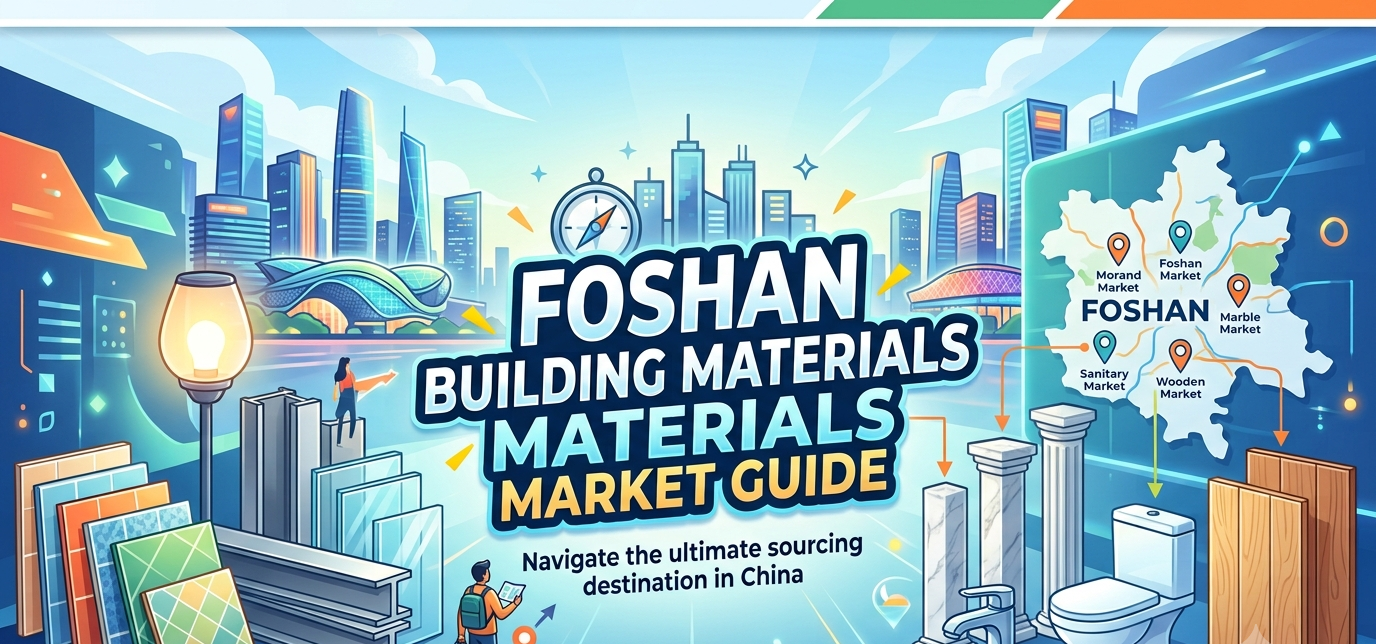
For international real estate developers, commercial contractors, and hospitality procurement managers, importing building materials directly from China offers significant cost and scale benefits. However, treating China as a singular manufacturing entity often leads to logistical inefficiencies. The key to successful high-volume procurement lies in understanding localized industrial clusters.
Foshan, a city in Guangdong province, functions as the absolute global epicenter for architectural finishes, custom interior joinery, and structural building components. Rather than relying on scattered suppliers across different provinces, institutional project buyers can source an entire interior Bill of Quantities (BOQ) within a 50-kilometer industrial radius.
Navigating this massive market landscape, however, requires moving past retail showrooms and understanding exactly where specific product tiers are manufactured, verified, and consolidated.
Key Takeaways
- Segment by Specialized Districts: Foshan is split into distinct industrial zones. Do not source ceramic tiles in the furniture district or aluminum windows in the ceramics hub; match your BOQ directly to the localized cluster.
- Look Past the Showroom: The massive exhibition markets in Foshan serve as trading fronts. Large-scale projects require stepping off the showroom floor and auditing the actual automated manufacturing lines behind them.
- Consolidate to Control Landed Costs: Because the product ecosystems are geographically dense, buyers can execute mixed-container consolidation locally, minimizing internal domestic trucking freight.
Which wholesale markets in Foshan align with commercial project scales?
Foshan does not host a single “mega-market” for building materials; it consists of distinct, district-sized wholesale hubs and specialized industrial zones. For B2B buyers managing hotel, apartment, or villa developments, three primary areas dictate the supply chain:
                  [Foshan Procurement Ecosystem]
                                │
        ┌───────────────────────┼───────────────────────┐
        ▼                       ▼                       ▼
   [Chancheng]              [Shunde]                [Nanhai]
Tiles & Sanitary Ware    Furniture & Cabinets    Windows & Doors
1. Ceramics, Porcelain Tiles & Sanitary Ware (Chancheng District)
- China Ceramics City (CCC): Located in central Chancheng, this is a structured, multi-story hub displaying mid-to-high-end brands. It is optimized for architectural design selection and initial sample collection.
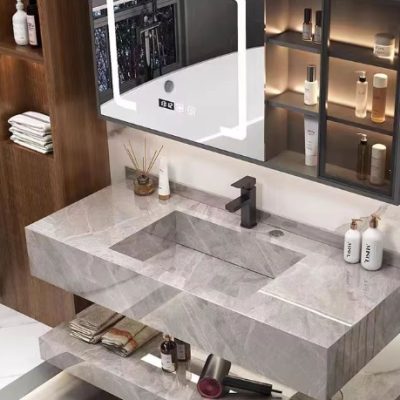
- Huayi International Decorate Market: A expansive marketplace that mixes large-scale tile wholesalers with bathroom vanity and commercial sanitary ware suppliers.
- Nanzhuang Town: The literal manufacturing heartland for large-format porcelain stoneware and sintered stone slabs. The massive wholesale warehouses located here handle bulk factory-direct shipments.
2. Furniture, Joinery & Cabinetry (Shunde District)
- Lecong Furniture Market: Stretching over several kilometers, this is the largest furniture trading cluster globally. Major commercial complexes like Louvre Furniture Mall showcase premium design options, while Sunlink Furniture Market focuses on contract-grade hospitality and commercial project furniture.
3. Aluminum Windows, Glass Systems & Doors (Nanhai District)
- Dali Town: China’s primary hub for aluminum extrusion. This is where structural window profiles, architectural glazing, curtain wall frameworks, and internal commercial doors are manufactured and traded at industrial volumes.
Why does direct showroom ordering present a risk for institutional buyers?
While walking through modern showrooms in Lecong or Chancheng is useful for aesthetic selection, placing commercial project orders directly with a basic market stall carries three specific risks for institutional buyers:
- Trading Middlemen Interventions: Many market booths operate as independent export trading houses or secondary distributors rather than primary factories. For an order of 200 apartment kitchens or a 5-star hotel FF&E package, buying from a middleman adds unnecessary markups and detaches you from the actual production line.
- Lack of Production Traceability: A showroom cannot guarantee line consistency. Without an independent factory floor audit, an overseas buyer cannot verify if the substrate core matches compliance metrics (like CARB Phase 2 or E0 formaldehyde limits) or if the factory uses automated CNC routing machinery.
- Fragmented Logistics Management: Showroom merchants operate on localized, isolated terms. They expect the buyer to arrange collection, manage separate export filings, and handle shipping for each small component, which quickly inflates port documentation overheads.
How should an on-the-ground procurement workflow be structured?
Moving a complex interior project from a paper blueprint to a loaded ocean container requires a disciplined, step-by-step technical execution framework.
1.BOQ Deep-Dive and Targeted Factory Mapping:Phase 1: Sourcing.
The project architectural drawings are audited. We bypass general retail showrooms, matching the technical specifications of your tiles, cabinets, windows, and furniture directly to verified primary OEM factories within Foshan’s specialized industrial towns.
2.1:1 Prototyping and Technical Sample Approvals:Phase 2: Validation.
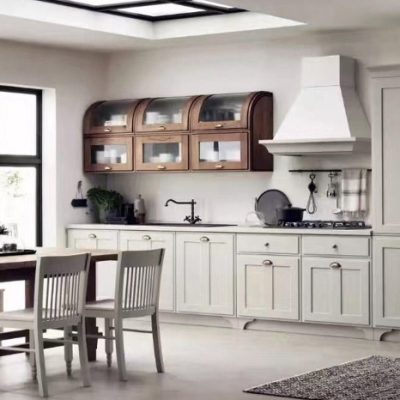
Before mass-producing complex built-in items, we mandate full-scale physical mockups (such as a complete bathroom vanity array or an apartment kitchen configuration). This physical gate checks structural tolerances, plumbing cutout paths, and color-batch accuracy under calibrated lighting.
3.In-Line Quality Inspections and Substrate Verifications:Phase 3: Production.
Our QC engineering team conducts unannounced audits on the active factory floors. We physically measure panel thickness, check substrate moisture content (ensured between 8% and 12%), and verify the application of PUR hot-melt edge-banding for wet-zone cabinetry.
4.Warehouse Staging and Density-Stratified Mixed Loading:Phase 4: Logistics.
Finished orders are collected at our central Foshan warehouse. We implement an engineered mixed-container load plan—securing heavy, flat masonry pallets on the floor and layering volumetric, flat-pack cabinetry on top—to maximize container space and avoid shipping empty air.
Why Choose HSY Sourcing as Your Foshan Building Materials Partner?
Navigating thousands of vendors across the South China industrial grid requires deep technical competence, localized contract enforcement, and independent ground representation. HSY Sourcing operates strictly as your dedicated procurement, engineering, and logistics office in Foshan, engineered to protect the commercial interests of international project developers.
- 100% Independent Representation: We hold zero factory alliances and do not accept hidden supplier commissions. We work exclusively for you on a transparent service framework, giving you direct access to original factory-floor pricing with zero markup.
- Cross-Category Technical Competence: Our team understands the intersection where different building materials meet on-site. We actively coordinate between your window fabricators, cabinet lines, appliance vendors, and tile makers to ensure every single element slots together perfectly during construction.
- Rigorous Milestone Inspection Protocol: Our QC engineers do more than count boxes at a loading dock. We conduct physical testing on the active line—checking tile shade calibrations, testing hardware mechanical cycle ratings, and auditing material density.
- Turnkey Warehouse Consolidation : From our centralized Foshan staging facility, we manage incoming factory deliveries, enforce rigid export-grade packaging standards (such as reinforced crating and edge-protectors), and execute dense container loading plans to minimize your landed ocean freight costs.
Frequently Asked Questions (FAQ)
What is the minimum project scale required to source directly from Foshan?
Foshan is optimized for commercial, high-volume production. To offset the fixed costs of international logistics, export customs clearance, and independent quality control, sourcing here is most effective for medium-to-large-scale real estate projects (such as multi-unit apartments, hotels, resorts, and villa communities) or bulk wholesale orders.
How do you handle compliance with different national building codes?
During the pre-production engineering phase, we explicitly review your destination market’s local municipal building codes. We screen the supplier pool to select factories that possess independently verified laboratory certifications. We verify emissions standards (such as CARB Phase 2 or E0 for cabinetry), non-slip metrics (DCOF) for commercial tiles, and proper electrical safety ratings (UL, CE, SAA) for all integrated lighting components.
What happens if an order fails inspection during our warehouse check-in?
If our receiving team identifies structural defects, dimensional deviations, or incorrect finishes at our warehouse dock, we immediately halt the intake process. We document the non-compliance with high-resolution photos and video, file a formal contract claim against the manufacturing factory, and return the defective batch for remanufacturing before the ocean container arrives.
Can fragile glass panels and heavy tiles be safely shipped in the same mixed container?
Yes. We prevent transit damage by following a strict density-stratified loading protocol at our local warehouse. Heavy, rigid materials like porcelain floor tiles or stone slabs are palletized, blocked, and braced directly to the container floor using structural timber and industrial dunnage airbags. Fragile items, such as tempered glass shower partitions or custom cabinetry doors, are packed in heavy plywood crates and vertically lashed to structural tie-down points on the upper loading tiers.