
Key Takeaways:
- Shipping “Air” is Expensive: Sofas are high-volume, low-weight cargo. Sourcing them in isolation wastes container space. Consolidating light furniture with heavy Foshan building materials (like aluminum windows) drastically cuts freight costs.
- Replacement Cycles Destroy Budgets: Specifying standard residential foam (25kg/m³) for a commercial hotel or apartment ensures the sofas will fail within 12 months. High-Resilience (HR) 40kg/m³ foam is a mandatory upfront investment.
- Moisture Equals Total Loss: Frames built with unseasoned wood (moisture content >12%) will warp or grow mold during 30-day ocean transits, resulting in entirely unsalvageable inventory.
- Compliance is a Hard Barrier: Importing fabrics that fail local commercial fire ratings (CAL 117 or BS 5852) means the goods cannot be legally installed in your project.
When procuring FF&E (Furniture, Fixtures, and Equipment) for a 200-room hotel or a multi-family apartment complex, the unit price on a supplier’s quotation is only a fraction of the actual expense. Bulk sofa purchasing is particularly prone to budget overruns because the most critical structural components are hidden beneath the upholstery.
Furthermore, project buyers often treat furniture and structural building materials as entirely separate supply chains. By doing so, they miss out on major geographic efficiencies. Foshan is uniquely positioned as the global hub for both commercial furniture (in Longjiang/Lecong) and architectural doors and windows (in Dali).
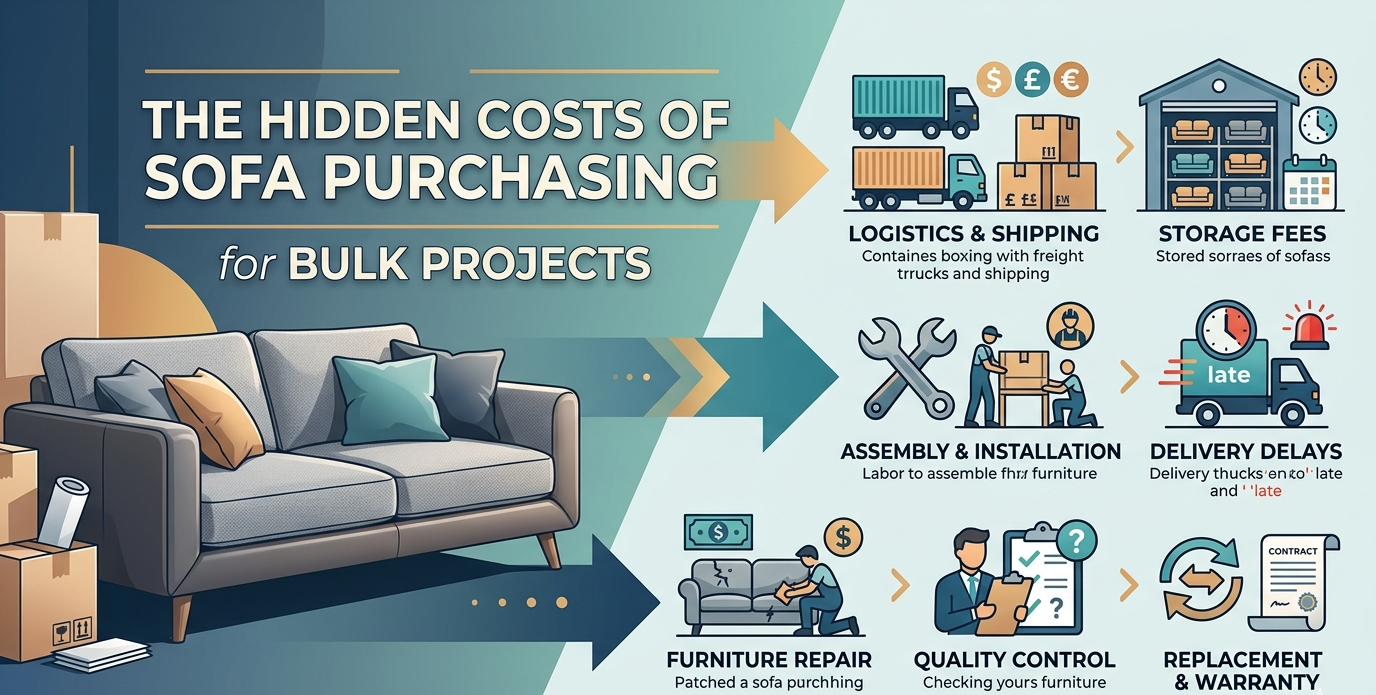
Here are the hidden costs of sourcing commercial sofas and how a consolidated Foshan procurement strategy eliminates them.
How Does Fragmented Sourcing Inflate Your Freight Bill?
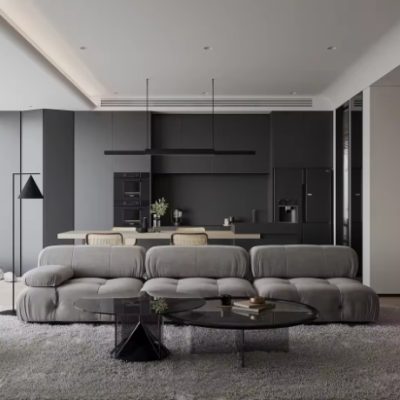
The most significant hidden cost in bulk furniture procurement is logistics. Sofas take up massive amounts of physical space but are relatively light. If you fill a 40HQ container exclusively with sofas, you “max out” the volume long before you reach the weight limit. You are effectively paying to ship air.
Conversely, if you buy heavy architectural building materials—like aluminum windows, glass curtain walls, or ceramic tiles—you will hit the container’s weight limit while the container is still half empty.
The Foshan Geographic Advantage: If you source your windows from one province and your sofas from another, you pay for two inefficiently loaded containers. Because Foshan manufactures both, your sourcing agent can combine these orders locally. We load the heavy window A-frames and floor tiles at the base of the container, and pack the lighter sofas and upholstered goods securely on top. This strategic cross-category consolidation maximizes both weight and volume, significantly driving down the shipping cost per item.
Are You Specifying the Right Foam Density for High-Traffic Areas?
A hotel lobby sofa or a serviced apartment couch experiences exponentially more use than a living room sofa. When a factory submits a surprisingly low bid for a bulk order, they almost always achieve that price by downgrading the internal polyurethane foam.
If you accept standard residential foam (typically 25kg/m³ to 28kg/m³), the hidden cost is premature replacement. The foam cells will permanently crush under commercial use, causing the fabric to wrinkle and the seating to sag.
To avoid the cost of replacing 100 sofas a year after opening, your Bill of Quantities (BOQ) must explicitly dictate commercial metrics: seat cushions require High-Resilience (HR) foam with a minimum density of 40kg/m³, and backrests require at least 30kg/m³.
What Happens When Wood Moisture Content Exceeds 12%?
The internal skeleton of a sofa dictates its lifespan. Cheap bulk orders frequently utilize MDF (Medium Density Fiberboard) or unseasoned “green” wood to cut material costs.
The hidden cost of unseasoned wood is environmental damage during transit. Ocean freight exposes cargo to extreme temperature and humidity fluctuations. If the internal wood frame has a moisture content above 12%, that moisture will be drawn out inside the shipping container. This leads to two critical failures:
- Structural Warping: The frame shrinks and cracks as it dries, causing the sofa to squeak and wobble.
- Mold Contamination: The trapped moisture creates mold that permeates the internal foam and fabric. By the time the container is opened at your job site, the entire batch may be biologically contaminated and unusable.
You must require kiln-dried solid hardwood and ensure your agent physically tests the raw frames with a moisture meter before assembly.
Will Your Upholstery Pass Local Fire and Building Inspections?
Commercial real estate is heavily regulated. A major hidden cost is discovering that your imported furniture is illegal to install because it fails local fire or safety codes.
Standard fabrics are highly flammable. If your project is in the United States, the materials must comply with CAL 117. For the UK or Australia, requirements like BS 5852 (Crib 5) are rigorously enforced by local building surveyors. If you cannot produce legitimate, verifiable laboratory test reports from the factory proving the fabric and foam are fire-retardant, local authorities will force you to remove the goods from the property.
Retrofitting fire compliance is impossible; it must be engineered at the factory level.
Why Is Pre-Shipment Inspection Too Late for Upholstered Goods?
Most remote buyers rely on pre-shipment photos. The factory sends an image of a fully finished, clean sofa, and the buyer pays the final invoice.
This is a massive financial risk. Once the fabric is stapled to the base, it is impossible to verify if the factory actually used the heavy-duty serpentine springs, the specified 40kg/m³ foam, or the kiln-dried hardwood you contracted them for. Discovering a structural shortcut after the goods are delivered to your project site results in total financial loss. Quality control must happen mid-production, physically inspecting the bare frames before upholstery begins.
Why Choose HSY Sourcing for Your Project?
At HSY Sourcing, we operate directly from Foshan, bridging the gap between heavy building materials and soft interior FF&E. We manage the technical realities of manufacturing so you don’t face unexpected costs upon delivery.
- Cross-Category Consolidation: We leverage Foshan’s unique geography. By managing both your structural window orders and your interior furniture packages, we consolidate heavy and light goods in our local warehouse, maximizing your shipping efficiency.
- Mid-Production Factory Audits: We do not rely on factory goodwill. Our team conducts physical inspections on the assembly line, using moisture meters on wood frames and verifying foam densities before the sofas are closed up.
- Compliance Enforcement: We ensure that your specific fire retardancy, abrasion resistance (Wyzenbeek/Martindale), and structural requirements are written into binding local contracts.
- Factual Reporting: We provide unedited, real-time photos and caliper measurements directly from the factory floor. No polished marketing images, just the physical truth of your production run.
Visit www.hsysourcing.com to share your project’s FF&E schedule and building material BOQ. Let our local team engineer a secure, cost-effective supply chain for your entire development.
Frequently Asked Questions (FAQ)
Q: Can we customize a standard factory sofa design to meet commercial building codes?
A: Yes. It is common to select a factory’s existing structural design to avoid paying for new prototype molds, and then upgrade the internal specifications. We instruct the factory to swap standard foam for 40kg/m³ HR foam and apply commercial-grade, fire-rated fabrics to meet your local requirements.
Q: How do you protect bulk furniture orders from moisture damage during sea freight?
A: Beyond mandating kiln-dried wood frames, we strictly enforce export packaging standards. Every sofa must be wrapped in heavy-duty sealed plastic, and we require the placement of industrial desiccant packets both inside the individual packaging and throughout the shipping container to absorb any ambient humidity during transit.
Q: If we are buying windows and sofas from different Foshan factories, who coordinates the timeline? A: As your local agent, that is our primary function. Custom architectural windows typically take 35 to 45 days, while bulk sofas might take 25 days. We coordinate the production schedules so that both categories finish at the same time, allowing us to consolidate them in our warehouse and load them into a single FCL (Full Container Load) shipment without incurring local storage fees.