
If you are a developer, a wholesaler, or an online retailer, adding bathtubs to your product line is a double-edged sword. On one hand, the profit margins can be substantial. A high-end freestanding tub that retails for $1,500 in New York or London often leaves the factory in China for less than $350.
On the other hand, sourcing bathtubs is terrifying for the inexperienced. Unlike small electronics or textiles, a bathtub is a giant, fragile bubble of air. It takes up massive space in a container, it can crack if a forklift hits a bump, and if the quality is poor, you can’t exactly ask the customer to mail it back.
At HSY Sourcing, located in Foshan (the heart of China’s sanitary ware industry), we manage these risks every day. We don’t just find factories; we act as the firewall between our clients and the potential disasters of international trade.
This guide is not about “why” you should source from China—you already know the economic reasons. This guide is about “how” to do it without losing your shirt. We will break this down into the three pillars that matter: Quality, Cost, and Logistics.
Where should you start looking for suppliers?
China is huge, but the sanitary ware industry is surprisingly concentrated. If you are looking for phone cases, you go to Shenzhen. If you are looking for bathtubs, you go to Foshan.
While you might find suppliers in Zhejiang or other provinces offering lower prices, the supply chain ecosystem in Foshan is unmatched. A bathtub isn’t just a piece of plastic; it requires molds, resin, fiberglass, stainless steel frames, and overflow hardware. In Foshan, the factories that make these components are all within a 30-minute drive of each other.
This proximity means two things for you: consistency and speed. A Foshan factory is less likely to run out of materials and more likely to have access to the latest mold designs. When you are browsing Alibaba or visiting the Canton Fair, always check the supplier’s location. If they are not in or near Foshan, you need to ask deeper questions about their supply chain stability.
How do you define “Good Quality” in a bathtub?
Quality in this industry is often invisible until it’s too late. A $200 tub and a $400 tub might look identical in a showroom photo, but their performance over time will be vastly different. The difference usually comes down to the raw material.
The “Yellowing” Trap
The most common complaint we hear from buyers who sourced blindly is: “The tubs turned yellow after six months.”
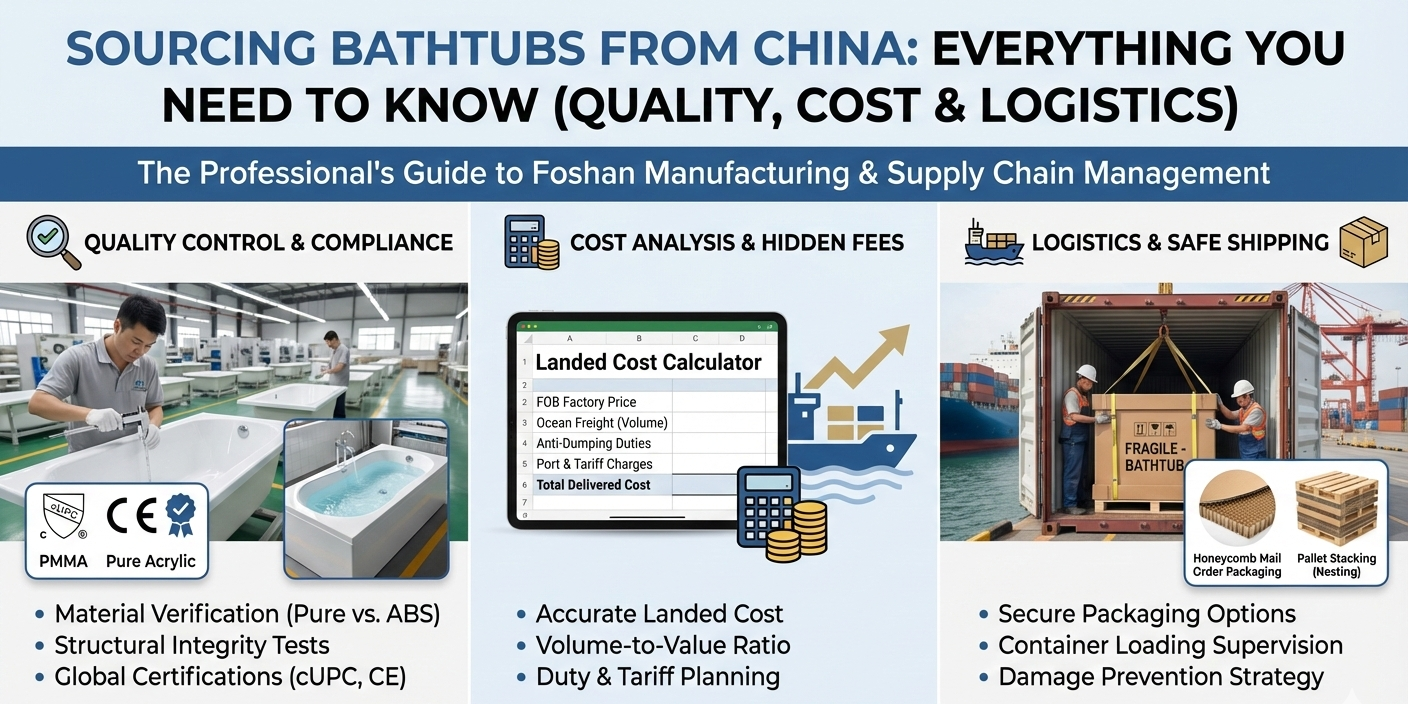
This happens when a factory uses ABS plastic capped with a thin layer of acrylic, or impure acrylic mixed with too much calcium powder. Real, high-quality bathtubs are made from PMMA (Polymethyl Methacrylate), also known as pure acrylic. PMMA is UV stable. It stays white for years.
The Structural Integrity
The shiny white surface is just the skin. The strength comes from the reinforcement layer underneath. This is a mixture of resin and fiberglass sprayed onto the back of the shell.
- Poor Quality: Thin, uneven spraying. You can see light passing through the tub if you shine a flashlight from behind. The bottom feels “bouncy” when you stand in it.
- Good Quality: Multiple layers of reinforcement, especially at the corners and the base. The baseboard (usually wood or composite) is fully encapsulated in resin so it never rots.
We created this comparison table to help you understand what you are paying for:
| Feature | Low-End (Budget) | High-End (Premium) |
| Material | ABS / Composite Sheet | 100% Pure Cross-linked Acrylic |
| Color Stability | Yellows within 6-12 months | Stays white for 10+ years |
| Reinforcement | 2 layers fiberglass + Calcium | 4-5 layers pure fiberglass + Resin |
| Weight (Acrylic) | 30kg – 35kg | 45kg – 55kg |
| Feel | Flexible, hollow sound | Solid, rigid, warm to touch |
Will these bathtubs be legal in your market?
Before you fall in love with a design, you must ask about paperwork. Sourcing a beautiful tub is useless if your local customs officer seizes it or your customer’s plumber refuses to install it.
North America (USA & Canada):
You absolutely need cUPC certification. This is non-negotiable for most professional projects. If you are selling on Amazon directly to DIY consumers, you might get away without it, but you are taking a huge liability risk. Professional plumbers will look for the cUPC sticker before they connect the drain.
Europe:
You need CE marking. This proves the product meets EU safety, health, and environmental protection requirements.
The Trap:
Do not trust a JPG image of a certificate sent via email. We have seen many factories use expired certificates or certificates belonging to other companies. At HSY Sourcing, we verify the certificate number directly with the testing laboratory (like IAPMO) to ensure it matches the factory name and the specific model numbers you are buying.
What is the true cost of importing a bathtub?
Novice importers often make the mistake of calculating profit based on the FOB price.
- FOB Price: The cost of the tub delivered to the Chinese port.
- Landed Cost: The cost of the tub sitting in your warehouse, ready to sell.
The gap between these two numbers is huge for bathtubs because of their Volume-to-Value ratio. You are shipping a lot of empty air.
Freight is the biggest variable.
In a 40HQ container, you can fit roughly 45 to 65 freestanding bathtubs, depending on the packaging method. If ocean freight is $4,000, your shipping cost is roughly $70 per tub. If ocean freight spikes to $8,000, that cost doubles to $140 per tub.
Don’t forget the Anti-Dumping Duties (ADD).
This is a critical “hidden” cost. Both the US and EU have anti-dumping duties on certain Chinese ceramic and bathroom products to protect local manufacturers. The rate varies significantly by factory. Some factories have a “low tax rate” (e.g., 20%), while others are hit with a “punitive rate” (e.g., 200%+).
Before you order, you must ask the factory for their specific ADD tax rate code and verify it with a customs broker in your country.
Here is a simplified Landed Cost Calculator example:
| Cost Item | Estimated Value |
| Factory Price (FOB) | $300.00 |
| Ocean Freight | $80.00 (avg) |
| Import Duty (Tariff) | $75.00 (varies by country) |
| Anti-Dumping Duty | $? (Must Verify!) |
| Port & Trucking Fees | $30.00 |
| Total Landed Cost | $485.00+ |
Note: This does not include marketing or warehouse storage.
How do you ship a fragile giant without breaking it?
Logistics is the final boss of bathtub sourcing. You can buy the best tub in the world, but if it arrives cracked, you have lost your money. Insurance might pay you back eventually, but you have lost the sales window and your customer’s trust.
Packaging Strategy
There are two main ways to pack bathtubs:
- Full Box (Mail Order Packaging):Each tub is in a heavy-duty, 7-layer honeycomb cardboard box with reinforced corners. This is essential if you are an e-commerce seller shipping directly to consumers via FedEx/UPS. It takes up more space in the container, increasing your freight cost per unit, but it reduces breakage.
- Stacking (Nesting):This is for wholesalers. The factory stacks 3-5 tubs on top of each other on a pallet, separated by foam blocks.
- Pro: You can fit 30% more tubs in a container, drastically lowering shipping costs.
- Con: You cannot ship these directly to consumers. You must unpack them in your warehouse.
Loading Supervision
Damage often happens at the Chinese port during loading. If the workers are rushing, they might throw heavy boxes of toilets on top of the bathtubs.
This is why we attend the loading. We ensure the “Tetris” is played correctly: heavy items on the bottom, bathtubs secured, and no empty spaces for cargo to shift during rough seas.
How do you manage Quality Control (QC) from thousands of miles away?
You cannot rely on the factory’s own QC report. It is a conflict of interest. They want to ship; you want perfection.
When we inspect bathtubs for clients, we focus on three specific tests:
- The Water Retention Test: We fill a random sampling of tubs with water and let them sit. We check for leaks at the drain and overflow. More importantly, we check if the water drains completely. If the bottom slope is uneven, water pools in the corners, which is a major defect.
- The Light Test: We use high-powered lights to check for surface scratches, pinholes, or uneven polishing that creates a “wavy” reflection.
- The Color Match: If you are buying a toilet and a tub, they must be the same shade of white. We use standard color cards to ensure consistency.
Conclusion
Sourcing bathtubs from China is a complex operation that sits at the intersection of manufacturing precision and logistical planning. It is not a passive investment. It requires active management.
You need to select the right material (PMMA over ABS), verify the legal paperwork (cUPC/CE), calculate the landed cost accurately (including taxes), and protect the cargo physically.
But when you get these steps right, the results are worth it. You are bringing a spa-like experience to your customers at a price point that domestic manufacturers simply cannot match.
Ready to start your sourcing journey?
At HSY Sourcing, we are your eyes and ears in Foshan. We know the factories, we know the pitfalls, and we know how to get your container safely to your door. Contact us today for a consultation on your specific project needs.