
If you’ve ever stepped foot in the Lecong furniture market in Foshan, you know the feeling. One showroom has the perfect sofa, another has the marble dining table you love, and a third has the office chairs.
By the end of the week, you have 15 different invoices from 15 different shops. Now comes the part that keeps buyers awake at night: How do you get all that stuff into one container without it arriving in pieces?
Consolidating a “mixed container” in Lecong isn’t a magic trick—it’s a logistical headache that requires a lot of phone calls and a very organized warehouse. Here is the reality of how it’s actually done.
Why is buying from 15 different Lecong shops so stressful?
The dream is simple: You buy everything, it all shows up at a warehouse on Monday, and the ship leaves on Friday.
The reality? Factories in China don’t coordinate with each other. Supplier A might finish your sofa in 20 days. Supplier B promised your bed in 21 days but actually takes 35. Supplier C forgot to include the legs for your table.
If you don’t have someone local to act as the “hub,” you end up paying for a container that is half-empty, or worse, you pay massive storage fees at the port while waiting for one late factory to finish three chairs.
Can you really trust 15 different factories to finish on the same day?
Short answer: No. In Lecong, many showrooms are just “fronts” for factories located an hour away. They all give you “estimated” lead times. To manage a mixed container from Foshan, you need a warehouse that can hold the early arrivals for free (or cheap) while we chase down the late ones.
We spend half our time on WeChat, pushing factory bosses to stay on schedule. Without this “pressure,” a mixed container can take three months to ship instead of one.
How does consolidation actually save you money?
If you shipped those 15 orders separately as LCL (Less than Container Load), you would be broke before the goods even arrived. LCL fees for 15 small shipments are astronomical because every single one has its own local handling charges, documentation fees, and customs entries.
By doing Foshan furniture consolidation, we pack everything into one 40HQ container. You pay:
- One ocean freight fee.
- One customs clearance fee.
- One trucking fee.
It is the only way to make importing furniture from China profitable for small-to-medium buyers or homeowners.
What actually happens at the warehouse before loading?
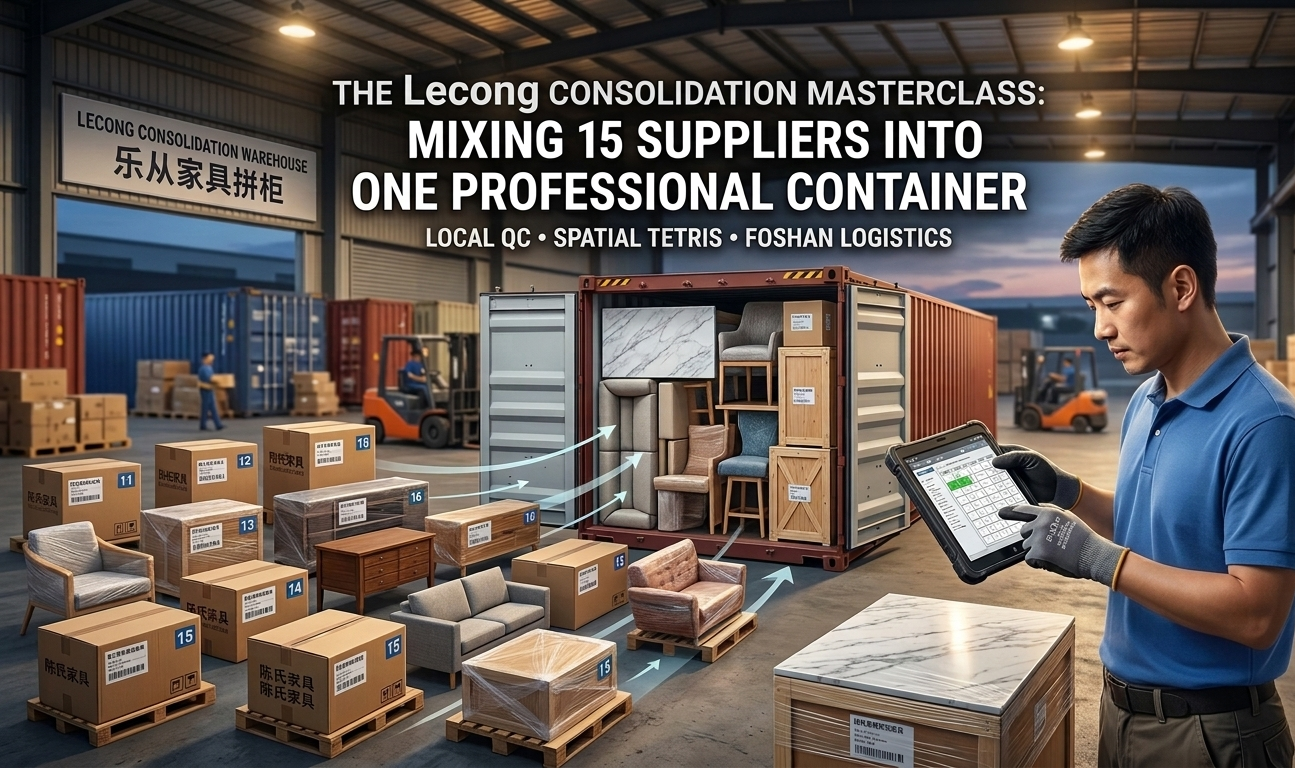
This is where the “Masterclass” part comes in. A warehouse isn’t just a big room; it’s a Quality Control center.
When the truck from the factory arrives at our warehouse, we don’t just sign the paper. We:
- Check the count: Did they send 10 chairs or 9?
- Inspect for damage: Lecong factories are notorious for “warehouse damage”—scratches that happen before the item even leaves the factory.
- Labeling: We make sure every box has your name and a clear description so you don’t have to open 100 boxes to find the screws for the bed.
- The Tetris Plan: We plan how to stack the heavy marble at the bottom and the light sofas on top so nothing gets crushed during 30 days at sea.
Why is the paperwork the hardest part of a mixed container?
When you ship a container with 15 suppliers, you technically have 15 different “exporters.” In China, you can’t just put them all in a box and leave. You need an export license for each, or you need to use a consolidated export entry.
We handle the customs documentation in Foshan, making sure the “Packing List” matches exactly what is in the container. If the paperwork says 50 boxes and customs finds 52, your container gets flagged, and you pay for the delay.
FAQ: The Reality of Mixed Containers
Q: What if one supplier is 2 weeks late?
A: This happens 80% of the time. We usually recommend shipping the 14 ready items and moving the late one to your next container, or having the factory ship it via air if it’s small. Never hold up a whole container for one small item—it costs more in storage than the item is worth.
Q: Do you charge a warehouse fee?
A: We usually provide 15–30 days of free storage for our clients. After that, there is a small daily fee. This is why we push factories hard to hit their deadlines—to save you money.
Q: Will the furniture arrive broken?
A: If you use the factory’s original “local” packaging, yes, it might break. We often recommend wooden crating for marble, glass, or delicate carvings. It’s an extra cost, but it’s cheaper than a broken dining table.
Q: Can I buy from shops that don’t have an export license?
A: Yes. Most shops in the Lecong furniture market don’t have their own export rights. As your Foshan sourcing agent, we act as the exporter of record to make the shipment legal.
The Bottom Line
Mixing 15 suppliers into one container is the best way to get a “designer look” at a factory price. But don’t try to manage it from a laptop in London or New York. You need a warehouse in Foshan and a team that isn’t afraid to argue with factory bosses.
Got a stack of invoices from Lecong? Send us your packing list, and we’ll show you how we can turn those 15 messy orders into one clean, professional container.