
Specifying windows and exterior glass doors for high-end residential projects—such as multi-million-dollar custom villas, modern estate builds, or coastal architectural homes—is one of the most critical decisions a custom builder, developer, or home owner makes. The fenestration package directly impacts the building envelope, thermal efficiency, structural wind resistance, and overall aesthetic quality.
Historically, US luxury builders relied almost exclusively on domestic architectural brands like Marvin, Fleetwood, or Western Window Systems. However, the rise of specialized architectural manufacturing hubs in Foshan, Guangdong, has made high-spec, factory-direct aluminum window packages an increasingly viable alternative.
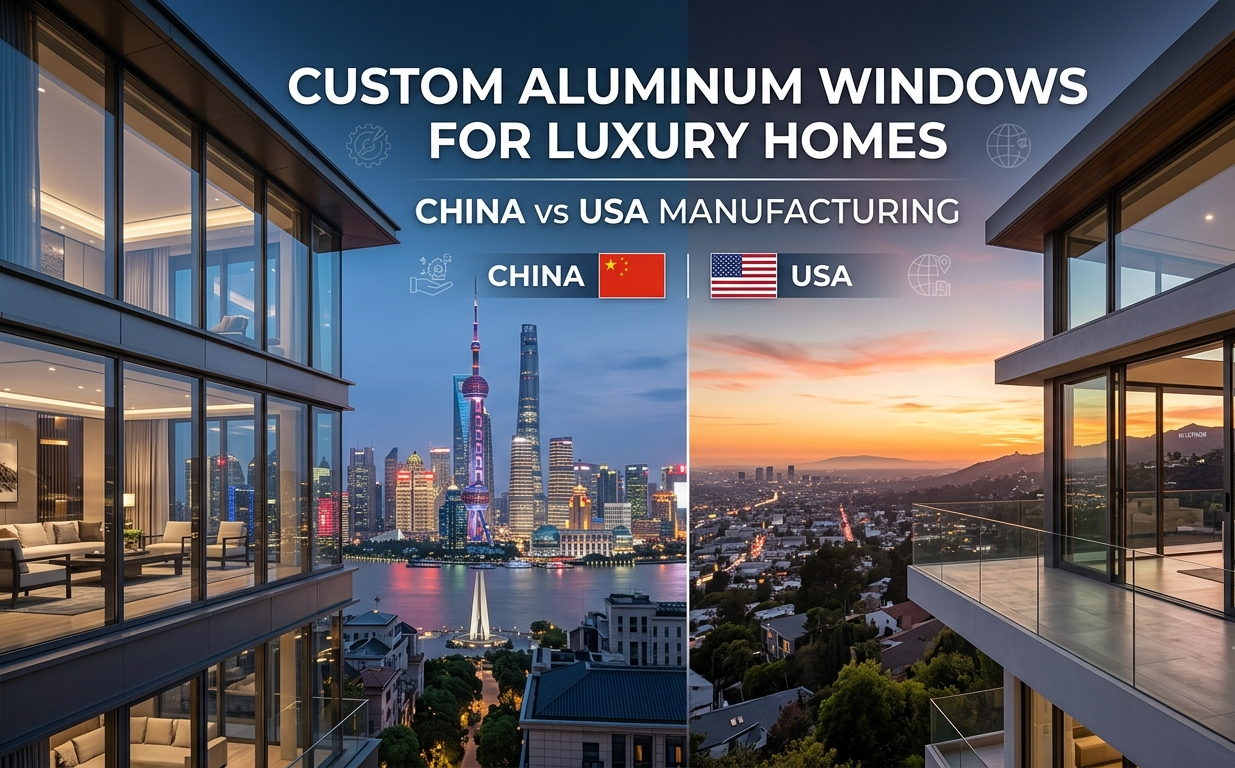
This article provides an objective, technical comparison between domestic US manufacturing and Foshan custom aluminum window production. We evaluate material specifications, code compliance, cost breakdown dynamics, lead time realities, and the engineering controls required to successfully import custom architectural glass.
Key Takeaways
- Material Engineering Parity: High-end Foshan export factories utilize the same primary raw materials as top-tier US manufacturers, including 6063-T5/T6 extrusion alloys, PA66 GF25 polyamide thermal breaks, and premium German hardware (Siegenia, Roto, HOPPE).
- Customization without Surcharge: US brands apply steep price penalties for non-standard openings, oversized glass panels (10 ft+ height), or custom anodized/PVDF finishes. Foshan factories treat custom die extrusions and custom dimensional profiles as standard operating procedure.
- Significant Landed Cost Value: Even after factoring in ocean freight, customs clearance, and US Section 301/232 tariffs, importing a complete villa window schedule from Foshan typically reduces material expenditures by 35% to 50% compared to US dealer retail quotes.
- Mandatory Code Verification: Imported windows must explicitly feature permanent etched SGCC (ANSI Z97.1) marks on tempered glass and documented NFRC thermal performance ratings to pass local US building inspections.
- The On-Ground Engineering Requirement: The primary risk of overseas procurement is drawing miscommunication—specifically Rough Opening (R.O.) deductions, flange setbacks, and flashing details. On-ground technical supervision in Foshan eliminates these failure points before shipment.
What Are the Core Structural and Material Differences Between US and Foshan Aluminum Windows?
When comparing premium aluminum windows across both markets, the engineering gap is far smaller than commonly assumed. Both domestic US luxury manufacturers and top-tier Foshan export facilities construct their window systems using similar industrial standards:
+-----------------------------------------------------------------------------------+
|                        TYPICAL SPECIFICATION COMPARISON                           |
+--------------------------+------------------------------+-------------------------+
| Feature                  | US Luxury Domestic Brand     | Foshan Premium Export   |
+--------------------------+------------------------------+-------------------------+
| Base Extrusion Alloy     | 6063-T5 / 6063-T6 Aluminum   | 6063-T5 / 6063-T6       |
| Main Profile Wall        | 1.8 mm – 2.5 mm              | 2.0 mm – 3.0 mm         |
| Thermal Isolation        | Pour-and-Debridge or PA66    | PA66 GF25 Polyamide     |
| Surface Coating          | AAMA 2605 (Kynar 500 / PVDF) | AAMA 2605 / Anodized    |
| Primary Hardware         | Truth / Custom Domestic      | Siegenia, Roto, HOPO    |
| Glass Construction       | Double/Triple Low-E Argon    | Double/Triple Low-E     |
+--------------------------+------------------------------+-------------------------+
Profile Thickness and Structural Integrity
Standard commercial replacement windows often use thin 1.4 mm aluminum profiles. Luxury villa projects, however, demand structural stability for expansive glass spans. Premium Foshan manufacturers construct heavy-duty casement and sliding systems with primary wall thicknesses ranging from 2.0 mm to 3.0 mm, meeting or exceeding the structural rigidity of North American residential window systems.
Thermal Break Technology
Aluminum is a highly conductive metal. Uninsulated aluminum frames will transfer exterior heat or cold rapidly into the building envelope.
- Many older US aluminum systems used poured-and-debridge polyurethane thermal breaks.
- High-end Foshan export systems utilize PA66 GF25 (25% glass-fiber reinforced polyamide) thermal break strips. These polyamide bars mechanically separate the interior and exterior aluminum extrusions, drastically reducing thermal conduction and preventing interior condensation.
Surface Finishes and Corrosion Resistance
Luxury homes, particularly coastal villas exposed to ocean air, require weatherable exterior coatings. Both US and Foshan factories offer AAMA 2605-compliant PVDF (Fluorocarbon/Kynar 500) powder coatings, which resist chalking, fading, and salt-spray corrosion for 20+ years when properly pre-treated.
How Do Manufacturing Costs and Pricing Models Compare for Custom Villa Packages?
Understanding the pricing discrepancy between US domestic window suppliers and Foshan direct factories requires looking at distribution models rather than raw material costs alone.
US DOMESTIC SUPPLY CHAIN:
[Factory] ──> [Regional Distributor] ──> [Local Dealer/Showroom] ──> [General Contractor] ──> [Homeowner]
(Multiple markup layers, showroom overhead, local dealer margins)

FOSHAN DIRECT SUPPLY CHAIN:
[Factory] ──> [HSY Sourcing Agent] ──> [FCL Ocean Freight] ──> [Jobsite Delivery]
(Factory-direct pricing + transparent agency oversight + freight/tariffs)
The US Dealer Model Overhead
When buying luxury windows through US dealer networks, the retail markup can add 200% to 400% above the base manufacturing cost. Dealers must cover showroom leases, regional distribution logistics, sales commissions, and territorial franchise fees. Furthermore, non-standard window dimensions or custom mullion layouts trigger steep “custom engineering fees”.
Landed Cost Dynamics from Foshan
A typical high-spec, thermally broken aluminum casement window with double-pane Low-E glass sourced directly from a Foshan factory costs roughly $180 to $320 per square meter ($17 to $30 per sq ft) at the factory gate.
Even after adding:
- International ocean freight and insurance.
- US import duties and federal tariffs (including Section 301 and Section 232 tariffs).
- Customs brokerage, port handling, and inland trucking.
The final landed cost for a full villa package (typically 30 to 60 units) averages 35% to 50% lower than equivalent quotes from US luxury dealers. The cost differential is even greater on complex, oversized configurations like 10-foot-tall lift-and-slide doors or slim-frame panoramic sliding systems.
Can Custom Aluminum Windows Sourced from Foshan Pass Strict US Building Codes?
Yes, but only if the specifications are explicitly mandated and verified during production. Chinese manufacturers build to whatever technical standard is requested in the purchase contract. A standard window built for domestic Chinese apartments will fail US building inspections unless configured for North American requirements.
+-----------------------------------------------------------------------------------+
|                    MANDATORY US CODE COMPLIANCE CHECKLIST                         |
|                                                                                   |
|  [Glass Safety]     ◄── Permanent SGCC / ANSI Z97.1 Logo Etched on Glass Corner   |
|  [Thermal Ratings]  ◄── NFRC Certified U-Factor & SHGC Performance Labels         |
|  [Impact Zones]     ◄── Florida Product Approval / Miami-Dade NOA (TAS 201/202/203) |
|  [Wood Trims]       ◄── EPA TSCA Title VI Formaldehyde Compliance Documentation   |
+-----------------------------------------------------------------------------------+
- Safety Glazing Certification (SGCC / ANSI Z97.1): US building codes require safety glass in all doors, hazardous locations, and near floor levels. Every tempered or laminated glass unit must feature a permanently etched SGCC certification logo in the corner. Removable paper stickers are not accepted by US building inspectors.
- Thermal Energy Performance (NFRC Ratings): State energy codes (such as California Title 24 or IECC standards) dictate maximum U-Factor (thermal heat loss) and Solar Heat Gain Coefficient (SHGC) limits. Foshan export factories with NFRC testing records provide required performance labels for plan submittals.
- Hurricane Impact Compliance: For coastal projects in Florida, Texas, or the Carolinas, windows require laminated glass assemblies and heavy-duty reinforced extrusions tested to ASTM E1886/E1996 or Miami-Dade TAS 201/202/203 standards.
How Do Real-World Lead Times Compare Between Domestic US Factories and Foshan Export Hubs?
Lead time is a frequent concern for general contractors managing rigid construction schedules. A comparison of real-world production and logistics timelines reveals a surprising outcome:
US DOMESTIC LUXURY LEAD TIME:
[Dealer Quote / CAD] ──> [Factory Backlog Queue] ──> [Production] ──> [Domestic Trucking]
    (2 - 3 Weeks)           (8 - 12 Weeks)          (4 - 5 Weeks)       (1 Week)
TOTAL: 15 TO 21 WEEKS

FOSHAN EXPORT ROUTE LEAD TIME:
[CAD Reconciliation] ──> [Sample / Mock-up Approval] ──> [Factory Production] ──> [Ocean Freight & Clearance]
    (1 - 2 Weeks)            (1 - 2 Weeks)               (4 - 5 Weeks)            (4 - 5 Weeks)
TOTAL: 10 TO 14 WEEKS
- US Domestic Realities: Due to dealer backlogs, custom color queues, and labor constraints, US luxury custom window lead times frequently range between 14 to 20+ weeks.
- Foshan Production Efficiency: Foshan fenestration factories operate at scale with automated CNC cutting, double-head corner crimping, and automated insulating glass unit (IGU) lines. Factory fabrication typically takes 30 to 35 days. Adding 25 to 35 days for ocean transit and port customs clearance results in a total turnaround of 10 to 14 weeks from final drawing approval.
What Are the Common Pitfalls When Importing Custom Windows Directly from China?
While the financial and technical advantages are significant, importing windows directly without on-ground oversight carries genuine operational risks:
- Dimensional & Deduction Misunderstandings: US drawings use imperial feet/inches and reference Rough Openings (R.O.). Chinese factories manufacture strictly to exact overall frame dimensions in millimeters. If a builder orders windows using raw opening sizes without subtracting installation tolerance gaps (typically 1/4″ to 3/8″ per side), the frames will not fit into the framed walls.
- Incorrect Frame Attachment Profiles: US timber-frame construction usually requires integrated nailing flanges (nail fins). European/Chinese masonry construction uses flush frames with subframe anchors. Ordering windows without specifying the correct nailing flange setback ruins jobsite waterproofing details.
- Freight and Transit Damage: Large glass panels and heavy aluminum frames will shift during ocean transit if stacked incorrectly. Shipping windows lying flat or packed loosely without rigid wooden A-frame skids leads to corner deformation or shattered glass upon arrival.
Why Choose HSY Sourcing as Your Window Procurement Partner in Foshan?
Navigating fenestration technicalities across international borders requires a dedicated local advocate on the factory floor. HSY Sourcing operates as your technical owner’s representative, quality inspector, and logistics controller in Foshan.
- CAD Plan Reconciliation and Shop Drawing Audits: Before any metal is cut, our engineering team converts your US architectural schedules and elevation sheets into precise metric production shop drawings. We verify Rough Opening deductions, nail fin setbacks, weep hole positioning, and hardware mounting heights directly with your architect or general contractor.
- On-Site Pre-Shipment Mock-Up & Dry Fit Inspections: We do not wait for windows to arrive in America to find mistakes. At the factory in Nanhai or Shunde, we supervise physical frame assembly, audit corner crimping tolerances, conduct water-spray penetration checks, and verify smooth roller operation on oversized sliding doors under workshop lights.
- Rigorous Code & Certification Verification: We inspect every glass pane prior to crating to ensure the permanent SGCC logo is cleanly etched. We verify that PA66 thermal breaks are installed correctly and confirm that all packaging bears mandatory ISPM 15 heat-treatment stamps.
- Custom Crate Engineering and Supervised Loading: We supervise the container loading process directly. Window units are mounted vertically on heavy-duty wooden A-frame skids, banded, ratcheted to container walls, and separated with industrial air bags to guarantee 100% damage-free jobsite arrival.
- Transparent Direct Agency Pricing: We operate on a clear, flat agency fee structure. You receive genuine factory-direct pricing invoices with zero hidden middleman markups, accompanied by complete US customs filing support.
Frequently Asked Questions (FAQ)
Can Foshan factories provide thermal performance documentation for US plan submittals?
Yes. Leading export-focused manufacturers in Foshan possess formal NFRC test reports and simulation data for their thermally broken window and door series. HSY Sourcing collects these specification sheets and performance labels during pre-production so your project team can submit them to local building departments for plan approval.
How are glass warranty claims or replacement parts handled if something breaks on site?
When shipping custom window packages, HSY Sourcing coordinates with the factory to manufacture and pack extra spare hardware components (such as handle sets, rollers, hinges, and corner seals) directly into the container. For insulated glass units (IGUs) accidentally damaged during installation, local glass shops in the US can cut and replace standard double-pane units locally using the frame’s removable interior glazing beads.
What is the minimum order size needed to justify importing custom windows from Foshan?
Importing is most cost-effective for whole-house villa packages, multi-unit residential projects, or commercial builds requiring at least $30,000 to $50,000+ in total material value (typically 25+ window/door units). Orders of this scale easily absorb international ocean freight, container handling, and tariff costs while preserving significant net savings.
Do Foshan windows come with integrated insect screens and blinds?
Yes. Foshan manufacturers specialize in integrated fenestration systems. Windows and doors can be specified with concealed retractable stainless steel mesh screens (high-strength security mesh), magnetic sliding screens, or motor-driven double-glazed internal blinds built directly inside the sealed glass cavity.