
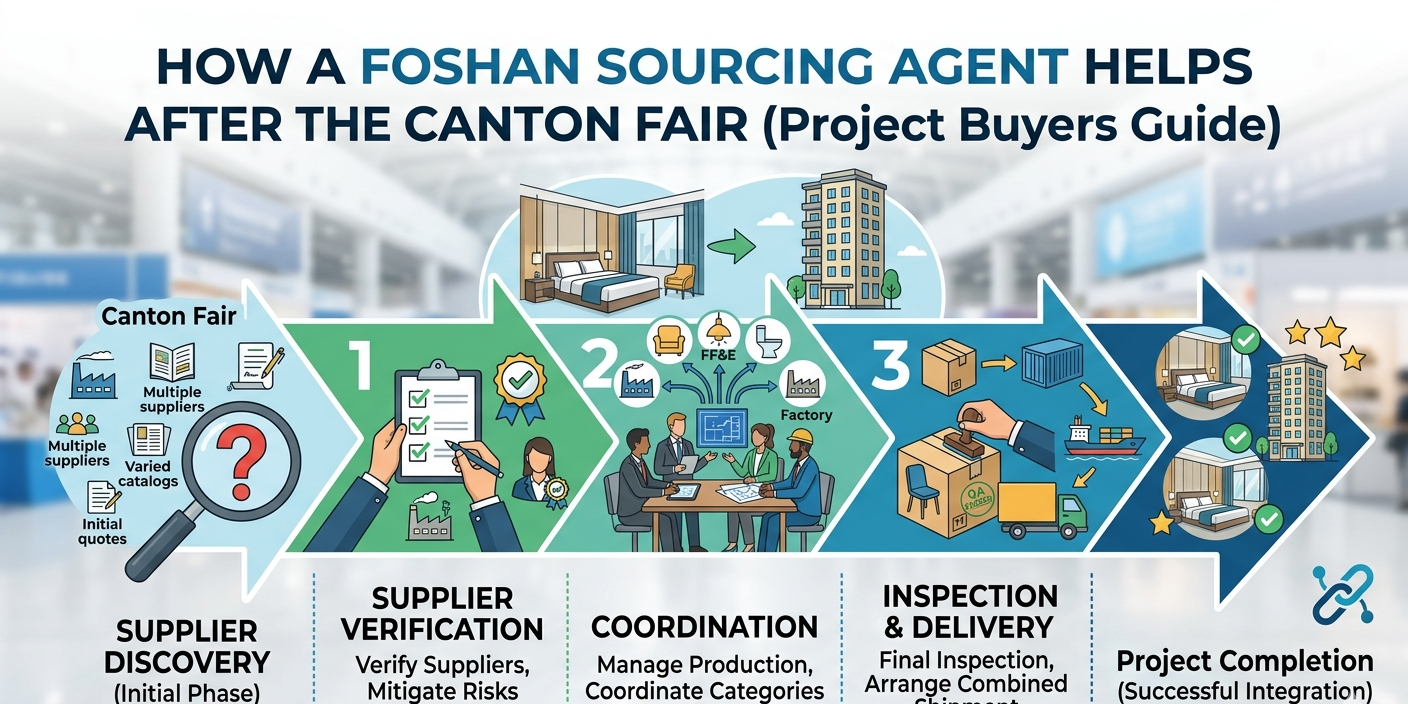
The Canton Fair is often the starting point for sourcing in China.
After the Canton Fair, many buyers face the real challenge—managing multiple suppliers and turning quotations into actual production. This is where a Foshan sourcing agent becomes essential.
Buyers come to explore suppliers, compare products, and understand pricing.
But once the exhibition ends, a more complex phase begins—especially for hotel, real estate, or construction projects.
Because finding suppliers is only one part of the process.
The real challenge is managing them.
This is where a Foshan sourcing agent becomes relevant.
What Happens After the Canton Fair?
After attending the Canton Fair, most buyers leave with:
- dozens of supplier contacts
- product catalogs and quotations
- initial ideas about pricing
However, very few buyers are ready to place orders immediately.
The next steps usually include:
- supplier verification
- sample development
- specification alignment
- price negotiation
- production planning
For project sourcing, these steps involve multiple suppliers across different categories.
Without coordination, things can quickly become disorganized.
Why Is Managing Multiple Suppliers So Difficult?
For project buyers, sourcing is rarely about one product.
You may be sourcing:
- furniture
- lighting
- sanitary ware
- building materials
Each supplier operates independently, with different:
- production timelines
- quality standards
- communication styles
Common problems include:
- inconsistent product quality
- delays from one supplier affecting the entire project
- misunderstandings in specifications
- difficulty tracking progress across factories
Even experienced buyers find this stage challenging without local support.
Why Foshan Matters After the Canton Fair
Foshan plays a key role in post-Canton Fair sourcing.
It is one of the largest manufacturing hubs in South China, especially for:
- furniture
- lighting (near Zhongshan)
- building materials
Its proximity to Guangzhou makes it a natural next step after the Canton Fair.
Many buyers follow this route:
👉 Canton Fair → Foshan factory visits → supplier selection
This is where sourcing becomes more practical and less theoretical.
Why Buyers Visit Foshan After the Canton Fair
Many suppliers you meet at the Canton Fair are based in Foshan or nearby regions. Visiting Foshan allows buyers to verify factories, compare suppliers, and better understand production capabilities before placing orders.
What Does a Foshan Sourcing Agent Actually Do?
A sourcing agent is not just a middleman.
For project buyers, their role is closer to a local coordinator.
Typical responsibilities include:
1. Supplier Verification
Before placing orders, verifying suppliers is critical.
This may involve:
- checking factory capabilities
- confirming production experience
- evaluating quality control systems
This step reduces risks that are not visible at exhibition booths.
2. Factory Visits and Coordination
Instead of visiting factories one by one, a sourcing agent can:
- arrange factory visits efficiently
- compare multiple suppliers in the same region
- provide local insights about factories
This saves time and helps buyers make more informed decisions.
3. Sample Development and Alignment
Samples are where many sourcing issues begin.
A sourcing agent helps:
- communicate specifications clearly
- coordinate revisions with factories
- ensure consistency across different suppliers
For projects, aligning samples across categories is essential.
4. Price Negotiation and Cost Control
Negotiation is not only about lowering prices.
It also involves:
- balancing cost and quality
- understanding hidden costs
- ensuring terms are realistic
A local agent can help bridge communication gaps and avoid misunderstandings.
5. Production Follow-Up
Once orders are placed, production management becomes critical.
A sourcing agent can:
- track production progress
- follow up with factories regularly
- identify potential delays early
This helps prevent last-minute surprises.
6. Quality Inspection
Quality control is especially important for project sourcing.
An agent can arrange:
- pre-production checks
- during-production inspections
- final inspections before shipment
This helps ensure that products meet agreed standards.
7. Shipment Coordination
For multi-category sourcing, logistics can be complex.
A sourcing agent helps:
- consolidate products from different suppliers
- manage packaging requirements
- coordinate shipping schedules
This reduces the risk of delays and misalignment.
What Problems Can a Sourcing Agent Help Prevent?
Working with multiple suppliers without coordination can lead to:
- inconsistent product specifications
- delays that affect the overall project timeline
- communication breakdowns
- unexpected cost increases
A sourcing agent does not eliminate all risks, but can help make the process more structured and controlled.
When Do You Actually Need a Sourcing Agent?
Not every buyer needs one.
You may consider working with a sourcing agent if:
- your project involves multiple product categories
- you are sourcing from several suppliers
- you cannot stay in China for long-term follow-up
- your team lacks local sourcing experience
For simple orders, direct sourcing may be sufficient.
For complex projects, coordination becomes more important.
Common Misunderstandings About Sourcing Agents
Some buyers assume:
- agents always increase costs
- agents replace direct factory relationships
- agents are only needed for beginners
In reality:
- costs can sometimes be offset by better coordination
- factories are still the actual producers
- even experienced buyers use local support for complex projects
Understanding the role correctly helps set realistic expectations.
How to Choose the Right Foshan Sourcing Agent?
If you decide to work with an agent, consider:
- experience with similar projects
- familiarity with product categories (furniture, building materials, etc.)
- communication clarity
- transparency in pricing and services
It’s important to see the agent as a coordination partner rather than just a service provider.
Key Takeaways
- The Canton Fair is only the starting point of sourcing
- Most sourcing work happens after the exhibition
- Managing multiple suppliers is the biggest challenge in project sourcing
- Foshan is a key hub for furniture and building materials sourcing
- A sourcing agent helps coordinate suppliers, quality, and logistics
FAQ: Working with a Foshan Sourcing Agent After the Canton Fair
Do I need a sourcing agent after visiting the Canton Fair?
It depends on your sourcing complexity.
If you are purchasing a single product from one supplier, you may manage the process yourself.
However, if your project involves multiple categories—such as furniture, lighting, and building materials—a sourcing agent can help coordinate suppliers and reduce operational complexity.
Can a sourcing agent guarantee product quality?
No agent can guarantee quality completely.
However, they can reduce risks by:
- verifying suppliers
- arranging inspections
- monitoring production
Quality still depends on clear specifications and proper communication.
How do sourcing agents charge for their services?
Pricing structures vary.
Common models include:
- percentage-based fees
- fixed service fees
- project-based pricing
It’s important to clarify the scope of services and cost structure before starting.
Will working with an agent increase my costs?
Not necessarily.
While there is a service fee, an agent may help reduce hidden costs such as:
- production errors
- delays
- inconsistent quality
In some cases, better coordination can offset the additional cost.
Can I still work directly with factories?
Yes.
A sourcing agent does not replace factories.
They act as a coordinator between you and multiple suppliers.
You can still maintain direct relationships with manufacturers while using an agent for support.
What is the biggest benefit of using a sourcing agent for projects?
The main benefit is coordination.
For project sourcing, the challenge is not finding suppliers—it’s managing them effectively.
A sourcing agent helps bring structure to a complex process involving multiple factories, timelines, and product categories.
Need help managing suppliers after the Canton Fair?
Our Foshan-based sourcing team helps with:
- factory visits and supplier verification
- multi-category sourcing coordination
- quality inspection and production follow-up
- shipment consolidation