
For international real estate developers, hospitality procurement executives, and commercial general contractors, interior wall cladding is a critical line item. Traditional wet-plaster work, manual drywall taping, and on-site painting are highly labor-intensive, drag down construction timelines, and introduce substantial quality-variance risks across hundreds of identical units.
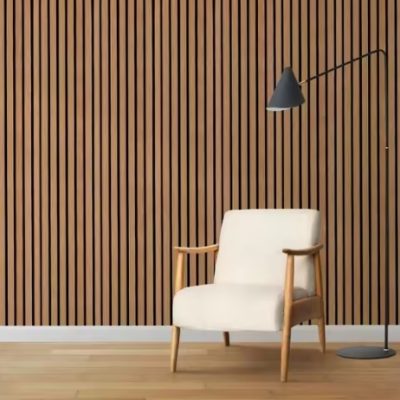
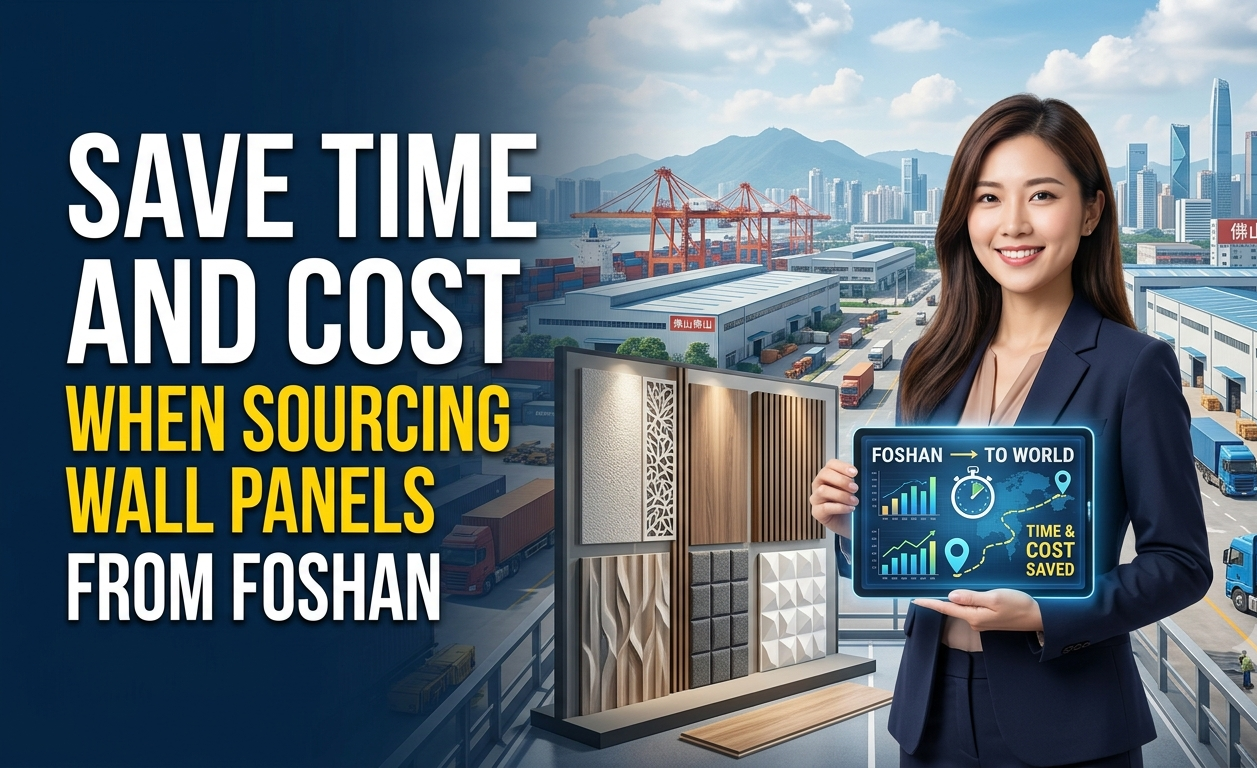
To compress hand-over schedules and control fit-out budgets, project buyers increasingly specify pre-finished engineered wall panels, such as co-extruded Wood Plastic Composite (WPC) fluted profiles or high-density bamboo charcoal fiber boards. Sourcing these products from the manufacturing clusters of Foshan, China, offers unmatched cost-efficiency. However, capturing these savings without sacrificing material lifespan requires a clear understanding of local supply chain dynamics, tooling logistics, and mixed-material container loading.
Why does the geographical density of Foshan’s manufacturing cluster directly reduce production lead times?
In supply chain logistics, geographical dispersion is a primary driver of cost inflation and production delays. If a factory must source its raw polymer resins from one province, its decorative vinyl films from another, and its processing machinery from a third, the cumulative transport time and middleman markups are built directly into your purchase order.
Foshan, particularly the Nanhai and Shunde districts, operates as a hyper-localized, vertically integrated industrial cluster for building materials. Within a tight radius of less than $50\text{ km}$, you can find:
- Primary Extrusion Facilities: Plants that melt and shape raw PVC, HDPE, and bamboo fiber compounds under high pressure.
- Chemical Compounding Suppliers: Local laboratories formulating UV stabilizers, impact modifiers, and B1-grade flame retardants.
- Film Gravure Printers: Industrial printing houses producing wear-resistant PVC, PET, and real-wood veneer laminate films.
- Tool and Die Workshops: Precision engineering shops cutting hardened steel extrusion dies down to tolerances of $\le \pm0.1\text{ mm}$.
Because these entities operate within the same municipal grid, a Foshan manufacturer can source customized films, adjust compound formulas, or repair a damaged extrusion die within hours rather than weeks. For a project buyer managing a tight hotel or apartment build phase, this compressed supply chain translates directly into shorter lead times, stable pricing tiers, and rapid physical prototype turnarounds.
How can project buyers avoid custom tooling charges for WPC and bamboo charcoal panels?
When an architect submits a custom interior drawing featuring a specific fluted spacing or a non-standard tongue-and-groove interlocking profile, many factories will immediately quote a custom tooling fee. For standard steel extrusion dies, this fee typically ranges from $\$1,500$ to $\$3,500$ per profile shape, along with a $15\text{-to-}20\text{-day}$ delay to cut, test, and calibrate the new mold.
For most commercial real estate projects, these custom tooling costs are entirely unnecessary.
Because Foshan manufacturers supply thousands of global hospitality and multi-family projects annually, their collective libraries of “public molds” are exceptionally deep. Standard commercial profiles—such as the popular $150\text{mm} \times 9\text{mm}$ flat interlocking slates, or $160\text{mm} \times 24\text{mm}$ triple-flute panels—are almost always active on factory floors.
By instructing your sourcing agent to audit the public mold inventories of pre-vetted factories, you can select pre-existing, structurally verified profiles. This completely eliminates custom tooling fees, avoids initial calibration errors, and allows the factory to begin extrusion within $48\text{ hours}$ of your deposit clearance.
What technical specifications must be written into the wall panel contract to prevent site installation failures?
A wall panel that looks flawless in a digital rendering can fail rapidly on-site if the physical chemistry of the substrate is substandard. To protect your investment, you must write precise, measurable technical parameters into your purchase contract rather than relying on vague terms like “commercial grade.”
[Contract Spec: Raw Bamboo Fiber %] ➔ [Automated PUR Adhesive Line] ➔ [Class B1 Flame Retardant Additives] ➔ [Moisture Level: 8% - 12%]
Your technical contract clauses should mandate the following thresholds:
1. High-Performance Lamination Bond (PUR Hot-Melt)
Standard budget wall panels use cheap water-based or Ethyl Vinyl Acetate (EVA) cold glues to adhere the decorative film to the substrate. EVA is a thermoplastic adhesive that softens when exposed to heat and humidity. In hotel bathrooms, kitchens, or tropical villa developments, steam will reactivate the glue, causing the decorative film to bubble and peel away.
Your contract must specify Polyurethane (PUR) Hot-Melt Lamination. PUR forms an irreversible covalent chemical bond with the substrate during curing, ensuring the film will not delaminate even under direct exposure to water or temperatures up to $120\text{°C}$.
2. Verified Substrate Core Density
To prevent panels from puncturing when struck by furniture, luggage, or cleaning carts, enforce strict density metrics:
- Bamboo Charcoal Solid Boards: Mandate a core density of $\ge 800\text{ kg/m}^3$.
- Co-Extruded WPC Hollow Panels: Mandate a minimum outer wall thickness of $\ge 2.2\text{ mm}$ to ensure structural rigidity.
3. Fire Retardant and Emission Compliance
Commercial projects must comply with local municipal building codes. Contractually require that the raw polymer mix contains specific halogen-free flame-retardant additives to achieve a certified Class B1 rating (difficult to ignite, self-extinguishing, low smoke density) under EN 13501-1 or equivalent ASTM E84 testing. Formaldehyde emissions must strictly comply with Class E0 or CARB Phase 2 limits.
How does mixed-container consolidation structurally lower the landed freight cost per square meter?
Wall panels are structurally flat and relatively light. If you fill an entire $40\text{-foot}$ High Cube (HQ) container solely with hollow WPC panels, the cargo will occupy the entire internal volume of $68\text{ m}^3$ long before it reaches the maximum ocean weight allowance of approximately $26\text{ metric tons}$. You end up paying full ocean freight rates to ship empty weight capacity.
Foshan’s unique geographical advantage as a one-stop construction hub allows for strategic, density-stratified container consolidation :
- The Bottom Layer (High Density): Load heavy, rigid cargo such as porcelain floor tiles, quartz countertops, or sanitary ware directly onto the container floor. These materials act as a stable base ballast, utilizing the container’s weight limit.
- The Upper Layer (Low Density / High Volume): Layer flat-packed, lightweight wall panels, matching skirting trims, and aluminum joining profiles securely on top of the heavy cargo, utilizing the remaining volumetric space.
By balancing heavy construction materials with lightweight wall cladding sourced from the same industrial cluster, your sourcing agent can pack containers to near $100\%$ capacity for both weight and volume. This logistics approach drops your localized shipping cost per square meter of wall paneling by up to $25\%$ to $35\%$ compared to booking independent, separate Less-than-Container Load (LCL) shipments.
Key Takeaways
- Bypass Tooling Overhead: B2B project buyers can save thousands of dollars and cut up to $15\text{ days}$ of production delays by utilizing the extensive libraries of existing public molds available among Foshan’s top manufacturers.
- Enforce the PUR Standard: Never accept standard EVA adhesives for commercial wall cladding. Mandate PUR hot-melt lamination to eliminate the risk of surface peeling and bubbling in high-humidity zones.
- Leverage Mixed Loading: Do not ship wall panels as standalone freight. Consolidate them vertically with heavy ballast materials like tiles or sanitary ware to minimize your freight cost per square meter.
Why Choose HSY Sourcing?
Navigating the industrial corridors of Foshan to secure competitive pricing while maintaining rigid quality standards requires a dedicated, technically competent local partner. HSY Sourcing operates as your on-the-ground procurement and engineering office in China.
- Absolute Independence: We do not work on factory kickbacks or hidden supplier commissions. We operate entirely on a transparent, flat service-fee framework, giving your development team direct access to true factory-floor pricing.
- On-the-Line Quality Control: Our QC engineers do not just check cartons at the warehouse dock. We visit the extrusion floors in person to verify raw compounding mixes, measure wall-panel thicknesses with digital calipers, and test the lamination bond strength before the goods are approved for packaging.
- Cross-Category Finish Matching: Cabinetry, doors, and wall panels must coordinate visually. We physically transport master control film and veneer samples between your independent wall panel, door, and millwork manufacturers in Foshan, ensuring a seamless color and grain match across your entire property.
- Engineered Container Consolidation: At our local staging facilities, we manage incoming deliveries from multiple vendors. We design and execute density-stratified load plans to maximize container space, secure fragile materials, and lower your total landed shipping costs.
Frequently Asked Questions (FAQ)
Can wall panels be manufactured to custom lengths to match our project’s exact ceiling heights?
Yes. For project orders meeting a minimum threshold (typically $\ge 500\text{ m}^2$), Foshan extrusion lines can cut panels to custom heights (e.g., $2.95\text{ m}$ or $3.15\text{ m}$). Ordering exact floor-to-ceiling lengths completely eliminates horizontal joint lines, saves on-site labor time, and reduces material cutting waste by $5\%$ to $10\%$.
How does HSY Sourcing verify that panels are actually Class B1 fire-retardant?
We do not rely on standard PDF certificates emailed by factory sales reps. We perform on-site flame tests on random extrusion samples using calibrated blowtorches to verify self-extinguishing behavior and smoke density. For strict municipal compliance, we coordinate formal batch testing through accredited third-party laboratories like SGS or Intertek.
What is the typical production lead time for a 3,000-square-meter apartment wall panel order?
When utilizing standard public molds, production generally requires 12 to 18 days once the master color lot and shop drawings are approved. If your order requires custom film printing or custom profile tooling, add an extra $10\text{ to }14\text{ days}$ to the schedule.
How do we prevent panels from scratching or denting during maritime transit?
Standard domestic packaging is highly vulnerable to container shifting. We require that all export orders are packed using heavy-duty, double-wall corrugated cartons with internal polyethylene foam sheets protecting the finished faces, wrapped in moisture-barrier shrink wrap, and secured on fumigated IPPC-stamped wooden pallets.