
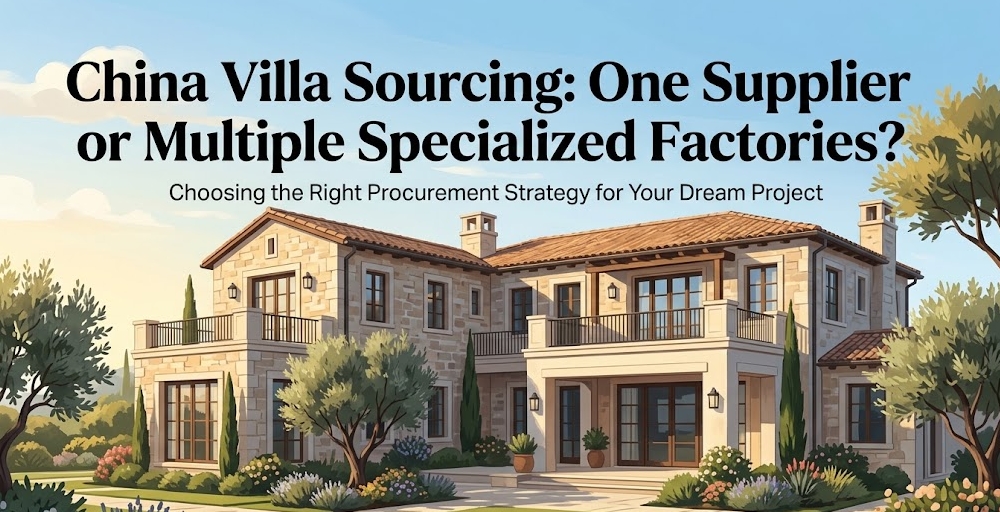
A private homeowner sourcing materials for a high-end villa from China quickly faces a key structural decision: Is it better to buy as much as possible from one large supplier, or work with several specialized factories?
The idea of using a single vendor is appealing. Dealing with one company promises a single point of contact, consolidated invoices, and less time spent managing communications. On the surface, it seems like the most efficient way to handle a complex build.
However, a private villa is not a standard apartment complex. It typically involves distinct design requirements across custom kitchens, dressing rooms, architectural aluminum windows, imported or local stone, custom joinery, and specialized sanitary ware. Expecting one manufacturer to produce every item at a consistently high standard often leads to compromises in quality, limited material options, or hidden subcontracting.
The alternative—working with multiple specialized factories—allows you to match each part of your project to a manufacturer that excels in that specific product category. But this approach creates a new challenge: who coordinates the technical details, production schedules, and material interfaces between all these independent suppliers?
The right sourcing structure depends on your specific villa design, your quality expectations, and how supplier coordination will be managed on the ground.
The Real Choice: One Supplier vs. Multiple Factories
The choice between one supplier and multiple factories is not about which model is “better,” but which one fits your project’s specific complexity.
┌─────────────────────────────────────────────────────────┐
│                 VILLA SOURCING MODELS                   │
├────────────────────────────┬────────────────────────────┤
│    ONE-SUPPLIER MODEL      │    SPECIALIZED MODEL       │
├────────────────────────────┼────────────────────────────┤
│ • Single point of contact  │ • Best-in-class quality    │
│ • Simplified invoicing     │ • Broader material choices │
│ • Easier initial process   │ • Precise customization    │
│ • Higher risk of outsourcing│ • Requires coordination   │
└────────────────────────────┴────────────────────────────┘
A single supplier offers convenience, but may lack depth in specific manufacturing categories. Working with specialized factories provides access to dedicated technical expertise, though it requires active oversight to ensure all parts fit together during installation.
Understanding Foshan’s Specialized Supply Chains
To understand why this choice exists, it helps to understand how manufacturing works in Foshan and the surrounding industrial hubs of Guangdong province.
Foshan is often described as a one-stop market for building materials, but it is actually a collection of distinct, highly specialized industrial clusters. A few kilometers can separate a district that produces architectural aluminum windows from an area focused on custom cabinetry, large-format sintered stone slabs, or sanitary ware.
                  ┌──────────────────────────────┐
                  │   FOSHAN INDUSTRIAL HUB      │
                  └──────────────┬───────────────┘
                                 │
     ┌───────────────────┬───────┴───────┬───────────────────┐
     │                   │               │                   │
┌────┴──────────────┐ ┌──┴────────────┐ ┌┴───────────────┐ ┌──┴──────────────┐
│ Custom Cabinetry  │ │ Aluminum      │ │ Natural &     │ │ Sanitary Ware  │
│ & Millwork        │ │ Windows/Doors │ │ Sintered Stone│ │ & Fittings     │
└───────────────────┘ └───────────────┘ └───────────────┘ └────────────────┘
Because these supply chains operate independently, very few factories manufacture across multiple distinct categories under one roof. A company that builds custom kitchen cabinets does not extrude aluminum window profiles or process raw marble blocks.
When a single supplier offers to supply your entire villa—from the main kitchen and aluminum windows to the bathroom vanities and outdoor stone—they are usually operating in one of two ways:
- They produce one core category in-house (such as cabinetry) and trade or subcontract the remaining categories (such as windows, stone, and sanitary ware).
- They are a trading company or package integrator that outsources 100% of the manufacturing across different specialized facilities.
Subcontracting is a standard practice in global manufacturing and is not inherently bad. However, for a private villa owner, it introduces an important operational distinction: One supplier does not equal one factory.
The One-Supplier Model: Benefits and Limitations
For some private residential projects, bundling the order with a single primary supplier or general trading vendor makes practical sense.
Potential Advantages
- Single Communication Channel: You or your interior designer deal with one project manager for updates, payments, and revisions.
- Simplified Commercial Terms: Instead of reviewing, negotiating, and tracking ten different factory contracts, you manage one master agreement.
- Streamlined Initial Follow-up: Tracking production progress across a single entity requires less immediate administrative overhead during the early stages of the project.
Realistic Limitations
- Variable Quality Across Categories: A supplier may produce exceptional lacquer kitchen cabinets but deliver average aluminum doors or standard-grade wardrobes. Their core manufacturing strength rarely extends across every product category.
- Middleman Markups on Subcontracted Items: When a cabinet manufacturer procures your stone countertops or bathroom fixtures from an outside factory, they typically apply an administrative or trading margin to those items.
- Loss of Direct Technical Control: When changes or technical queries arise regarding a subcontracted item (such as window glass performance or appliance cutouts), communication must pass through the primary supplier to the actual manufacturer, increasing the risk of misinterpretation.
- Lack of Transparency: It becomes difficult to verify where subcontracted items are manufactured, what raw materials are used, or whether proper quality control is performed at the secondary factory.
The Multiple-Specialized-Factory Model
Working directly with specialized factories for major product categories allows you to leverage the full strength of Foshan’s specialized manufacturing ecosystem.
┌─────────────────────────────────────────────────────────────────┐
│                 SPECIALIZED FACTORY SELECTION                   │
├──────────────────────┬──────────────────────────────────────────┤
│ Kitchen & Joinery    │ Specialized Cabinetry Factory            │
│ Windows & Sliding    │ Dedicated Architectural Aluminum Producer│
│ Stone & Slabs        │ Specialized Stone Processing Plant       │
│ Loose Furniture      │ Dedicated Upholstery & Woodworking Mill  │
└──────────────────────┴──────────────────────────────────────────┘
Potential Advantages
- Best-in-Class Manufacturing: You can select a dedicated kitchen manufacturer that specializes in complex cabinet engineering, a window factory that understands thermal break technology, and a dedicated stone processor with advanced CNC machinery.
- Broader Customization and Material Selection: Specialized factories offer deeper expertise, wider hardware catalogs, and specialized finish options tailored specifically to their trade.
- Clearer Price Transparency: Purchasing directly from category-specific manufacturers eliminates secondary markups on outsourced items, making it easier to evaluate the true production cost of each material.
- Direct Technical Alignment: Your architectural drawings are reviewed directly by the engineers who physically manufacture the products, reducing miscommunication on tolerances and site conditions.
Realistic Limitations
- Higher Administrative Workload: Managing separate contracts, payment schedules, drawing approvals, and production timelines across multiple factories requires significant time and effort.
- Communication Gaps: Dealing with multiple factory sales representatives—who may have varying levels of English proficiency or technical expertise—can slow down decision-making.
- Increased Risk at Product Interfaces: When independent factories produce components that interact on site (such as stone countertops fitting onto kitchen carcasses), neither factory takes responsibility for ensuring the two items align unless coordinated during production.
The Hidden Challenge: Cross-Trade Coordination
The primary difficulty when using multiple specialized factories is not managing separate invoices. It is managing the physical interfaces where different products meet on the job site.
In a custom villa, building materials do not exist in isolation. They interact constantly:
                    ┌─────────────────────────┐
                    │  Custom Joinery /       │
                    │  Cabinetry              │
                    └────────────┬────────────┘
                                 │
         ┌───────────────────────┼───────────────────────┐
         │                       │                       │
┌────────┴────────┐     ┌────────┴────────┐     ┌────────┴────────┐
│ Stone & Slabs   │     │ Built-in        │     │ MEP & Lighting  │
│ (Cutouts/Weight)│     │ Appliances      │     │ (Power/Vents)   │
└─────────────────┘     └─────────────────┘     └─────────────────┘
- Kitchen Cabinets + Stone Countertops: If your cabinetry comes from a specialized joinery factory and your marble from a stone processor, both suppliers must work off the exact same CAD drawings. Seam locations, overhang support, basin cutouts, and edge profiles must be verified between both factories before cutting begins.
- Built-in Wardrobes + Finished Flooring: Wardrobes designed to fit flush against finished floor levels require precise coordination regarding floor thickness, subfloor prep, and ceiling drop-margins.
- Aluminum Windows + Wall Cladding: Exterior window reveal dimensions directly dictate how stone cladding, interior plasterboard, or tile reveals are detailed.
- Kitchen Carcasses + Appliances: Integrated appliances require specific ventilation channels, electrical access, and exact cutout dimensions. Passing a basic specification sheet to a cabinet maker is rarely enough; actual physical cutouts must be cross-referenced against factory production drawings.
When you use a single vendor, they bear the responsibility for these interfaces. When you use multiple specialized factories, you or your local representative must manage these trade interfaces.
Comparing Total Sourcing Costs
A common misconception among homeowners is that buying directly from multiple specialized factories will automatically yield the lowest total cost.
While unit factory prices from specialized manufacturers are often lower than a bundled quotation from a general supplier, factory price is only one component of the total project cost.
┌────────────────────────────────────────────────────────┐
│               TOTAL PROCUREMENT COST                   │
├────────────────────────────────────────────────────────┤
│ Factory Unit Prices (Cabinetry, Stone, Windows, etc.)  │
│ + Pre-Shipment Quality Inspections                     │
│ + Local Warehouse Receiving & Storage                  │
│ + Container Loading & Packing Consolidation            │
│ + Ocean Freight, Insurance & Import Duties             │
│ = Actual Delivered Project Cost                        │
└────────────────────────────────────────────────────────┘
When evaluating your procurement budget, consider these additional factors:
- Inspection Costs: Checking quality across five distinct factories requires multiple site visits during production and pre-shipment assembly.
- Local Logistics & Storage: Goods produced by different factories will rarely be finished on the exact same day. Items that are finished early require secure local storage until the remaining products are ready to load.
- Container Space Utilization: Shipping partially filled containers from individual factories increases sea freight expenses. Consolidating shipments locally ensures full container utilization.
- Packaging and Crating: Different factories use different packaging standards. Heavy items like stone or fragile items like lacquered panels require custom wooden crating to survive international ocean freight.
A low ex-factory price from a specialized manufacturer can quickly be offset by inefficient shipping, damaged goods due to poor packaging, or site rework caused by unverified dimensions.
When Does Each Approach Make Sense?
To determine the right sourcing structure for your project, evaluate your villa’s design complexity against your capacity for project management.
When One Supplier May Be Practical
- The project design is straightforward, with standard architectural details and minimal complex customization.
- The supplier genuinely specializes in your highest-value category (such as cabinetry) and handles secondary items with full transparency.
- You or your designer prefer to manage a single point of contact and accept a curated, limited selection of materials.
- The project has a tight timeline that leaves little room for managing multiple factory negotiations and individual drawing approvals.
When Multiple Specialized Factories Make Sense
- The villa features highly customized, complex designs—such as specialized joinery, architectural aluminum systems, or custom stone features.
- Design consistency, specific finish selections, and high-end material quality take precedence over purchasing convenience.
- You want complete visibility into material specifications, hardware lines, and individual factory capabilities for each category.
- You have a dedicated local partner or sourcing agent on the ground in China to manage technical communications, factory inspections, receiving, and shipment consolidation.
Decision Matrix: Structuring Your Procurement
Use this comparison matrix to evaluate which approach aligns best with your villa project’s priorities:
| Project Priority | One General Supplier | Multiple Specialized Factories | Multiple Factories + Local Sourcing Partner |
| Communication Overhead | Low (Single contact) | Very High (Multiple factories) | Low to Moderate (Single local agent contact) |
| Product Customization & Quality | Moderate to Limited | High (Category-specific expertise) | High (Category-specific expertise) |
| Material & Hardware Transparency | Low (Bundled specs) | High (Direct factory specs) | High (Verified specs & samples) |
| Trade Interface Coordination | Managed by Supplier | Managed by Homeowner / Designer | Managed by Local Sourcing Partner |
| Logistics & Consolidation | Handled by Supplier | Complex (Multiple shipments) | Streamlined (Local warehouse consolidation) |
| Overall Project Risk | Dependent on Vendor Integrity | High risk of coordination errors | Low to Moderate (Managed local control) |
The Role of a Local Foshan Sourcing Partner
If your villa project demands the quality and customization of specialized factories, the main challenge becomes on-the-ground management. This is where an independent local sourcing partner provides essential operational support.
As a Foshan-based sourcing agent specializing in residential and private villa building materials, HSY Sourcing operates as your independent representative on the ground. We do not manufacture products, nor are we tied to specific factories.
                               ┌───────────────────────────┐
                               │  PRIVATE VILLA OWNER /    │
                               │  ARCHITECT / DESIGNER     │
                               └─────────────┬─────────────┘
                                             │
                               ┌─────────────┴─────────────┐
                               │  HSY SOURCING             │
                               │  (Local Sourcing Partner) │
                               └─────────────┬─────────────┘
                                             │
         ┌───────────────────┬───────────────┴───────────────┬───────────────────┐
         │                   │                               │                   │
┌────────┴────────┐ ┌────────┴────────┐             ┌────────┴────────┐ ┌────────┴────────┐
│ Cabinetry       │ │ Aluminum Windows│             │ Stone Processing│ │ Sanitary Ware  │
│ Factory         │ │ Factory         │  (Etc...)   │ Plant           │ │ Manufacturer   │
└─────────────────┘ └─────────────────┘             └─────────────────┘ └─────────────────┘
When managing a multi-factory procurement structure, a local sourcing partner helps by:
- Auditing Specialized Suppliers: Pre-screening factories based on their actual production capability, machinery, and past project experience, rather than relying on showroom appearances.
- Standardizing Quotations: Reviewing line-item specifications across different factories to ensure materials, finishes, hardware series, and structural specs are compared accurately.
- Managing Trade Interfaces: Cross-checking CAD shop drawings between joinery, stone, window, and appliance suppliers to prevent dimensional misalignments before production begins.
- In-Process & Trial-Assembly Inspections: Visiting individual factories during manufacturing to inspect material quality, finish accuracy, and pre-shipment dry-assemblies.
- Warehouse Consolidation & Loading: Receiving finished goods from multiple factories at a central Foshan facility, inspecting packaging condition, and supervising container loading to maximize shipping efficiency.
By combining the manufacturing strengths of specialized Chinese factories with dedicated local coordination, private homeowners can achieve high-end customization while keeping project risk and logistics under control.
Practical Example: A Private Villa Sourcing Structure
To see how this works in practice, consider a typical private villa procurement plan involving multiple product categories:
┌─────────────────────────────────────────────────────────────────┐
│                    VILLA PROCUREMENT PLAN                       │
├───────────────────┬───────────────────────────┬─────────────────┤
│ PRODUCT CATEGORY  │ MANUFACTURING APPROACH    │ LOCAL CONTROL   │
├───────────────────┼───────────────────────────┼─────────────────┤
│ Main Kitchen &    │ Specialized Custom        │ Factory trial-  │
│ Dressing Rooms    │ Joinery Factory           │ assembly check  │
├───────────────────┼───────────────────────────┼─────────────────┤
│ Architectural     │ Specialized Aluminum      │ Waterproof &    │
│ Windows & Doors   │ Profile Manufacturer      │ glass spec verification │
├───────────────────┼───────────────────────────┼─────────────────┤
│ Interior & Floor  │ Dedicated Stone           │ Dry-lay pattern │
│ Marble / Slabs    │ Processing Plant          │ & shade grading │
├───────────────────┼───────────────────────────┼─────────────────┤
│ Sanitary Ware &   │ Established Brand         │ Pre-shipment    │
│ Bathroom Fixtures │ Distributors / Factories  │ water-pressure check │
└───────────────────┴───────────────────────────┴─────────────────┘
In this scenario, attempting to force all four categories into a single factory would likely compromise the quality of the windows, stone, or joinery.
Instead, sourcing each category from a specialized manufacturer ensures high-level production quality. A local sourcing partner manages drawing reviews, coordinates factory timelines, inspects finished goods at each plant, and consolidates the items into unified ocean containers at a local Foshan warehouse.
Key Takeaway
There is no universal rule stating that a private villa must be sourced entirely from one supplier or strictly from ten separate factories.
If your villa design relies on standardized materials and simple customization, working with a capable primary supplier can offer a convenient, streamlined experience.
However, if your project involves high-value custom joinery, specialized architectural glazing, detailed stone work, and specific material selections, leveraging Foshan’s specialized factories will yield superior results. Success under this model simply requires clear technical documentation, active trade coordination, and reliable oversight on the factory floor.
Frequently Asked Questions
Is it better to source a villa from one Chinese supplier?
It depends on your villa’s design complexity and your management resources. One supplier simplifies communication and contracts, but may compromise quality in categories outside their core manufacturing strength. Multiple specialized factories yield higher product quality, but require active trade coordination.
Can I buy kitchen cabinets and wardrobes from different factories?
Yes. Many homeowners select one factory that excels in high-end lacquer or veneer work for the main kitchen, and a different factory for standard wardrobe carcasses. However, you must ensure that hardware specifications, material grades, and design details remain consistent between both suppliers.
Is it cheaper to use several specialized factories in China?
Unit factory prices from specialized manufacturers are often lower than bundled quotes from a general trading vendor. However, overall cost savings depend on how effectively you manage local logistics, quality inspections, container consolidation, and cross-trade drawing coordination.
How do I coordinate technical details between multiple Chinese suppliers?
Cross-trade coordination requires checking CAD shop drawings across all vendors before production starts. For example, appliance cutouts must match cabinet drawings, and stone seam layouts must align with cabinet support structures. If you cannot manage this technical review in person, a local sourcing partner can coordinate these details directly with the factory engineering teams.
Can products from different Foshan factories be shipped together?
Yes. Goods manufactured at different factories across Foshan and Guangdong can be delivered to a local consolidation warehouse. Once all items are inspected, verified, and safely packed, they are loaded into unified sea freight containers for direct export to your project destination.