
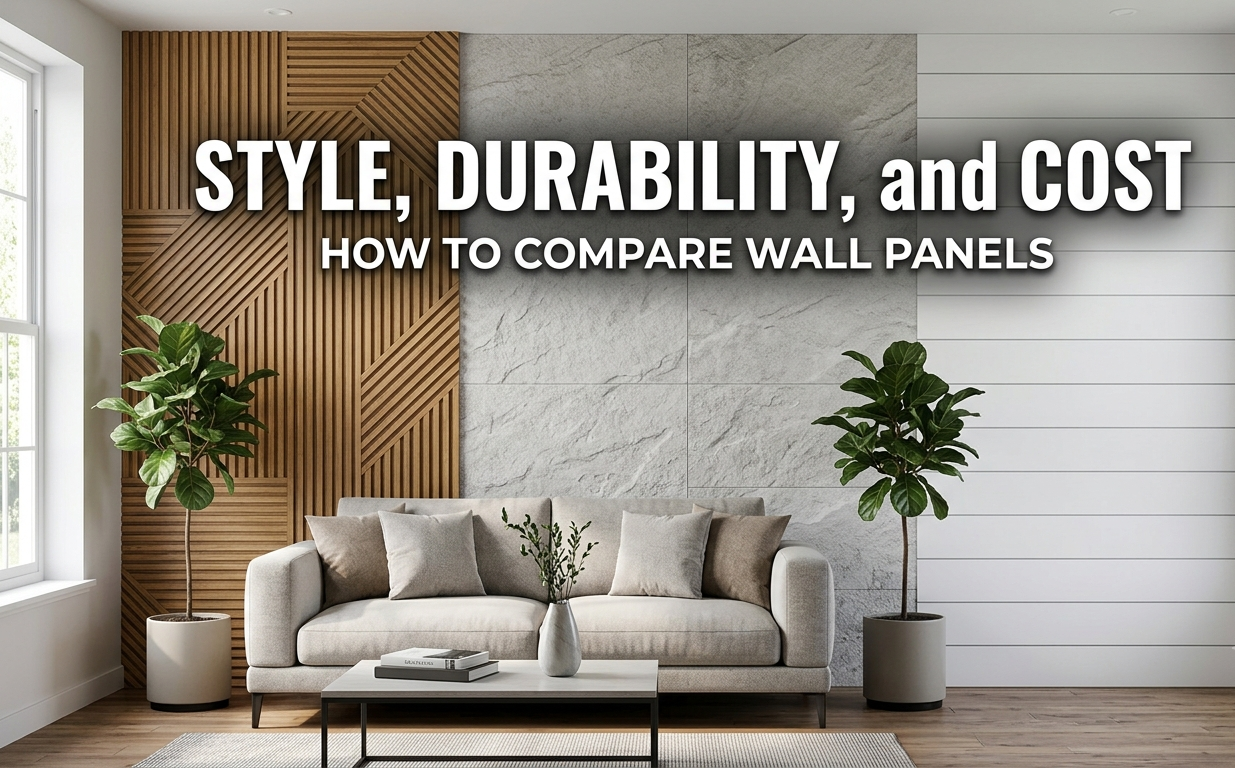
When managing the interior fit-out of a hospitality development, a multi-family apartment block, or a luxury villa project, wall cladding selection directly impacts both the construction schedule and the long-term maintenance budget. Wall panels have largely replaced traditional drywall plastering and painting in commercial specs because they offer a repeatable, pre-finished surface that cuts on-site labor hours.
However, choosing the wrong substrate can result in severe post-installation failures, such as delamination in high-humidity zones or cracking in high-traffic corridors. To optimize procurement, project buyers must systematically evaluate wall panels across three interdependent metrics: aesthetic intent, structural durability, and total landed cost.
Key Takeaways
- Substrate Dictates Lifespan: SPC and bamboo charcoal fibers offer the highest impact resistance for public commercial zones, while engineered timber core provides the acoustic and visual premium required for high-end residential suites.
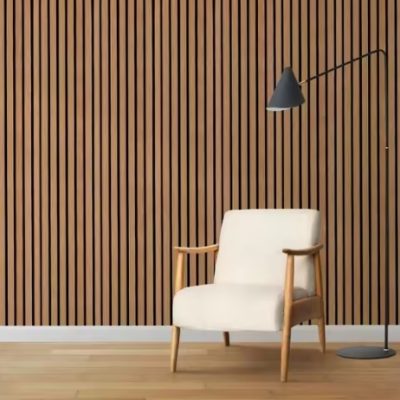
- Lamination Type Controls Style: Real wood veneers and high-fidelity PUR hot-melt wrapped PVC films provide realistic textures without the weight or maintenance liabilities of raw materials.
- Foshan Cluster Economics: Sourcing from Foshan minimizes raw material markups and domestic logistics costs due to the tight integration of local polymer extruders and surface film manufacturers.
What are the primary material options for commercial wall panels?
Wall panels are classified by their core substrate composition. The core determines how the panel reacts to structural shifts, moisture, and impact, while the surface finish delivers the required design style.
- WPC (Wood Plastic Composite): A hollow or solid extrusion of PVC resin and recycled wood flour. It is lightweight and highly moisture-resistant but has lower impact resistance compared to denser composites.
- SPC (Stone Plastic Composite): A solid core composed of natural limestone powder and PVC stabilizers. It is completely waterproof, structurally rigid, and possesses inherent fire-retardant properties.
- Bamboo Charcoal Fiber Panels: A co-extruded composite utilizing pulverized bamboo carbon and polymers. Known for high dimensional stability, low thermal expansion, and excellent structural recovery.
- Engineered Wood Veneer (MDF/Plywood Core): A premium substrate consisting of high-density fiberboard or marine-grade plywood topped with a sliced layer of natural or technical timber veneer.
- Flexible Stone (MCM / PU): An ultra-thin sheet made from modified clay or polyurethane that mimics split-face slate or volcanic rock, capable of wrapping around radius walls and structural columns.
How do you balance aesthetics, durability, and cost metrics?
Evaluating wall panels requires looking beyond the initial factory-gate price sheet. Buyers must account for installation speed, scrap rates, and localized performance requirements.
The matrix below provides a direct technical comparison of the primary contract-grade panels manufactured in the Foshan cluster:
| Substrate Type | Cost Tier (FOB Foshan) | Impact & Scratch Resistance | Moisture & Warp Resistance | Common Aesthetic Finishes | Recommended Project Target |
| WPC Panels | Low | Moderate (Prone to heavy dents) | High (Zero rotting) | Woodgrain PVC Film, Matte Solid Colors | Apartment bedrooms, hotel corridor ceilings, budget housing. |
| SPC Panels | Medium | High (Excellent for high-traffic) | Excellent (Submerged stable) | Sintered Stone Look, Marble, Micro-cement | Hospitality lobbies, commercial elevators, public washrooms. |
| Bamboo Charcoal | Medium-High | High (Flexural toughness) | Very High (Low expansion) | Fabric texture, metallic foil, high-gloss UV | Hotel feature walls, villa master bedrooms, office partitions. |
| Wood Veneer (Plywood/MDF) | High | Moderate (Requires protective clear coats) | Low-Moderate (Requires strict climate control) | Natural Oak, Walnut, Engineered Technical Timber | Luxury villa lounges, executive boardrooms, presidential suites. |
| Flexible Stone (PU/MCM) | High | Moderate-High (Pliable) | High (Weatherproof) | Natural slate, raw concrete, travertine split-stone | Hotel exterior facades, lobby columns, villa accent walls. |
Why does the Foshan industrial cluster lower wall panel procurement costs?
The pricing structural advantage found in Foshan is a result of geographic supply chain concentration, not a compromise on raw material density.
Wall panel production requires massive inputs of PVC resins, calcium carbonate powder, and surface foils. In Foshan, the chemical raw material distribution centers, specialized tooling workshops, and heavy extrusion machinery manufacturers are located within a 30-minute logistics radius.
Because local extruders do not pay long-distance overland freight to secure raw materials or custom steel dies, their operational overhead is significantly lower than isolated factories in other regions. For international buyers, this means lower unit costs, reduced minimum order quantities (MOQs) for custom profiles, and shortened production lead times.
What technical compliance parameters must project buyers verify?
Procuring building materials based solely on small visual showroom samples introduces extreme structural and legal risks to a real estate development. Independent verification of technical data is mandatory before authorizing mass production.
1. Fire-Retardant Certification
Commercial projects globally mandate strict fire ratings for wall finishes (e.g., ASTM E84 Class A in the United States or EN 13501-1 Class B-s1, d0 in Europe). Standard polymer formulations are highly combustible. Factories must introduce specific flame-retardant chemical additives into the extrusion mix to meet these criteria. Buyers must request verified testing documentation from international labs like SGS or Intertek.
2. Formaldehyde and VOC Emissions
Indoor air quality is a core component of modern building compliance. Engineered wood panels (MDF/Plywood) must comply with international emission limits, specifically reaching E0, EN 717-1, or CARB Phase 2 standards. Composite panels (WPC/SPC) should be verified as lead-free and phthalate-free.
3. Tongue-and-Groove Milling Tolerances
Most modular wall panels utilize a tongue-and-groove or click-lock connection system. If the factory’s extrusion calibration shifts by even 0.3mm during a production run, the panels will fail to lock flush on-site. This creates visible gaps or uneven vertical lips that catch shadows under downlighting, ruining the finish.
Why partner with HSY Sourcing for your wall panel procurement?
Navigating the vast building material markets in Foshan requires independent, technically competent oversight to protect your capital. HSY Sourcing operates strictly as your on-the-ground procurement and quality control office, working solely on behalf of the buyer.
- Direct Factory Matching: We audit local extruders to match your project with raw manufacturers holding the appropriate heavy tonnage machinery and valid export certifications, bypassing third-party trading markups.
- Technical Specification Enforcement: We review your architectural drawings and interior specs, ensuring the factory uses the correct substrate densities, PUR hot-melt adhesives, and certified fire-retardant additives.
- Rigorous Milling and Adhesion QC: Our team performs physical in-line inspections. We check tongue-and-groove interlocking accuracy, test surface film adhesion via cross-hatch testing, and verify color batch consistency across high-volume runs.
- Logistical Optimization and Consolidation: Wall panels are volumetric, long, and highly vulnerable to edge-crushing during transport. We manage the entire packaging protocol—enforcing reinforced corner guards and heavy-duty crating—and consolidate your panels with your furniture and sanitary ware orders to maximize container utilization.
Frequently Asked Questions (FAQ)
How do you prevent color shading variation across a large wall panel order?
Color shading variation happens when a factory uses different batches of PVC decoration film or varying timber log cuts during separate production runs. For large real estate or hotel projects, HSY Sourcing enforces a strict “single-batch” protocol. We require the manufacturer to lock down the entire volume of surface film or veneer from the same raw material batch before commencing the extrusion process.
Can WPC or SPC wall panels be installed directly over raw concrete walls?
While WPC and SPC panels can tolerate minor surface irregularities due to their rigidity, installing them directly over damp, completely uneven raw concrete is not recommended. For commercial projects, we advise installing a lightweight steel or treated timber furring strip grid first, or ensuring the wall is completely leveled and sealed with a moisture barrier before adhesive or mechanical clips are applied.
What is the standard packaging specification for exporting long wall panels?
Standard wall panels are typically 2.8 meters to 3 meters in length, making them susceptible to bending and corner damage. We mandate that factories wrap panels face-to-face with protective foam sheets, pack them into heavy 5-layer corrugated export cartons, and secure them onto fully enclosed, fumigated wooden pallets or iron racks with rigid plastic edge protectors.
How do you verify that a factory is using high-quality PUR adhesive for lamination?
Low-grade cold glues degrade quickly under temperature changes, causing the surface film to bubble or delaminate. During our unannounced factory audits, HSY Sourcing physically inspects the lamination line to verify the presence of active Polyurethane Reactive (PUR) hot-melt machinery and checks the manufacturer’s glue supply chain records.