
Finding a factory in China is no longer the hard part—platforms like Alibaba have made supplier discovery incredibly easy. The real challenge is finding someone on the ground who will protect your margins, enforce your quality standards, and manage the logistical chaos of a multi-supplier order.
Typing “China sourcing agent” into Google yields thousands of results. But how do you separate a professional project management team from a middleman working out of their bedroom?
If you are sourcing for complex orders—like hotel projects, wholesale distribution, or custom product development—here is a practical guide on how to evaluate and choose a sourcing agent you can actually trust.
1. Transparency is Non-Negotiable
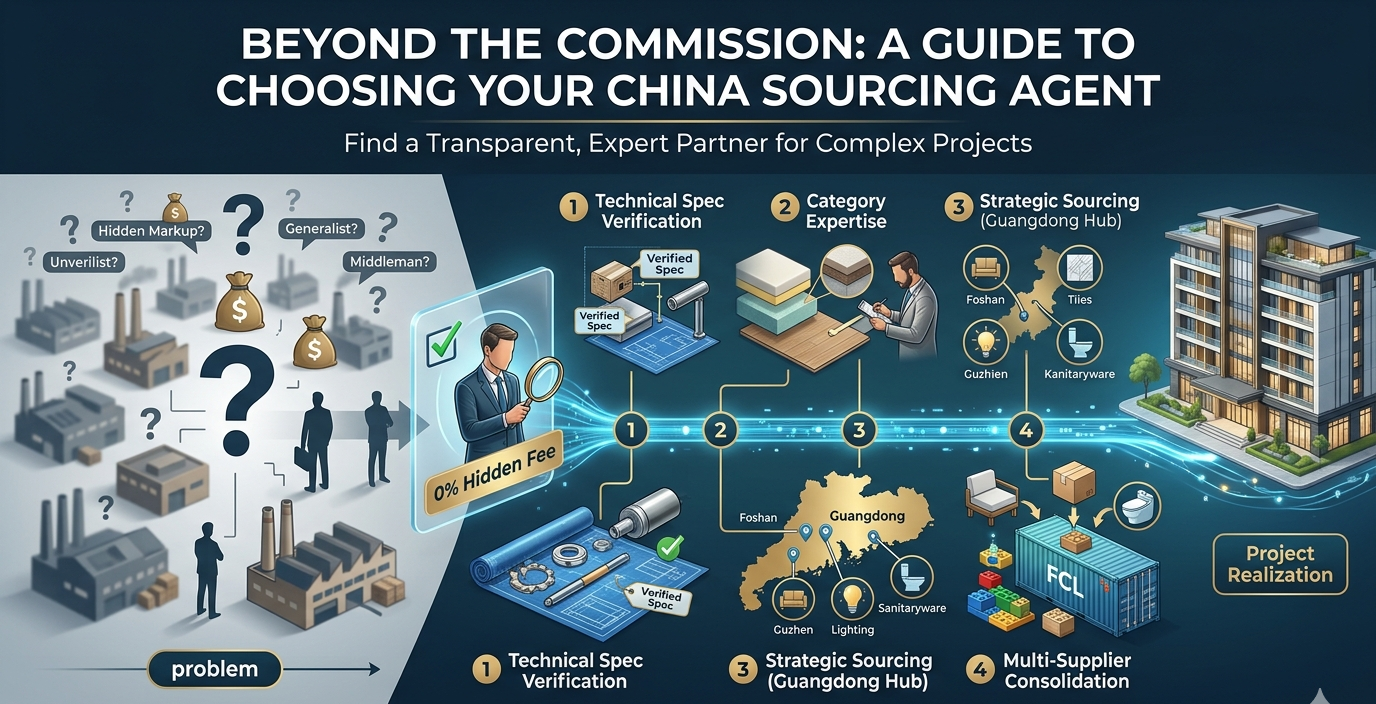
The biggest complaint buyers have about Chinese sourcing agents is the “hidden kickback.” Many traditional agents claim to work for free or charge a miraculously low 2% commission, only to secretly add a 20% markup to the factory’s price.
How to test them: Ask the agent if they will share the factory’s direct contact information and original quotations. A reliable sourcing partner operates with full transparency. They charge a clear service fee for their project management and QC work, and they let you know exactly who is manufacturing your goods. If an agent hides the factory name, they are a trader, not a sourcing partner.
2. Generalists vs. Specialists
An agent who claims to be an expert in sourcing cheap plastic toys, high-tech electronics, and heavy building materials is likely an expert in none of them.
Quality control requires deep, category-specific technical knowledge. If you are importing furniture or building materials, your agent needs to understand wood moisture content, Martindale rub tests, and PVD coating processes.
How to test them: Ask technical questions about your product category during the interview. Ask to see a sample of a previous Quality Control (QC) report they have conducted for a similar product.
3. Location Matters (Proximity to Industrial Hubs)
China is massive. If you are sourcing lighting and furniture, and your agent is based in Beijing or Shanghai, they are useless to you. They will have to fly to the factories in Guangdong, and you will be paying for their flights and hotels.
How to test them: Match the agent’s location to your product’s industrial cluster. If you are sourcing construction materials, furniture, or sanitary ware, your agent must be based in or near Guangdong province (like Foshan, Guangzhou, or Shenzhen) so they can drive to the factory within an hour to solve sudden production issues.
4. Do They Have an In-House QC Team?
Sourcing the product is only 20% of the job; ensuring it meets your specifications before it gets loaded into a container is the other 80%. Many solo agents outsource their quality control to cheap third-party freelancers who don’t understand your specific project requirements.
How to test them: Ask about their inspection process. A professional agency will perform mid-production inspections (to catch errors before the goods are finished) and pre-shipment inspections (PSI) using their own trained staff.
5. Logistics and Consolidation Capabilities
If you are buying from five different factories, shipping five separate LCL (Less-than-Container Load) shipments will destroy your profit margins. A competent agent does more than just talk to suppliers; they manage the physical goods.
How to test them: Ask if they have access to a consolidation warehouse. The best agents will collect the goods from all your suppliers, store them in a central warehouse, perform a final cross-category quality check, and load them into a single FCL (Full Container Load) to optimize your freight costs.
Key Takeaways
- Demand Transparency: Never work with an agent who refuses to share the factory’s direct details or original pricing.
- Hire for the Category: Choose an agent who specializes in your specific industry so they can perform highly technical quality control.
- Location is Strategic: Ensure your agent is located within driving distance of your manufacturing hubs (e.g., Foshan for building materials and furniture).
- Consolidation Saves Margins: A good agent should be able to store, inspect, and combine goods from multiple factories into one container shipment.
FAQ: Hiring a Sourcing Agent in China
How much should a legitimate sourcing agent charge?
Professional agents typically charge a project management fee based on the complexity of the order, or a commission ranging from 5% to 10% of the total order value. Be highly suspicious of agents charging 1% or 2%—they are almost certainly taking hidden kickbacks from the factory.
What is the difference between a sourcing agent and a trading company?
A trading company buys the product from the factory, marks up the price, and sells it to you. You do not know who makes the product. A true sourcing agent acts as your local representative, connects you directly with the factory, and charges a service fee for managing the production, QC, and logistics.
Do I need an agent if I just buy directly from Alibaba?
For small, simple, off-the-shelf retail orders, buying direct on Alibaba is fine. However, if you are developing custom products, placing multi-supplier project orders (like equipping a hotel), or need strict quality compliance, an agent on the ground is mandatory to prevent costly mistakes.
Meet the HY Sourcing Team: Your On-the-Ground Project Managers
At HY Sourcing, we don’t just forward emails between you and a factory. We act as your dedicated local office, your quality control inspectors, and your logistics coordinators.
Based in the heart of China’s premium manufacturing hubs, our team specializes in complex, high-stakes B2B procurement—particularly for building materials, commercial furniture, and multi-supplier projects.
Why partner with HY Sourcing?
- Zero Hidden Margins: We operate on a transparent service-fee model. You get the direct factory price, every time.
- Technical QC Expertise: Our inspectors don’t just look at the packaging; we verify raw materials, structural integrity, and compliance with your local market standards.
- Seamless Consolidation: We manage the chaos. Whether you have 3 suppliers or 30, we consolidate your goods in our facilities, ensure batch consistency, and load your containers strategically.
Stop gambling with your supply chain. Let a professional team handle the execution so you can focus on growing your business.