
You placed an order with a factory in Guangdong. The deposit is paid, production is finishing up, and the factory is asking for the final balance before they ship.
Since you can’t fly to China to check the goods yourself, you have to send someone. But who?
If you search online, you basically have two choices: hire a big third-party inspection in China (like SGS, V-Trust, or AsiaInspection), or work with a local China sourcing agent (like us here in Foshan).
Both will go to the factory. Both will look at your products. But the way they operate—and what happens when they find a problem—is completely different. Let’s break down the reality of how these two options actually work on the ground.
What exactly does a third-party inspection (TPI) company do?
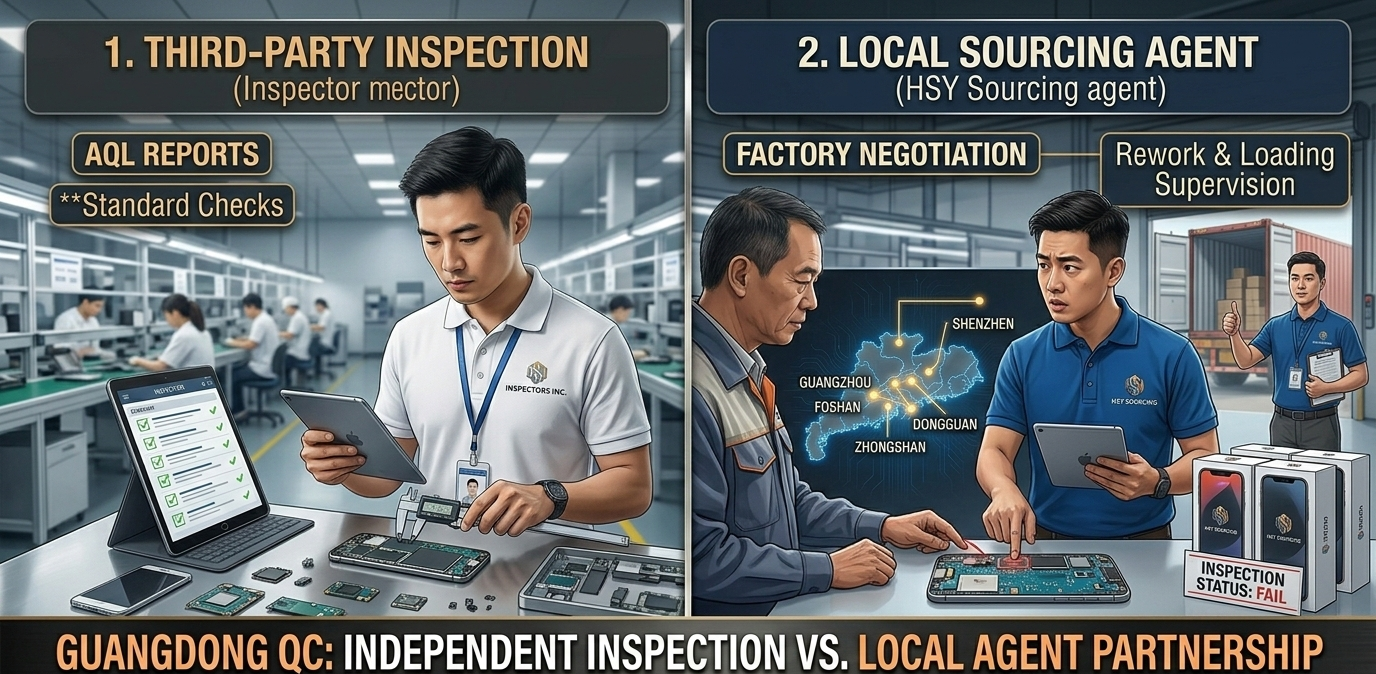
A third-party inspection company is like a grading machine. When you hire them for a pre-shipment quality control check, they send an inspector to the factory for one day.
They follow a strict mathematical formula called AQL (Acceptable Quality Limit). If you ordered 2,000 units, they might pull 125 units from the pile. They check them against your checklist, take lots of photos, and count the defects.
Within 24 hours, they email you a 30-page PDF report. The report will end with a clear grade: PASS, FAIL, or PENDING.
The good part: They are highly standardized, objective, and great if you need official compliance paperwork for big retail chains.
Where does the third-party inspection fall short?
Here is the part most buyers don’t realize until it’s too late: Third-party inspectors are reporters, not fixers.
Let’s say the inspector finds that 15% of your products have scratched paint. They will mark the report as “FAIL,” pack up their clipboard, and leave the factory.
Now you wake up in your time zone, open the PDF, and see the bad news. What happens next?
- The inspector won’t stay to force the factory to repaint the items.
- They won’t negotiate a discount for you.
- They won’t supervise the factory workers taking the bad products out of the good boxes.
You are left alone to fight with the factory sales rep over WeChat or email, trying to convince them to fix a mess that you can’t even see.
How is a local sourcing agent different?
When you hire a Foshan agent in China (or an agent covering Shenzhen, Dongguan, etc.), you aren’t just buying a PDF report. You are hiring an extension of your own company.
A good agent also checks the goods, but their job doesn’t end if they find a problem. Their job is to solve it.
If our team goes to a factory in Dongguan and finds that the barcodes are printed incorrectly, we don’t just write it down and go home. We walk straight to the factory boss and say: “Stop packing. These labels are wrong. We need to reprint them today, and I am going to wait here until the first batch is done right.”
A local agent handles the arguments, manages the rework schedule, and comes back to verify the fix. We also handle the container loading supervision, ensuring the factory doesn’t accidentally load the rejected goods into your shipment.
Which option actually saves you money?
It depends on how you define “cost.”
A standard third-party inspection usually costs around $300 per man-day. It’s a flat, predictable fee.
A China sourcing agent in Foshan might charge a daily rate, a flat project fee, or a small percentage of the order, depending on the arrangement.
While the upfront cost might look similar, an agent saves you money when things go wrong. If an order fails a TPI inspection, you have to pay another $300 for them to go back a week later to re-inspect. With an agent, managing the rework and the final loading is usually part of the sourcing management package.
When should you use which service?
There is no “one size fits all.” Here is the realistic breakdown:
Use a Third-Party Inspection Company if:
- You are a massive corporation (like Target or Walmart) that requires standardized, audited compliance reports.
- You are buying very simple, standard items where the only risk is a slight color variance.
- You already have a dedicated, full-time employee in your home country who has the time to argue with Chinese factories over failed reports.
Use a Local Sourcing Agent if:
- You are an Amazon seller, an e-commerce brand, or a mid-sized importer.
- You are buying customized products, electronics, or furniture where “small” details matter.
- You need someone to actually manage suppliers remotely across the Guangdong area (Foshan, Shenzhen, Zhongshan).
- You want someone to not just inspect the goods, but also coordinate the export logistics and watch the container get loaded safely.
FAQ: Inspections and Agents in China
Q: Can a third-party inspector or a local agent be bribed by the factory?
A: Let’s be honest: corruption can happen anywhere in the world. Big TPI companies rotate their inspectors to prevent this, but it still occasionally happens. For agents, reputation is everything. A reliable agent relies on your repeat business for years; taking a quick bribe from a factory would ruin their entire business model. Always do a video call and vet your agent before hiring them.
Q: Do local agents use AQL standards too?
A: Yes, professional agents know and use AQL standards for sampling. The difference is flexibility. If we find a major issue early in the sampling process, we don’t waste time checking the rest—we stop the line immediately to address the root cause.
Q: Can I use an agent just for inspection, even if I found the supplier myself?
A: Absolutely. Many of our clients find their own suppliers on Alibaba. They hire us purely for factory audits in Guangdong and pre-shipment inspections because they know we can drive to the factory in an hour if there’s a sudden problem.
The Bottom Line
If you just want a piece of paper that says your goods were checked, hire a big third-party company.
But if you want someone to actively protect your money, argue on your behalf, and make sure the goods actually get fixed before they go into the shipping container, you need a local partner on the ground.