
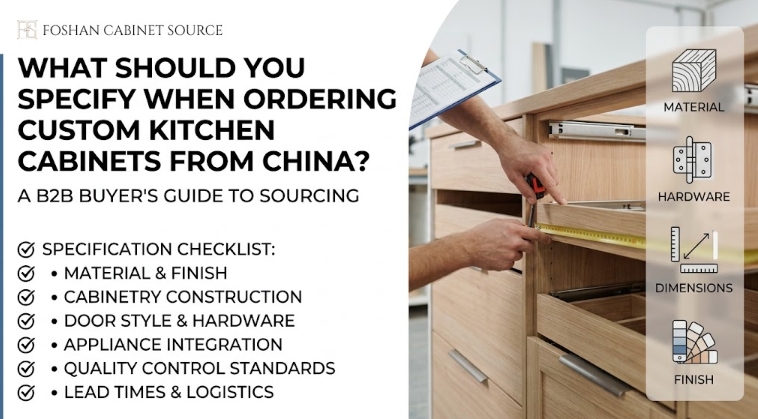
Custom millwork defines the visual and operational tone of a high-end luxury kitchen. For American private estate owners building or renovating a luxury villa, procuring custom kitchen cabinets directly from specialized manufacturers in Foshan and Shunde offers access to high-grade materials, bespoke architectural veneers, and German concealed hardware at factory direct pricing.
However, custom cabinetry manufactured overseas cannot be ordered using vague descriptive terms like “modern oak kitchen” or “high-end white cabinets.” Chinese cabinetry factories operate strictly on precise technical specifications, imperial-to-metric CAD shop drawings, hardware callouts, and formaldehyde safety certifications.
Omitting key technical parameters leads to sub-grade particleboard cores, mismatched veneer grain patterns, non-compliant drawer slide depths, and spatial conflicts during jobsite installation.
This guide outlines the exact material, hardware, dimensional, and environmental specifications American villa owners must define before releasing custom kitchen cabinet orders to factory production in China.
Key Takeaways
- Specify CARB Phase 2 / EPA TSCA Title VI Substrates: To clear US Customs and prevent indoor air off-gassing, all plywood and MDF cores must carry certified CARB P2 or EPA TSCA Title VI stamps rather than generic E1 standards.
- Require Birch Plywood Boxes Over Particleboard: For luxury residential applications, specify $18\text{mm}$ ($3/4\text{-inch}$) multi-ply birch plywood for cabinet boxes rather than melamine-faced chipboard (MFC) or low-density particleboard.
- Hard-Code German Concealed Hardware Brands: Never accept “standard soft-close hinges.” Explicitly call out brand, model, and weight ratings—such as Blum CLIP top BLUMOTION hinges and Blum LEGRABOX soft-close drawer runners.
- Mandate Physical Sample Sign-Off and 100% Trial Assembly: Never approve production based on digital renders. Require a physical sample box containing veneer strike-offs and door profiles, followed by a full trial assembly on the factory floor before export packaging.
Which Core Materials and Environmental Certifications Protect Your Home’s Air Quality?
The internal carcass (box) material dictates structural integrity, moisture resistance, and indoor air safety. US municipal codes and environmental standards require strict documentation for imported composite wood products.
+-----------------------------------------------------------------------------------+
|                  CABINET CARCASS & BOARD SPECIFICATION MATRIX                     |
+--------------------------+------------------------------+-------------------------+
| Material Parameter       | Standard Export Grade        | Tier-1 Luxury Villa Spec|
+--------------------------+------------------------------+-------------------------+
| Carcass Substrate        | 16mm Particleboard / Melamine| 18mm Birch Plywood      |
|                          | Chipboard (MFC)              | (Multi-ply marine grade)|
+--------------------------+------------------------------+-------------------------+
| Emission Certification   | Chinese National E1 Standard | CARB Phase 2 / EPA      |
|                          |                              | TSCA Title VI Certified |
+--------------------------+------------------------------+-------------------------+
| Back Panel Thickness     | 5mm Single-face MDF          | 9mm to 12mm Solid       |
|                          |                              | Plywood Reinforcement   |
+--------------------------+------------------------------+-------------------------+
| Edge Banding Tech        | Standard EVA Hot-melt Glue   | PUR Glue or Laser Edge  |
|                          | Line                         | Banding (Zero Joint)    |
+--------------------------+------------------------------+-------------------------+
1. Environmental Safety: CARB P2 / EPA TSCA Title VI
Standard Chinese Domestic or generic export cabinetry often uses E1 formaldehyde emission standards ($\le 0.124\text{ mg/m}^3$). However, the US Environmental Protection Agency enforces stricter limits via EPA TSCA Title VI / CARB Phase 2 ($\le 0.05\text{ ppm}$ for plywood).
- Uncertified composite wood risk border retention by US Customs or off-gassing toxic fumes inside your closed home.
- Your purchase contract must explicitly state: “All cabinet boxes, door cores, and veneers must utilize certified CARB Phase 2 / EPA TSCA Title VI compliant plywood with mill test reports attached.”
2. Carcass Substrate: 18mm Birch Plywood vs. Particleboard
While commercial builders use Melamine-Faced Chipboard (MFC) to save costs, luxury estate builds demand high-density multi-ply birch plywood ($18\text{mm}$ or $3/4\text{-inch}$ nominal thickness).
- Moisture Resistance: Birch plywood resists swelling under sink areas and humid climates compared to particleboard.
- Screw Holding Power: Heavy natural stone countertops (such as $30\text{mm}$ quartzite or marble slabs) exert immense downward force. Plywood cores retain structural fasteners far better than compressed wood chips.
3. Edge Banding: PUR Glue or Zero-Joint Laser Banding
Standard cabinet factories use EVA hot-melt glue, which leaves a visible dark glue line that can peel over time when exposed to steam from dishwashers or cooktops.
- Specify PUR (Polyurethane) glue or Laser Edge Banding. PUR glue creates a moisture-proof, heat-resistant bond with a virtually invisible seam between the melamine/veneer face and the edge tape.
How Do You Specify Door Finishes and Architectural Veneer Matching?
The aesthetic quality of custom millwork depends on the door substrate, surface finish application, and veneer grain alignment across cabinet faces.
+-----------------------------------------------------------------------------------+
|               DOOR FINISH & GRAIN ALIGNMENT SPECIFICATIONS                        |
|                                                                                   |
|  [Veneer Matching]   ──> Book-matched or Slip-matched natural wood veneers       |
|  [Grain Continuity]  ──> Continuous vertical/horizontal grain across door sets   |
|  [Lacquer Process]   ──> 7-layer PU (Polyurethane) coating with UV blocker       |
|  [Lacquer Type]      ──> Matte (10-15% sheen) or High-Gloss Polished Lacquer     |
+-----------------------------------------------------------------------------------+
1. Grain Matching Across Adjacent Doors
When ordering natural wood veneers (e.g., American Walnut, Smoked Oak, or Teak), individual door panels must not be cut from random veneer sheets.
- Continuous Grain Alignment: Specify that veneer grain must run continuously across all adjacent lower drawers, upper doors, and appliance panel overlays.
- Matching Technique: Call out Book-matching (symmetrical mirrored grain) or Slip-matching (repeating parallel pattern) on shop drawings before production.
2. Lacquer Finishes: 7-Layer Polyurethane (PU) Systems
For painted shaker-style doors or ultra-smooth slab doors, low-grade factories apply basic acrylic lacquers that yellow under sunlight and chip easily.
- Specify a 7-layer Polyurethane (PU) coating process consisting of 3 primer base coats, 2 color coats, and 2 protective clear topcoats.
- Include an anti-yellowing UV blocker additive in the lacquer spec, especially for bright white or light grey finishes positioned near floor-to-ceiling windows.
What Hardware Brands and Internal Organizer Specs Are Required?
Cabinet door movement, drawer glide smoothness, and soft-close longevity depend entirely on the hardware specified. Never leave hardware selection to factory discretion.
+-----------------------------------------------------------------------------------+
|                   HARDWARE & INTERNAL MECHANISM CALLOUTS                          |
+--------------------------+------------------------------+-------------------------+
| Component                | Unspecified Factory Default  | Luxury Villa Spec       |
+--------------------------+------------------------------+-------------------------+
| Door Hinges              | Generic Asian Brand          | Blum CLIP top BLUMOTION |
|                          | Soft-close                   | (110° / 155° Zero-Protrusion)
+--------------------------+------------------------------+-------------------------+
| Drawer Runners           | Undermount 3-fold ball       | Blum LEGRABOX / TANDEMBOX|
|                          | bearing slides               | (40kg to 70kg weight rate)
+--------------------------+------------------------------+-------------------------+
| Corner Storage           | Basic wire lazy susan        | Kesseböhmer LeMans II   |
|                          |                              | Pull-out trays          |
+--------------------------+------------------------------+-------------------------+
| Lift Systems (Uppers)    | Gas spring struts            | Blum AVENTOS HF / HK-S  |
|                          |                              | Bi-fold lift systems    |
+--------------------------+------------------------------+-------------------------+
1. Blum CLIP top BLUMOTION Hinges
Specify genuine Blum CLIP top BLUMOTION hinges with integrated soft-close mechanisms.
- For cabinets with internal pull-out drawers, specify 155° zero-protrusion hinges so the open door clears the frame opening entirely, preventing the drawer from scratching the inner door face.
2. Heavy-Duty Drawer Glide Capacities
Standard kitchen drawers are rated for $30\text{kg}$ ($66\text{ lbs}$). Deep pot drawers, heavy utensil pull-outs, and wide island drawers require dynamic weight ratings of $50\text{kg}$ to $70\text{kg}$ ($110\text{ to }154\text{ lbs}$).
- Specify steel-walled drawer systems such as Blum LEGRABOX or Grass Vionaro.
How Do You Ensure Appliance Cutouts and Plumbing Align on the Jobsite?
The primary point of failure during installation is spatial conflict between cabinet carcasses, integrated US appliances, and wall rough-ins.
+-----------------------------------------------------------------------------------+
|                   CAD & APPLIANCE RECONCILIATION CHECKLIST                        |
|                                                                                   |
|  1. US Appliance PDFs    ──> Extract official manufacturer technical cut-sheets   |
|  2. Imperial to Metric   ──> Convert all inch dimensions to exact millimeter CAD  |
|  3. Electrical/Plumbing  ──> Overlay wall outlets, gas lines, & drain channels    |
|  4. Countertop Thickness ──> Factor 20mm/30mm stone overhangs & mitered aprons     |
|  5. Filler/Scribe Strips ──> Add 25mm to 50mm wall scribe fillers for wall variance|
+-----------------------------------------------------------------------------------+
1. Appliance Technical Cut-Sheet Integration
Do not provide factories with general appliance model names alone. Download and supply the official architectural specification PDF for every appliance model (e.g., Sub-Zero panel-ready refrigerators, Wolf built-in ovens, Cove dishwashers, Miele induction cooktops).
- The factory CAD engineer must hard-code these exact ventilation clearances, hinge swing paths, and power cord recesses directly into the CNC routing files.
2. Scribe Strips and Wall Tolerances
US residential drywall is rarely perfectly straight or plumb.
- Shop drawings must incorporate $25\text{mm}$ to $50\text{mm}$ ($1\text{ to }2\text{ inch}$) scribe fillers on outer cabinet end-panels. This allows your local trim carpenter to scribe and cut the filler strip precisely against the uneven wall on-site without cutting into the structural cabinet carcass.
What Are the Cost Dynamics of Importing Custom Cabinets from China?
Evaluating an overseas cabinetry order requires calculating the complete landed cost delivered to your construction site, rather than comparing initial factory quotes alone.
+-------------------------------------------------------------------------+
|                  TOTAL LANDED COST BREAKDOWN STRUCTURE                  |
|                                                                         |
|  [EXW Factory Cabinetry Cost] ──> Plywood Boxes, Veneer Doors, Hardware |
|             +                                                           |
|  [Export Packaging & Staging] ──> Solid Plywood Crates & Palletization  |
|             +                                                           |
|  [Ocean Freight & Transit]    ──> 40ft HQ Container + Marine Insurance  |
|             +                                                           |
|  [Customs Duties & Tariffs]   ──> US HTS Codes + Section 301 Tariffs    |
|             +                                                           |
|  [Local US Drayage]           ──> Liftgate Flatbed Delivery to Site     |
+-------------------------------------------------------------------------+
Cost Comparison Scenario: 8,000 Sq. Ft. Luxury Estate Kitchen
Includes main chef’s kitchen, large double island, concealed pantry (scullery), and custom wet bar millwork:
- US Boutique Custom Cabinetry Showroom: $140,000 to $240,000 (excluding sales tax and local installation).
- Foshan Direct Factory Cost (Tier-1 Export Spec): $38,000 to $62,000 EXW.
- Landed Expenses (Packaging, Staging, Freight, Tariffs, Customs, Drayage): $16,000 to $26,000.
- Total Landed Cost: $54,000 to $88,000.
Net landed savings for the private estate owner average 35% to 50%, while securing higher material specifications (such as CARB P2 marine plywood, 7-layer PU lacquers, and genuine Blum LEGRABOX hardware) across the entire build.
Why Private Villa Owners Partner with HSY Sourcing in Foshan
Procuring custom luxury millwork from overseas requires technical oversight directly on the shop floor. HSY Sourcing acts as your independent procurement manager, engineering reviewer, and quality management team in Foshan and Shunde.
- Client-First Advocacy: We work exclusively for you, the private villa owner. We operate on a transparent service fee structure with zero factory markups, hidden commissions, or vendor kickbacks.
- Technical CAD & Appliance Auditing: We review all shop drawings, convert imperial measurements to metric CNC files, cross-reference US appliance cut-sheets, and enforce CARB Phase 2 compliance certificates.
- Physical Sample Verification: Before mass production begins, we compile and dispatch a master sample box directly to your US home—containing physical veneer strike-offs, lacquer swatches, edge-banding samples, and hardware mechanisms for your review and approval.
- Mandatory 100% Factory Trial Assembly: Before any cabinetry is approved for packing, we enforce a complete mock-up trial assembly on the factory floor in Shunde:
- Dimensional Verification: Checking carcass squareness, overall lengths, and appliance cutouts.
- Hardware Operation: Verifying soft-close drawer action, door alignment, and zero-protrusion hinge clearances.
- Finish Inspection: Inspecting veneer grain continuity across door sets under high-intensity lighting.
- Supervised Staging & Container Loading: We manage staging at our Foshan facility, inspect heavy-duty solid plywood crates, and supervise container loading with dunnage air bags and strapping to ensure safe ocean transit to your jobsite.
Frequently Asked Questions (FAQ)
Will my local trim carpenter be able to install cabinetry imported from China?
Yes. Custom frameless (European-style) cabinetry manufactured in Foshan follows standardized installation procedures. HSY Sourcing provides comprehensive CAD elevation drawings, cabinet numbering maps, assembly hardware, and scribe fillers that allow experienced US finish carpenters to complete the installation smoothly.
How do I ensure panel-ready appliances fit the cabinet door fronts?
HSY Sourcing requires the official installation manual and technical cut-sheet for your specific panel-ready appliance models (e.g., Sub-Zero or Miele). We verify that the factory CNC machines the exact door panel thickness, mounting bracket hole patterns, and edge reveals required by the appliance manufacturer.
What happens if a cabinet door or panel arrives damaged?
Because HSY Sourcing archives the final CAD drawings, finish codes, and dimensional data for every cabinet component in your project, replacement parts can be re-manufactured immediately in Shunde and air-freighted directly to your US jobsite. Additionally, all shipments are covered by comprehensive marine cargo insurance.
Are RTA (Ready-to-Assemble) or pre-assembled cabinet boxes better for ocean shipping?
For luxury villa projects, pre-assembled cabinet boxes (or rigid factory-assembled carcasses) are strongly recommended over flat-pack (RTA). Rigid factory assembly utilizes dowel-and-glue construction under pneumatic press clamps, providing superior structural rigidity for heavy natural stone countertops.