
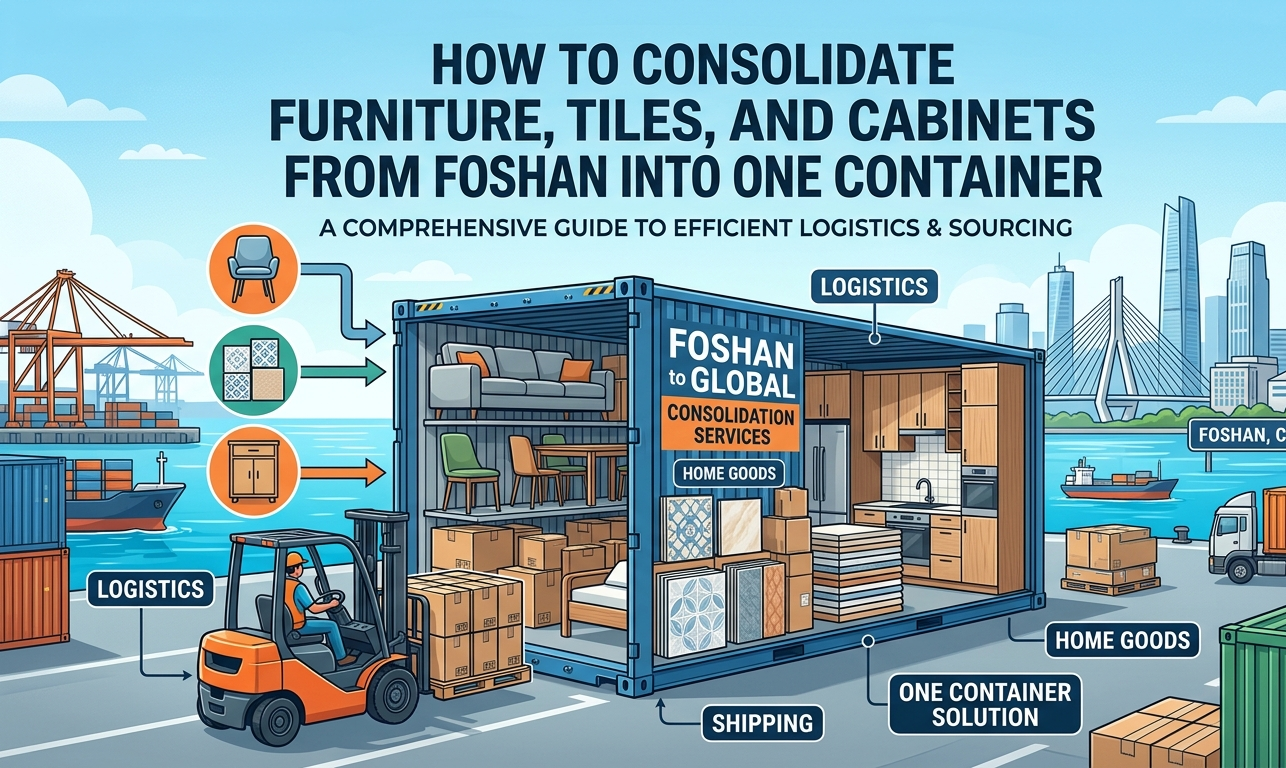
For international real estate developers, hotel procurement directors, and villa builders, managing the logistics of an interior fit-out is just as critical as negotiating the material costs. A standard project Bill of Quantities (BOQ) requires heavy structural materials like porcelain tiles, alongside bulky, space-consuming items like custom cabinetry and upholstered furniture.
Shipping these categories independently is a massive drain on project capital. Shipping a container of only tiles maxes out the weight limit while leaving half the container physically empty. Conversely, shipping a container of only furniture fills the spatial volume but wastes the paid weight capacity.
The most effective way to drive down total landed costs is through mixed-container consolidation . By centralizing procurement in Foshan, China—a hyper-dense industrial hub for interior materials—project buyers can engineer shipments that perfectly balance weight and volume, maximizing the ROI on every cubic meter of ocean freight.
Key Takeaways
- The Weight-to-Volume Ratio: Pairing high-density cargo (tiles) with high-volume cargo (furniture and cabinets) ensures you utilize 100% of a container’s paid capacity, drastically lowering per-unit freight costs.
- Production Synchronization: Custom cabinetry requires 45 days to manufacture, while standard tiles require 15 days. Staggering purchase orders ensures all goods arrive at the consolidation warehouse simultaneously, avoiding demurrage or storage penalties.
- Localized Ecosystem: Foshan’s unique geography allows a sourcing team to collect materials from specialized manufacturing districts within a 50-kilometer radius, eliminating expensive cross-province domestic shipping.
Why does Foshan’s geography make mixed container consolidation efficient?
In a fragmented supply chain, a buyer might order cabinets from a coastal province, tiles from an inland hub, and sofas from another region. Attempting to consolidate these goods means paying high domestic freight charges to truck them to a single port, quickly wiping out any savings gained from combining the shipment.
Foshan eliminates this geographical friction. The city operates as a closed-loop supply chain for commercial interiors. Within a very short driving distance, procurement teams have direct access to specialized industrial clusters:
- Shiwan (Chancheng District): The manufacturing epicenter for porcelain flooring, sintered stone, and ceramic sanitary ware.
- Lecong and Leliu (Shunde District): The world’s largest concentration of contract furniture, custom millwork, and upholstery factories.
- Dali (Nanhai District): The primary zone for architectural aluminum profiles, windows, and doors.
Because these factories are neighbors, a Foshan-based sourcing agent can dispatch trucks to pick up completed batches from multiple factories and deliver them to a central consolidation warehouse within hours, keeping domestic logistics costs near zero.
How do you balance weight and volume in a single shipping container?
Ocean freight is billed by the container size (e.g., 20GP, 40HQ), not the exact weight. Therefore, shipping efficiency is an exercise in utilizing both the maximum physical payload (weight) and the maximum Cubic Meters (CBM) of volume.
Building materials fall into two logistical extremes:
| Cargo Type | Characteristics | Logistical Problem if Shipped Alone |
| Porcelain Tiles / Stone | Extremely heavy, low volume. | Hits maximum legal container weight while 50% of the space remains empty. |
| Sofas / Assembled Cabinets | High volume, lightweight. | Fills the physical space quickly while utilizing only 20% of the allowable weight. |
Consolidating these materials into one container is the logistical “golden ratio.”
Warehouse teams execute this by loading the heavy pallets of porcelain tiles flat on the floor of the 40HQ container to create a stable, weight-bearing base. Once the weight limit is optimized at the bottom, the remaining vertical space is filled with lightweight, volumetric cartons of custom cabinetry, sofas, and lighting fixtures. This ensures you do not pay to ship empty air.
What timeline management strategies prevent warehouse storage fees?
You cannot successfully consolidate a container if the materials arrive at the warehouse months apart. Warehouses charge holding fees, and prolonged storage exposes materials to potential damage or moisture.
Managing a mixed container requires reverse-engineering the production schedule based on the most complex item in your BOQ.
For example, custom hotel cabinetry and millwork usually require a 40 to 45-day production window due to CAD drawing approvals, veneer matching, and painting. Standard porcelain tiles, however, can often be pulled from factory stock or produced in 10 to 15 days. A professional sourcing team will issue the deposit for the cabinetry first. They will then intentionally delay the production release for the tiles and furniture until the cabinets are in their final assembly phase. This staggered approach ensures all disparate categories arrive at the Foshan loading dock within the same 48-hour window.
How are fragile goods protected during mixed cargo loading?
Loading heavy masonry and fragile custom woodwork into a steel box destined for a multi-week ocean voyage carries inherent risks. Standard factory packaging is often insufficient for mixed-load export.
Strict packing protocols must be enforced before the container doors are sealed:
- Palletization Standards: All tiles must be packed face-to-face, crated on fumigated wooden pallets (ISPM-15 compliant), and shrink-wrapped with rigid corner protectors.
- Structural Segregation: You cannot simply stack a wooden cabinet directly on top of a tile pallet. The warehouse loading team must build internal structural bridges—using heavy-duty plywood boards and load-bearing dunnage—to separate the dense cargo on the bottom from the fragile cargo on top.
- Blocking and Bracing: The upper layer of volumetric furniture must be tightly blocked and strapped to the container’s interior lashing rings to prevent shifting, crushing, or sliding when the vessel hits rough seas.
Why choose HSY Sourcing as your consolidation partner?
Attempting to coordinate production schedules, quality inspections, and complex container loading across five different factories from overseas is an operational liability. HSY Sourcing functions as your dedicated purchasing department and logistics hub on the ground in Foshan.
- Turnkey Warehouse Facilities: We operate our own consolidation facilities in Foshan. We physically receive your tiles, cabinets, and furniture, conduct incoming quality checks, and stage the goods for optimized loading.
- Direct OEM Factory Access: We connect your project directly with audited, primary manufacturers, bypassing local trading companies to secure baseline commercial pricing.
- In-Line Quality Control: We enforce the rule of preventing “Sample Approved, Bulk Rejected” scenarios. Our inspectors are on the factory floors checking cabinet moisture content, tile batch shading, and sofa frame integrity before anything is shipped to our warehouse.
- Engineered Loading Plans: We utilize load-planning software and experienced dock crews to maximize your CBM output, ensuring your mixed containers are packed safely and efficiently to drive down your total landed project costs.
Frequently Asked Questions (FAQ)
What is the minimum order required to execute a mixed container consolidation?
Mixed container consolidation is most effective when you have enough total volume to fill at least one 20GP container (roughly 28 CBM) or a 40HQ container (roughly 68 CBM). This volume is typical for a multi-unit apartment renovation, a boutique hotel floor, or a comprehensive luxury villa fit-out.
Can you consolidate goods if we purchase from a supplier outside of Foshan?
Yes. While we strongly recommend sourcing the bulk of heavy items (like tiles and aluminum) within Foshan to avoid domestic shipping costs, we frequently receive specialized items from other provinces (such as specific commercial lighting from Zhongshan or hardware from Wenzhou). We handle the domestic freight coordination to bring those items into our Foshan warehouse for final consolidation.
How do customs declarations work when there are multiple product categories in one container?
This is handled through a consolidated packing list and commercial invoice. Our export documentation team categorizes every item by its specific HS (Harmonized System) code. We compile the data from the various factories and submit a single, unified customs declaration on your behalf, ensuring seamless export clearance from the Chinese port and straightforward import processing in your destination country.
How do we verify the quality of the goods before the container is sealed?
HSY Sourcing provides comprehensive transparency. Before loading begins, we supply a detailed inspection report that includes high-resolution photos and videos of the completed goods, packaging condition, and dimensional verifications. We only authorize the physical loading of the container once your team signs off on the final inspection report.