
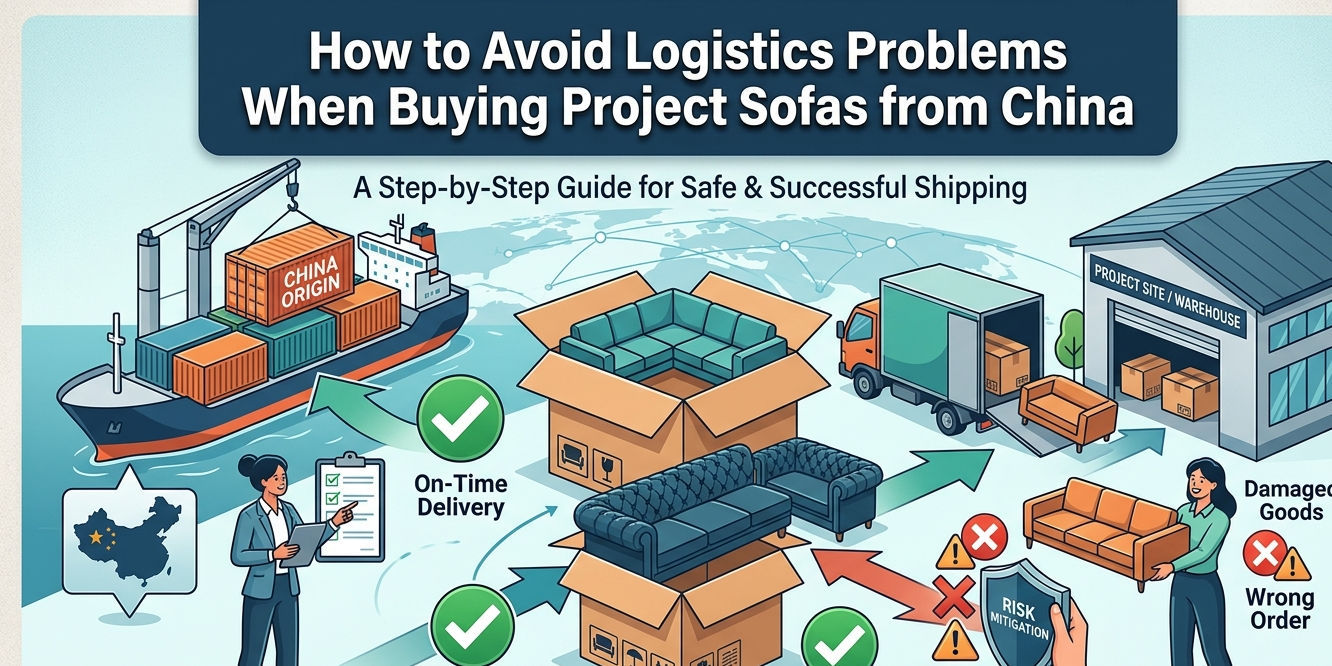
Sourcing commercial sofas for a 200-room hotel or a large apartment complex from Foshan makes immediate financial sense. The Shunde district of Foshan (specifically Lecong and Longjiang) is the largest furniture manufacturing cluster in the world. Buying direct cuts out multi-tiered distributor markups.
However, the factory-gate price is only one part of the equation. Sofas are notoriously difficult to ship. They are bulky, fragile, and highly susceptible to environmental damage. A poorly managed logistics plan will erase your procurement savings through inflated freight bills, transit damage, or port storage penalties.
If you are managing the FF&E (Furniture, Fixtures, and Equipment) procurement for a real estate development, here are the logistical pitfalls you must avoid and how to engineer a secure supply chain from Foshan to your job site.
Why Are You Paying to Ship “Air” in Your Containers?
The most expensive mistake buyers make when importing sofas is shipping them in isolation.
Ocean freight is charged per container, constrained by two limits: maximum weight and maximum volume (CBM – Cubic Meters). Sofas are high-volume, low-weight cargo. If you load a 40HQ container exclusively with hotel sofas, you will fill the physical space (reaching max CBM) while only utilizing about 30% of the container’s allowable weight. You are effectively paying international freight rates to ship empty space.
The solution is cross-category consolidation. Foshan is unique because it manufactures both light FF&E and heavy building materials. By utilizing a local sourcing agent, you can mix your cargo. We load heavy, dense materials—like ceramic tiles from Chancheng or aluminum windows from Dali—at the base of the container. We then load the lighter sofas on top. This perfectly optimizes both weight and volume, drastically lowering the shipping cost per unit.
How Does Ocean Humidity Cause Irreversible Mold Damage?
Ocean transit exposes cargo to extreme temperature swings and high humidity. A 30-day journey across the ocean can turn a shipping container into a localized greenhouse.
If moisture enters your sofa packaging, the internal foam and fabric act like sponges. By the time you open the container on-site, the sofas will be covered in toxic mold and mildew, resulting in a 100% total loss. Remediation is rarely possible.
To prevent this logistical disaster, your procurement contracts must enforce strict export packaging standards before the goods leave the factory floor:
- Wood Moisture Testing: The internal wood frame must be kiln-dried and physically tested to ensure moisture content is strictly below 12% before upholstery begins.
- Moisture Barriers: Every sofa must be wrapped in a heavy-duty, heat-sealed PE (Polyethylene) plastic bag.
- Industrial Desiccants: Silica gel or calcium chloride desiccant packs must be placed both inside the sealed sofa packaging and hung strategically throughout the shipping container to absorb ambient humidity.
What Causes Structural Crushing During Container Transit?
A shipping container experiences severe turbulence at sea, including pitching, rolling, and sudden drops during port handling. If bulk sofas are simply stacked loosely on top of each other to maximize space, the combined weight of the top rows will crush the frames and permanently deform the foam of the bottom rows.
Furthermore, project sofas often feature exposed commercial-grade metal legs or solid wood bases. If these are not protected, they will puncture the fabric of adjacent units.
Proper loading logistics require:
- Detachable Hardware: Sofa legs should be engineered to be detachable, shipped in separate hardware boxes, and assembled on-site to prevent puncturing and save space.
- Structural Packaging: Standard export cartons are not enough for bulk stacking. Sofas must be packed in reinforced corrugated boxes with hard edge-protectors.
- Load Distribution: If loading without boxes (soft packing), the container must be engineered with internal plywood shelving or load-bearing straps so the weight of the upper rows is transferred to the container walls, not the furniture below.
Why Do Desynchronized Production Timelines Inflate Storage Costs?
A large interior fit-out involves dozens of factories. The sofa factory might finish your order in 25 days, while your custom lighting takes 40 days, and your fire-rated doors take 45 days.
If you allow the sofa factory to deliver the goods to the departure port immediately, those sofas will sit in a humid port warehouse for three weeks waiting for the rest of your materials. Port storage fees accumulate daily and will quickly destroy your budget. Conversely, leaving finished sofas sitting on a crowded factory floor increases the risk of accidental damage from forklifts.
To avoid timeline mismatches, you need a local staging warehouse in Foshan. A local agent syncs the production timelines based on your construction schedule, collects the finished goods from various factories, stores them safely in a single dry facility, and executes loading only when the full shipment is ready to depart.
Key Takeaways
- Mix Heavy and Light Cargo: Consolidate Foshan’s heavy building materials (windows/tiles) with light sofas to maximize container weight and volume efficiency.
- Enforce Moisture Control: Demand wood moisture content under 12%, sealed PE wrapping, and container desiccants to prevent transit mold.
- Engineer the Packaging: Ensure detachable legs and reinforced edge-protectors to prevent crushing and fabric punctures during ocean turbulence.
- Centralize Your Staging: Use a local Foshan warehouse to align production timelines and avoid exorbitant daily storage fees at the shipping port.
Why Choose HSY Sourcing for Your Project?
At HSY Sourcing, we operate directly from Foshan, the epicenter of China’s building materials and furniture supply chain. We treat logistics as a core component of procurement, not an afterthought.
- Local Consolidation Warehouse: We do not let scattered factory timelines dictate your freight costs. We collect your sofas, cabinetry, and architectural materials, storing them safely in our Foshan facility until we can engineer an optimized, full-container load.
- Pre-Loading Quality Control: Our team physically verifies that the factory used the correct commercial foam, tested the wood moisture, and applied the exact moisture-barrier packaging required for ocean transit.
- On-Site Loading Supervision: We do not trust third-party port workers to load your fragile FF&E. Our team supervises the container loading process, ensuring heavy goods are secured at the base and soft goods are protected from crushing.
Visit www.hsysourcing.com to share your FF&E schedules and project BOQ. Let us secure a reliable, damage-free supply chain for your next development.
Frequently Asked Questions (FAQ)
Q: Is it better to ship project sofas fully assembled or knocked down (KD)?
A: For commercial projects, the main structural frame should always be shipped fully assembled to ensure long-term stability under heavy use. However, the legs or bases should be KD (knocked down) and shipped inside a zippered compartment under the sofa. This prevents transit damage and drastically reduces the cubic volume per unit.
Q: Can we arrange for the Foshan factory to ship directly to our project site?
A: Direct factory shipping is only efficient if you are ordering enough sofas to perfectly fill a 40HQ container. If your order is a Less-than-Container Load (LCL), direct shipping is risky and expensive. It is always safer and more cost-effective to let a local agent consolidate the sofas with your other building materials first.
Q: What happens if a sofa is damaged during shipping despite good packaging?
A: A robust logistics strategy includes proper marine cargo insurance. Before the container is sealed in Foshan, we take comprehensive photos and videos of the fully compliant packaging and loading process. If an unavoidable accident occurs at sea, this documentation guarantees a smooth, undisputed insurance payout to cover replacement costs.