
Key Takeaways
- DIY is fine for small, “off-the-shelf” orders with low customization and low financial risk.
- Agents are mandatory for complex manufacturing, multi-supplier consolidation, and high-ticket orders where “Quality Fade” could bankrupt you.
- The Cost-Benefit Math: A good agent should save you more in “landed costs” and “avoided mistakes” than the 5-10% commission they charge.
- Transparency is the Filter: If an agent won’t let you talk to the factory, they aren’t an agent—they are a middleman.
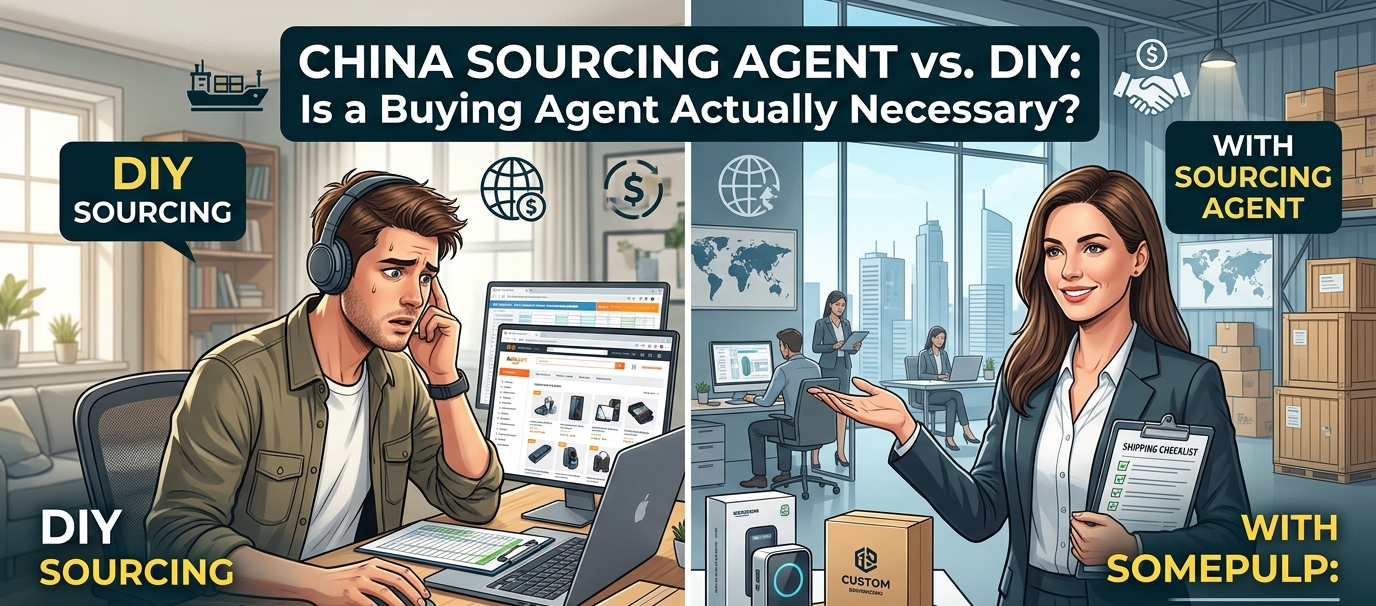
Let’s be honest: If you are buying 200 standard t-shirts or a few boxes of phone cases from a “Gold Supplier” on Alibaba, you probably don’t need a buying agent. You can handle the chat, pay via Trade Assurance, and hope for the best.
But as your business scales, the “hope for the best” strategy becomes a massive liability. In the world of China sourcing, the biggest risks aren’t usually scams—they are misunderstandings and quality erosion. Here is the practical breakdown of whether you should hire a pro or keep doing it yourself.
Can you successfully source from China without an agent?
Yes, absolutely. Thousands of entrepreneurs do it every day. If your product is a “commodity” (something the factory makes every day for a hundred other people) and you have a low tolerance for overhead, DIY is the way to start.
However, DIY sourcing requires you to be your own project manager. You are the one staying up until 2 AM to talk to sales reps, the one deciphering cryptic shipping documents, and the one taking the 100% loss if the container arrives and the colors are “slightly off.” If you have more time than money, DIY is your school.
At what order volume does a buying agent become essential?
The “Agent Threshold” usually hits when one of two things happens: your order value exceeds $10,000, or your product requires custom tooling/technical specs.
Once you are moving significant capital, a 5% or 7% commission is essentially a very cheap insurance policy. An agent isn’t just a “translator”; they are a localized risk manager. They perform the factory audits that prove the “factory” isn’t just a trading desk in an apartment, and they conduct pre-shipment inspections that catch defects before you pay the final 70% balance.
How does a sourcing agent actually save you money?
It sounds counterintuitive to pay someone a commission to “save” money, but the math usually checks out in three areas:
- The “Local” Price: Factories often quote 10-15% higher to Westerners to cover the “hassle factor.” A local agent negotiates in the local dialect, knowing the actual raw material costs for that week.
- Logistics Consolidation: If you buy furniture from three different Foshan factories, shipping them as three separate LCL (Less than Container Load) shipments is a financial disaster. An agent consolidates them into one FCL (Full Container Load), often saving 30-50% on freight.
- Avoiding “Quality Fade”: This is the silent killer. The first order is great; the third order uses cheaper plastic or thinner fabric. An agent on the ground prevents this by being physically present for random QC checks.
What are the risks of relying 100% on Alibaba and Google?
Online platforms are a great starting point, but they are “curated” environments. A factory’s Alibaba profile is their best Sunday suit.
Without an agent, you have no way of knowing if the factory has recently lost its best technicians, if they are subcontracting your order to a smaller, dirtier workshop next door, or if they are facing financial trouble. An agent living in the same industrial cluster (like Foshan or Guangzhou) hears the industry “noise” and can pivot you to a safer supplier before your deposit vanishes.
How do you distinguish a true agent from a hidden middleman?
A true buying agent works for you. They are transparent about the factory names, they encourage you to visit, and they charge a visible fee.
A “hidden middleman” acts as a firewall. They hide the factory’s identity because their only “value” is the markup they’ve added. If you ask your “agent” for the factory’s address and they get defensive, you aren’t working with a partner—you’re working with a reseller.
Why Choose HSY Sourcing as Your China Partner?
At HSY Sourcing, we don’t believe every buyer needs an agent, but we believe every serious buyer needs an advocate. We specialize in the high-stakes sectors of furniture, building materials, and technical textiles.
- Zero Hidden Markups: Our fee structure is 100% transparent. You pay the factory gate price, and we charge our agreed-upon service fee.
- Foshan-Based Expertise: We are physically located in the heart of the world’s largest manufacturing clusters. We don’t just “email” factories; we drive there.
- End-to-End Protection: From initial vetting and contract negotiation to rigorous QC and final container loading, we act as your branch office in China.
Stop guessing and start scaling. Visit www.hsysourcing.com to see how we turn China sourcing into a predictable process.
FAQ
Q: Is it cheaper to go direct to a factory?
A: On paper, yes. In reality, often no. Without an agent, you may pay higher “foreigner” prices, get hit with higher shipping rates, and have no recourse if the quality is poor. A good agent pays for themselves through better negotiation and logistical efficiency.
Q: Do agents take kickbacks from factories?
A: Unethical ones do. This is why you should always choose an agent with a transparent fee structure and clear references. At HSY Sourcing, our loyalty is 100% with the buyer.
Q: Can an agent help with small MOQs?
A: Yes. Often, a factory that says “No” to a random person on the internet will say “Yes” to a sourcing agent they already have a long-standing relationship with.