
Key Takeaways:
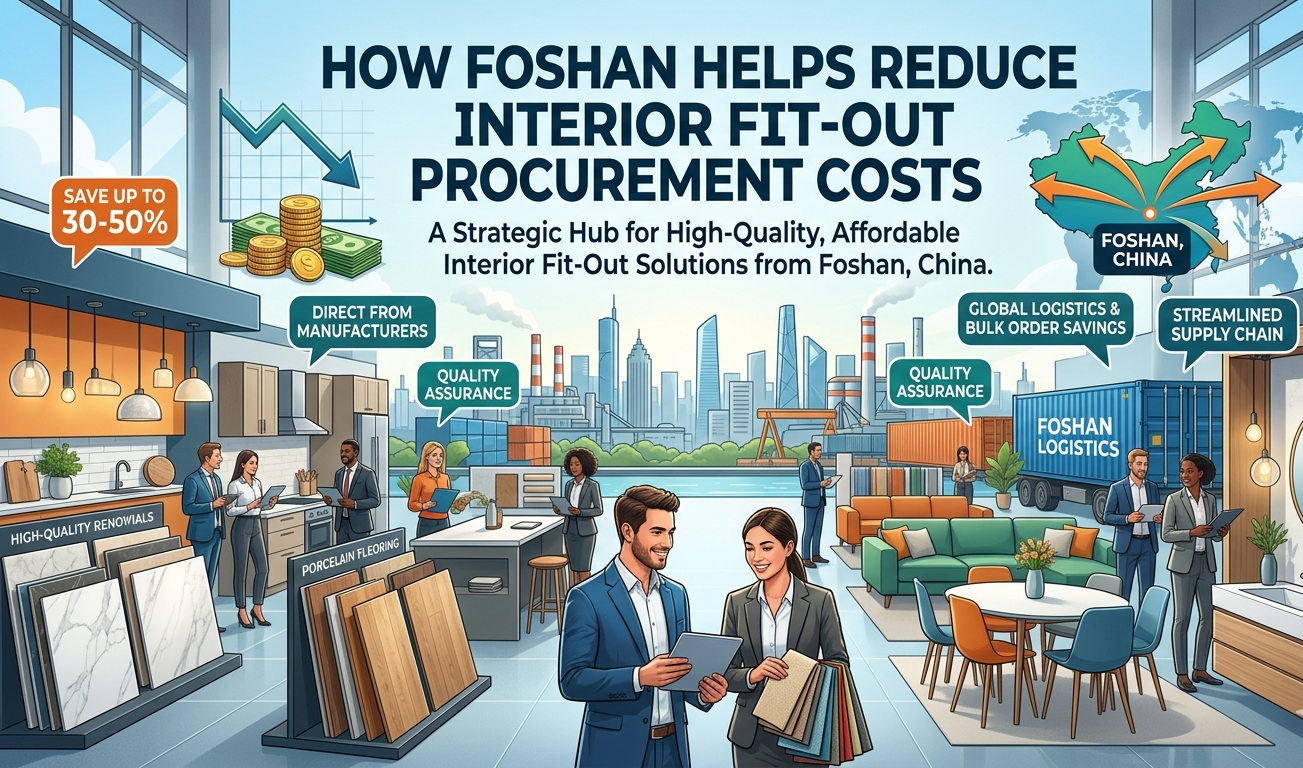
- Industrial Clustering Eliminates Inland Freight: Foshan concentrates aluminum windows, ceramics, and furniture within a 50-kilometer radius, drastically reducing domestic transport costs before export.
- Direct Factory Procurement Cuts Out Middlemen: Bypassing multi-tiered international wholesalers and buying directly from Foshan production lines removes standard 20% to 40% markup layers.
- Strategic Container Loading Maximizes Budgets: Heavy architectural materials (like windows and tiles) can be packed with high-volume, low-weight items (like sofas and cabinetry) to fully optimize ocean freight costs.
- On-Site Quality Control Prevents Total Loss: Catching a specification error on the factory floor in Foshan costs almost nothing to fix. Catching it on a live construction site thousands of miles away derails the entire project budget.
Procuring the interior fit-out materials and FF&E (Furniture, Fixtures, and Equipment) for a large-scale real estate project is a capital-intensive process. For a 300-room hotel, a high-rise apartment complex, or a series of luxury villas, the Bill of Quantities (BOQ) spans dozens of different product categories.
Developers globally turn to China to manage these costs. However, sourcing from scattered provinces creates logistical bottlenecks that erase the initial price savings.
Foshan offers a unique geographical advantage. It is not just a manufacturing city; it is a highly integrated supply chain ecosystem. Here is how centralizing your project procurement in Foshan drives down total interior fit-out costs.
Why Does Geographic Concentration Lower Freight and Logistics Costs?
A standard commercial fit-out requires heavy structural materials, delicate decorative items, and bulky furniture. If a developer sources lighting from Zhejiang, doors from Shandong, and furniture from Guangdong, they must pay high inland trucking fees to bring these goods to a single export port. Furthermore, managing multiple factory timelines across different provinces frequently leads to delays and expensive storage fees at the port.
Foshan solves this geographic fragmentation. It is home to distinct, world-leading manufacturing clusters located right next to each other:
- Dali Town (Nanhai District): The global epicenter for aluminum extrusion, architectural windows, and commercial door systems.
- Lecong & Longjiang (Shunde District): The largest contract and commercial furniture manufacturing hub in the world.
- Chancheng District: The primary manufacturing base for ceramic tiles, sanitary ware, and bathroom fixtures.
Because these critical factories are located within a 50-kilometer radius, a local agent can collect, inspect, and transport all materials to a centralized warehouse for a fraction of standard inland freight costs.
How Does Direct Factory Access Eliminate Multi-Tiered Markups?
When developers buy building materials through traditional domestic distributors or international trading companies, the product has usually passed through two or three intermediaries. Each layer adds a markup—often between 20% and 40%—to cover their own overhead and profit margins.
By utilizing a local Foshan sourcing agent, developers gain direct access to the OEM (Original Equipment Manufacturer) factory lines. You are purchasing the exact same commercial-grade acoustic windows, fire-rated doors, and high-density foam sofas, but at the raw factory-gate price. This direct-to-source model allows procurement teams to reallocate budget toward upgrading material specifications (such as selecting Better-grade thermal breaks or higher-end wood veneers) without exceeding the original budget limits.
Why is Cross-Category Consolidation Crucial for Large Projects?
Shipping inefficiencies are one of the largest hidden costs in international procurement.
Ocean freight charges are based on the container, not the contents. If you fill a 40-foot container strictly with custom hotel sofas, you will run out of space long before you reach the weight limit. You are paying to ship empty space. Conversely, if you fill a container purely with ceramic tiles or heavy glass window panels, you hit the maximum weight limit while the container is still half empty.
The Foshan Advantage: Because Foshan produces both heavy building materials and light interior furnishings, you can execute cross-category consolidation. We strategically load the heavy materials—like structural aluminum window sub-frames, heavy A-frame glass, and floor tiles—at the bottom of the container. We then utilize the remaining volume by securely packing lighter FF&E items, such as upholstered seating, mattresses, and cabinetry, on top. This perfectly optimizes both the weight and volume capacities of the container, effectively minimizing your freight cost per item.
How Do Local Quality Control Teams Prevent Expensive Rework?
The most expensive building material is the one that has to be ordered twice.
Remote buyers frequently rely on pre-shipment photos sent by the factory. By the time a custom architectural window is fully glazed and wrapped in protective film, you cannot see if the factory used the specified PA66 nylon thermal break strip. By the time an interior wall panel arrives on your site, you cannot fix a mismatched dye lot.
If defective goods arrive at your project site, the costs are catastrophic: you lose the material cost, the ocean freight cost, and you incur heavy penalties for delaying the construction schedule.
Having a procurement team on the ground in Foshan shifts quality control to the mid-production phase. Inspectors take physical measurements of aluminum thicknesses, test the moisture content of wood cores, and verify hardware brands before the goods are packaged. Finding and correcting a deviation on the factory floor costs nothing and keeps your timeline intact.
Why Choose HSY Sourcing for Your Fit-Out Project?
At HSY Sourcing, we are stationed directly in Foshan, giving your project immediate leverage over China’s premium building material and interior fit-out supply chains. We operate as your localized procurement and engineering division.
- Door & Window Dominance: We lean heavily into Foshan’s aluminum extrusion advantage. We bridge the gap between your architect’s CAD drawings and the factory, ensuring strict adherence to thermal, acoustic, and structural building codes.
- Factual Factory Oversight: We reject polished marketing images. Our engineers provide unedited, real-time data from the factory floor—verifying core materials, fire ratings, and hardware compliance mid-production.
- Unified Project Staging: We do not let factories dictate your shipping schedule. We receive your diverse BOQ items at our Foshan warehouse, inspecting and staging them so they can be loaded sequentially based on your job site’s construction phases.
- Transparent Sourcing: No hidden margins, no exaggerated claims. We focus purely on executing your technical specifications efficiently.
Visit www.hsysourcing.com to share your project’s BOQ and interior design schedules. Let us engineer a secure, cost-effective supply chain for your development.
Frequently Asked Questions (FAQ)
Q: Can we source a complete hotel or apartment fit-out from Foshan, or do we need to look at other cities?
A: You can source nearly 100% of a standard commercial fit-out directly from Foshan. The city’s manufacturing ecosystem covers architectural glazing, interior and exterior doors, flooring, wall cladding, sanitary ware, custom joinery, and all loose furniture. Keeping procurement localized here is the most effective way to control costs.
Q: How do you handle minimum order quantities (MOQs) when buying direct from factories?
A: Factories usually require high MOQs for single-item retail orders. However, for project-based procurement—such as outfitting a 50-unit apartment building or a boutique hotel—the overall volume satisfies factory requirements. We consolidate your BOQ and negotiate project-based terms, often securing bulk pricing even for highly customized interior items.
Q: How do you ensure the building materials meet our local country’s compliance standards?
A: Compliance is our first filter. Whether you need AS2047 for Australian windows, CE marking for European projects, or specific fire-retardancy ratings (like ASTM E84) for US interiors, we mandate these requirements in the initial local manufacturing contracts. We only engage with Foshan factories capable of producing the necessary third-party laboratory test reports.