
Key Takeaways:
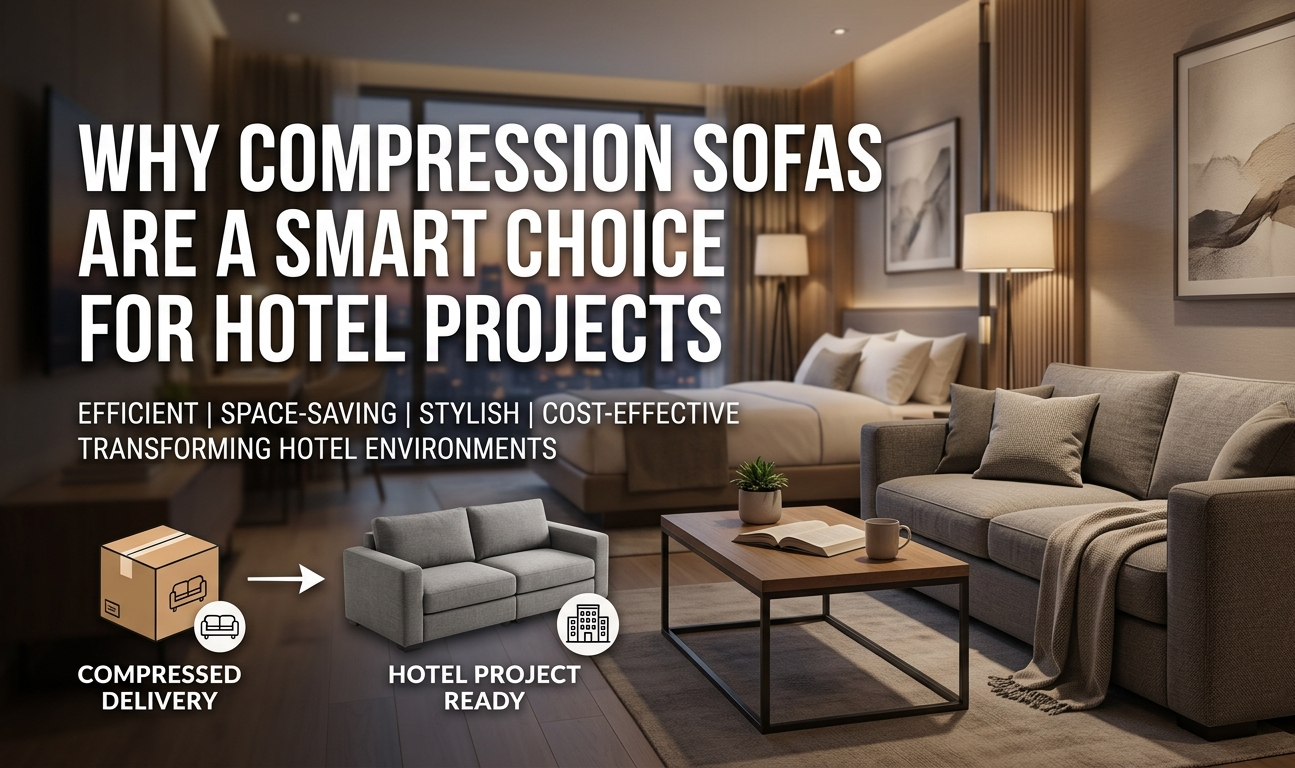
- 60% Volume Reduction: Standard commercial sofas ship mostly “air.” Heavy-duty vacuum compression drops a typical 1.5 CBM sofa down to less than 0.6 CBM, significantly lowering international freight costs per unit.
- Solves Final-Mile Intralogistics: Moving hundreds of rigid, fully assembled sofas through narrow hotel corridors or standard guest elevators slows down the handover schedule. Compressed, boxed units fit standard service lifts and reduce on-site handling damage.
- Demands Commercial-Grade Foam: Vacuum packing is a brutal stress test for polyurethane foam. Hotel builds must specify a minimum density of 35kg/m³ to 40kg/m³ High-Resilience (HR) foam, or the seat cushions will fail to fully rebound.
- Protects Outer Materials from Transit Friction: Sealing the upholstered components inside a compressed, heat-sealed plastic chamber minimizes fabric chafing and moisture absorption during long ocean transits.
When managing the FF&E (Furniture, Fixtures, and Equipment) package for a 150-room hotel or a multi-family apartment development, the physical volume of loose furniture represents a major financial challenge. Traditional commercial sofas are bulky, awkward to handle, and expensive to transport across ocean shipping lanes.
To combat rising logistics fees, international project buyers are increasingly turning to vacuum-compressed sofas.
Foshan—specifically the Lecong and Longjiang industrial zones—is the global epicenter for this technology, blending advanced vacuum-press machinery with deep commercial upholstery expertise. Here is a realistic look at why compression sofa engineering makes financial and logistical sense for large-scale hospitality projects.
How Do Compression Sofas Drastically Lower International Freight Expenses?
The primary driver for choosing a compression sofa is the mathematics of ocean freight. Traditional furniture shipping is inherently inefficient because rigid sofas consume substantial cubic volume (CBM) while weighing very little. You quickly fill a 40HQ container’s space while utilizing only a small fraction of its legal weight capacity.
When a factory applies an industrial vacuum press to an engineered sofa, the air is completely extracted from the internal foam and pocket spring layers. The unit is flattened and rolled or packed flat into heavy-duty corrugated cartons.
This process reduces the physical footprint of a three-seater sofa by 50% to 60%. In practical terms, where a standard 40HQ container might only accommodate 30 to 40 traditional fully assembled sofas, the same container can hold 80 to 100 compressed units. This directly halves your shipping cost per key.
Why is Interior Logistics a Major Bottleneck in Hotel Construction Sites?
A major hidden cost in real estate development is the labor required to move materials from the unloading bay to the upper floors. On a live hotel construction site, delivery days are chaotic.
Moving 200 fully assembled, wide-arm sofas into standard passenger elevators or up narrow service stairwells is slow, labor-intensive work. It frequently leads to two costly problems: accidental gouges in newly painted hallway drywall, and tears in the sofa’s outer upholstery fabric as laborers force them through tight guestroom doorways.
Compressed sofas are delivered in compact, rectangular boxes. A single worker using a standard hand truck can easily transport three or four units at once using the building’s standard service lift. The boxes remain sealed inside the specific guestrooms until the final fit-out phase, keeping the fabric safe from ambient construction dust, paint splatters, and handling damage.
Can Compressed Foam Truly Recover to Its Original Shape and Density?
This is the most critical technical question a hospitality procurement manager must ask. If a factory uses cheap materials, a vacuum-compressed sofa will stay permanently flattened or look heavily wrinkled after it is opened.
The ability of a sofa to rebound perfectly within 24 to 48 hours depends strictly on the core material specifications:
| Component | Standard Residential Grade (Fails Compression) | Recommended Commercial Project Grade (Full Recovery) |
| Foam Type | Low-density polyfoam (20 – 25 kg/m³) | High-Resilience (HR) Polyurethane Foam (35 – 40 kg/m³) |
| Internal Support | Standard horizontal zig-zag springs | Individually Wrapped Pocket Coil Springs |
| Frame Material | Fixed particle board or soft pine blocks | Knock-Down (KD) Steel or Kiln-Dried Solid Hardwood |
As shown in the technical breakdown above, high-resilience foam features an open-cell structure that acts like a highly elastic sponge. When the vacuum seal is broken, air rushes back into the cells, pulling the foam back to its original engineered thickness. If a factory attempts to compress standard 25kg/m³ foam, the cellular walls will collapse permanently, resulting in saggy seat cushions and immediate comfort failure.
What Structural Specifications Must a Hotel Sofa Have to Support Compression?
A sofa cannot be compressed if it has a rigid, solid wooden outer frame that cannot be disassembled. Therefore, compression sofas require specialized product engineering before the production lines start.
The armrests and backrests are typically engineered as independent modular components. They utilize internal metal interlocking brackets or heavy-duty steel bolt configurations. The factory compresses the core cushioning elements flat, and the solid wooden or steel frame sub-assemblies are packed tightly alongside them in the same flat carton.
Once on-site at the hotel, your installation crew simply bolts the modular segments together. This approach achieves a completely solid, non-squeaking commercial frame without shipping a massive, unyielding wooden box across the ocean.
Why Choose HSY Sourcing for Your Furniture Procurement?
Based directly in the heart of Foshan’s manufacturing zone, HSY Sourcing manages the technical realities of contract furniture procurement for international real estate developers and hospitality buyers.
- Geographic Proximity to Longjiang: We work directly with the tier-one commercial furniture factories in Shunde that possess the heavy-duty hydraulic press machinery needed to execute secure vacuum packaging.
- Physical Foam Density Audits: We do not trust factory paperwork. Our quality control team goes to the production floor with digital scales and calipers to physically verify that your sofas are built with 35kg/m³+ High-Resilience foam before any compression takes place.
- Cross-Category Shipping Consolidation: Foshan is a powerhouse for both furniture and architectural building materials. We store your compressed sofa boxes in our local staging warehouse and load them strategically into containers alongside your Foshan doors, windows, or ceramic tiles—ensuring zero wasted volume or weight capacity.
- Strict Fire and Fabric Compliance: We verify that the chosen upholstery meets your local market’s legal frameworks (such as CAL 117 in the US or BS 5852 Crib 5 in the UK) and monitor the factory’s certification validity on your behalf.
Visit www.hsysourcing.com to submit your project’s FF&E schedules. Let our local engineers help you optimize your shipping volume and safeguard your furniture investment.
Frequently Asked Questions (FAQ)
Q: How long can a hotel sofa safely remain compressed inside its box before it causes permanent damage?
A: For commercial-grade HR foam and pocket spring systems, sofas can safely remain vacuum-sealed for up to 2 to 3 months. This provides a safe window for ocean transit and customs clearance. However, we advise our clients to open the boxes within 14 days of arrival at the project site to allow the foam to breathe and fully stabilize before installation.
Q: Do compression sofas end up looking loose or heavily wrinkled after decompression?
A: Minor surface wrinkling is normal immediately after breaking the plastic seal. However, if the factory has properly matched the fabric elasticity to the foam core, these wrinkles will naturally smooth out within 48 hours as the foam fully expands. For premium hospitality finishes, a quick pass with a commercial garment steamer on-site eliminates any remaining transit creases instantly.
Q: Are modular compression sofas durable enough to handle high-traffic resort or apartment use?
A: Yes, provided the interlocking hardware is engineered correctly. The modular connections utilize heavy-duty M8 steel bolts and reinforced iron drop-in brackets rather than simple wood screws. This creates a structural joint that is often more rigid than a traditional doweled wooden joint, ensuring it easily withstands heavy commercial use.