
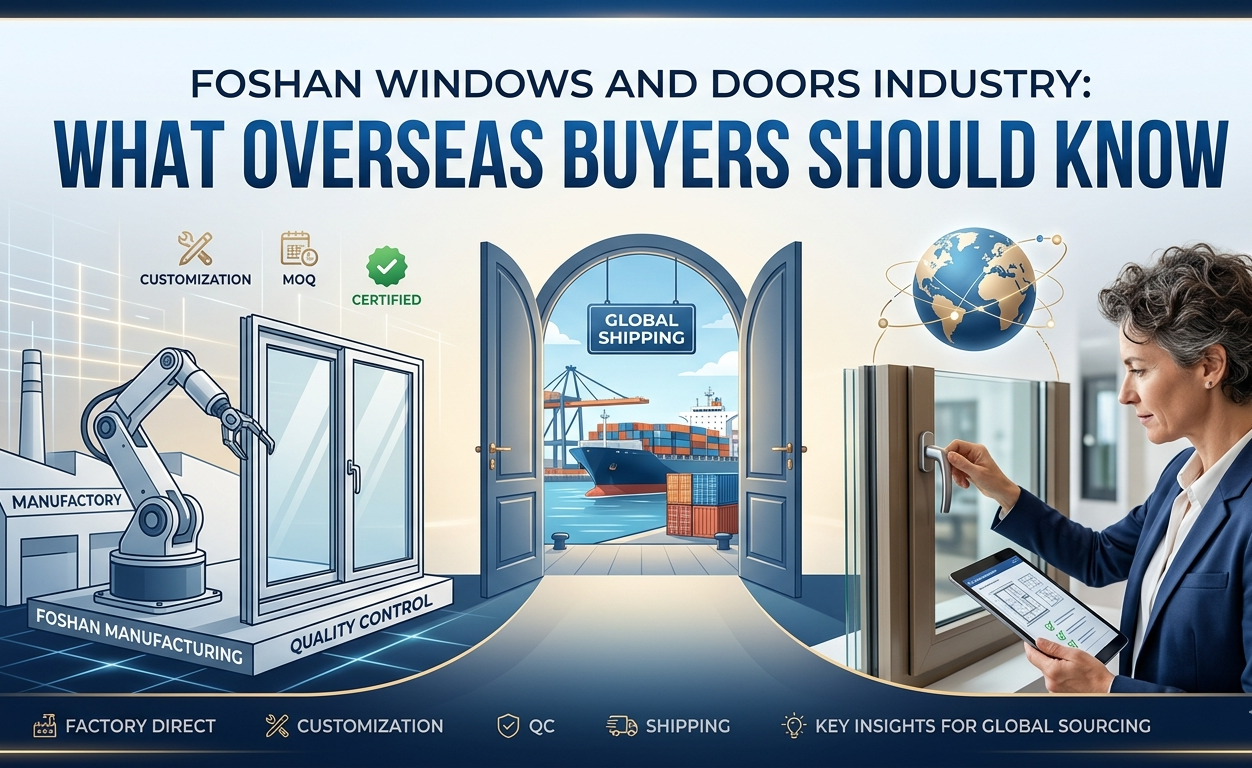
For overseas property developers, contractors, and building material wholesalers, sourcing architectural windows and doors from China is a standard practice to control project costs. However, placing a high-value order based purely on an Alibaba catalog or a well-designed website often leads to structural failures on the job site.
If you are sourcing aluminum windows and doors in China, your supply chain will inevitably lead you to Foshan, specifically the Nanhai District. Foshan is the unquestioned epicenter of China’s aluminum industry. This guide breaks down the physical reality of the Foshan cluster and what professional buyers actually need to specify to prevent costly mistakes.
Why is Foshan the absolute center for aluminum windows and doors?
Foshan’s dominance is not built on cheap labor; it is built on severe supply chain density. When you purchase a window from a manufacturer in Foshan, you are tapping into an ecosystem where every component is produced within a 20-kilometer radius.
- The Dali Extrusion Cluster: Dali Town in Foshan’s Nanhai District produces a massive share of China’s raw aluminum profiles. A window assembly factory in Foshan does not need to pay high freight costs to transport aluminum bars from another province.
- Surface Treatment Hub: The factories that perform powder coating, PVDF (fluorocarbon) coating, and anodizing are located directly adjacent to the extrusion plants. This allows for rapid turnaround on custom architectural colors.
- Glass and Hardware Proximity: Foshan and the broader Guangdong region house thousands of tempering glass plants and hardware manufacturers. This density eliminates the bottlenecks that factories in other parts of China face when waiting for specialized components.
How do trading companies differ from actual Foshan factories?
A major risk for overseas buyers is confusing an office-based trading company with an actual manufacturer. While traders can offer good English communication, they add a markup and reduce your control over the production line.
To verify an actual Foshan factory, you need to look at their physical infrastructure:
- Extrusion vs. Assembly: Very few factories do both. Most window factories are “assembly plants” that buy profiles from large extruders like Jianmei or Fenglu. You must know if your supplier is actually cutting and assembling the frames, or just brokering the deal.
- Machine Inventory: Ask for videos of their CNC cutting machines, double-head miter saws, and corner crimping machines. If they cannot show these in operation, they are likely outsourcing your order to a smaller workshop.
- Physical Address: Check their business license. If the address is in a high-rise office building in central Guangzhou or Shenzhen, rather than an industrial park in Nanhai (Foshan), they are a trading company.
What engineering specifications must buyers define in their RFQ?
Vague requests result in low-quality products. If you ask for a “sliding aluminum window,” a factory will quote the thinnest profile and cheapest glass to win the order. Your Request for Quotation (RFQ) must dictate the following technical data:
- Aluminum Wall Thickness: The absolute minimum for residential windows is 1.4mm. For heavy commercial doors, sliding patio doors, or high-wind zones, you must specify 2.0mm or 3.0mm.
- Thermal Break Material: To prevent condensation and heat transfer, the aluminum profiles must be separated by an insulator. Mandate PA66 Nylon strips. Do not accept PVC, which will become brittle and crack within a few years.
- Glass Composition: Specify exact layers. For example: 6mm Low-E Tempered + 12A (Argon) + 6mm Clear Tempered. Ensure they carry the SGCC (USA) or AS2208 (Australia) safety stamps if your local building code requires it.
- Hardware: The locking mechanism and rollers will fail long before the aluminum frame does. Explicitly require trusted international brands like German Siegenia or Hoppe, or premium Chinese brands like KinLong.
How should you handle logistics and physical packaging?
A perfectly manufactured window is worthless if the glass shatters inside the shipping container. Shipping building materials requires rigid protocols.
- No Cardboard Packaging: Never allow the factory to ship windows wrapped only in cardboard and plastic film.
- Wooden Crates: Mandate that all units are packed in fully enclosed, IPPC-stamped (fumigated) wooden crates or heavy-duty steel A-frames.
- Container Loading Rules: Glass must be loaded and secured vertically. Your contract should stipulate that any glass broken due to horizontal stacking or poor lashing is the factory’s financial responsibility.
Key Takeaways
- Supply Chain Density: Source from Foshan to leverage the fastest and most cost-effective aluminum extrusion cluster in the world.
- Technical Precision: Protect your project by specifying 1.4mm+ wall thickness, PA66 thermal breaks, and specific hardware brands before paying a deposit.
- Factory Verification: Differentiate between office-based traders and actual assembly plants by reviewing their CNC equipment and physical location in industrial zones.
- Strict Logistics: Enforce the use of fumigated wooden crates and vertical loading to prevent catastrophic glass breakage during ocean freight.
Why Choose HSY Sourcing?
Managing a container of custom windows from thousands of miles away requires a technical presence on the factory floor. HSY Sourcing operates directly within the Foshan building materials and customized furniture clusters, providing developers and contractors with the physical oversight needed to execute complex orders.
- Factory Auditing: We bypass the traders and take you straight to verified assembly plants in Nanhai. We physically check their machinery and production capability before you sign a contract.
- Technical Blueprint Review: We match the factory’s shop drawings against your architectural plans, verifying rough openings and hardware configurations to prevent job-site installation failures.
- In-Process Quality Control: We use calipers to measure aluminum thickness and inspect the thermal break materials during production, stopping errors before the frames are sealed.
- Container Consolidation: If your project requires windows, cabinetry, and tiles, we consolidate these items at our local facility, optimizing container space and ensuring secure, export-grade crating.
FAQ
Q1: Do Foshan factories carry the necessary certifications for my country?
A: Yes, many export-focused factories hold certifications like AS2047 (Australia), NFRC (North America), or CE (Europe). However, you must state your compliance requirements in the initial RFQ, as certified glass and profiles cost more than standard domestic materials.
Q2: What is a typical Minimum Order Quantity (MOQ) for custom windows?
A: For standard assembly using existing profiles, the MOQ is usually around 50 to 100 square meters. If you require a custom extrusion die to be cut for a unique profile, the factory will typically require an order of several tons of raw aluminum.
Q3: How long is the lead time for a commercial window order?
A: Production generally takes 25 to 35 days after the final CAD shop drawings are approved and the deposit is paid. Custom powder-coating colors may add an extra week.
Q4: Should I source the glass separately from the aluminum frames?
A: For 90% of buyers, it is safer and more cost-effective to have the Foshan window factory handle the glazing. They have established relationships with local tempering plants and will guarantee the final assembly and sealing of the double/triple-glazed units.