
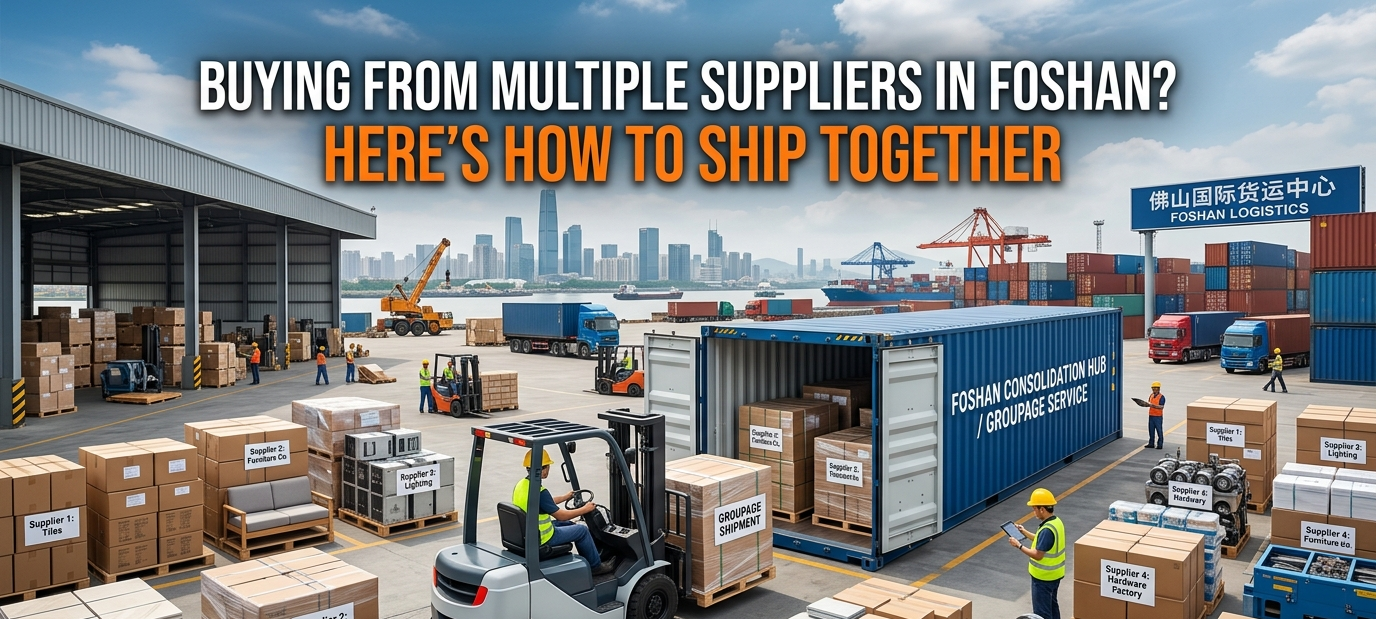
For international real estate developers, hospitality procurement executives, and commercial contractors, sourcing from Foshan, China offers direct access to the world’s most concentrated interior manufacturing cluster. A comprehensive project Bill of Quantities (BOQ), however, rarely comes from a single factory floor. To fit out a hotel, villa development, or multi-family apartment block, a buyer must source porcelain tiles from Chancheng, custom cabinetry and furniture from Shunde, and architectural aluminum glazing from Nanhai.
While purchasing directly from specialized primary factories maximizes your purchasing power, it introduces a severe logistical bottleneck: How do you ship items from ten completely different suppliers efficiently without multiplying your shipping costs?
Allowing each vendor to ship independently results in fragmented, high-cost Less than Container Load (LCL) shipments, redundant local export filings, and premium destination port surcharges. The structural solution to this cross-border supply chain challenge is centralized local cargo consolidation. Below is the operational blueprint on how to safely merge multi-vendor building materials into a single, optimized Full Container Load (FCL).
Key Takeaways
- Centralize Your Local Staging: Move your cargo out of the factories and into a single, project-managed local warehouse in Foshan to eliminate uncoordinated shipping windows.
- Bypass Destination LCL Stripping Fees: Consolidating separate vendor runs into a single FCL container eliminates the premium per-CBM sorting and handling surcharges at the destination terminal.
- Balance the Container Payload: Engineer the physical load sequence by matching heavy architectural masonry with lightweight, volumetric furniture to utilize close to 100% of the container’s volume and weight limits.
Why does independent shipping from multiple factories compromise project budgets?
When an overseas buyer allows multiple independent manufacturers to manage their own international shipping, logistics expenses accumulate rapidly. The hidden financial leak is rarely the factory’s production cost; it builds up during the domestic staging, export customs, and destination port clearance phases.
[Fragmented Path]  ──> 8 Separate Factories ──> 8 LCL Shipments ──> 8 Local Fees & High Breakage Risk
[Consolidated Path]──> 1 Foshan Warehouse ──> 1 Optimized FCL ──> 1 Flat Transit Fee & Balanced Loading
Relying on decentralized factory shipping introduces three specific operational liabilities:
- Redundant Documentation and Customs Brokerage Fees: Every independent cargo delivery requires its own unique export customs declaration in China and a corresponding import entry filing at your destination port. Importers end up paying duplicate customs broker handling charges, terminal documentation invoices, and port security fees for every minor order.
- Premium Destination Port Surcharges: Public LCL containers are unpacked and sorted at a local destination terminal warehouse. The local labor rates for unpacking, pallet-sorting, and staging mixed freight at Western or Middle Eastern ports are calculated on a premium per-CBM basis, which can easily exceed the cost of the entire ocean voyage.
- Uncontrolled Cargo Damage (Crushing): In a public LCL container, your goods are packed purely based on the physical sequence in which cargo arrives at the port terminal. Fragile custom kitchen cabinets or premium upholstered sofas can easily end up placed directly beneath un-palletized metal fabrications or heavy industrial components from unrelated shippers.
How does a local staging warehouse simplify physical quality control?
A centralized consolidation warehouse acts as a critical technical barrier where your product specifications are physically verified before goods are loaded into the ocean container. While conducting quality control audits on active factory lines is necessary, a central warehouse allows your sourcing team to execute cross-category interface checks that individual factories cannot perform in isolation.
For instance, an independent sourcing team at a central staging facility can physically pull a custom quartz countertop sample from a stone fabricator and test its alignment directly against a structural undermount basin from a separate sanitary ware vendor. We test joint tolerances, verify color-batch consistency under calibrated lighting, and check raw wood core moisture content using electronic pin meters.
Discovering a dimensional mismatch or an incorrect finish at our warehouse dock allows us to halt the intake process immediately, file an enforceable claim against the manufacturer’s contract, and return the defective batch for remanufacturing before the shipping container is booked.
What step-by-step warehouse sequence guarantees an engineered container load?
Once materials from your suppliers arrive at the central staging ground, the physical assembly of the container must follow a strict engineering protocol. Building materials cannot simply be stacked in the order they arrive; they must be arranged by density, weight tolerances, and geometric packaging structure.
1.Material Intake, Counting, and Moisture Auditing:Phase 1: Receiving Gate Control.
As trucks arrive from individual factories, every pallet is unloaded, photographed, and measured. The incoming quantities are verified against the master project BOQ, and wood core moisture levels are checked with pin meters to ensure they are stabilized between 8% and 12% before storage.
2.3D Volumetric Container Payload Optimization:Phase 2: Load Engineering.
Before the physical container arrives, the actual packaging dimensions (CBM) and total gross weights are entered into load-planning software. This calculates the precise layout needed to utilize nearly 100% of a 40HQ container’s 68 CBM volume while remaining safely within legal port weight boundaries.
3.Density-Stratified Mixed Container Loading :Phase 3: Structural Stacking.
Heavy, rigid items (tiles, stone slabs, cast-iron plumbing) are loaded flat across the container floor to build a low, stable center of gravity. Reinforced plywood decking and industrial dunnage airbags are installed to establish a secondary structural floor before stacking lightweight, volumetric items (cabinets, sofas, mattresses) on top.
4.Unified Export Documentation Assembly:Phase 4: Customs Processing.
The unique packing lists, commodity descriptions, and factory invoices from all suppliers are compiled into a single clean export declaration file. Every product is matched to its precise Harmonized System (HS) code to avoid structural inspection holds at both the shipping port and destination customs.
Why Choose HSY Sourcing for Your Multi-Supplier Consolidation in Foshan?
Managing the logistics, quality control, and timing of multiple distinct factories cannot be reliably executed from an overseas office. HSY Sourcing operates as your independent, on-the-ground purchasing and engineering team in Foshan, representing the explicit commercial interests of real estate developers.
- Dedicated Local Consolidation Facilities: We operate secure warehouse space in the heart of the Foshan industrial zone. We handle the physical staging, sorting, and long-term tracking of your project’s complete multi-vendor BOQ.
- Cross-Category Technical Inspections: Our team doesn’t just count boxes. We inspect product specifications at the factory line—checking tile shade variations, custom cabinet dimensions, and click-lock profiling before approving transfer to the warehouse.
- Comprehensive Custom Brokerage: Combining products from multiple vendors means navigating complex export legal profiles. We compile individual factory inputs into a single, clean customs declaration pack, managing local tax compliance structures and ensuring straightforward clearance.
- Optimized Container Engineering: We calculate weight-to-volume ratios for every shipment, combining heavy finishes with volumetric items to ensure you maximize your container space without paying for empty air or risking crushing damage.
Frequently Asked Questions (FAQ)
What happens if different factories complete production at different times?
This is normal in multi-vendor procurement. Our staging warehouse provides flexible storage windows tailored to your project’s construction schedule. We coordinate with your factories to synchronize timelines, but if a specific cabinetry line experiences an unavoidable delay, your early-completed building materials (such as tiles or sanitary ware) are held securely in our dry racking bays until the complete shipping volume converges.
How do you handle export customs clearance when a container holds goods from ten different factories?
Different manufacturers in China operate under different export tax profiles. Some possess independent export licenses, while others require domestic invoicing. HSY Sourcing manages this complexity behind the scenes: we legally merge the diverse packing lists, classify each item under its precise Harmonized System (HS) code, and generate a single consolidated export declaration that complies with maritime laws.
What happens if we discover damaged packaging or wrong specifications upon warehouse receipt?
If an item arrives at our warehouse dock with damaged packaging or incorrect dimensions, we immediately halt the check-in process. We document the issue with high-resolution photos and video, file an immediate claim with the manufacturing factory, and coordinate local transport to return the defective batch for remanufacturing before the primary container loading date arrives.
Can your warehouse team handle fragile materials like large-format sintered stone panels?
Yes. Large-format sintered stone and natural marble slabs are highly vulnerable to cracking from structural flexing during ocean transport. We mandate that factories secure these products in heavy-duty, enclosed wooden A-frame crates. Inside the shipping container, these frames are loaded vertically along the steel sidewalls and lashed down with high-tensile structural strapping to prevent any shifting during rough sea transit.