
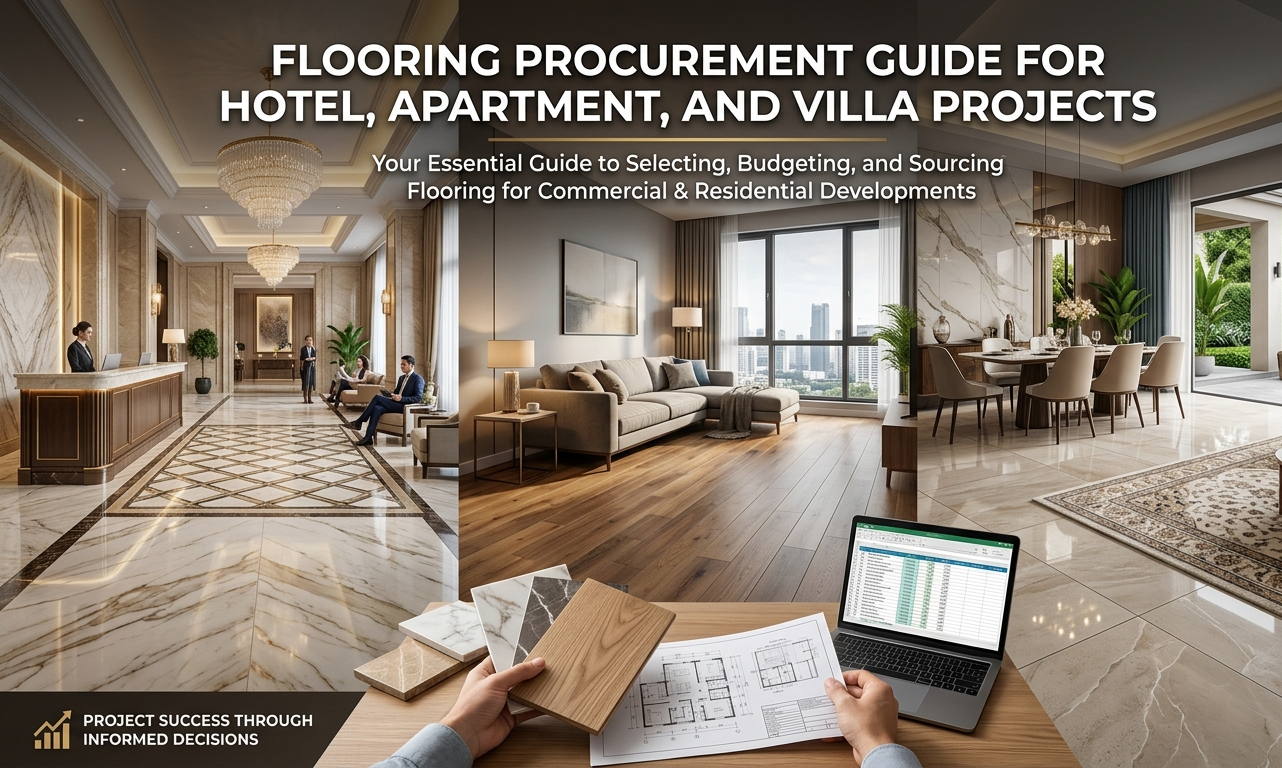
In commercial real estate development, flooring is one of the most heavily scrutinized CAPEX line items. It spans the largest physical surface area of the property, dictates the acoustic performance of the rooms, and takes the highest volume of physical abuse. Replacing failed commercial flooring post-installation is catastrophically expensive due to the associated labor costs and operational downtime.
For procurement directors managing hotels, multi-family apartments, or luxury villas, sourcing flooring directly from overseas manufacturers is the standard strategy for budget control. However, buying based on visual catalogs is a high-risk proposition. Different property types require fundamentally different substrate technologies, wear layers, and fire ratings. Executing a bulk flooring order safely requires tapping into a concentrated industrial supply chain like Foshan, China, where material specification, quality control, and heavy logistics can be managed centrally.
Key Takeaways
- Specification Dictates Lifespan: A 0.5mm (20 mil) wear layer is the baseline for commercial SPC/LVT flooring; applying standard residential grades to a hospitality project guarantees premature failure.
- Weight Limits Overrule Volume: Flooring is incredibly dense. Shipping strategies must account for maximum container weight limits (tonnage) rather than just volumetric space (CBM).
- Acoustic and Fire Compliance is Mandatory: Commercial flooring must pass local fire marshal inspections (e.g., ASTM E84, EN 13501) and meet strict Impact Insulation Class (IIC) ratings to prevent noise transfer between floors.
Why is Foshan the strategic hub for commercial flooring procurement?
When buyers think of Foshan, they typically think of the Chancheng and Shiwan districts—the undisputed global capitals of porcelain tiles, large-format slabs, and sintered stone. However, Foshan’s logistical infrastructure makes it the central nervous system for all interior decorative flooring, including SPC (Stone Plastic Composite), LVT (Luxury Vinyl Tile), and engineered hardwood.
While some polymer extrusion plants are located in neighboring provinces, Foshan serves as the commercial aggregation and export point. The world’s top architectural hardware, acoustic underlayment, and flooring transition-strip manufacturers are physically located here.
For a project buyer, this geographic concentration is an operational necessity. If your project requires 10,000 square meters of SPC flooring, the accompanying baseboards (skirting), acoustic IXPE padding, and aluminum transition thresholds can all be sourced, color-matched, and consolidated within a 30-kilometer radius. This eliminates the domestic logistics friction that typically delays fragmented supply chains.
How do flooring specifications differ across commercial property types?
A product engineered for a residential villa will fail in a high-turnover apartment, just as an apartment-grade floor will fall short of a luxury hotel’s acoustic requirements. Procurement teams must define strict internal parameters in their Bill of Quantities (BOQ).
| Project Type | Recommended Substrate | Critical Technical Specifications to Verify |
| Hotels & Hospitality | Commercial SPC, Large-Format Porcelain, or Commercial Broadloom/Carpet Tiles. | Acoustics: Minimum 1.5mm to 2.0mm attached IXPE acoustic pad to achieve high IIC ratings. Durability: Minimum 0.5mm (20 mil) wear layer for polymer floors. |
| Multi-Family Apartments | SPC or Glue-down LVT (Luxury Vinyl Tile). | Waterproofing: 100% waterproof core to prevent tenant water damage. Maintenance: UV-coated surface for stain resistance. High-grade click-lock systems (e.g., Valinge or Unilin) for rapid installation. |
| Luxury Villas | Engineered Hardwood (Oak, Walnut) or Sintered Stone Slabs. | Aesthetics: Minimum 3mm to 4mm real wood veneer for multiple future sandings. Stability: Multi-layer birch or eucalyptus plywood core to prevent warping in variable climates. |
What are the critical compliance and performance metrics to verify?
Digital sourcing platforms often obscure the technical differences between high-grade and low-grade flooring. When outfitting a commercial building, buyers must verify specific laboratory testing data before authorizing production.
- Wear Layer Thickness: For SPC and LVT, the decorative film is protected by a clear vinyl wear layer. Residential floors use 0.2mm to 0.3mm. Commercial projects must specify a minimum of 0.5mm (20 mil) or 0.7mm (28 mil) to withstand heavy foot traffic and rolling luggage.
- Fire Retardancy: Commercial buildings face strict safety codes. The flooring must have documented fire ratings. Ensure the factory can provide active, third-party test reports showing compliance with standards like ASTM E84 (Class A) for North America or Bfl-s1 under EN 13501 for Europe.
- Slip Resistance: Lobbies, bathrooms, and wet areas require specific dynamic coefficient of friction (DCOF) ratings. Look for R10 or R11 slip-resistance ratings, particularly for porcelain tiles used in public access zones.
How can bulk buyers optimize shipping for high-density flooring?
The most common logistical mistake inexperienced buyers make is misunderstanding the weight-to-volume ratio of flooring. Flooring—whether porcelain tile, engineered wood, or stone-core SPC—is incredibly dense cargo.
If you attempt to fill a 40-foot High Cube (40HQ) container entirely with flooring, you will exceed the legal maximum payload weight (usually around 26 to 28 metric tons) while the container is still half physically empty.
Efficient procurement requires strategic load planning:
- The 20GP Strategy: If you are ordering only flooring, it is often more cost-effective to ship using smaller 20-foot General Purpose (20GP) containers. They handle dense weight efficiently and cost less to ship than 40HQs.
- Mixed Container Consolidation: If your BOQ includes other interior items, Foshan allows for the optimal logistical balance. A sourcing team can load the heavy pallets of flooring flat on the bottom of a 40HQ container, and then fill the massive remaining air space with lightweight, volumetric cargo—such as hotel sofas, custom cabinetry, or decorative lighting. This ensures you utilize 100% of both the weight capacity and the volumetric space, aggressively driving down your total landed cost.
Why choose HSY Sourcing as your Foshan procurement partner?
Executing a multi-container flooring order requires technical oversight on the factory floor and strict logistical coordination. HSY Sourcing operates as your independent, ground-level purchasing and engineering office in Foshan.
- Direct Manufacturer Matching: We bypass trading companies and connect your real estate project directly with audited, export-oriented extrusion mills and ceramic kilns scaled for commercial volumes.
- Specification Enforcement: We translate your architectural requirements into hard factory mandates. We physically verify the thickness of the wear layer, the density of the SPC core, and the integrity of the click-lock milling before mass production begins.
- Compliance Verification: We demand and verify third-party laboratory data (SGS, Intertek) for fire codes, VOC emissions (FloorScore/CARB Phase 2), and acoustic ratings, ensuring your materials will pass local building inspections.
- Turnkey Consolidation & Packaging: Operating from our Foshan warehouse, we coordinate the safe palletization of your flooring (using fumigated, ISPM-15 compliant wood) and engineer mixed-container loading plans with your other building materials to maximize freight efficiency and prevent transit damage.
Frequently Asked Questions (FAQ)
Can we order custom flooring colors or wood grains for our project?
Yes. For SPC, LVT, and engineered wood, factories work with specialized decorative film and veneer suppliers. If your project meets a minimum order quantity (typically around 1,000 to 1,500 square meters per color), the factory can custom-match exact wood grains, stone textures, or specific gloss levels based on a physical control sample provided by your design team.
How do you prevent flooring from being damaged by moisture during ocean transit?
Ocean freight exposes cargo to extreme humidity and temperature shifts. We enforce strict export packaging protocols. Flooring cartons are tightly stacked on fumigated pallets, wrapped in heavy-duty shrink plastic, and secured with rigid edge protectors. Additionally, we mandate the placement of industrial desiccants (moisture absorbers) inside the shipping container to control humidity levels during the voyage.
What is the standard lead time for a commercial flooring order?
For standard SPC profiles, LVT, or porcelain tiles using in-stock decorative films, production for 2 to 5 containers typically requires 20 to 25 days. If your project demands a custom-milled engineered wood or a proprietary decorative film that must be printed from scratch, the lead time will extend to 35 to 45 days.
Is SPC flooring truly waterproof for apartment bathrooms?
The SPC core itself (limestone and PVC mix) is 100% waterproof and will not swell or warp when submerged. However, the installation method and the perimeter sealing dictate the actual water resistance of the room. We ensure the click-lock profiling is milled to precise tolerances (e.g., licensed Valinge systems) to create a tight top seal, but the perimeter edges must still be properly caulked by your installation team on-site.