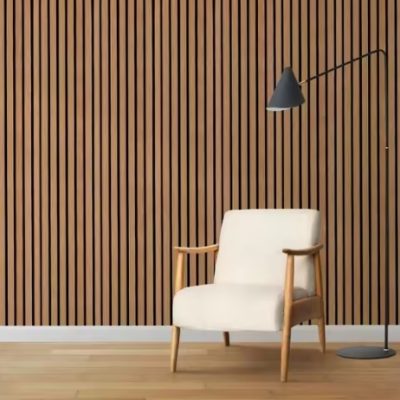

Selecting the correct interior wall cladding for commercial real estate—whether a 200-key hotel, a high-density apartment complex, or a luxury villa project—requires balancing material cost, installation speed, and long-term durability. Wall panels have replaced traditional wet-work (plastering and painting) in many commercial fit-outs because they standardize the finish and drastically reduce on-site labor hours.
Procurement managers must navigate a complex market of substrates, surface films, and fire ratings. As the primary manufacturing hub for interior building materials, Foshan, China, offers a complete ecosystem for wall panel production. This guide details the exact material specifications project buyers need to understand before placing bulk orders.
Key Takeaways
- Match Substrate to Application: High-traffic areas require high-impact SPC or Bamboo Charcoal panels, while luxury suites benefit from engineered wood veneers.
- Verify Technical Certifications: Commercial projects strictly require verified fire-retardant (e.g., Class A/B) and low-formaldehyde (E0/CARB Phase 2) certifications from the factory.
- Cluster Economics: Sourcing wall panels directly from Foshan lowers costs because polymer suppliers, extrusion lines, and lamination factories operate within the same geographic zone, minimizing domestic freight overhead.
What are the primary wall panel materials used in commercial projects?
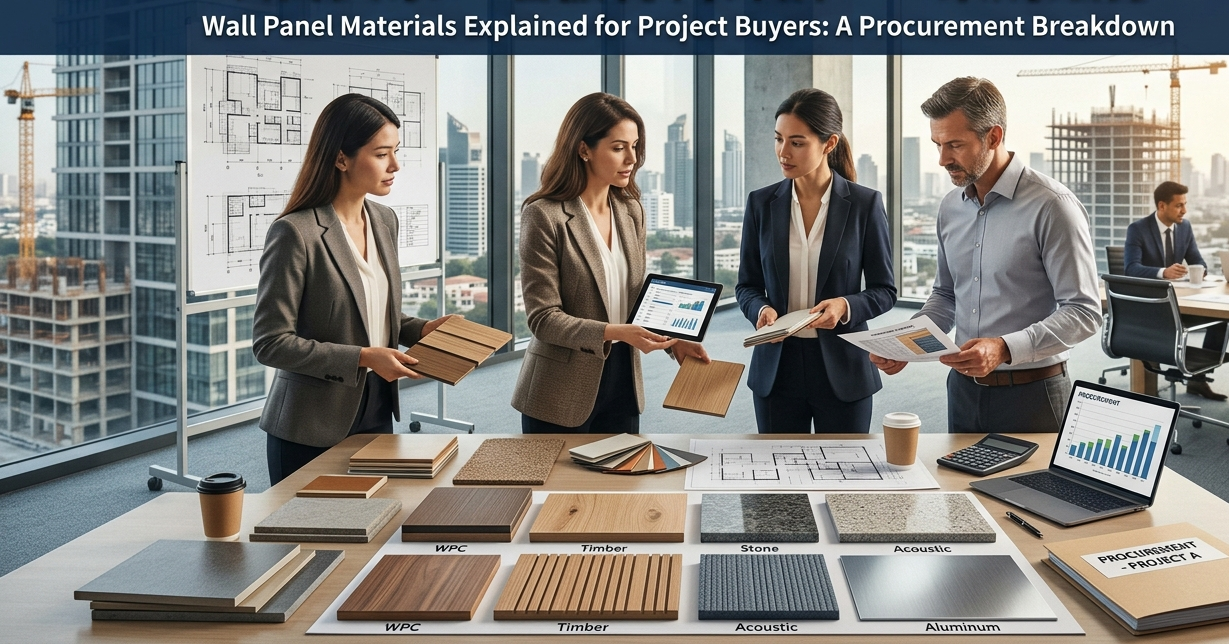
The Foshan manufacturing market categorizes interior panels by their core substrate. The substrate dictates the panel’s structural integrity, moisture resistance, and weight, while the surface lamination dictates the aesthetic.
| Material Type | Core Composition | Key Performance Characteristics | Standard Project Applications |
| WPC (Wood Plastic Composite) | Wood fiber mixed with thermoplastic resins (PVC/PE) | High moisture resistance, lightweight, cost-effective, easily cut on-site. | Apartment corridors, budget hotel rooms, bathroom dry zones. |
| SPC (Stone Plastic Composite) | Natural limestone powder and PVC stabilizers | Extremely dense, high impact resistance, zero water absorption, inherent fire resistance. | High-traffic hospitality lobbies, commercial elevator lobbies. |
| Bamboo Charcoal Fiber Panel | Bamboo wood powder, calcium powder, carbon fiber | Excellent structural stability, high bending strength, rapid click-lock installation. | Modern hotel feature walls, office partitions, quick-renovation projects. |
| Engineered Wood Veneer (MDF/Plywood) | Medium-density fiberboard or multi-layer plywood core | High-end acoustic properties, authentic tactile feel, requires climate control. | Luxury villa living areas, hotel executive suites, boardrooms. |
| Flexible Stone Veneer (PU/MCM) | Polyurethane or modified clay powder | Ultra-lightweight, bendable around columns, highly realistic stone textures. | Villa exterior feature walls, curved hotel reception areas. |
How does the Foshan industrial cluster impact wall panel procurement costs?
Foshan’s pricing advantage is derived from supply chain density, not compromised material quality.
Wall panel manufacturing is a multi-step process: raw polymer extraction, profile extrusion, and surface film lamination. In isolated manufacturing regions, a factory must pay heavy inland freight to transport PVC resin or decorative PVC films from other provinces. In Foshan, a wall panel extruder can source thousands of decorative film patterns (wood grain, marble, fabric textures) from suppliers located just kilometers away.
For international buyers, this means lead times for custom-colored panels are measured in days rather than weeks, and the factory’s operational overhead is significantly lower. These structural savings are reflected in the final FOB unit price.
What technical specifications should buyers verify before mass production?
Procuring wall panels based purely on a small visual sample often leads to compliance failures during site installation. Project buyers must mandate that factories meet specific technical tolerances.
- Fire Retardancy Compliance: Hotels and apartments are subject to strict building codes. Buyers must specify the required fire rating (e.g., ASTM E84 for North America, EN 13501-1 for Europe) during the quoting phase. Standard WPC is naturally combustible; achieving commercial fire ratings requires the factory to add specific chemical fire retardants into the extrusion mix, which slightly alters the material cost.
- Extrusion and Milling Tolerances: Most commercial panels use a tongue-and-groove or click-lock system for seamless installation. If the factory’s extrusion molds are worn, a 0.5mm deviation in the locking mechanism will cause visible gaps across a 10-meter wall.
- Lamination Adhesion Strength: The decorative surface film must be fused to the core using high-quality polyurethane (PUR) hot melt adhesive. Inferior adhesives will cause the film to bubble or peel under high humidity or temperature fluctuations.
Why choose HSY Sourcing as your procurement partner in Foshan?
Managing bulk building material orders remotely exposes project developers to significant quality and logistical risks. HSY Sourcing operates as your independent procurement office in Foshan, ensuring your technical specifications are met exactly as drafted.
- Direct OEM Factory Allocation: We bypass trading companies and source directly from primary extrusion factories equipped to handle commercial volume requirements.
- Technical Specification Audits: We verify that the factory is using the correct substrate density, fire-retardant additives, and PUR adhesives before any contract is signed.
- In-Line Quality Control: Our team conducts physical inspections during production to verify locking mechanism tolerances, color batch consistency, and straightness to prevent warping issues.
- Consolidated Project Logistics: We coordinate the production timelines of your wall panels with your furniture, lighting, and sanitary ware orders. By consolidating these disparate goods in Foshan, we optimize container loading density and significantly reduce your total shipping costs.
Frequently Asked Questions (FAQ)
Can we order custom panel textures or colors for our hotel project?
Yes. If your project meets a minimum order quantity (typically around 800 to 1,000 square meters per profile), the factory can custom-match the surface lamination film to your exact interior design specifications, including custom wood grains, metallic finishes, or solid colors.
How do you pack wall panels to prevent transit damage?
Wall panels are long and susceptible to edge crushing. We mandate strict export packaging: panels are stacked face-to-face with protective interlayers, packed in reinforced cartons, and secured onto enclosed wooden pallets with heavy-duty strapping and rigid corner protectors.
What is the standard production time for bulk wall panel orders?
For standard profiles and in-stock decorative films, a 40HQ container can generally be produced in 15 to 20 days. If the project requires custom profile extrusion molds, the engineering and sampling phase will add an additional 10 to 15 days.
Do these panels require specialized installation hardware?
Most commercial WPC, SPC, and Bamboo Charcoal panels utilize a standardized aluminum or stainless-steel snap-clip system concealed behind the tongue-and-groove joint. We ensure that the factory includes the precise calculation of matching installation clips and structural adhesive with your bulk order.