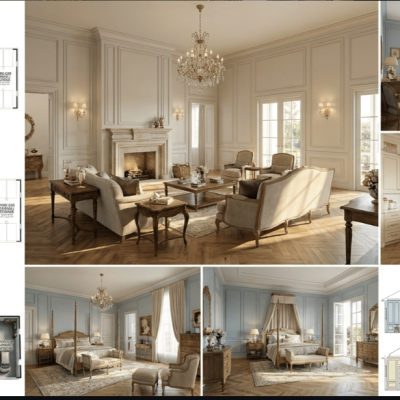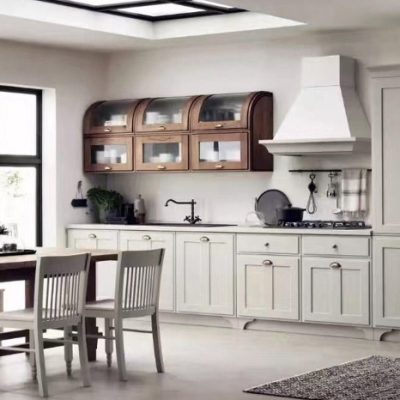

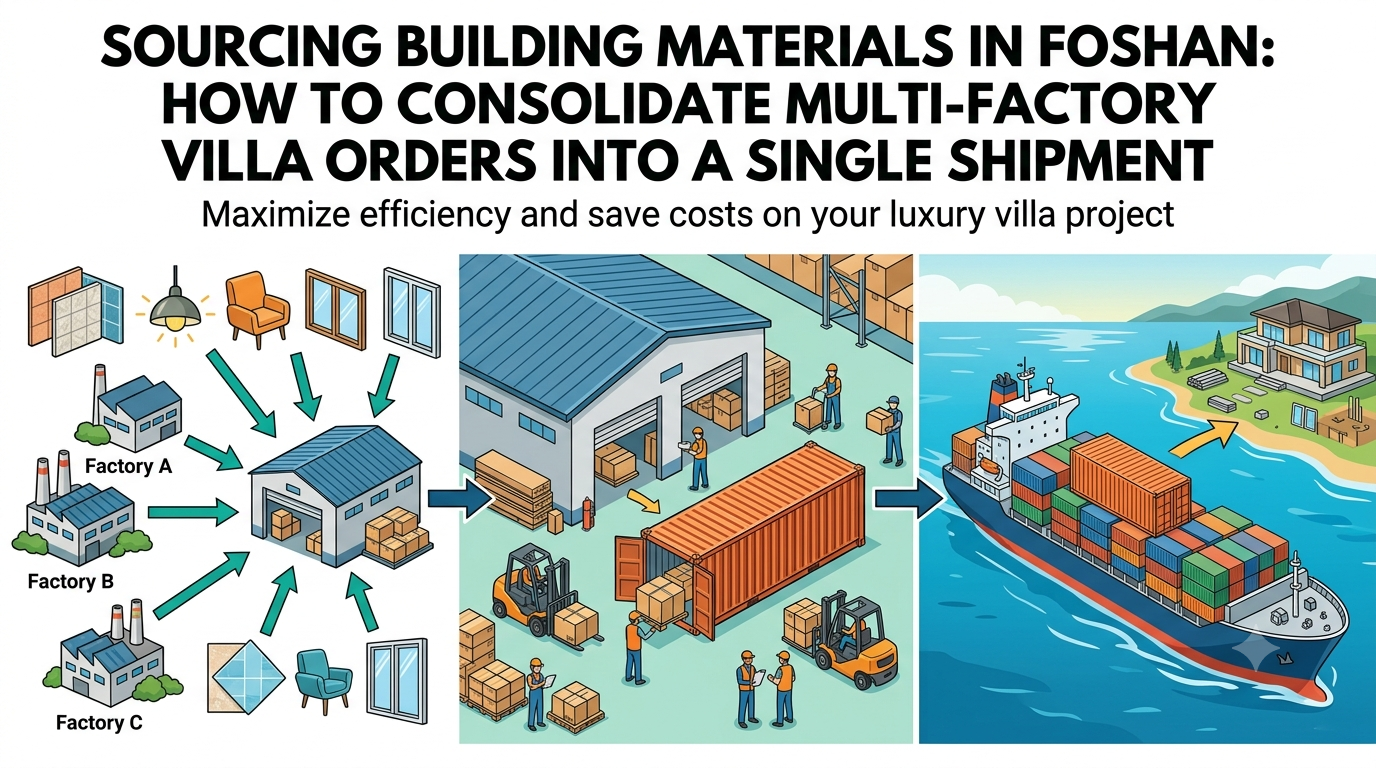
Purchasing finishing materials directly from Foshan allows developers and private builders to access factory pricing across a broad spectrum of products—from porcelain slabs and aluminum windows to custom kitchen cabinets and sanitary ware. However, a luxury villa build rarely relies on a single manufacturer. A typical high-spec project requires coordinating orders across 10 to 20 separate factories.
Shipping these orders individually via Less than Container Load (LCL) freight dramatically inflates transport overhead through duplicate port charges, customs filing fees, and increased risk of transit damage due to repeated cargo handling.
Consolidating your orders into dedicated Full Container Load (FCL) shipments at a central Foshan warehouse is the standard operational method to control logistics costs and verify product quality before goods leave China.
Key Takeaways
- Freight Cost Reduction: Consolidating multiple factory shipments into a single 40ft High Cube (40HQ) container lowers ocean freight and destination port handling fees by 40% to 60% compared to separate LCL shipments.
- Lead-Time Synchronization: Custom joinery and aluminum window systems require 35 to 45 days of production, while tiles take 10 to 15 days. Production schedules must be reverse-engineered to prevent extended warehouse storage fees.
- Physical Staging Gateway: Staging items in a centralized Foshan warehouse provides a final opportunity to check crate dimensions, inspect packaging integrity, and verify piece counts against the Bill of Quantities (BOQ).
- Load Order Strategy: Heavy, high-density products (tiles, natural stone) must be loaded onto the container floor, while lightweight or custom joinery, doors, and glass fixtures are secured on upper tiers or dedicated A-frame racks.
Why Is Container Consolidation Essential for Villa Projects in Foshan?
Foshan is not a single giant market under one roof; it is a regional industrial network. Tiles are manufactured in Nanhai and Shiwan, aluminum windows in Dali, custom cabinets in Shunde, and sanitary ware in Chancheng.
Multi-Factory Supply Chain (Fragmented vs. Consolidated)

Fragmented (LCL Shipping):
Factory A (Tiles)     ──> Port Handling ──> LCL Ship ──> High Fees & Risk
Factory B (Windows)   ──> Port Handling ──> LCL Ship ──> High Fees & Risk
Factory C (Cabinets)  ──> Port Handling ──> LCL Ship ──> High Fees & Risk

Consolidated (FCL Shipping):
Factory A, B, C... ──> Foshan Staging Warehouse ──> QC & FCL Loading ──> Single 40HQ Container
When you order from multiple plants, attempting to ship each order as it finishes creates operational inefficiencies:
- Excessive LCL Handling Fees: Freight forwarders charge minimum documentation, terminal handling (THC), and clearance fees per LCL bill of lading. Five LCL shipments often cost more in local charges than one full 40HQ container.
- Risk of Cargo Damage: LCL cargo is handled, stacked, and moved multiple times at origin and destination warehouses alongside random commercial freight.
- Unsynchronized Site Delivery: Receiving villa materials at the construction site in small, fragmented batches complicates installation logistics and increases local staging costs.
By bringing all orders to a central local warehouse, you gain full control over cargo packing, weight distribution, and export documentation.
How Do You Coordinate Production Schedules Across 10+ Different Factories?
The primary cause of shipping delays in material procurement is poor production schedule alignment. Different building products have vastly different manufacturing cycles:
| Product Category | Production Lead Time | Staging Priority |
| Standard Tiles & Sanitary Ware | 10 – 15 Days | Low (Stocked or fast kiln runs) |
| Sintered Stone Slabs (Custom Cutting) | 15 – 20 Days | Medium |
| Thermal Break Aluminum Windows | 30 – 40 Days | High (Requires early shop drawing approval) |
| Custom Kitchen Cabinets & Joinery | 35 – 45 Days | High (Requires detailed CAD sign-off) |
| Bespoke Lighting & Loose Furniture | 25 – 35 Days | Medium |
To execute a smooth consolidation process, procurement schedules must be planned backward from your target shipping date:
Consolidation Procurement Timeline:
Week 1: Finalize BOQ & Sign-Off All Factory CAD Drawings
Week 2–5: Manufacture Long-Lead Items (Windows, Kitchens, Doors)
Week 5–6: Manufacture Short-Lead Items (Tiles, Sanitary Ware, Lighting)
Week 7: Staging at Foshan Central Warehouse & Pre-Shipment Inspection
Week 8: Container Loading, Export Customs Clearance & Port Dispatch
Staggering deposit releases and production start dates ensures that all items arrive at the staging warehouse within a tight 5 to 7-day window, preventing unnecessary storage fees.
What Does the Physical Warehousing and Staging Process Involve?
Once goods leave individual factories, they arrive at the staging warehouse in Foshan. This step serves as the critical quality control checkpoint before international transit.
Warehouse Staging Steps:
1. Receiving & Gate Check (Outer Packaging & Box Counts)
 └── 2. BOQ Cross-Verification (Model Numbers, Color Codes, Quantities)
      └── 3. Unboxing & Random Quality Sampling (Dimensions, Finishes)
           └── 4. Crate Reinforcement & Palletizing
                └── 5. Final CBM & Weight Measurements for Container Plan
1. Cargo Receiving and Outer Condition Inspection
As factory trucks unload at the warehouse, receiving staff inspect outer corrugated boxes, wooden crates, and pallet wrappings. Any crushed boxes, water stains, or broken crate frames are documented immediately with photographic evidence before the delivery driver departs.
2. Bill of Quantities (BOQ) Audit
Each incoming shipment is cross-referenced against the master procurement list. Staff verify model numbers, color codes (RAL paint codes or wood veneer batch tags), edge profiles, and total unit counts.
3. Sampling Inspection
Selected cartons are opened to inspect finished surface quality, tile shade consistency across boxes, cabinet hardware operation, and glass edge grinding.
How Do You Load Mixed Building Materials to Prevent Damage in Transit?
Loading a mixed building material container requires strict engineering logic regarding weight distribution, center of gravity, and structural pressure. A standard 40ft High Cube container has a volume capacity of approximately 68 CBM and a maximum payload weight capacity of 26,000 kg to 28,000 kg (depending on ocean carrier and road weight limits).
40HQ Container Load Order Diagram:

[ FRONT / AXLE (Heavy) ]    [ CENTER (Medium Density) ]    [ REAR / DOOR (Light / Fragile) ]
 ├── Porcelain Tiles         ├── Sanitary Ware             ├── Plywood Custom Cabinets
 ├── Sintered Stone Crates   ├── Aluminum Window Profiles  ├── Architectural Lighting
 └── Natural Stone Slabs     └── Internal Door Frames      └── Foam Wrapped Accessories
Key Rules for Container Loading:
- Bottom-Heavy Stacking: High-density materials like porcelain tiles, stone slabs, and bagged adhesives must be loaded flat on the container floor. Never stack light timber or hollow cabinet boxes underneath dense stone crates.
- Vertical A-Frame Securing for Large Slabs: Large-format sintered stone slabs ($1600\times3200\text{mm}$) and oversized glass panels are loaded on heavy-duty, fumigated wooden A-frames positioned along the container’s structural side walls.
- Weight Distribution Compliance: Heavy goods must be spread evenly across the floor length to ensure the container’s center of gravity is balanced, meeting international highway safety standards for axle loads during port trucking.
- Lashing and Blocking: Empty voids between crates are filled with inflatable air dunnage bags. Cargo is secured using heavy-duty nylon ratchet straps attached to the container’s internal steel tie-down rings.
What Customs Documents and HS Codes Are Required for Mixed Material Containers?
Clearing a consolidated container through export customs in China and import customs at your destination port requires meticulous paperwork. Because a single container holds multiple product categories, incorrect Harmonized System (HS) codes or discrepancies in declared values will result in customs holds and expensive port storage charges.
Essential Shipping Documentation Set:
 ├── Master Bill of Lading (B/L)
 ├── Consolidated Commercial Invoice (CI)
 ├── Consolidated Detailed Packing List (PL) by Crate/Pallet
 ├── Certificate of Origin (CO / Form E / Form F depending on region)
 └── ISPM-15 Wood Packaging Fumigation Certificate
1. Itemized Packing List by Container Position
The packing list must detail exactly which products are loaded into each section of the container, including piece counts, net weights, gross weights, cubic measurements, and factory supplier details.
2. HS Code Classification
Each material category requires accurate HS code mapping to ensure smooth customs processing:
- Porcelain Slabs / Ceramic Tiles: HS Code Chapter 69
- Aluminum Windows & Doors: HS Code Chapter 76
- Wooden Millwork & Kitchen Cabinets: HS Code Chapter 94
- Sanitary Ware & Faucets: HS Code Chapter 69 / 84
3. ISPM-15 Fumigation Compliance
All solid wood packing materials, wooden pallets, and A-frame crates must be heat-treated or chemical-fumigated in accordance with ISPM-15 international standards and bear official stamp markings.
Why Partner with HSY Sourcing for Your Villa Material Consolidation in Foshan?
Managing the logistics of 10 to 20 sub-tier suppliers across different manufacturing districts in Foshan requires dedicated project management, physical warehouse infrastructure, and technical oversight. HSY Sourcing serves as your technical procurement and logistics partner on the ground.
1. Dedicated Local Staging Warehouse in Foshan
We operate a spacious, secure warehouse in Foshan designed specifically for receiving, staging, and inspecting mixed building materials. Our facility is equipped with forklifts, specialized slab-handling cranes, and custom packing equipment.
2. Engineering and Technical Drawing Oversight
Before goods ever reach our warehouse, our technical team reviews factory shop drawings against your architectural plans. We verify structural profile tolerances, hardware compatibilities, and site measurements to prevent errors early in production.
3. Strict Three-Stage On-Site Quality Control
We enforce rigid inspection gateways:
- Raw Material Verification: Checking board formaldehyde grades (E0/ENF), aluminum extrusion wall thickness, and stone batch dye lots.
- In-Line Assembly Checks: Inspecting trial cabinet modules and testing window seal tightness during production.
- Pre-Shipment & Loading Audit: Conducting 100% finished goods checks, packaging integrity tests, and supervising container packing.
4. Turnkey Export Logistics and Customs Management
HSY Sourcing consolidates invoices, prepares multi-commodity export customs declarations, manages ISPM-15 fumigation, and coordinates with ocean shipping lines to ensure your container arrives safely at your project site port.
Frequently Asked Questions About Foshan Material Consolidation
How much warehouse storage time is included during the staging process?
HSY Sourcing provides complimentary staging storage at our Foshan warehouse for up to 30 days. This gives your suppliers sufficient buffer time to deliver goods without incurring storage penalties while awaiting long-lead custom items.
What happens if a factory delivers damaged or non-compliant goods to the warehouse?
Because we perform receiving inspections as trucks arrive, damaged or incorrect items are identified immediately. We reject non-compliant deliveries on the spot, document the defects, and require the factory to remanufacture or correct the order locally before final supplier payments are released.
Can HSY Sourcing handle export customs for small factories that lack export licenses?
Yes. Many specialized boutique joinery or metalwork workshops in Foshan do not hold independent export licenses. HSY Sourcing acts as the licensed exporter of record, consolidating all sub-orders under our export compliance umbrella to clear China Customs legally.
How do you determine whether a project needs a 20ft container or a 40ft High Cube container?
Once factory CAD shop drawings and order quantities are confirmed, we calculate the total volume (CBM) and gross weight (KG) using 3D container-loading software. Generally, if your total cargo volume exceeds 28 CBM or 18,000 kg, a 40ft High Cube container (capacity up to 68 CBM) is the most cost-effective option.