
It’s March 2026. You are walking the aisles of CIFF Guangzhou, and you finally find the perfect dining chair. But you want it in green velvet instead of black leather, and you only need 20 pieces to test your market.
You ask the sales rep. She smiles and says: “No problem, we can customize. But the MOQ is 100 pieces per color.” For an importer or an Amazon seller trying to test a new product, a high MOQ is a dealbreaker. But before you walk away, you need to understand why factories set these limits and how you can negotiate them down. Here is the realistic way to handle custom orders and MOQs without making the factory lose money.
Why do CIFF exhibitors demand such high MOQs for custom designs?
Factories don’t set high MOQs just to annoy you. They do it because changing a production line costs money.
If they have to stop the machines, adjust the cutting templates for wood, and train the workers on a new stitching pattern, they lose half a day of production. If you are only buying 20 chairs, the factory will actually lose money on the labor. The “100 piece” rule is their way of ensuring the machine setup time is worth it.
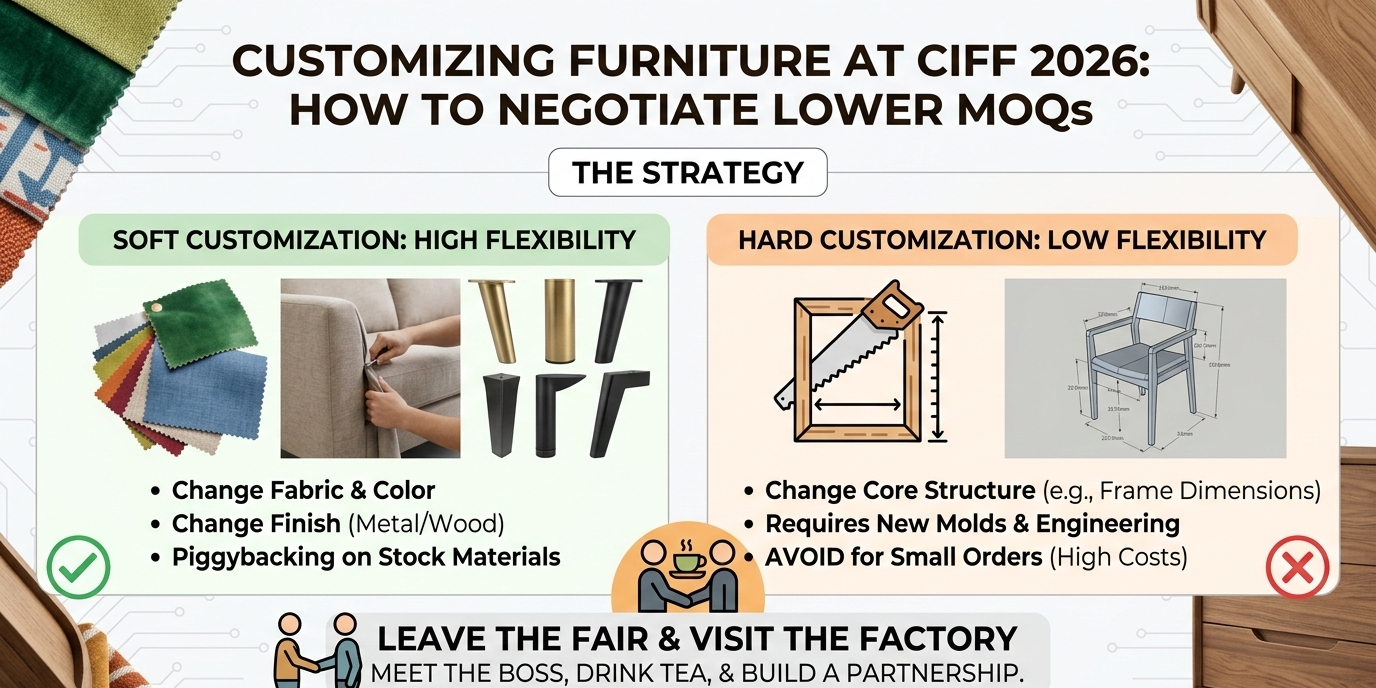
What is the difference between “Soft” and “Hard” Customization?
If you want to lower the MOQ, you have to know what you are asking for.
- Soft Customization: Changing the fabric, the leather color, or the finish of the metal legs. Factories are usually open to negotiating this because it doesn’t change the core structure.
- Hard Customization: Changing the width of a sofa from 220cm to 210cm, or changing the curve of a wooden chair back. This requires new molds and new engineering. Never ask for hard customization on a small order. The factory will either refuse or give you a terrible price. Stick to standard sizes and change the surface materials.
How can you use “Piggybacking” to lower the MOQ?
This is a classic Foshan sourcing trick. Factories buy their raw materials (like fabric and foam) in bulk rolls. If you want a specific green velvet that they don’t have in stock, they have to buy a whole roll from the market, which forces them to ask you for a high MOQ.
The Solution: Ask the factory what materials they are currently running for other large orders. If you “piggyback” on a fabric they already have in stock, they have zero material risk. Suddenly, that MOQ of 100 pieces can drop to 20 pieces because they don’t have to order custom raw materials just for you.
Why is paying a “Sample Surcharge” the smartest move?
Most buyers argue with the sales rep: “Give me 20 pieces at the 100-piece price, and if it sells well, I promise I will buy 500 next time!” Chinese factories hear this empty promise 50 times a day at CIFF. They won’t believe you.
Instead, speak the language of business. Offer to pay a 15% to 20% surcharge for your small test order. Tell them: “I will pay a higher price for these 20 pieces to cover your setup costs. But when I place the bulk order of 100 pieces next month, you deduct this extra surcharge from the total.” This shows you are a serious professional, protects the factory’s margin, and gets your small batch produced.
Why is the CIFF booth the worst place to negotiate MOQs?
The people standing at the booth in Pazhou are usually sales reps. They are given a price sheet and a strict set of rules by the boss. They do not have the authority to lower the MOQ for a new customer.
If you really want to customize a product with a low MOQ, you have to leave the fair and go to the factory in Foshan. When you sit in the boss’s office, drink tea, and explain your business model, the rules change. Bosses have the power to say “yes” to a small order if they like you and believe in your future volume.
The Bottom Line
Customization is possible, but it requires compromise. Don’t act like the factory owes you a favor. Work with their production realities, be willing to pay a fair premium for small batches, and negotiate with the decision-makers.
Tired of hearing “MOQ 100” at CIFF? As local Foshan agents, we know exactly which factories are flexible and which ones are rigid. [Contact HSY Sourcing] while you are in Guangzhou. We can often consolidate materials from the local Lecong fabric markets and bring your MOQs down to a realistic number.
FAQ: The Reality of Custom Orders and MOQs
Q: Can I mix different colors or items to reach the factory’s MOQ?
A: Yes, this is a very common strategy. If the factory says the MOQ is 50 sofas, you can usually negotiate to do 25 in beige and 25 in grey. But there is a catch: it must be the same type of fabric. If you ask for 25 in cheap polyester and 25 in imported Italian leather, the factory will say no, because they have to buy from two different raw material suppliers.
Q: Will the factory charge me extra to make a custom sample first?
A: Yes, always. Expect to pay 2 to 3 times the normal wholesale price for a customized sample. This isn’t them ripping you off. It costs a lot of money to have a master craftsman stop the production line to build a single, one-off piece. The standard practice in Foshan is that the factory will refund this extra sample fee when you finally place the bulk order.
Q: How long does a custom sample actually take to make after CIFF?
A: If a sales rep at the booth excitedly tells you, “We can finish it in 7 days!”—be very careful. Unless it is a simple fabric change on a frame they already have sitting in the warehouse, a real custom sample takes 15 to 30 days. They have to source the materials, cut new templates, and test the structure. Give them the time they need, or the sample will look rushed and sloppy.
Q: What happens if I push the factory too hard for a low MOQ and a cheap price?
A: You will get garbage. This is the biggest mistake foreign buyers make. If you force a factory boss into a corner where he isn’t making any money on your small order, he won’t tell you. He will just quietly use lower-density foam, thinner inner wood, or cheaper stitching to recover his margin. If you want a small quantity, pay a fair premium. Protect their profit, and they will protect your quality.
Q: Can I just buy the raw materials myself in Lecong and give them to the factory?
A: Yes, this is called “Customer’s Own Material” (COM). If you are buying a small amount of furniture but want a very specific luxury fabric, we often take our clients to the Lecong fabric market. You buy exactly 50 meters of the fabric you love, and we deliver it to the factory. This completely removes the factory’s “material MOQ” excuse.