
If you are developing a multi-family apartment building, a student housing project, or a row of townhouses for rent, the kitchen is where you spend a large chunk of your budget. It’s also the room that will take the most abuse.
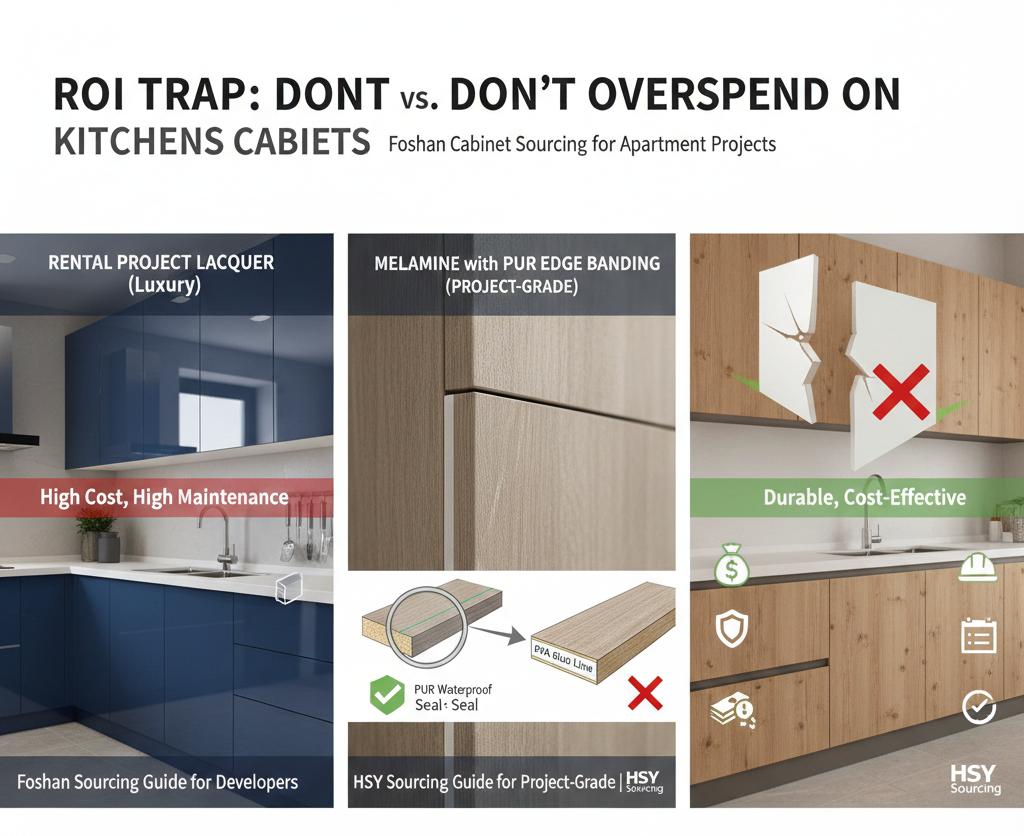
When you start requesting quotes from cabinet factories in Foshan, China, you will quickly notice a massive price difference between materials. A kitchen finished in high-gloss lacquer might cost 30% to 50% more than the exact same layout finished in melamine.
For a 50-unit apartment building, that price gap can equal tens of thousands of dollars.
Many developers look at the shiny, mirror-like finish of lacquer in the factory’s catalog and think: “If I spend the extra money, I can charge higher rent.” As a sourcing agent based in Foshan who has managed hundreds of containers of cabinets for overseas projects, let me give you the honest truth: Putting high-gloss lacquer in a standard rental property is almost always a costly mistake. Melamine is the undisputed king of rental projects, but only if you buy the right kind.
Here is the reality of what happens when these cabinets leave the showroom and meet real-life tenants.
Why do Chinese factories always push high-gloss lacquer?
When you browse Alibaba or visit a showroom in Foshan, the front displays are almost always high-gloss lacquer or premium wood veneers. Factories love selling lacquer.
First, it looks incredibly impressive. It has a high-end, modern European feel that photographs beautifully. Second, the profit margin for the factory is much higher. The process of making lacquer cabinets involves multiple coats of paint, baking, and polishing. It takes more time and skill, so they can charge a premium.
If you are building a $3 million luxury villa to sell, lacquer is a great choice. The buyer expects that level of finish. But factories will often try to push this “luxury” material onto developers building mid-range rentals simply because it increases the order value. They aren’t the ones who have to deal with the maintenance three years later.
What actually happens to lacquer cabinets in a rental apartment?
When you buy a rental property, you have to assume that tenants will not treat the kitchen like it belongs to them.
High-gloss lacquer is essentially a thick layer of baked paint. While it is somewhat hard, it is incredibly vulnerable to sharp impacts.
- A tenant drops a heavy fork against the lower cabinet door.
- A kid bangs a metal toy against the drawer front.
- Someone cleans the shiny surface with a rough scouring pad.
What happens? The lacquer chips or gets covered in swirl scratches.
Here is the biggest nightmare for a property manager: You cannot easily patch a chipped lacquer door. Unlike drywall, you can’t just put some filler in it and paint over it. To fix a damaged lacquer cabinet, you usually have to replace the entire door.
Furthermore, because lacquer paint fades slightly over time due to UV light from windows, if you order a replacement door from China two years later, the white color of the new door will not perfectly match the slightly aged white of the old cabinets. You are left with a patchy-looking kitchen.
Is melamine really just “cheap board”?
When some older contractors hear the word “melamine,” they think of the cheap, peeling, white particleboard furniture from 20 years ago. That is no longer the reality of the Foshan supply chain.
Modern melamine (often referred to as MFC – Melamine Faced Chipboard) is made by pressing a heavy-duty decorative paper infused with resin onto a core board under high heat and pressure.
Today, the printing technology is so advanced that a wood-grain melamine board actually has a textured feel. It looks 90% as good as real wood veneer, but with a massive advantage: It is incredibly tough.
Melamine is highly resistant to scratches. You can run a key across a good quality melamine board, and it will leave no mark. It resists heat and stains. If a tenant spills coffee or bumps it with a chair, it survives. If a door does get broken, a replacement door will match the color perfectly because the color is printed, not mixed in a paint bucket.
For a rental project, melamine gives you the best Return on Investment (ROI). You save 30% on the initial purchase, and your maintenance costs drop to near zero.
Where is the hidden danger when buying melamine in China?
If melamine is so great, why do some people still have bad experiences with it? The answer lies in one critical detail that most buyers never see: The Edge Banding .
When a factory cuts a melamine board, the raw wood core is exposed on the edges. To cover this, they apply a strip of PVC edge banding. This is where cheap Chinese factories cut corners.
Low-end factories use EVA glue. It’s cheap and easy to apply. However, EVA glue leaves a visible dark glue line. Worse, it is not waterproof. In a kitchen environment where boiling water creates steam, or a tenant spills water near the sink, moisture sneaks through that EVA glue line. Once water hits the particleboard core, the board swells, the edge banding peels off, and the cabinet is ruined.
High-end Foshan factories use PUR glue (or laser edge banding). PUR glue creates a microscopic, waterproof seal. You cannot see a glue line, and water cannot penetrate it. A melamine cabinet sealed with PUR glue can survive in a humid bathroom or a busy kitchen for a decade without peeling.
How does the price gap affect your overall project ROI?
Let’s look at the simple math for a 50-unit apartment building.
If a factory quotes you $2,500 per kitchen for Melamine and $3,500 for High-Gloss Lacquer, the difference is $1,000 per unit.
- Initial Savings: You save $50,000 upfront by choosing Melamine.
- Maintenance Savings: Over the next 5 years, you might have to replace 20 damaged lacquer doors (plus the expensive shipping of small parts from China). With Melamine, that replacement rate drops to almost zero.
Tenants renting standard or mid-tier apartments do not pay an extra $100 a month in rent just because the cabinets are painted rather than pressed. They care that the kitchen looks clean, modern, and functions well. High-quality wood-grain or matte melamine achieves this perfectly.
How can a local agent protect your budget and reputation?
If you just go on Alibaba and ask for “Melamine Cabinets,” you will get 50 different prices. The cheapest price will almost certainly use low-grade boards with EVA glue. But from a computer screen 5,000 miles away, they all look exactly the same.
This is why developers and contractors use HSY Sourcing as their ground team in Foshan.
We don’t just negotiate the price; we audit the factory’s production line.
- We check what brand of edge banding machine they are using (Homag machines from Germany are the gold standard in Foshan).
- We verify if they are using PUR glue.
- We check the thickness of the board (insisting on 18mm thickness instead of the flimsy 16mm standard).
- We ensure the hinges and drawer slides are heavy-duty, because a strong door is useless if the hinge breaks.
You don’t need a factory to sell you a shiny dream; you need a factory that delivers reliable, headache-free products that protect your profit margins.
Are you planning the budget for your next rental or apartment project? Don’t guess which material is right based on photos. Contact HSY Sourcing today. Send us your floor plans, and we will give you a realistic, straightforward quote for durable, project-grade cabinets straight from Foshan’s best manufacturers.
FAQ: Straight Answers for Apartment Developers and Contractors
1. Will Chinese melamine cabinets pass local environmental and health standards?
This is a very common and valid concern. Years ago, cheap Chinese particleboard was infamous for high formaldehyde emissions. Today, the standard has completely changed, but you still have to verify it. For projects in the US or Europe, we strictly require factories to use CARB P2 or E0-grade core boards. As your agent, we don’t just look at a shiny PDF certificate; we check the physical ink stamps on the side of the raw boards in the factory warehouse before they are cut.
2. Will melamine make my newly built apartments look cheap to prospective tenants?
Not anymore. If you haven’t looked at modern melamine in the last five years, you will be surprised. The factories in Foshan now use “Synchronized Wood Grain” technology. This means the texture you feel with your hand perfectly matches the printed wood knots you see with your eye. We also frequently source “Super Matte” or “Anti-Fingerprint” melamine, which looks identical to high-end Italian painted cabinets but costs a fraction of the price and is much harder to scratch.
3. If we save money by choosing melamine doors, should we also use cheaper hardware to maximize our ROI?
Absolutely not. This is the biggest mistake a developer can make. A cabinet door doesn’t move; the hinge does. If you use a cheap, no-name hinge, the door will sag and break off within a year, no matter what material the door is made of. We always advise our clients: Save your budget on the door finish, but spend it on the hardware. We ensure factories use genuine global brands like Blum or Hettich, or top-tier Chinese engineering brands like DTC, which are tested for 100,000 open/close cycles.
4. What if my project is a luxury condo building for sale, not for rent? Should I still avoid lacquer?
If you are building luxury condos to sell, the rules change. Buyers paying a premium expect luxury materials, and since they own the property, they tend to treat the kitchen with more care than a renter would. In this case, High-Gloss Lacquer, Wood Veneer, or PET are excellent choices. However, lacquer requires extremely strict quality control during production to avoid “orange peel” textures or dust trapped under the paint. This is exactly where our local QC team steps in to inspect the panels before they are packed.
5. How long does it take to produce and ship a 50-unit melamine cabinet order from Foshan?
Once the shop drawings and materials are confirmed, a standard 50-unit melamine project usually takes about 30 to 35 days to manufacture in Foshan. Melamine is faster to produce than lacquer because it doesn’t require weeks of painting and drying time. Add another 25 to 35 days for ocean freight (depending on your location), and you should plan for a 2.5 to 3-month lead time from the day you pay the deposit to the day the container arrives at your site.