
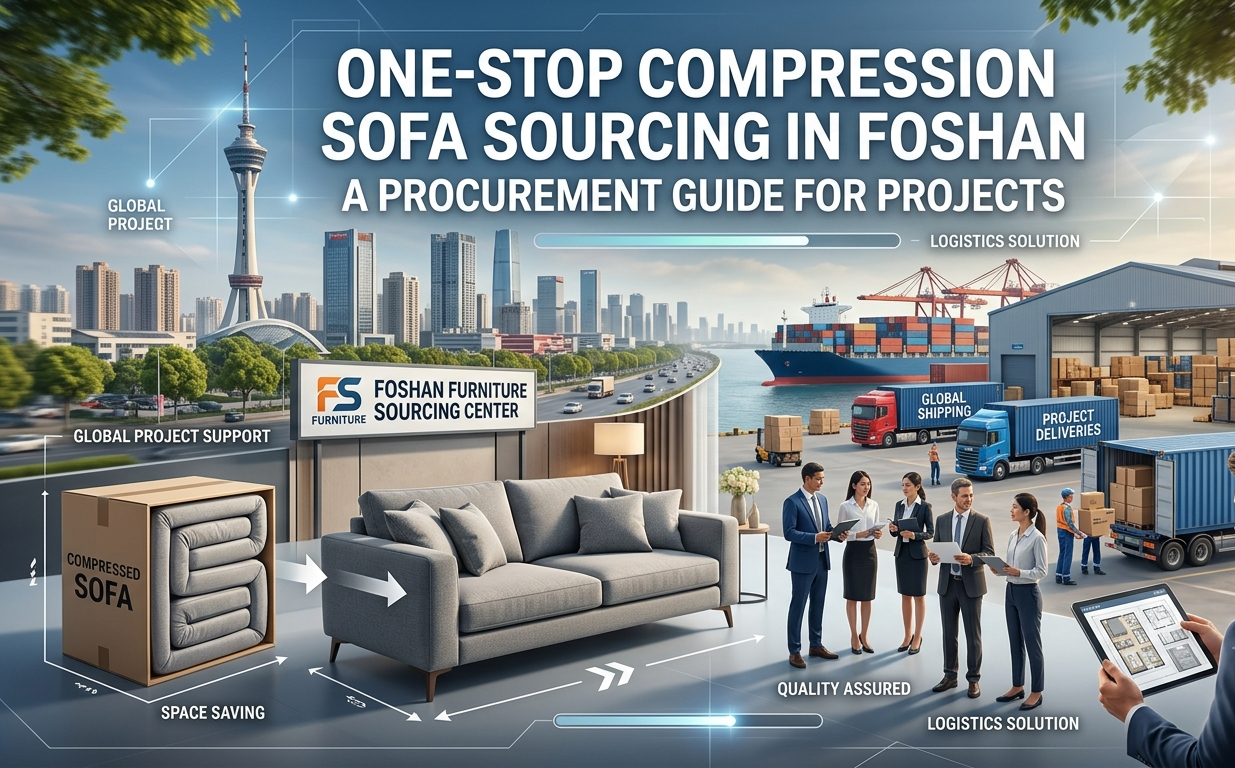
For large-scale real estate developments—particularly student housing, serviced apartments, and budget hospitality projects—shipping traditional, fully assembled sofas presents a massive logistical inefficiency. Sofas are high-volume, low-weight items, meaning buyers often pay heavy ocean freight rates to ship “empty air” inside standard 40HQ containers.
The introduction of vacuum compression technology to commercial seating has structurally changed this equation. Foshan, as a primary hub for furniture manufacturing, has aggressively adopted compression packaging for sofas. Sourcing these units directly from the Foshan cluster allows procurement teams to drastically increase container loadability while maintaining commercial-grade durability.
Key Takeaways
- Logistical Efficiency: Vacuum-compressed packaging can reduce a sofa’s shipping volume (CBM) by 50% to 70%, doubling or tripling the number of units that fit into a single shipping container.
- Material Dependency: The success of a compression sofa relies entirely on the quality of the polyurethane foam. Low-density foam will fail to recover its structural shape after being vacuum-sealed for weeks during ocean transit.
- Supply Chain Density: Sourcing in Foshan provides direct access to integrated factories that manufacture the high-resilience foam, performance fabrics, and vacuum-sealing machinery within the same industrial zone.
What is a compression sofa and why is it essential for volume projects?
A compression sofa (often utilizing a “sofa-in-a-box” concept) is engineered specifically for volume reduction. Using heavy industrial hydraulic presses, the air is extracted from the foam cushions and the entire unit is vacuum-sealed into a flat or rolled package.
For a procurement manager outfitting a 300-unit apartment complex, the math is straightforward. A standard fully-assembled 3-seater sofa might occupy 1.5 to 2.0 CBM (Cubic Meters). A 40HQ container holds approximately 68 CBM. This limits the container to roughly 35 to 45 sofas. By utilizing compression technology, that same sofa’s volume can drop to 0.4 CBM, allowing over 150 units to fit into the same container. This directly reduces the landed cost per unit by slashing the per-item freight expenditure.
What technical specifications should buyers verify for vacuum-packed seating?
Not all sofas can be compressed, and attempting to compress sub-standard materials results in defective goods upon arrival. Buyers must mandate specific technical parameters during the factory quoting phase.
| Component | Technical Requirement for Compression | Risk of Non-Compliance |
| Foam Density | Minimum 35kg/m³ (High-Resilience) polyurethane foam. | Foam memory is destroyed during transit; cushions remain flat, lopsided, or rigid upon unpacking. |
| Upholstery Fabric | High-stretch, synthetic blends (e.g., specific polyesters) with high rub counts. | Permanent, unrecoverable creases and wrinkles in the fabric after the vacuum seal is broken. |
| Internal Framing | Modular (Knock-Down) steel or solid wood frames that pack separately, or 100% frameless all-foam construction. | Structural snapping under hydraulic pressure if traditional fixed frames are used. |
| Packaging Material | Multi-layer, puncture-resistant PE (Polyethylene) vacuum bags. | Loss of vacuum seal during shipping, causing the sofa to prematurely expand and damage the outer carton. |
How does sourcing from the Foshan cluster reduce manufacturing costs?
The cost advantage of sourcing compression sofas from Foshan is rooted in supply chain integration. A compression sofa requires highly specific, heavy-duty industrial pressing machinery, which represents a high capital expenditure for factories.
In Foshan’s Shunde district, factories have scaled this technology specifically for export volume. Furthermore, the factories producing the necessary high-resilience chemical foam are located adjacent to the upholstery workshops. This geographic proximity means sofa manufacturers do not pay long-distance domestic freight to acquire the heavy foam blocks, and they can run rapid prototyping to test how a specific foam batch recovers from compression before authorizing mass production.
Why choose HSY Sourcing for your compression sofa procurement?
Executing a bulk order for compression sofas requires stringent, on-the-ground verification. Once a defective sofa is vacuum-sealed and shipped, the error cannot be identified until it arrives and is unboxed at your project site. HSY Sourcing operates as your dedicated procurement and inspection office in Foshan to mitigate these risks.
- Targeted Factory Allocation: We connect your project strictly with factories that own their own compression machinery and have a verified track record of exporting vacuum-packed goods, rather than standard factories outsourcing the packing process.
- Pre-Production Recovery Testing: Before mass production begins, we mandate a physical compression test. We vacuum-seal the prototype, leave it compressed for 72 hours, and measure its exact recovery time and dimensional accuracy upon opening.
- Material Auditing: We physically inspect the foam density and fabric elasticity on the factory floor to ensure the manufacturer is not substituting high-density project foam with cheaper, low-density alternatives.
- Container Loading Optimization: Because compression sofas are highly space-efficient, we can strategically consolidate these units with other bulky project materials (like case goods, lighting, or wall panels), maximizing every cubic meter of your shipping container.
Frequently Asked Questions (FAQ)
How long does it take for a compression sofa to fully expand after unpacking?
While the sofa will regain about 80% of its volume within the first few hours, full structural recovery and the smoothing of fabric wrinkles typically require 24 to 48 hours in a room-temperature environment.
Can compression sofas meet commercial fire retardant standards?
Yes. The high-density foam and upholstery fabric can be chemically treated during the manufacturing process to meet international fire standards, such as CAL117 for North America or BS5852 for the UK. These requirements must be specified in the initial Bill of Quantities (BOQ).
Are there design limitations when choosing compression sofas?
Yes. Compression technology is best suited for modern, modular, or frameless designs. Traditional sofas with fixed, intricate wooden exoskeletons, rolled arms, or rigid genuine leather upholstery cannot be vacuum-compressed without causing permanent damage.
What happens if the vacuum seal breaks during ocean transit?
If the inner PE bag is punctured, the foam will begin to draw in air and expand inside the cardboard shipping box. To prevent this from rupturing the carton and disrupting the container load, HSY Sourcing mandates the use of heavy-duty, multi-layered plastic wrapping and reinforced export cartons designed to contain accidental expansion.