
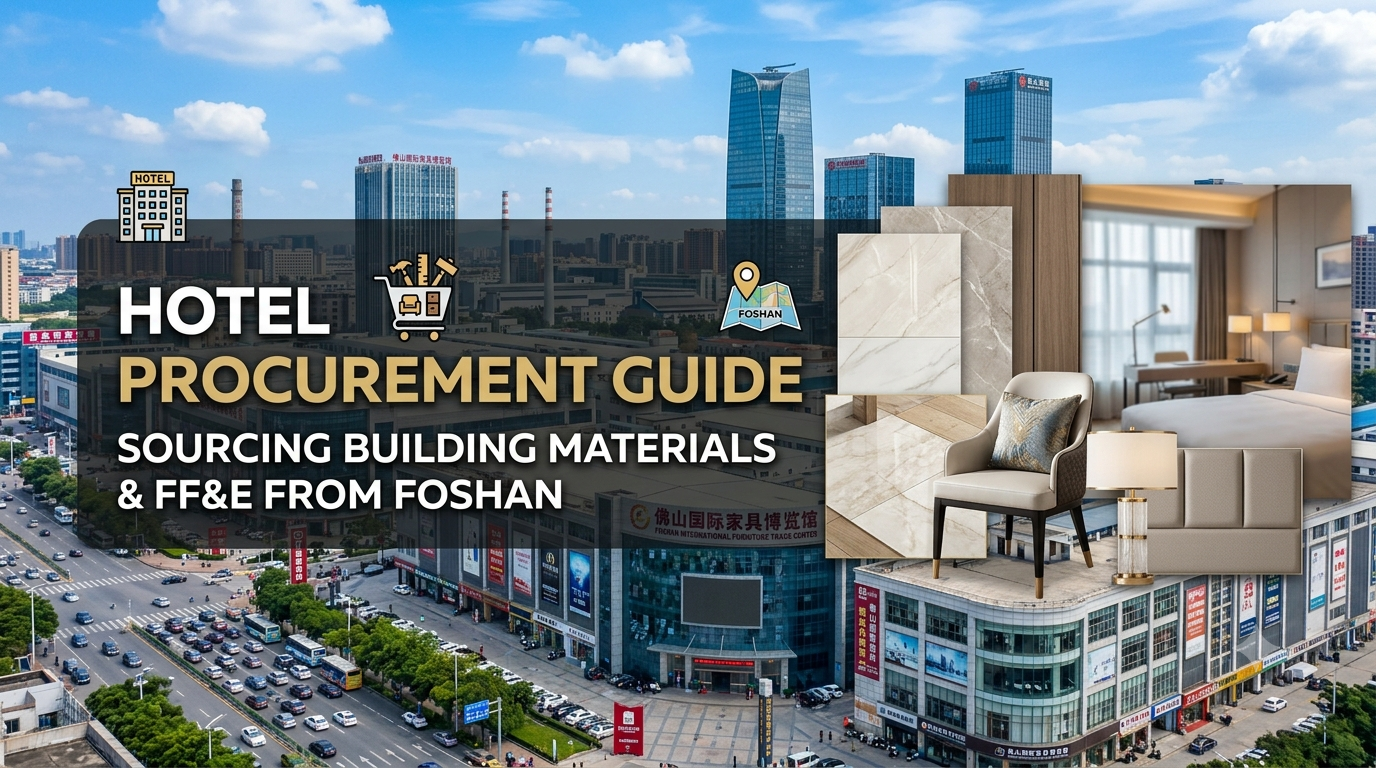
Sourcing architectural building materials and FF&E (Furniture, Fixtures, and Equipment) from Foshan, China can lower direct material costs by 30% to 45% compared to Western domestic distributors. However, capturing these savings requires strict supply chain management. Delivering a hotel, luxury apartment, or villa project on schedule requires managing dozens of specialized factories, ensuring compliance with international building codes, and executing quality control before goods leave the port.
This guide details how commercial developers, procurement directors, and project managers can source building materials and FF&E from Foshan efficiently while mitigating risk.
What Are the Key Takeaways for Foshan Hotel Sourcing?
- Geographic Specialization: Foshan’s manufacturing base is split across specific districts. You must visit Chancheng for porcelain tiles and sanitary ware, Lecong for loose and fixed contract furniture, Dali for architectural aluminum, and Shunde for custom millwork and cabinetry.
- Mock-Up Room (MUR) Mandatory Rule: Never sign off on bulk production for a hotel or apartment project without inspecting a fully assembled Mock-Up Room on site or at the factory.
- Strict Technical Compliance: Generic factory statements like “export quality” do not protect your project. Contractual specifications must mandate independent lab reports (e.g., SGCC/CE for glass, CARB Phase 2/E0 for composite wood, UL/CE for electrical).
- Controlled Moisture Content: Custom joinery and wooden furniture produced in humid Southern China must be kiln-dried to match the equilibrium moisture content (EMC) of your destination site (typically 8%–12% for North America and Europe).
- Container Consolidation: Consolidating shipments from 10 to 20 different suppliers into single container loads reduces freight overhead and prevents port clearance bottlenecks.
What Makes Foshan the Primary Hub for Hotel FF&E and Building Materials?
Foshan is the world’s largest integrated manufacturing cluster for architectural products and contract furnishings. Rather than operating as a single market, Foshan consists of localized industrial districts specialized by material category.
| Industrial District | Core Product Categories | Sourcing Capabilities & Standards |
| Chancheng & Nanzhuang | Porcelain tiles, large-format sintered stone slabs, ceramic sanitary ware. | High-volume production, water absorption rates $<0.5\%$, custom tile sizes up to $1600 \times 3200\text{ mm}$. |
| Lecong & Longjiang | Casegoods, upholstered seating, outdoor hotel furniture, guestroom FF&E. | Over 3,000 furniture factories, high-durability contract fabrics ($>50,000$ Martindale cycles), flame retardant foams. |
| Shunde District | Custom kitchen cabinetry, wardrobes, vanity units, wall paneling (millwork). | Custom shop drawing production, E0/CARB Phase 2 board options, premium hardware integration. |
| Dali Town (Nanhai) | Aluminum windows, curtain wall systems, interior glass partition doors. | Thermal break profiles, double/triple insulated glass units (IGU), anodized and PVDF coatings. |
How Does the Step-by-Step Hotel Procurement Process Work in China?
Commercial procurement requires a structured 5-stage timeline to move from initial design drawings to final job-site delivery.
┌─────────────────────────┐     ┌─────────────────────────┐     ┌─────────────────────────┐
│ 1. BOQ & Specifications │ ───>│  2. Factory Vetting &   │ ───>│  3. Mock-Up Room (MUR)  │
│       Alignment         │     │     Bidding (RFQ)       │     │     Approval & Sign     │
└─────────────────────────┘     └─────────────────────────┘     └─────────────────────────┘
                                                                             │
┌─────────────────────────┐     ┌─────────────────────────┐                  │
│  5. Consolidation, LCL  │ <───│ 4. 3-Tier Quality Control│ <─────────────────┘
│   & Container Loading   │     │    & Factory Audits     │
└─────────────────────────┘     └─────────────────────────┘
Stage 1: Specification & BOQ Alignment
The procurement agent reviews the project Bill of Quantities (BOQ), architectural elevations, and interior design specification sheets. Unclear material calls (e.g., “marble finish”) are translated into exact commercial specs (e.g., “Calacatta white sintered stone, 12mm thickness, polished finish, Mohs hardness 6”).
Stage 2: Factory Vetting & Bidding
Requests for Quotations (RFQs) are issued to 3–5 pre-screened, tier-1 factories per product category. Factories are vetted based on operational capacity, financial stability, ISO 9001 quality management, and past export experience with international hotel brands.
Stage 3: Mock-Up Room (MUR) Approval
Before mass production starts, the selected factories produce a full set of prototype furniture, millwork, and finishes for a single sample room. The developer, architect, or sourcing agent inspects the room for structural integrity, joinery precision, color accuracy, and ergonomic comfort.
Stage 4: Mass Production & 3-Tier Inspection
Once shop drawings and sample finishes are signed off, production begins. Inspections occur across three milestones:
- Raw Material Inspection: Verifying wood board core quality, metal frame gauges, and fabric specs before cutting.
- Mid-Production Inspection (In-Line QC): Checking assembly joinery, internal hardware reinforcement, and dimension tolerances.
- Pre-Shipment Inspection (PSI): Random sampling across completed boxes using AQL 2.5 standards to test finish, stability, packaging robustness, and drop testing.
Stage 5: Warehouse Consolidation & Loading
Goods from multiple factories are shipped to a central Foshan warehouse. Items are inspected for transit packaging, sorted by installation sequence (e.g., structural materials first, soft furnishings last), and loaded into sea containers.
How Do You Prevent Quality Failures and Material Non-Compliance?
Procuring from overseas introduces operational risks that can stall job sites if not managed proactively on the ground.
       Risk Factor                   Primary Failure                          Prevention Protocol
┌───────────────────────┐       ┌───────────────────────┐       ┌───────────────────────────────────────────┐
│ Moisture Content      │ ───>  │ Board Warping &       │ ───>  │ Enforce 8%-12% MC limit via digital meter │
│ Mismatch              │       │ Veneer Cracking       │       │ before sealing and packaging.             │
└───────────────────────┘       └───────────────────────┘       └───────────────────────────────────────────┘
┌───────────────────────┐       ┌───────────────────────┐       ┌───────────────────────────────────────────┐
│ Ceramic Tile Color    │ ───>  │ Visible Shade & Size  │ ───>  │ Lock single batch production run + order  │
│ Variation             │       │ Misalignment on Site  │       │ 10%-15% extra for waste allowance.        │
└───────────────────────┘       └───────────────────────┘       └───────────────────────────────────────────┘
┌───────────────────────┐       ┌───────────────────────┐       ┌───────────────────────────────────────────┐
│ Non-Compliant         │ ───>  │ Customs Seizure or    │ ───>  │ Require pre-production lab reports        │
│ Materials             │       │ Building Code Rejection│       │ (CE, UL, SGCC, CARB Phase 2).             │
└───────────────────────┘       └───────────────────────┘       └───────────────────────────────────────────┘
Moisture Content Rule: Foshan’s high humidity means solid wood and composite boards naturally absorb moisture. If goods are sealed with moisture content above 14%, they will warp and split when exposed to dry interior climate systems in North America, Europe, or the Middle East. Contractually require all timber to be kiln-dried to 8%–12% MC before finish application.
Key Material Compliance Benchmarks:
- Glazing & Windows: SGCC (USA), CE / EN 12150 (Europe), or AS/NZS 2208 (Australia) certified toughened laminated glass.
- Panels & Cabinetry: CARB Phase 2, EPA Title VI, or European E0 formaldehyde emission standards for particleboards and MDF.
- Hospitality Fabrics: Flame retardant treatments conforming to BS 5852 (Crib 5) or NFPA 260 standards.
- Electrical & Lighting: UL/ETL (North America), CE (Europe), or SAA (Australia) driver and fixture approvals.
Why Is Container Consolidation Essential for Multi-Category Projects?
A typical hotel or multi-family project requires materials from 10 to 20 different manufacturers (e.g., doors from one factory, tiles from another, lighting from a third). Shipping individual Less-than-Container Load (LCL) orders increases freight expenses, multiplies customs documentation fees, and creates chaotic, staggered job-site deliveries.
Benefits of Centralized Warehousing & Loading:
- Lower Logistics Overhead: Consolidating cargo into full 40ft High Cube (40HQ) containers drops shipping costs by up to 35% compared to multiple LCL shipments.
- Density-Stratified Container Loading: Heavy high-density goods (porcelain tiles, stone slabs, vitreous china toilets) are loaded onto the container floor to form a low center of gravity. Lighter, bulky items (loose chairs, headboards, lamps) are strapped securely above.
- Sequenced Site Unloading: Containers are packed so that structural and first-fix items (flooring, sanitary rough-ins, doors) arrive first, followed by second-fix items (cabinets, loose furniture).
Why Choose HSY Sourcing as Your Sourcing Partner in Foshan?
Navigating Foshan’s vast manufacturing network directly requires dedicated on-ground management to protect your capital and project timelines. HSY Sourcing operates as your independent, local procurement team in Foshan.
What Sets HSY Sourcing Apart:
- Direct Factory Access: We connect you directly with top-tier, export-ready manufacturers—cutting out middle trading markups while ensuring transparent factory-direct pricing.
- Strict On-Site Quality Control: Our quality control engineers conduct 3-stage inspections (raw materials, mid-production, pre-shipment) at the factory floor. We measure moisture content, verify dimensions against shop drawings, and test hardware durability before release.
- Comprehensive Engineering & Shop Drawing Review: We don’t just pass quotes along. Our team reviews CAD drawings, material callouts, and hardware specifications to identify structural flaws or cost-saving value engineering options before production starts.
- Centralized Consolidation & Shipping: We manage our own local Foshan warehousing facility. We inspect, bundle, and density-pack your materials from multiple factories into unified containers, handling export customs clearance and international freight forwarding end-to-end.
- Legal & Commercial Protection: Contracts are drawn under enforceable Chinese commercial laws with clear defect penalties, payment milestones linked to inspection pass rates, and guaranteed lead times.
What Are the Most Common Questions About Sourcing from Foshan? (FAQ)
Q1: How early in the project timeline should we engage a sourcing agent in Foshan?
We recommend engaging a local sourcing partner during the schematic design or early design development phase (typically 4 to 6 months before expected site installation). This allows sufficient time for value engineering, sample sign-off, shop drawing reviews, mock-up room fabrication, and 30–45 days of sea freight transit.
Q2: What is the typical lead time for custom hotel FF&E and building materials?
- Standard Stocked Items (Tiles, Sanitary Ware): 10–20 days.
- Custom Cabinetry, Doors, and Windows: 25–35 days.
- Complete Hotel Guestroom FF&E Packages: 35–50 days following final shop drawing and sample approval.
Q3: How do we ensure custom furniture matches our interior design specifications exactly?
Every custom piece begins with a formal 2D/3D shop drawing process prepared by the factory and audited by HSY Sourcing. Production only starts after physical material sample swatches (wood finish, fabric, metal hardware) and detailed shop drawings are formally signed off by your project architect or designer.
Q4: Can HSY Sourcing handle customs clearance and delivery to our project site?
Yes. We offer comprehensive Door-to-Door (DDP) or Delivered at Place (DAP) logistics services. We manage China export declarations, ocean freight booking, destination port customs clearance, duty payment processing, and final flatbed trucking directly to your construction job site.
Q5: What are the standard payment terms when ordering from Chinese factories?
Standard commercial terms are a 30% deposit upon purchase order confirmation and shop drawing sign-off to initiate production, and the 70% balance payment paid after a successful final pre-shipment inspection (PSI) before container loading.