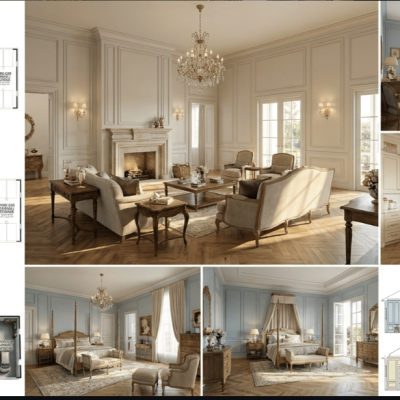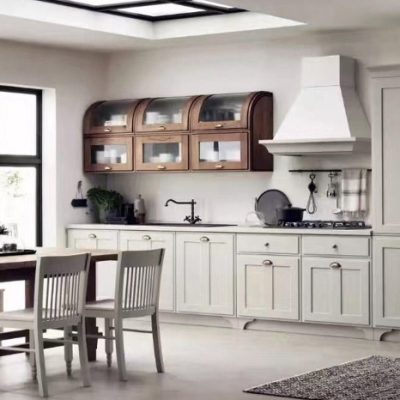

Procuring high-end finishing materials for a luxury villa or multi-family project directly from Foshan, Guangdong offers significant cost advantages and access to high-spec customization. However, a complete residential finish package—encompassing custom millwork, large-format sintered stone, thermally broken aluminum windows, and sanitary fixtures—is never produced under a single factory roof.
A typical luxury villa build requires purchasing from 8 to 15 specialized manufacturers spread across different industrial districts in Foshan, including Shunde, Nanhai, and Nanzhuang.
Without a local, dedicated staging facility, managing these disparate factory output schedules creates severe logistical friction. Shipping items separately via Less than Container Load (LCL) increases port handling fees, multiplies physical handling damage risks, and leads to dislocated jobsite deliveries.
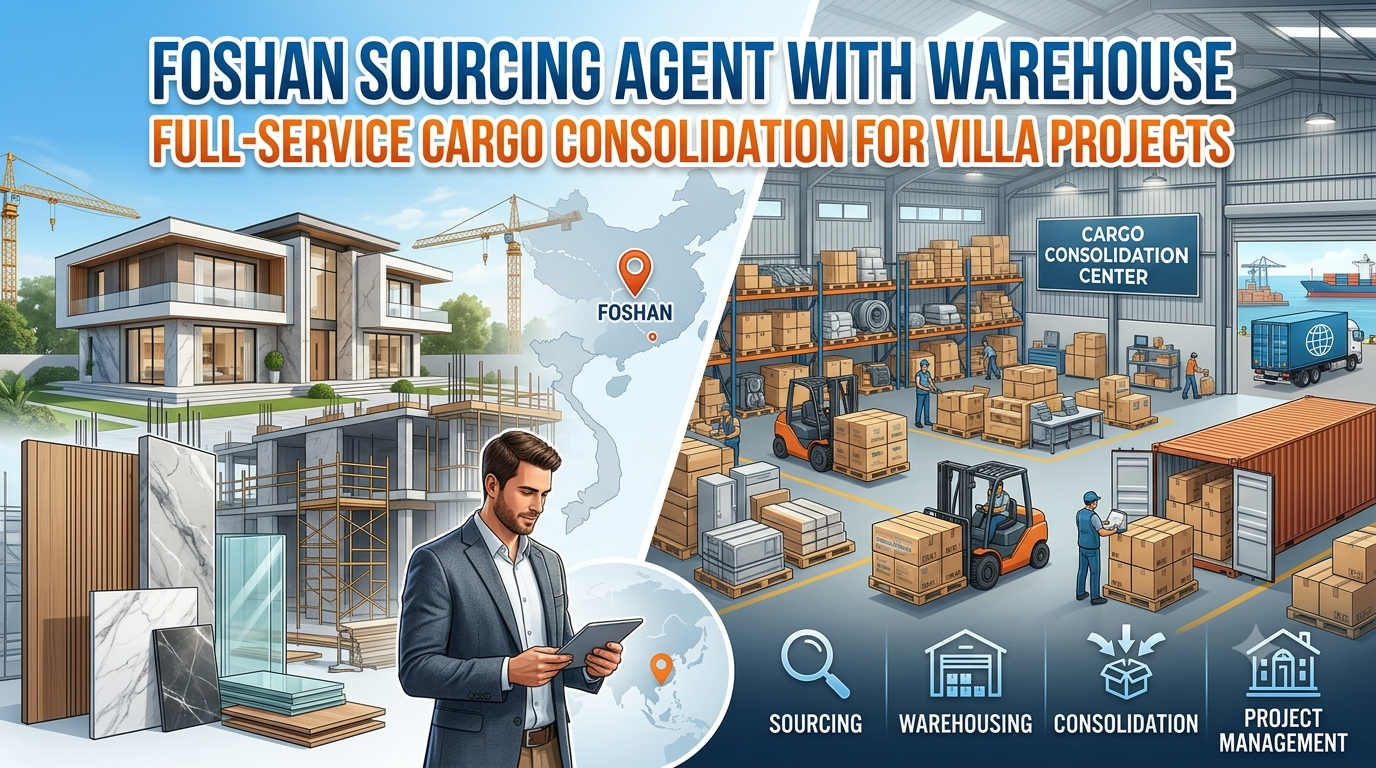
Partnering with an on-ground Foshan sourcing agent with an independent staging warehouse solves these operational roadblocks. This guide explains how full-service cargo consolidation works, how local staging protects material quality, and how supervised container loading ensures safe transit to international jobsites.
Key Takeaways
- Staggered Production Control: Specialized factories complete orders at different times (e.g., sanitary ware in 2 weeks, custom kitchens in 5 weeks, aluminum windows in 6 weeks). A local staging warehouse holds completed goods safely without accruing port storage or container demurrage charges.
- Comprehensive Receiving Audits: Inspecting crates and cartons at the Foshan staging facility identifies outer damage, dimensional mismatches, or missing hardware while goods are still local—allowing fast factory replacement before ocean transit.
- Ocean Freight & Terminal Savings: Combining 10+ individual factory orders into unified 40ft High Cube (HQ) Full Container Loads (FCL) reduces total logistics and port handling expenditures by up to 35% to 45% compared to multiple LCL shipments.
- Precision Weight and Space Distribution: Mixing dense materials (porcelain slabs, stone) with high-volume, lightweight items (flat-packed cabinetry, furniture) maximizes the container’s interior space while keeping gross trailer weights strictly within destination highway road limits.
Why Do Custom Villa Sourcing Projects Require a Local Foshan Staging Warehouse?
Procuring architectural building materials for a luxury villa project is fundamentally different from buying standardized commercial merchandise. Each material category operates on different lead times, packaging formats, and weight profiles:
| Material Category | Primary Manufacturing District | Typical Factory Lead Time | Packaging & Freight Characteristic |
| Custom Millwork & Kitchens | Shunde District | 4 to 6 Weeks | High-volume, lightweight flat-packs or pre-assembled boxes. |
| Sintered Stone & Porcelain | Nanzhuang / Shiwan | 2 to 3 Weeks | High-density, extremely heavy, fragile wooden A-frames. |
| Aluminum Windows & Doors | Nanhai District | 5 to 7 Weeks | Structural length, fragile double/triple glazed glass panels. |
| Sanitary Ware & Faucets | Leling / Chaozhou | 2 to 3 Weeks | High density, delicate ceramic bodies, compact palletization. |
If each supplier ships independently upon finishing production:
- LCL Shipping Costs Surge: LCL freight incurs repeated origin/destination Container Freight Station (CFS) charges, documentation surcharges, and deconsolidation fees per supplier.
- High Damage Exposure: LCL cargo is loaded and re-sorted multiple times at intermediate transit hubs. Heavy stone crates sitting next to unbraced millwork cartons frequently lead to crushed packaging and broken contents.
- Jobsite Disruption: Materials arrive at the construction site in disjointed batches, forcing contractors to store sensitive interior woodwork out in the open before the building envelope is weatherproofed.
A dedicated Foshan staging warehouse acts as a central holding buffer. Goods are collected, audited, and held free of charge until the complete project package is ready for single-container loading.
How Does the Cargo Consolidation Workflow Function from Factory Pickup to Container Sealing?
Executing a seamless consolidation process requires clear operational steps managed by an on-ground logistics team:
[1. Factory Readiness Check] ➔ [2. Warehouse Receiving & Audit] ➔ [3. Inventory & Hardware Check]
                                                                          │
[6. Supervised Loading & Port] ◄── [5. 3D Weight/Volume Plan] ◄───────────┘
1. Staggered Factory Receiving
As each factory completes its production run, HSY Sourcing arranges local truck transport to bring the finished goods directly to our Foshan staging warehouse. This prevents factories from storing finished goods in dusty workshop corners or pushing them to port terminals prematurely.
2. Immediate Package and Structural Audit
Upon receiving goods at the loading dock, warehouse technicians perform a thorough receiving inspection:
- Outer Packaging Integrity: Crates, cartons, and pallets are checked for water stains, crushed corners, or loose banding.
- Fumigation & Timber Compliance: Solid wood pallets and skids are verified for legible ISPM 15 heat-treatment (HT) stamps to ensure seamless entry through US Customs and Border Protection (CBP).
3. Inventory Reconciliation Against Project BOQ
Items are cataloged against the master Bill of Quantities (BOQ). Critical smaller items—such as cabinet handles, shower drain channels, door hinges, and spare touch-up tiles—are reconciled to ensure no missing hardware halts jobsite installation later.
What Quality Control Checks Occur Inside the Warehouse Before Loading?
The staging warehouse serves as the final quality filter before materials leave China. Identifying mistakes while products are still in Foshan is significantly cheaper and faster than discovering errors after opening a container on an overseas jobsite.
+-------------------------------------------------------------------------+
|                  WAREHOUSE QUALITY CONTROL CHECKLIST                    |
|                                                                         |
|  [Dimensional Verification] ◄── Check frame sizes, slab cuts against CAD|
|  [Hardware Reconciliation]  ◄── Match hinge/slide counts to BOQ lists   |
|  [Wood & Glass Compliance]  ◄── Verify TSCA Title VI labels & SGCC marks|
|  [Crate Reinforcement]      ◄── Audit A-frames, corner foam, & banding  |
+-------------------------------------------------------------------------+
1. Spot-Checking Dimensions and Finishes
Our inspectors uncrate sample units to verify dimensions against approved CAD shop drawings. Color batches for ceramic tiles, veneer grain consistency across cabinet panels, and paint finishes on aluminum extrusions are double-checked under clean warehouse lighting.
2. Code Markings and Certification Stamps
- Glazing: Safety glass installed in doors or windows is audited to confirm that permanent, etched SGCC (ANSI Z97.1) logos appear on the glass corners rather than removable stickers.
- Composite Wood: Plywood and MDF carcases are checked for required EPA TSCA Title VI formaldehyde compliance labels on master cartons.
3. Repackaging and Custom Crate Reinforcement
If factory packaging is deemed insufficient for ocean transport, our warehouse team reinforces wooden skids, adds edge guards, wraps pallets in heavy moisture-barrier stretch film, or constructs custom wooden A-frames for large-format glass or stone slabs.
How Are Heavy Stone and Bulky Cabinetry Balanced Inside a Single Container?
Loading a mixed-category container requires balancing volumetric space against maximum allowable road weight limits. Overloading container axles leads to severe fines and forced transloading at destination ports.
+-------------------------------------------------------------------------+
|                  40ft HQ MIXED CARGO CONTAINER LAYOUT                   |
|                                                                         |
|  [FRONT / TRACTOR AXLE]                                [REAR / DOORS]   |
|  +-------------------+  +--------------------+  +--------------------+  |
|  | Sintered Stone &  |  | Custom Cabinetry   |  | Sanitary Ware &    |  |
|  | Ceramic Tiles     |  | & Flat-Pack Wood   |  | Lighting Cartons   |  |
|  | (Floor Level)     |  | (Mid Section)      |  | (Rear Floor)       |  |
|  +-------------------+  +--------------------+  +--------------------+  |
|  | Glass & Windows Secured Vertically along Walls with Heavy Straps  |  |
+-------------------------------------------------------------------------+
Navigating Highway Weight Restrictions
While a 40ft High Cube container can physically hold up to 26,000 kg (57,300 lbs) of payload, US Department of Transportation (DOT) highway road limits cap the total weight of the truck, chassis, and container.
To ensure the container can travel on roads legally without requiring costly heavy-weight overweight permits or port transloading, total cargo payload is calculated and capped around 17,500 to 19,500 kg (38,500 to 43,000 lbs).
Strategic Staging Strategy
- Floor Level Weight Staging: Extremely dense, heavy cargo (porcelain tiles, natural marble slabs) is distributed flat across the container floor over the front and center axles.
- Volumetric Upper Staging: The upper vertical space is packed with lightweight, high-volume cargo—such as vanity boxes, flat-packed wardrobes, wall paneling, or acoustic foam.
- Vertical Securing for Glass & Windows: Windows and large glass assemblies are secured vertically in heavy wooden A-frames along the container side walls and ratcheted directly to internal steel tie-down rings.
- Void Suppression: All remaining gaps between crate rows are filled with industrial inflatable dunnage air bags to prevent cargo shifting when the vessel encounters ocean swells.
Why Choose HSY Sourcing as Your Foshan Warehouse and Consolidation Partner?
Navigating multiple factory deliveries, warehousing, and container loading requires an experienced local partner acting purely in your interest. HSY Sourcing operates as your dedicated local procurement manager, inspector, and logistics controller in Foshan.
- Dedicated Staging Warehouse in Foshan: We operate clean, secure staging warehouse facilities located near Foshan’s primary manufacturing hubs. We receive, inspect, and hold goods from your various specialized suppliers free of charge during the project consolidation window.
- 3D Container Loading & Weight Optimization: Before a single box is loaded, our logistics team designs a 3D digital loading schematic. We optimize volumetric space while strictly respecting destination highway axle weight limits to avoid port penalties.
- On-Ground Hands-On Supervision: We do not delegate container loading to factory workers or third-party drivers. HSY inspectors supervise the entire loading process on-site—managing weight distribution, ratcheting fragile glass skids, placing dunnage air bags, and capturing detailed photo/video records of every loading stage.
- Rigorous Receiving Quality Audits: When materials arrive at our staging warehouse, we perform physical audits—verifying outer package integrity, checking wood ISPM 15 stamps, and confirming correct dimensional labels before items enter the container.
- Unified Customs Documentation: We compile separate factory manifests, invoices, and technical compliance certificates into one clear, master documentation package (Commercial Invoice, Packing List, Bill of Lading), coordinating directly with your customs broker for smooth port entry.
Frequently Asked Questions (FAQ)
How long can HSY Sourcing hold my materials in the Foshan staging warehouse?
We offer flexible staging windows for active villa projects. If one specialized manufacturer (e.g., custom curved glass doors) experiences a 2-week production delay, your previously completed goods (tiles, cabinetry, plumbing) remain safely stored in our warehouse without accruing port storage fees or container demurrage.
What happens if a crate arrives damaged at the HSY staging warehouse from a local factory?
Because we inspect cargo upon arrival at our Foshan warehouse, damaged packaging or incorrect items are caught immediately—while the product is still local. We reject the damaged crate and coordinate with the local factory to repair or remake the item before the ocean container is loaded, preventing defective goods from ever shipping overseas.
Can HSY Sourcing handle export customs declarations for goods bought from smaller suppliers who lack export licenses?
Yes. Many specialized boutique factories or custom artisan workshops in Foshan do not possess direct export licenses. As your licensed China sourcing agent, HSY Sourcing manages official export customs declarations, compliant commodity inspections, and documentation consolidation under our export entity.
How do you protect fragile items like sintered stone slabs or glass doors during container loading?
Fragile items are never laid flat on the floor or placed underneath heavy cartons. Sintered stone and glass panels are mounted vertically inside custom-built, reinforced wooden A-frames or crates. These frames are positioned against container steel walls, strapped securely using heavy-duty ratchet tie-downs, and cushioned with inflatable dunnage air bags to eliminate shifting during transit.